
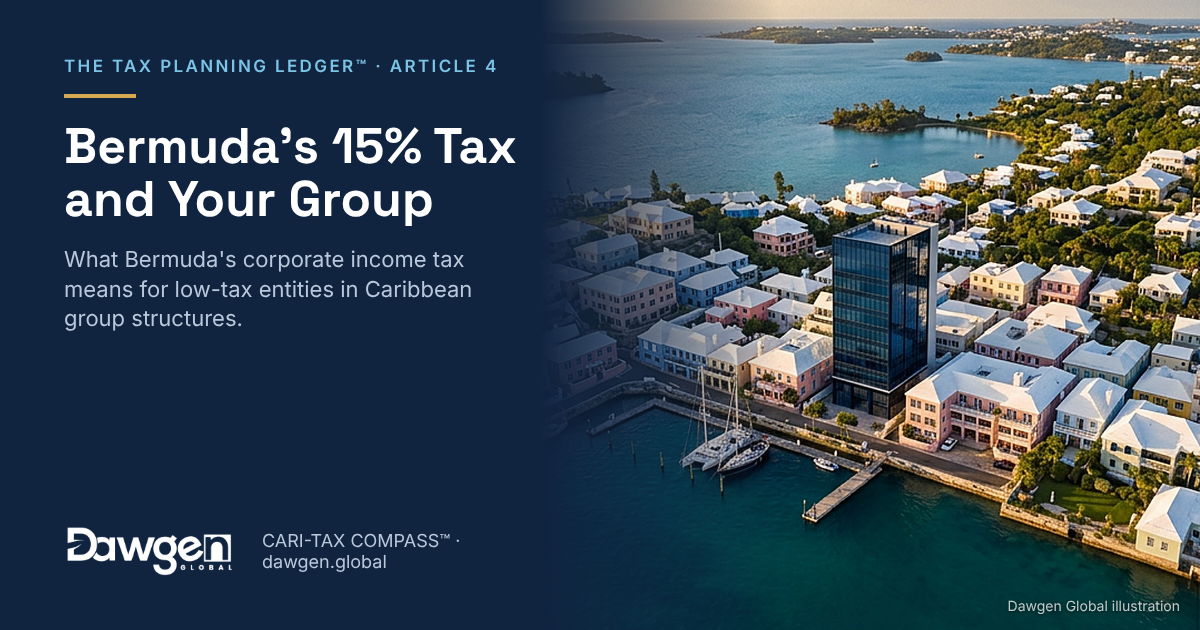
For generations, Bermuda stood for one thing in the world of tax: no corporate income tax. Insurance groups, holding companies and investment vehicles located there for its legal system, its regulators and its reputation, and the absence of tax was part of the attraction. That changed on 1 January 2025, when Bermuda began applying a 15% corporate income tax to entities in large multinational groups.
Bermuda’s decision matters well beyond Bermuda. It shows how a leading financial centre has responded to the global minimum tax, and it forces every Caribbean group with entities in a low-tax centre to ask whether its structure still does what it was designed to do.
What Bermuda introduced
The Corporate Income Tax Act 2023 became law in December 2023 and applies to fiscal years beginning on or after 1 January 2025. Its main features are:
- Who pays. The tax applies to Bermuda entities that are part of a multinational group with annual consolidated revenue of EUR 750 million or more, the same threshold as the global minimum tax. Companies in smaller groups remain outside the tax.
- The rate. 15%, matching the global minimum.
- The base. The rules draw on the definitions used in the global minimum tax, with Bermuda-specific provisions, elections and exclusions, including transition rules for income earned before the regime began.
- A new Corporate Income Tax Agency administers the tax. Final administrative regulations were issued in May 2025, and an instalment filing (Form 001) was released in January 2026. The Agency also became the competent authority for the Common Reporting Standard and country-by-country reporting in March 2026.
- Tax credits. The Tax Credits Act 2025, enacted in December 2025, created a credit regime that can benefit both corporate income taxpayers and certain other entities, with draft regulations consulted on in 2026.
- Old assurances. For in-scope groups, the corporate income tax disregards the tax assurance certificates previously issued to companies.
Alongside the tax, a consolidated Beneficial Ownership Act came into force in November 2025, extending transparency requirements in line with international standards.
Why Bermuda did it
The reasoning is practical. Under the global minimum tax, profits taxed at less than 15% in Bermuda would be topped up somewhere: in the parent company’s country, or in other countries where the group operates. Bermuda’s choice was to collect that tax itself or let it go elsewhere. By introducing its own 15% tax, and pairing it with a credit regime designed to support activity on the island, Bermuda kept the revenue and kept a tool to reward substance.
What it means for Caribbean groups
The effect depends on the size of the group.
Groups above the threshold. For a large group, a Bermuda entity no longer offers a zero-tax result. The question becomes whether Bermuda still offers the best combination of regulation, substance, talent and market access for the activity concerned. For many insurance and reinsurance operations, it may; for passive holding or financing entities that existed mainly for tax, the case is weaker.
Groups below the threshold. For most Caribbean groups, nothing changes in the Bermuda tax charge itself: their Bermuda entities remain outside the corporate income tax. But the environment has changed:
- Tax authorities in the territories where profits are earned are paying closer attention to payments made to low-tax entities, such as management fees, royalties, interest and insurance premiums.
- Economic substance, transfer pricing and beneficial ownership rules mean that an entity with no real activity is increasingly hard to defend.
- Banks, investors and acquirers ask more questions about structures that rely on low-tax entities.
- A growing group may cross the threshold within a few years, at which point the structure stops working and may be costly to unwind.
The wider lesson for low-tax entities in the region
Bermuda is one of several responses in the region. Barbados introduced a domestic minimum top-up tax for large groups and a 9% rate for domestic companies. The Bahamas introduced a domestic minimum top-up tax without introducing a general corporate income tax. Other centres have not yet acted. For a Caribbean group choosing where to locate a holding, insurance, treasury or intellectual property company, the comparison is no longer simply “low tax or no tax”. It is about the rate after minimum tax, the substance required, treaty and withholding tax access, regulatory standing and the cost of compliance.
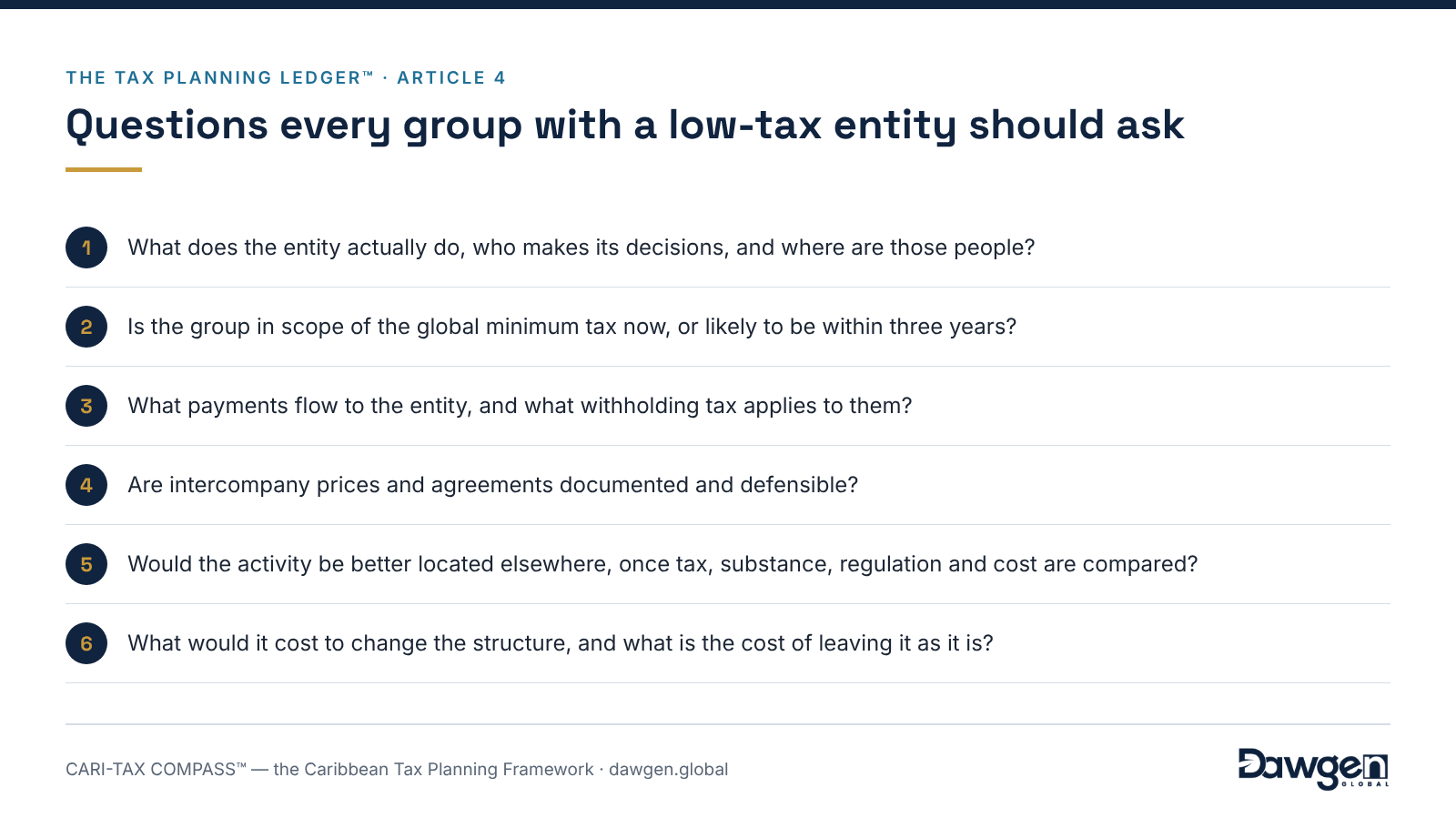
Questions every group with a low-tax entity should ask
- What does the entity actually do, who makes its decisions, and where are those people?
- Is the group in scope of the global minimum tax now, or likely to be within three years?
- What payments flow to the entity from operating territories, and what withholding tax applies to them? Bermuda has few tax treaties, so domestic withholding rates in the paying territory often apply in full.
- Are intercompany prices and agreements documented and defensible?
- Would the same activity be better located elsewhere, once tax, substance, regulation and cost are compared?
- What would it cost to change the structure, and what is the cost of leaving it as it is?
 Dawgen Global illustration
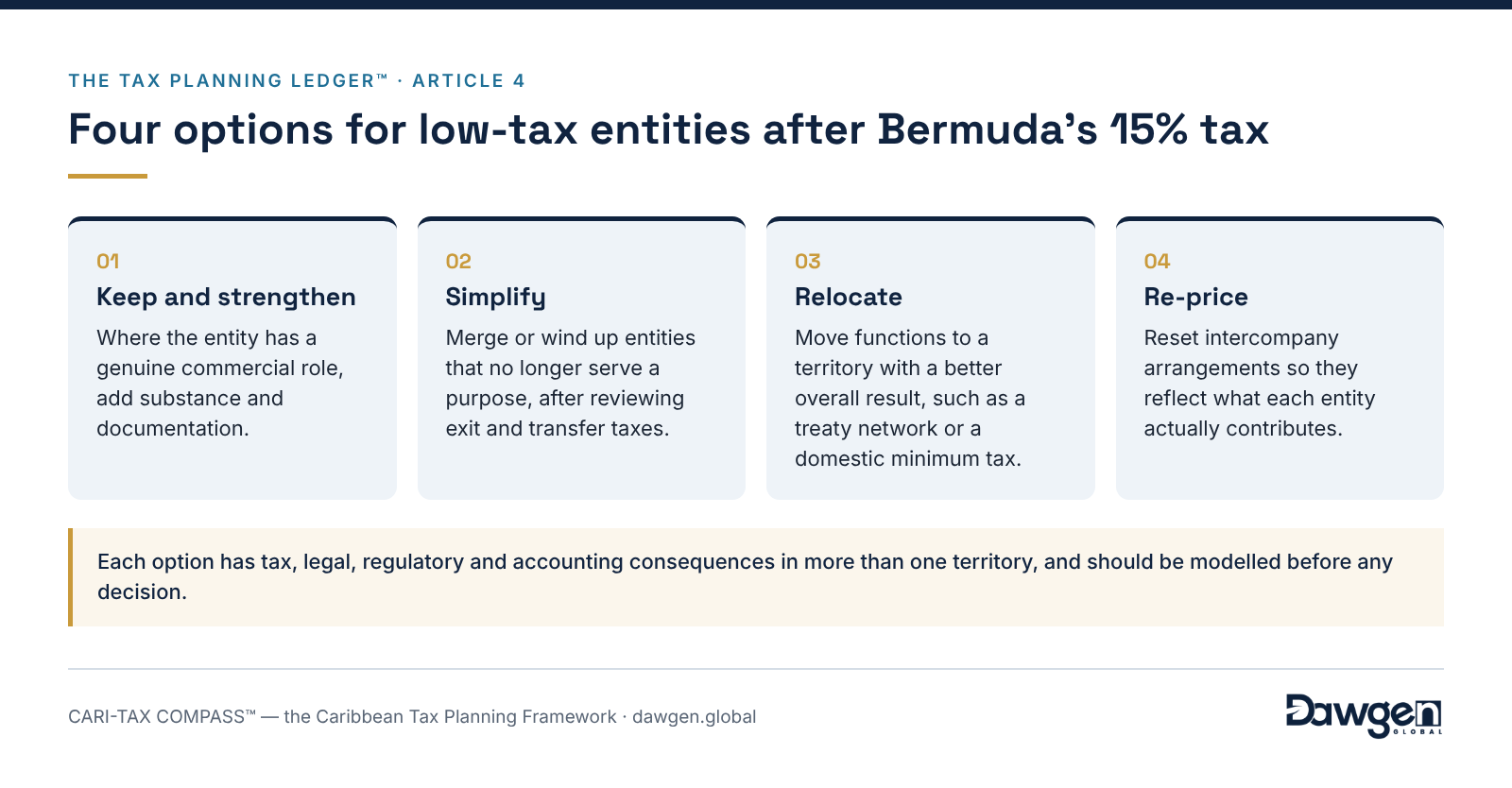
Options to consider
There is no single right answer, but the realistic options usually include:
- Keep and strengthen the entity where it has a genuine commercial role, adding substance and documentation.
- Simplify by merging or winding up entities that no longer serve a purpose, after reviewing exit and transfer taxes.
- Relocate functions to a territory that offers a better overall result, such as one with a treaty network or a domestic minimum tax regime that keeps the tax local.
- Re-price intercompany arrangements so they reflect what each entity actually contributes.
Each option has tax, legal, regulatory and accounting consequences in more than one territory, and should be modelled before any decision.
 Dawgen Global illustration
How Dawgen Global can help
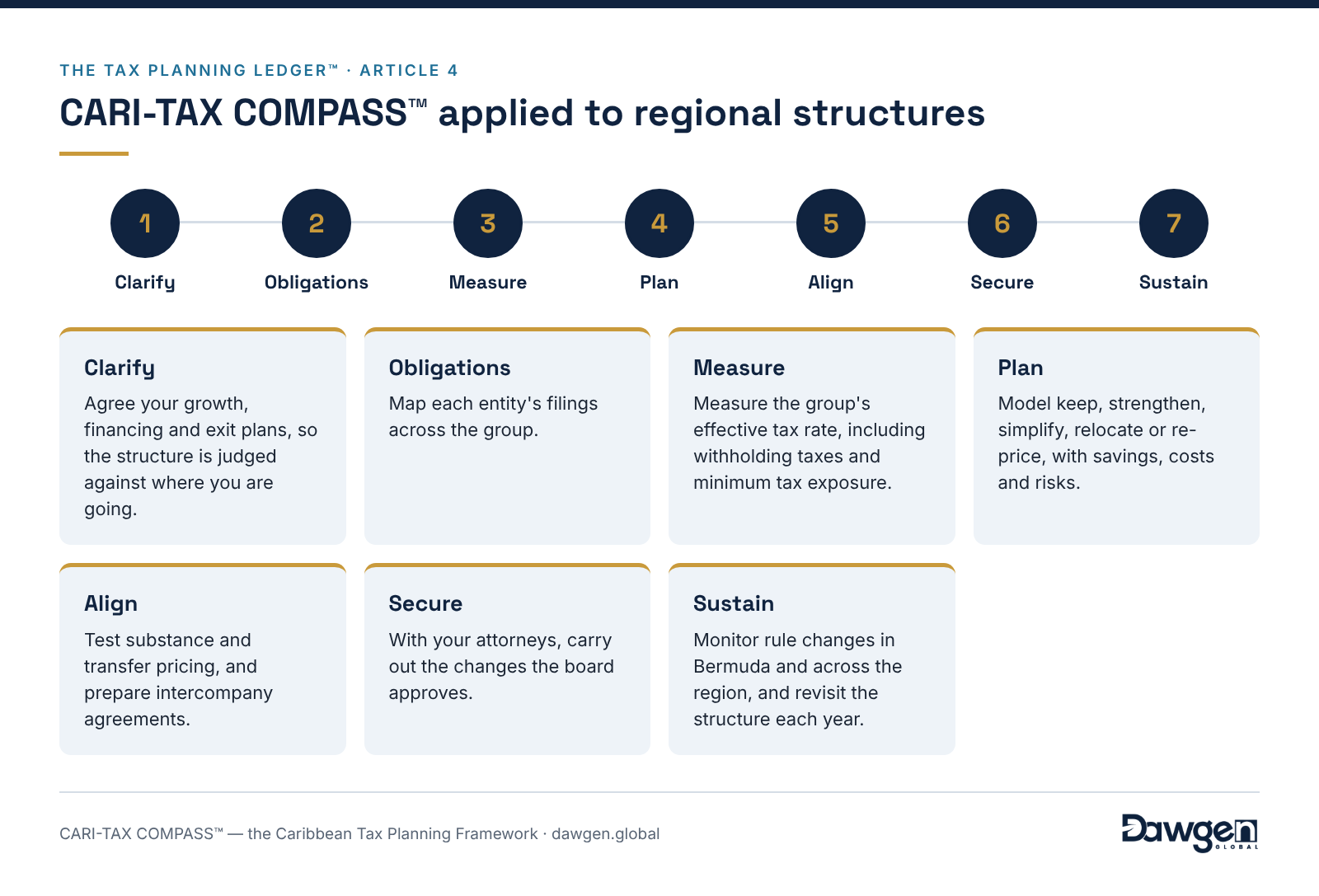
Our Cross-border Structuring Review, part of the Plan stage of CARI-TAX COMPASS™, the Caribbean Tax Planning Framework, examines every entity in your group, what it does and what it costs in tax, and compares the realistic options.
- Clarify: we agree your growth, financing and exit plans, so the structure is judged against where you are going.
- Obligations and Measure: we map each entity’s filings and measure the group’s effective tax rate, including withholding taxes on cross-border payments and any exposure to minimum tax.
- Plan: we model the options — keep, strengthen, simplify, relocate or re-price — and set out the savings, costs and risks of each.
- Align and Secure: we test substance and transfer pricing, prepare intercompany agreements and, with your attorneys, carry out the changes the board approves.
- Sustain: we monitor rule changes in Bermuda and across the region and revisit the structure each year.
We also support groups with existing Bermuda entities on corporate income tax scope assessments, transfer pricing and the documentation that tax authorities and investors now expect.
 Dawgen Global illustration
Where to start
Take the CARI-TAX COMPASS™ Tax Health Score at dawgen.global/tax-health-score to see how your structure scores on efficiency, documentation and readiness for change. Or speak with our Caribbean Tax Service Desk at info@dawgen.global or (876) 926-5210, or with our Bermuda desk at bermuda@dawgen.com.
In Article 5, we turn to the digital economy and compare how Jamaica and Trinidad and Tobago are bringing foreign digital services into the tax net.
Dawgen Global — Big Firm Capabilities. Caribbean Understanding.
This article is general information and is not a substitute for advice on your circumstances. Confirm the current position before acting.
About Dawgen Global
Dawgen Global is an independent, integrated multidisciplinary professional services firm headquartered at 47 Trinidad Terrace, New Kingston, Jamaica, serving 35 territories across the Caribbean. Founded and led by Dr. Dawkins Brown, Executive Chairman, the firm is independent and not affiliated with any international network. It delivers a full suite of professional services under one roof: audit and assurance; tax advisory; IT and digital transformation; risk management; cybersecurity; actuarial and insurance regulatory advisory; HR advisory; mergers and acquisitions; corporate recovery; business advisory and strategy; accounting BPO and virtual CFO services; and legal process outsourcing.
The proposition is simple: big-firm capability without the big-firm price. Dawgen Global’s integrated approach is built for the specific complexities and opportunities of the Caribbean market, helping organizations make sharper, better-informed decisions that drive measurable progress.
To explore a partnership, reach out:
- Website: dawgen.global
- Email: info@dawgen.global
- WhatsApp (Global): +1 555-795-9071
- Caribbean offices: +1 876-665-5926 | +1 876-929-3670 | +1 876-926-5210