Why smaller businesses should buy cybersecurity as one system, not a collection of products
A security stack built one invoice at a time
Ask a Caribbean business owner how they protect their company and you will often hear a list. An antivirus licence bought in 2019. A backup tool added after a scare. An encryption product a client insisted on. A device-management app the IT contractor recommended.
Each purchase made sense on the day. Together, they rarely make a system. Six tools, six dashboards, six renewal dates, and often nobody whose job it is to watch any of them.
That is the paradox of small-business security today. Firms are spending more, yet feel less protected. TechAisle research found that 65% of small businesses feel underprepared compared with their peers, and that their security challenges are growing about 1.2 times year on year.
The skills gap is the real threat
The tools are not the main problem. The people are, or rather the absence of them.
ConnectWise research found that 76% of small businesses lack the in-house skills to handle cybersecurity issues, while 89% worry about being targeted within six months. In the Caribbean, where cybersecurity specialists are scarce and expensive, that gap is wider still.
A patchwork of products demands exactly the expertise most firms lack. Someone must integrate the tools, tune them, read their alerts, renew them and make sure they do not contradict one another. When that someone does not exist, the stack quietly decays.
The hidden cost of vendor sprawl
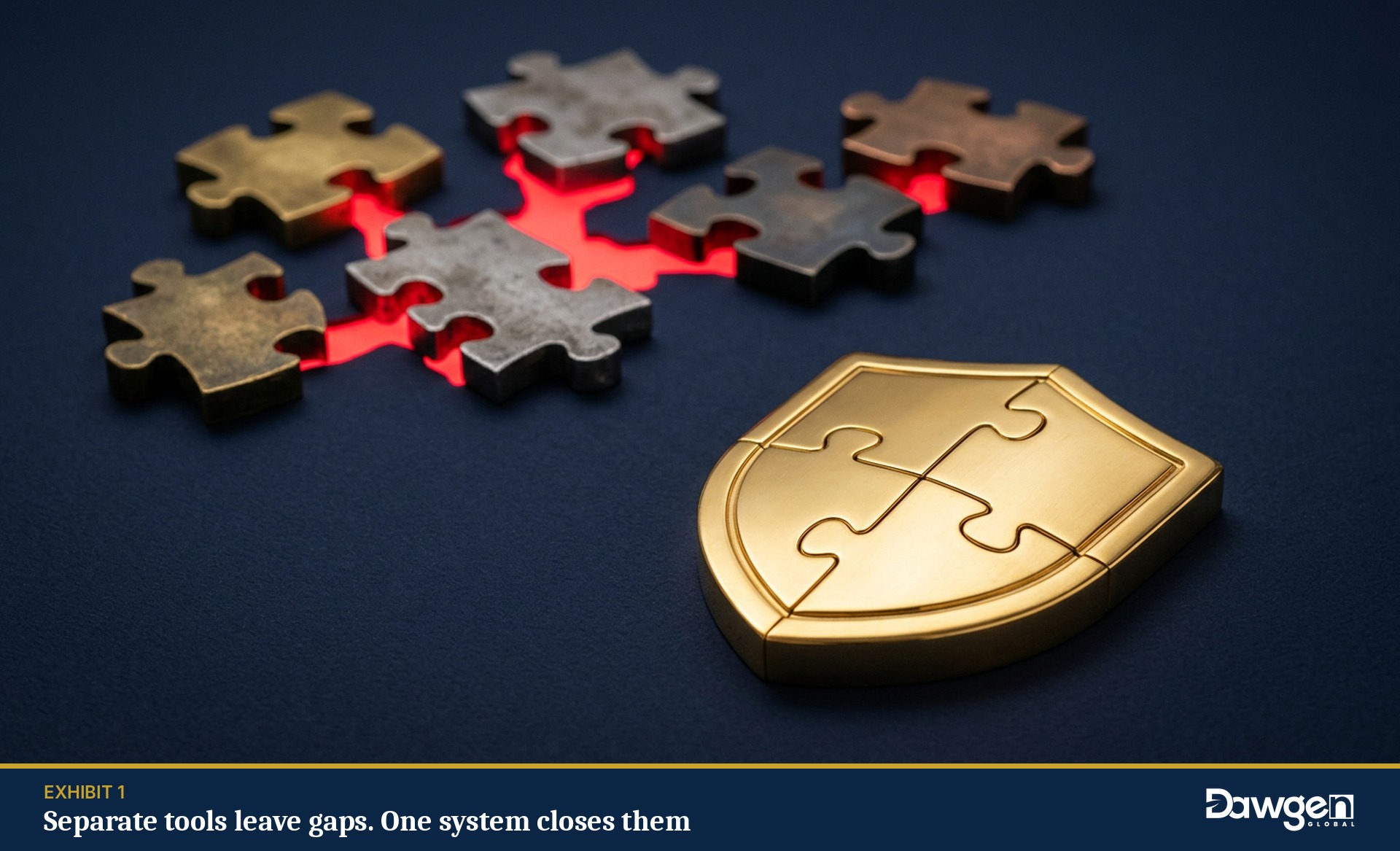
The price of a fragmented security stack never appears on one invoice. It shows up in staff time, integration gaps and renewal creep.
| Factor | One integrated solution | Multiple separate vendors |
| People needed | 1–2 staff to manage | 3–5 staff to procure, test and deploy |
| Integration | Unified management from one console | Gaps and conflicts between products |
| Maintenance | One vendor, one support path | Many vendors, finger-pointing when things break |
| Scalability | Add users and devices from one platform | Each new system multiplies the complexity |
| Renewal costs | Typically lower through bundled pricing | Higher, with separate price increases |
| Renewal effort | One contract | Many contracts and negotiations |
| Expertise | Joined-up knowledge across security domains | Fragmented knowledge, product by product |
The most dangerous cost is invisible: the gap between tools. Attackers do not respect product boundaries. A breach that starts with a malicious USB stick, moves through a phishing link and ends with encrypted files touches three separate systems. If those systems do not talk to each other, nobody sees the whole attack until it is over.
What modern endpoint protection must actually do
If the answer is not more tools, what should one integrated system deliver? Five capabilities matter most.
- Stop threats before they run. Traditional antivirus relies on databases of known threats, and it is always one step behind. Modern protection uses AI models that analyse a file before it executes, online or offline, and block it if it looks malicious, even if it has never been seen before.
- Catch what gets through, in real time. Behavioural AI watches what programmes do, not just what they are. When a process starts encrypting files at speed, the system recognises ransomware behaviour and stops it without waiting for a human.
- Tell the story and undo the damage. The best systems automatically link individual events into a single storyline of the attack: where it came in, what it touched, where it went. Affected devices can then be cleaned up with a single action, without an engineer writing scripts at midnight.
- Make the data itself untouchable. Even when malware reaches a machine, protected data should remain encrypted and invisible to it. Data that cannot be seen cannot be stolen, cloned or wiped. Ransomware loses its leverage.
- Control everything that plugs in. USB drives, keyboards, cables and Bluetooth devices can all carry attacks. Modern protection identifies rogue hardware, enforces device policies and keeps a live inventory of every asset on the network, with up-to-date intelligence on known vulnerabilities.
Add security built into the device itself (verified supply chain, self-healing firmware, hardware-protected keys) and you have genuine defence in depth from the chip to the cloud.
Automation is the small business’s security team
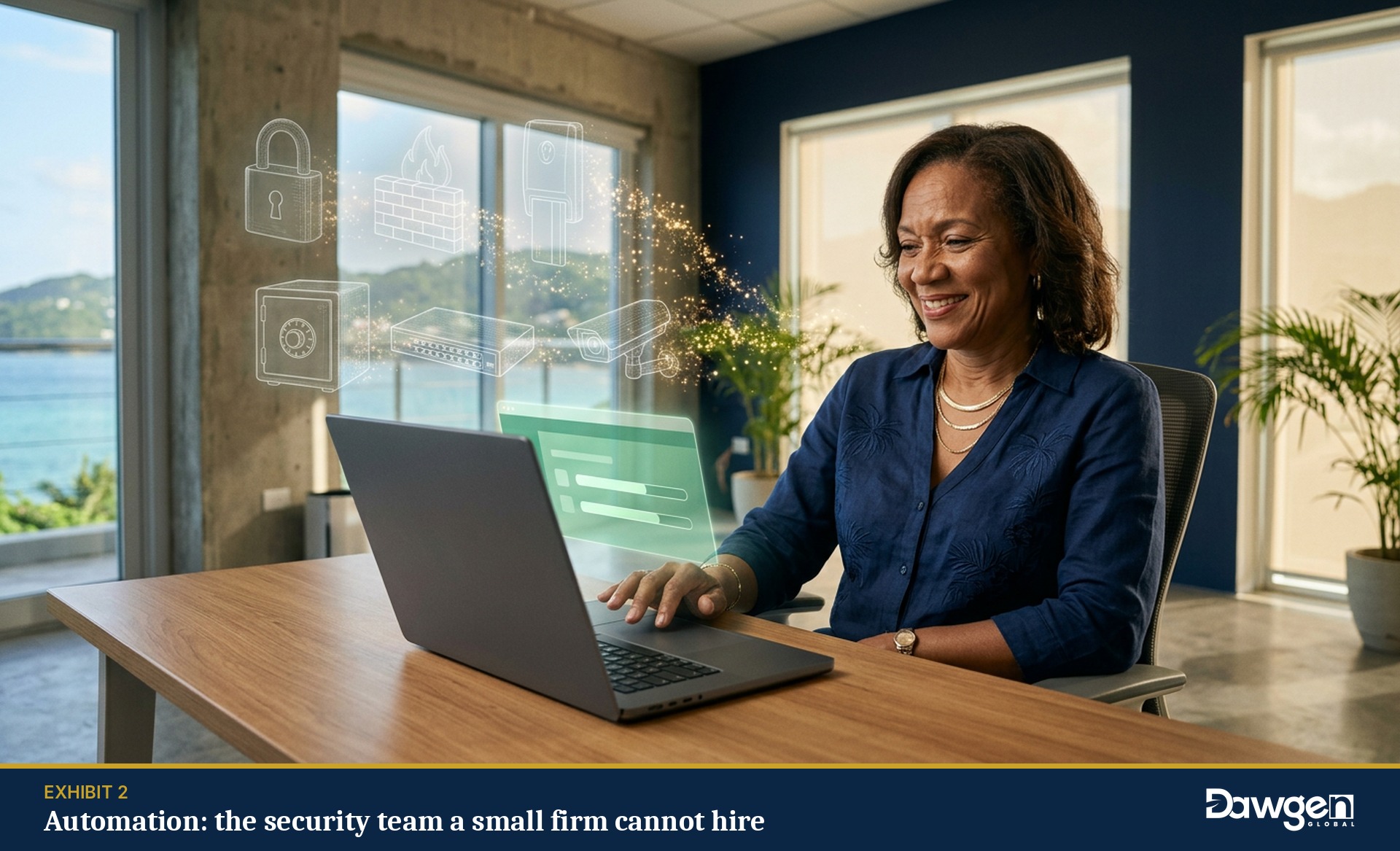
Large enterprises answer the threat with security operations centres staffed around the clock. Most Caribbean businesses cannot, and should not try to, build one.
They do not need to. The same TechAisle research found that 57% of small businesses and 60% of mid-market firms want AI to automate their response to security incidents. That instinct is right. For a smaller firm, automation is not a luxury; it is the security team it cannot afford to hire.
AI-driven protection works at 2 a.m. on a public holiday. It does not take leave, and it does not miss an alert because it was busy fixing the printer. Your IT staff move from fighting fires to overseeing a system that fights them automatically.
Right-sized protection, not enterprise excess
Consolidation does not mean buying everything. It means buying the right layers, in the right order, under one roof.
| Protection level | What it adds | Best suited to |
| Foundation | Hardware-level security built into business devices: supply-chain assurance, firmware resilience, security chip, on-chip biometrics | Every business, at every device refresh |
| Core | AI-driven ransomware and malware detection with automated response, plus endpoint data encryption and hiding | Firms holding client, payment or personal data |
| Advanced | USB and peripheral threat control, full hardware asset visibility across IT and connected devices | Regulated firms, multi-site operations, firms with operational technology |
The recommended position for most businesses holding sensitive data is Core plus Advanced, built on the Foundation. Because these layers are bundled, the cost is typically far below assembling equivalent capability from separate vendors.
Evidence for regulators, insurers and clients
Consolidation has a benefit that rarely features in the sales pitch: it makes security provable.
TechAisle found that 59% of small businesses have no formal risk assessment framework. When a regulator, a cyber insurer, a correspondent bank or a large client asks how you protect data, a single platform produces one coherent answer. Six tools produce six partial ones.
Under Jamaica’s Data Protection Act and comparable laws across the region, being able to demonstrate appropriate security measures is as important as having them.
Eight questions before you renew another licence
- How many security products do we pay for, and who monitors each one?
- If ransomware started on one laptop tonight, what would stop it, and who would know?
- Can our tools share information, or does each see only its own slice?
- Is our protection based on AI and behaviour, or on lists of known threats?
- If a laptop were stolen tomorrow, could anyone read its data?
- Do we know every device, including USB and peripherals, connected to our network?
- When do our security contracts renew, and what are we paying in total?
- Could we show an insurer or regulator, in one document, how we protect our data?
If these questions are hard to answer, the issue is not your people. It is the architecture.
Advice first, technology second
Technology is only half the answer. The other half is choosing it well, deploying it properly and governing it afterwards.
That is why Dawgen Global approaches endpoint security as advisors first. We start with your risks, your data and your obligations, then recommend the protection that fits, and only what fits. Through our authorised technology partnerships we can then deliver and deploy that protection as one integrated solution, with one point of accountability.
And because we are a multidisciplinary firm, the conversation does not stop at technology. We connect your endpoint protection to your risk management, your data protection compliance and your board’s oversight of cyber risk.
Request your Security Stack Consolidation Review
Stop paying for complexity that leaves you exposed. In a focused review, Dawgen Global will:
- inventory every security tool, licence and renewal date you currently carry;
- identify the gaps and overlaps between them, and where an attack could pass unseen;
- compare your total cost of ownership with an integrated, right-sized alternative; and
- give you a clear consolidation roadmap, from Foundation to Advanced, matched to your budget.
One system. One partner. Total protection. Email [email protected], call (876) 926-5210 or US 855-354-2447, or visit dawgen.global to book your review this month. We start with a no-obligation scoping conversation, and agree scope and fees only once we understand your needs.
Dawgen Global — Big Firm Capabilities. Caribbean Understanding.
Sources
- TechAisle SMB and mid-market cybersecurity readiness research, as cited in the partner solution deck.
- ConnectWise, SMB research (2022): https://www.connectwise.com/resources/smb-research-2022
About Dawgen Global
Dawgen Global is an independent, integrated multidisciplinary professional services firm headquartered at 47 Trinidad Terrace, New Kingston, Jamaica, serving more than 15 territories across the Caribbean. Founded and led by Dr. Dawkins Brown, Executive Chairman, the firm is independent and not affiliated with any international network. It delivers a full suite of professional services under one roof: audit and assurance; tax advisory; IT and digital transformation; risk management; cybersecurity; actuarial and insurance regulatory advisory; HR advisory; mergers and acquisitions; corporate recovery; business advisory and strategy; accounting BPO and virtual CFO services; and legal process outsourcing.
The proposition is simple: big-firm capability without the big-firm price. Dawgen Global’s integrated approach is built for the specific complexities and opportunities of the Caribbean market, helping organizations make sharper, better-informed decisions that drive measurable progress.
To explore a partnership, reach out:
- Website: dawgen.global
- Email: [email protected]
- WhatsApp (Global): +1 555-795-9071
- Caribbean offices: +1 876-665-5926 | +1 876-929-3670 | +1 876-926-5210


