
Executive Summary
Somewhere in the Caribbean this week, an executive will approve a payment for a “penetration test,” receive a hundred-page PDF full of colour-coded severity scores, file it with satisfaction — and remain exactly as exposed as before. What was purchased was almost certainly a vulnerability scan: a legitimate, useful, automated exercise that is nonetheless a categorically different product from a penetration test, in the way that a smoke detector is a categorically different product from a fire drill. Both matter. Neither substitutes for the other. And organisations that confuse them make decisions — and give assurances to boards, insurers and regulators — on foundations that do not exist.
This article, the most technical in this series so far, is deliberately written for a non-technical reader, because the confusion it addresses is commercial before it is technical: it persists because it is profitable for some vendors and comfortable for some buyers. It explains what a vulnerability scan actually does and what it genuinely cannot; what a penetration test involves and why the human adversary is the point; how to tell, from the report on your desk, which one you actually received; and — the discipline that matters most — how raw technical severity must be translated into business risk before anyone makes a decision with it. It closes with practical guidance on using each tool at the right cadence, and eight questions to ask before signing any testing proposal.
The Most Expensive Confusion in Caribbean Cybersecurity
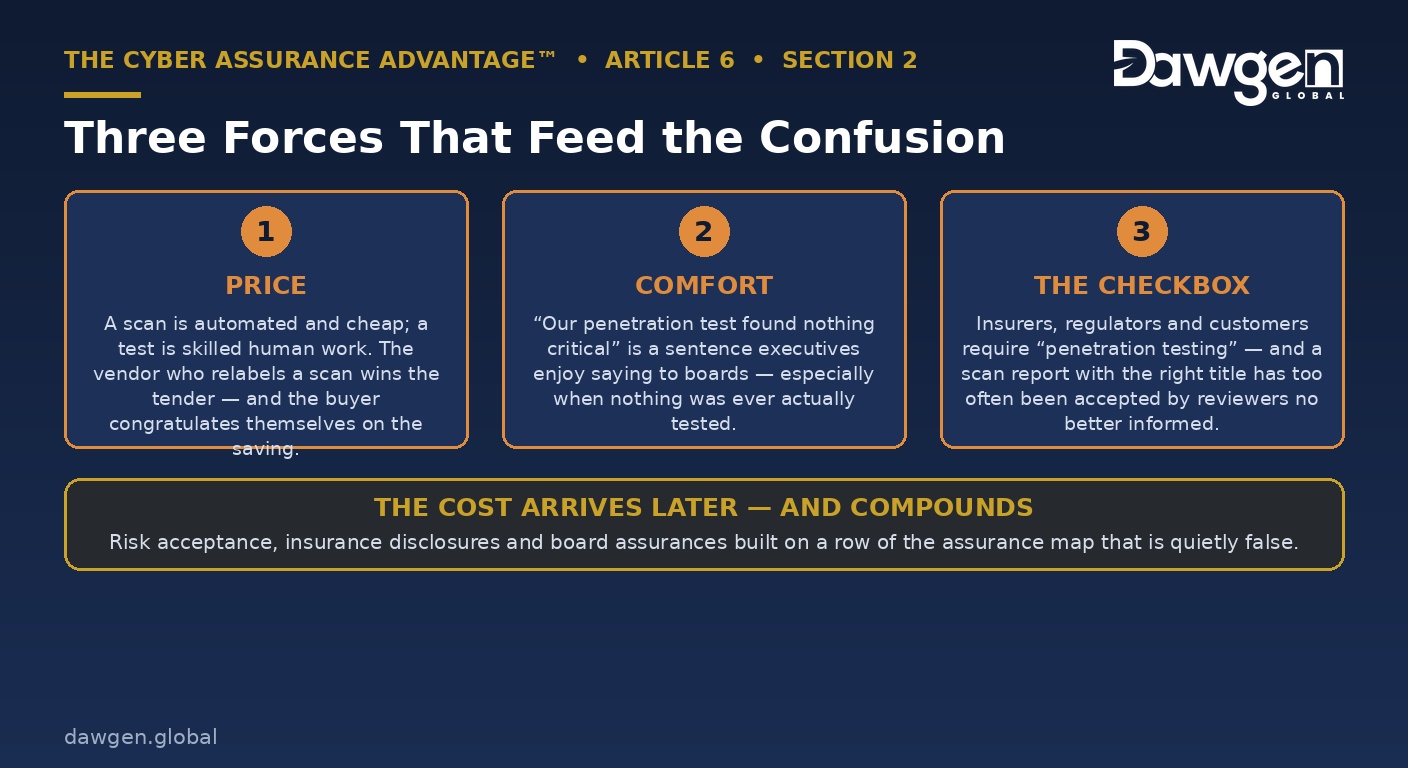
The scan-versus-test confusion survives because three forces feed it. The first is price. A vulnerability scan is largely automated and can be sold cheaply at scale; a genuine penetration test is skilled human work and costs multiples more. A vendor who labels a scan a “penetration test” wins the tender against honest competitors, and a buyer who does not know the difference congratulates themselves on the saving. The second is comfort. A scan of a reasonably maintained environment often returns a manageable-looking report, and “our penetration test found nothing critical” is a sentence executives enjoy saying to boards. The third is the checkbox. Insurers, regulators, correspondent banks and enterprise customers increasingly require “penetration testing” — and a scan report with the right title has, too often, been accepted in satisfaction of the requirement by reviewers no better informed than the buyer.
The cost of the confusion arrives later, and compounds. Decisions about risk acceptance, insurance disclosures, board assurances and regulatory attestations are made on the belief that defences were tested when they were merely inventoried. The organisation’s cyber assurance map — the instrument this series introduced in Article 2 — shows a row marked “penetration tested” that is quietly false. And when a real attacker arrives, the difference between the two products is demonstrated at the worst possible price.
What a Vulnerability Scan Actually Is — and What It Genuinely Cannot Do
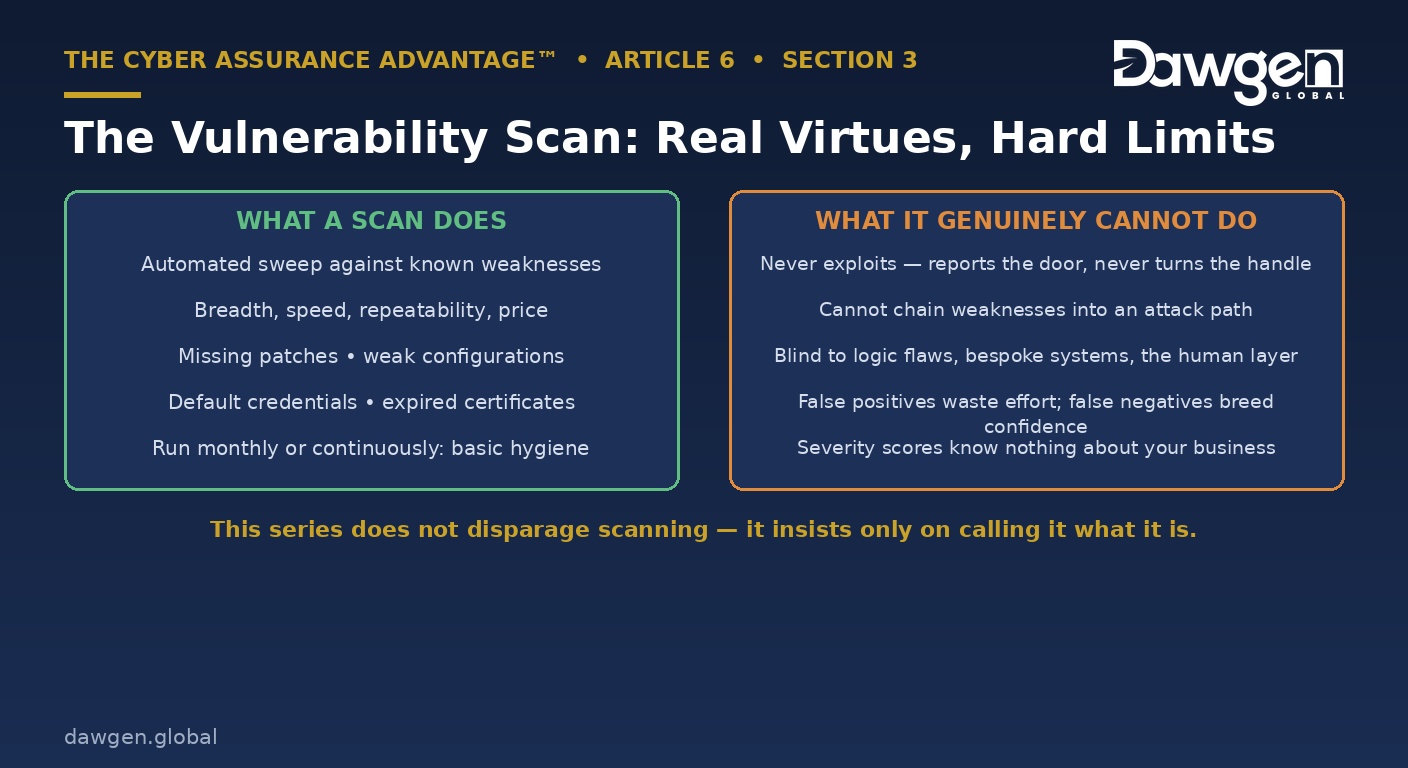
A vulnerability scan is an automated sweep. Software examines systems across the network — servers, workstations, network devices, sometimes applications — and compares what it finds against a database of known weaknesses: missing patches, outdated software versions, weak configurations, default credentials, expired certificates. Its virtues are real: breadth, speed, repeatability and price. A good scanning programme, run monthly or continuously, is basic cyber hygiene — the equivalent of a fleet manager checking every vehicle’s service record. This series does not disparage scanning; it insists only on calling it what it is.
What a scan cannot do defines its boundary. It does not exploit anything: it reports that a door looks unlocked without ever turning the handle, so it cannot tell you what an intruder could actually reach. It cannot chain weaknesses together — the modest misconfiguration plus the reused password plus the over-privileged service account that, combined, hand an attacker the domain. It misses whole categories of exposure: business-logic flaws in applications, weaknesses in bespoke systems it has no signatures for, and the human layer entirely. It produces false positives that waste remediation effort and false negatives that breed false confidence. And its severity scores describe technical characteristics in isolation, with no knowledge of what any system means to your business — a limitation this article returns to below, because it is where most misjudgement happens.
What a Penetration Test Actually Is — and Why the Human Is the Point
A penetration test is an authorised, objective-driven attack performed by a skilled human adversary. The tester does what the scanner cannot: thinks. Given an objective that mirrors a real loss scenario — reach the core banking records, generate a fraudulent payment instruction, seize the domain, exfiltrate the member database — the tester probes, exploits, pivots and chains, combining technical weaknesses with contextual judgement exactly as a genuine attacker would. The deliverable is not a list of theoretical exposures but proof: a documented attack path showing what was actually achieved, how, and what stood — or failed to stand — in the way.
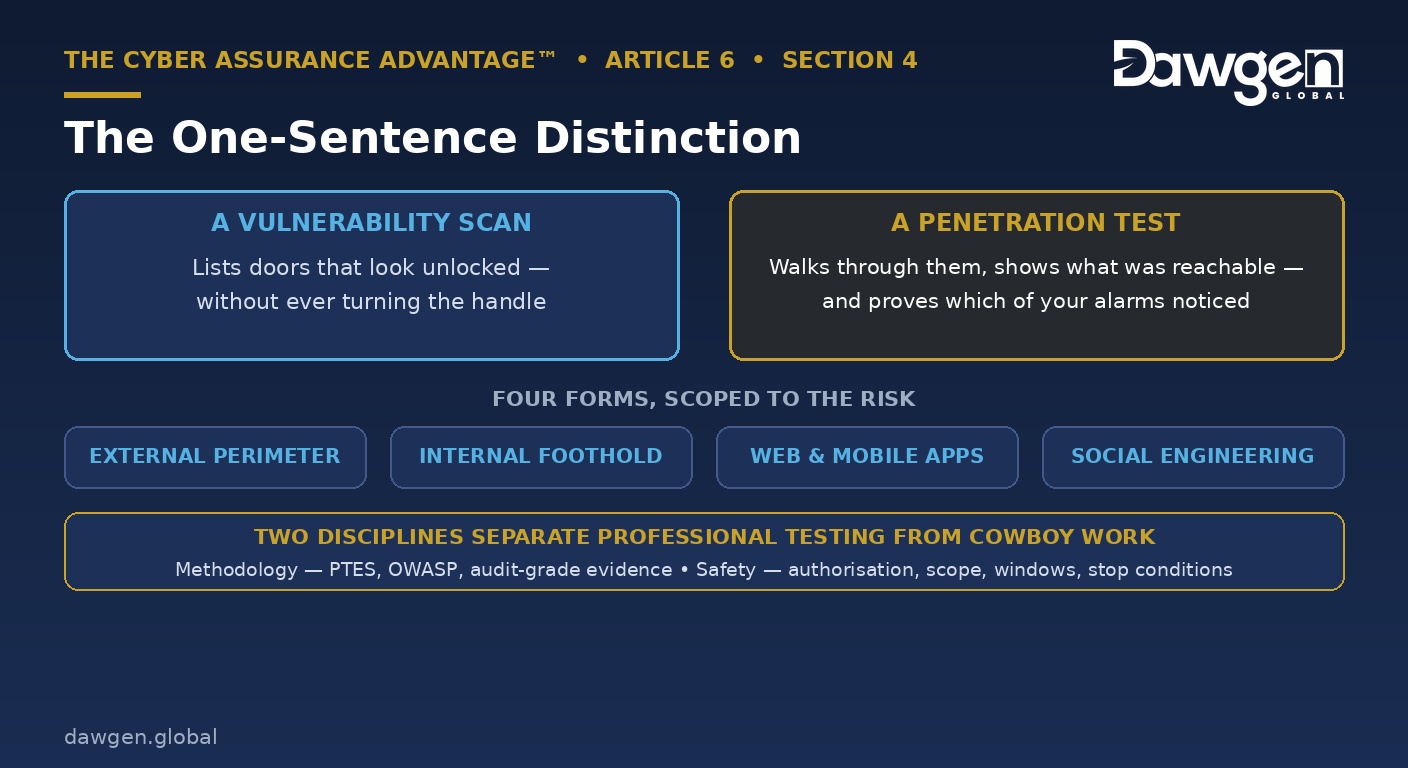
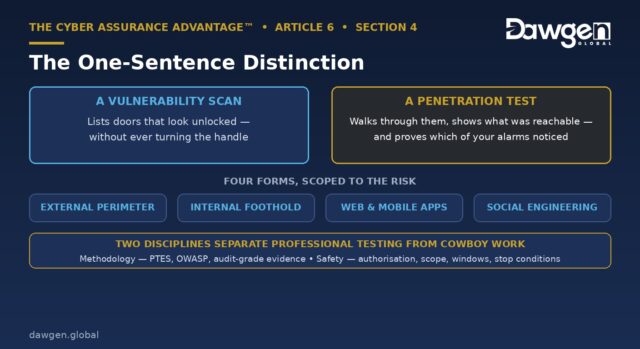
Serious testing takes several forms, scoped to the risk: external testing of the internet-facing perimeter; internal testing that assumes a foothold and asks how far an intruder could travel; web and mobile application testing against flaws in the systems that face customers and members; and social engineering, which tests the human layer through controlled phishing and pretext exercises. Two disciplines separate professional testing from cowboy work, and this series has met them before: methodology — recognised approaches such as PTES and the OWASP Testing Guide, with findings evidenced to the audit-grade standard Article 4 described — and safety: written authorisation, agreed scope and testing windows, stop conditions and data-handling rules, so that the exercise proves the risk without creating it.
| THE ONE-SENTENCE DISTINCTION
A vulnerability scan lists doors that look unlocked. A penetration test walks through them, shows you what was reachable inside — and proves which of your alarms noticed. |
How to Tell What You Actually Bought
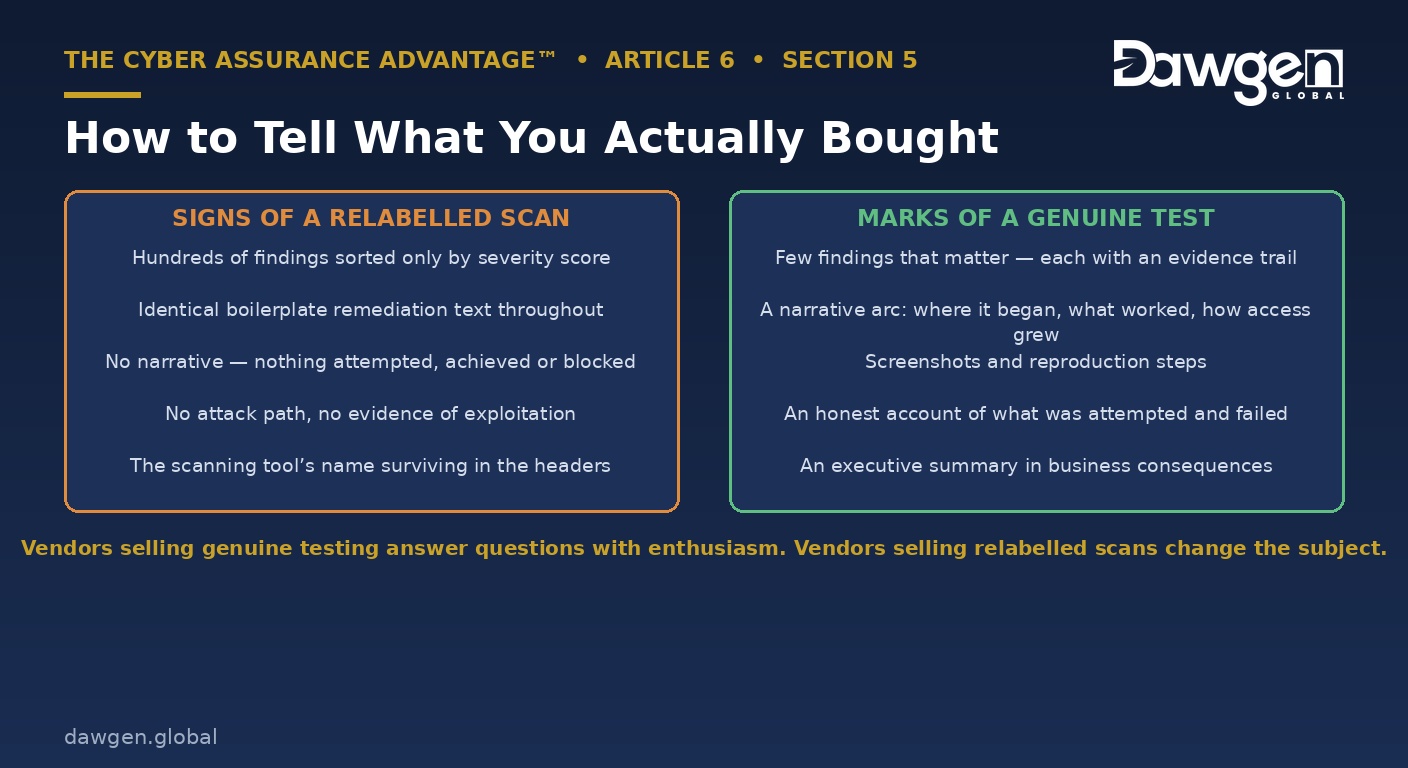
The report on your desk answers the question in minutes. A scan masquerading as a penetration test betrays itself reliably: hundreds of findings sorted purely by severity score; identical boilerplate remediation text repeated under finding after finding; no narrative of what was attempted, achieved or blocked; no attack path; no evidence of exploitation; a delivery date suspiciously close to the start date; and often the scanning tool’s own name surviving somewhere in the headers. A genuine penetration test report reads differently: a small number of findings that matter, each with an evidence trail; a narrative arc — where the tester began, what was tried, what worked, how access expanded; screenshots and reproduction steps; an honest account of what was attempted and failed, which is itself assurance; and an executive summary that speaks in business consequences rather than plugin identifiers.
Before the engagement, the same clarity is available by asking. Who, by name and qualification, will perform the testing? What methodology governs it? What are the objectives, expressed as business scenarios? How many days of skilled human effort are included — a number that cannot honestly be small? And what happens after the report: is retesting of remediated findings included, or does assurance end at the PDF? Vendors selling genuine testing answer these questions with enthusiasm. Vendors selling relabelled scans change the subject.
From Severity Score to Business Risk: The Translation Discipline
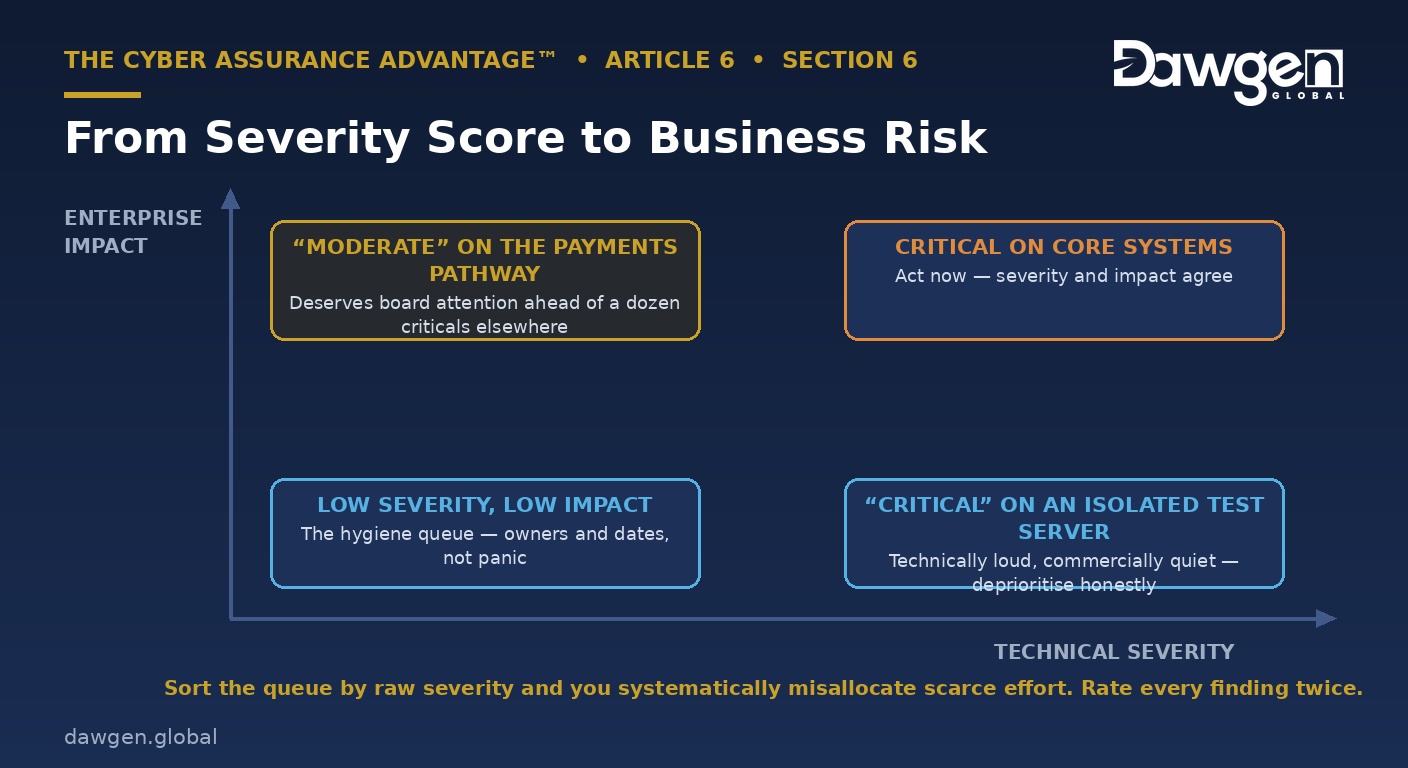
Even a genuine test — and certainly every scan — arrives speaking the wrong language for decision-making. Industry severity scores such as CVSS rate a weakness’s technical characteristics: how easily it is exploited, from where, with what technical consequence. What no generic score can know is context — what the affected system does for your business, what data it touches, what it connects to, and what compensating controls surround it. This is why the same “critical” can be nearly meaningless on an isolated test server and existential on the payments pathway, and why a “moderate” weakness on the member database may deserve the board’s attention ahead of a dozen criticals elsewhere. Sorting the remediation queue by raw severity — the default behaviour of most organisations — systematically misallocates scarce effort.
The correction is the dual rating this series introduced in Article 4: every finding scored twice, once for technical severity and once for enterprise impact, with prioritisation following the business. The translation must reach language as well as numbers. “CVSS 9.8 on host 10.4.2.117” moves no one; “an attacker exploiting this weakness can generate fraudulent payment instructions from inside our network, and our monitoring did not detect the test team doing so” moves boards, budgets and remediation calendars. Producing that sentence requires the testing discipline and the assurance discipline in the same room — the integrated model of Article 4, and the reason technical findings belong inside governance rather than in a drawer beside it.
The Right Tool at the Right Cadence
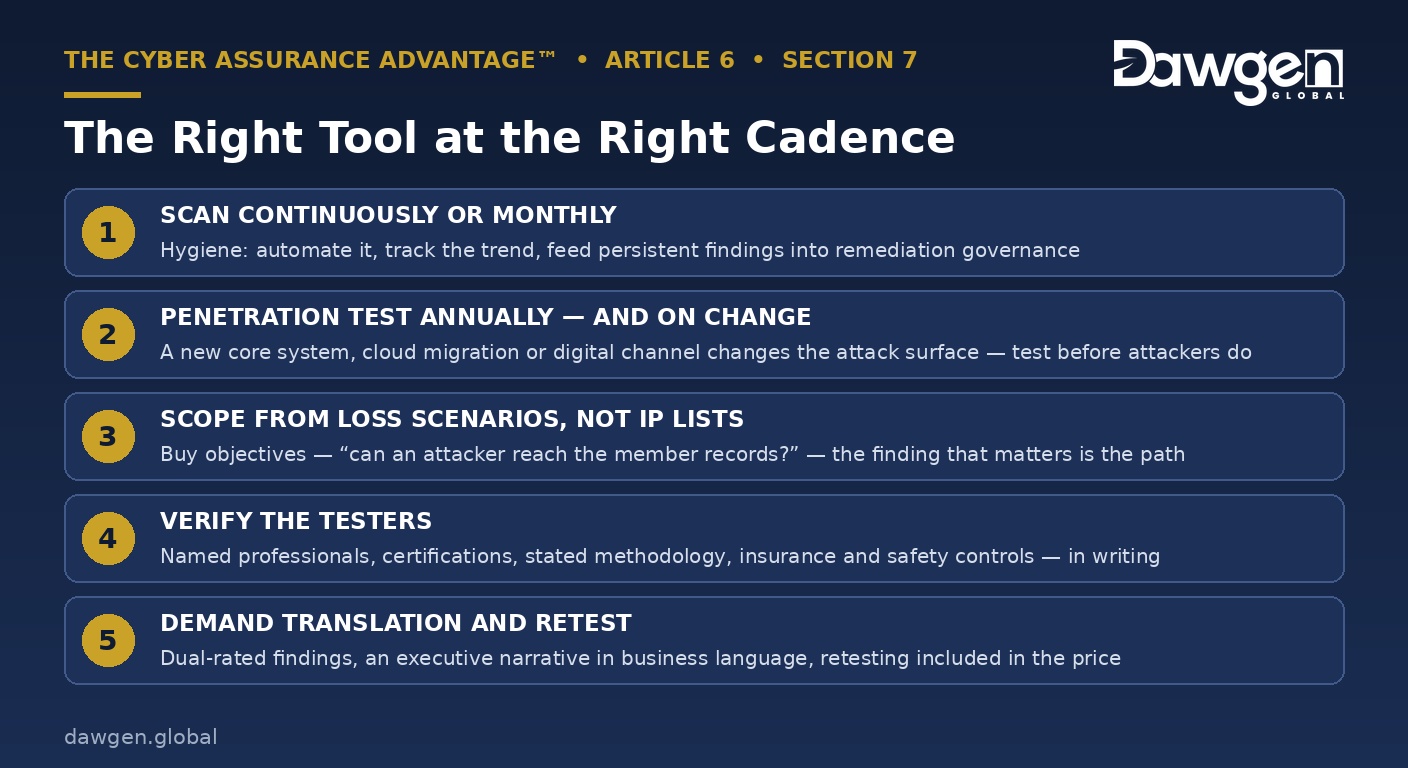
- Scan continuously or monthly. Scanning is hygiene: automate it, track the trend, and feed persistent findings into the remediation governance this series has described — owners, dates, verified closure.
- Penetration test annually — and on material change. A new core system, a major cloud migration, a new digital channel or a merger changes the attack surface; test it before attackers do.
- Scope tests from loss scenarios, not IP lists. Buy objectives — “can an attacker reach the member records?” — rather than address ranges; the finding that matters is the path, not the port.
- Verify the testers. Named professionals, recognised certifications, a stated methodology, professional indemnity and insurance, and the safety controls of Article 4 — in writing, before work begins.
- Demand translation and retest. Require dual-rated findings, an executive narrative in business language, and included retesting of remediated items — the difference between a report and assurance.
The Dawgen Global Perspective
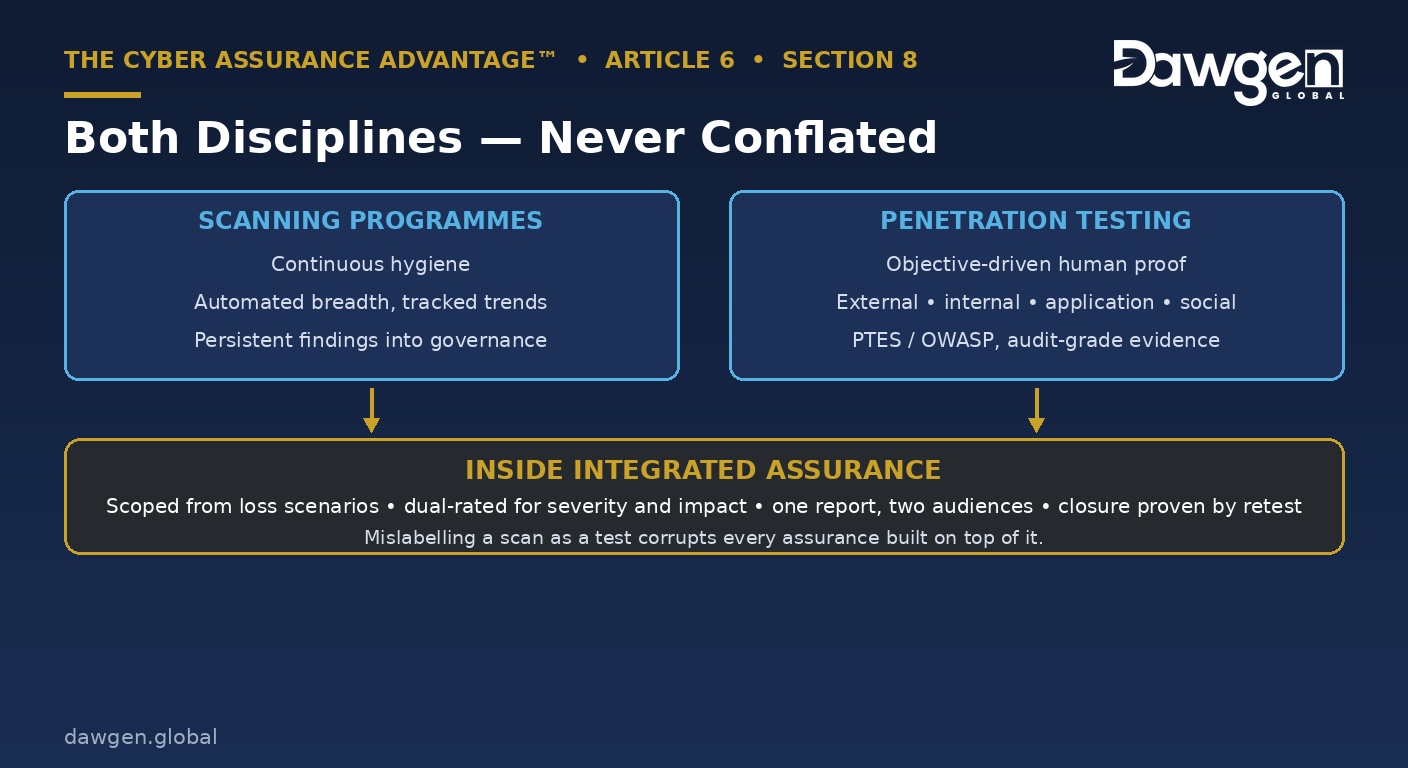
Dawgen Global’s position on this confusion is blunt because the stakes justify bluntness: mislabelling a scan as a penetration test is not a marketing shortcut — it corrupts every assurance built on top of it, from the audit committee’s comfort to the insurance disclosure to the regulator’s file. The firm’s technical validation practice performs both disciplines and never conflates them: scanning programmes for continuous hygiene, and genuine objective-driven penetration testing — external, internal, application and social engineering — delivered under recognised methodologies, audit-grade evidence standards and the safety controls intrusive work demands.
Crucially, both live inside the integrated assurance model this series has built article by article: testing scoped from the organisation’s loss scenarios, findings dual-rated for technical severity and enterprise impact, results reported once to two audiences, and closure proven by retest. The next article turns from testing defences to the scenario every Caribbean board now names first when asked what keeps it awake: ransomware — and the resilience disciplines that decide whether it becomes an incident or a catastrophe.
Eight Questions to Ask Before You Sign a Testing Proposal
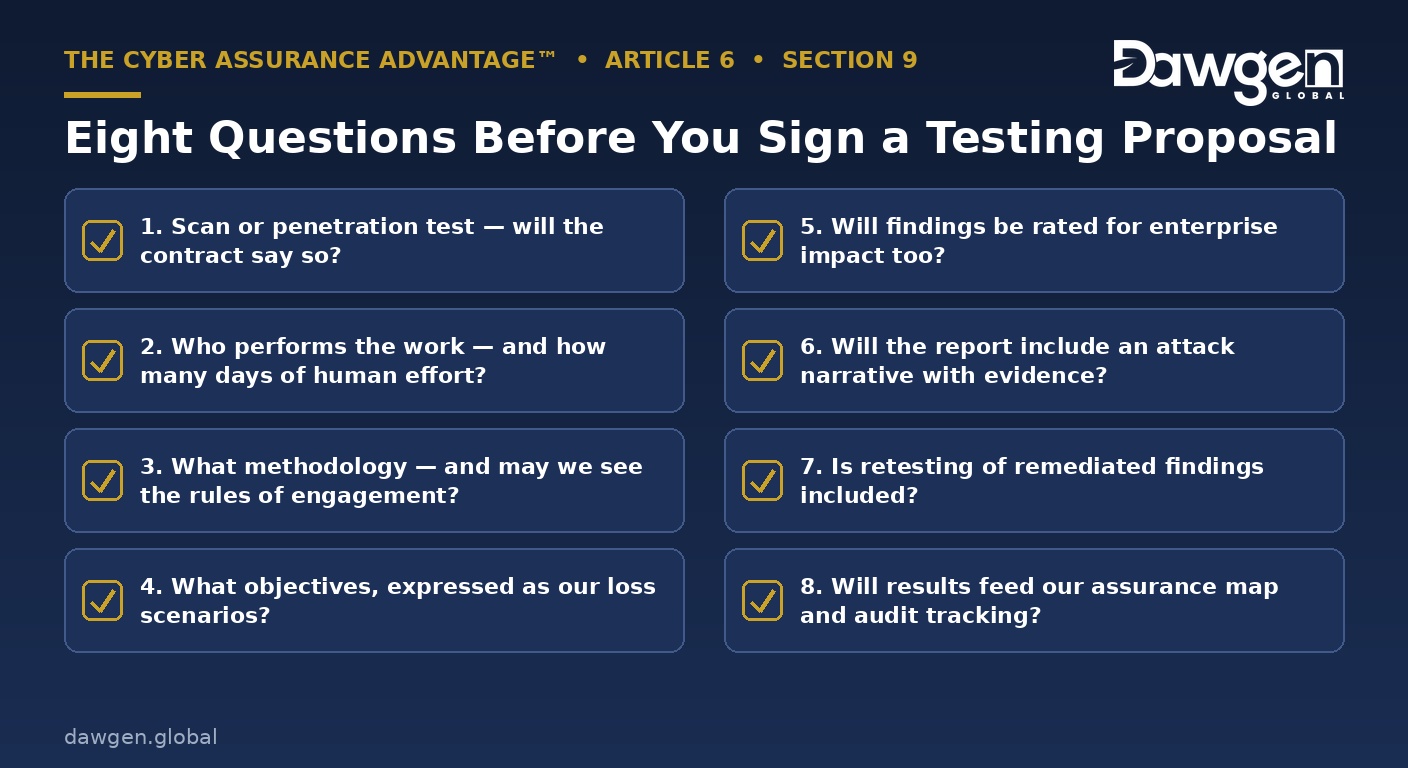
- Is this a vulnerability scan or a penetration test — and will the contract say so, in those words?
- Who, by name and qualification, will perform the work — and how many days of human testing effort are included?
- What methodology governs the engagement — and may we see the rules of engagement and safety controls?
- What objectives will the test pursue, expressed as our business loss scenarios?
- Will findings be rated for enterprise impact as well as technical severity?
- Will the report include an attack narrative with evidence — and an executive summary in business language?
- Is retesting of remediated findings included in the price?
- Will results feed our assurance map and audit tracking — or arrive as a standalone PDF?
Frequently Asked Questions
Our scan came back clean. Does that mean we are secure?
It means the automated sweep found no known signatures on the systems it could see, on that day. It says nothing about whether weaknesses can be chained, whether bespoke applications are flawed, whether staff would resist a targeted phishing campaign, or whether monitoring would detect an intruder. A clean scan is good hygiene news — not an assurance conclusion.
How often should a Caribbean organisation commission a penetration test?
Annually as a baseline for most organisations, and additionally after material change — a new core platform, a cloud migration, a new customer-facing channel. Highly digital or regulated institutions increasingly move to rotating testing across the year so that different parts of the estate are examined on a continuous cycle.
Is penetration testing safe for production systems?
Professionally conducted, yes. Safety is procedural: written authorisation, agreed scope and windows, fragile systems identified in advance, stop conditions, and testers who hold to them. These controls — the same ones Article 4 embedded in the integrated audit — are precisely what separates professional testing from the cowboy work that gives the discipline a bad name.
Our insurer accepted our scan report as a penetration test. Is that not enough?
It was enough to renew the policy; it is not enough to protect the organisation — and the gap carries its own risk. Representations made at underwriting are examined hardest at claim time, and an insurer that discovers “penetration testing” meant a relabelled scan has an argument you do not want to meet while uninsured losses accumulate. Accuracy in what you attest is part of the protection.
Move From Cybersecurity Assumptions to Independent Cyber Assurance
Dawgen Global combines cyber governance, risk-based internal audit, penetration testing, resilience assessment and remediation validation to help Caribbean organisations determine whether their cybersecurity controls are properly designed and operating effectively. To establish what your defences actually withstand — and what your last report actually was — request a confidential technical validation scoping discussion or an independent review of your current testing arrangements.
About Dawgen Global
Dawgen Global is an independent, integrated multidisciplinary professional services firm headquartered at Dawgen Towers, 47-49 Trinidad Terrace, Kingston 5, Jamaica, serving more than 15 territories across the Caribbean. Founded and led by Dr. Dawkins Brown, Executive Chairman, the firm is independent and not affiliated with any international network. It delivers a full suite of professional services under one roof: audit and assurance; tax advisory; IT and digital transformation; risk management; cybersecurity; actuarial and insurance regulatory advisory; HR advisory; mergers and acquisitions; corporate recovery; business advisory and strategy; accounting BPO and virtual CFO services; and legal process outsourcing.
The proposition is simple: big-firm capability without the big-firm price. Dawgen Global’s integrated approach is built for the specific complexities and opportunities of the Caribbean market, helping organizations make sharper, better-informed decisions that drive measurable progress.
To explore a partnership, reach out:
- Website: dawgen.global
- Email: [email protected]
- WhatsApp (Global): +1 555-795-9071
- Caribbean offices: +1 876-929-3670 | +1 876-926-5210


