Boards rarely fail through negligence. They fail through cadence — because certain risks simply are not visible between one audit and the next. Here are the six places that vision goes dark, and what it takes to keep the lights on.
Across the first two articles in this series I made two arguments. First, that annual governance has become a liability — that the audit cycle leaves an eleven-month blind spot the modern risk landscape is only too happy to exploit. Second, that the answer is a continuous operating model: governance bought as an ongoing service rather than an annual event. This article gets specific. If oversight goes dark between audits, where exactly does it go dark? The answer, in my experience, is remarkably consistent. There are six blind spots — and almost every governance failure I have seen begins in one of them.
A word on the term. Boards are conscientious and committees work hard; this is not about effort. The problem is structural. An annual cadence and fragmented reporting mean that some risks are simply not in view when decisions are made.
A blind spot is rarely a failure of diligence. It is a failure of cadence.
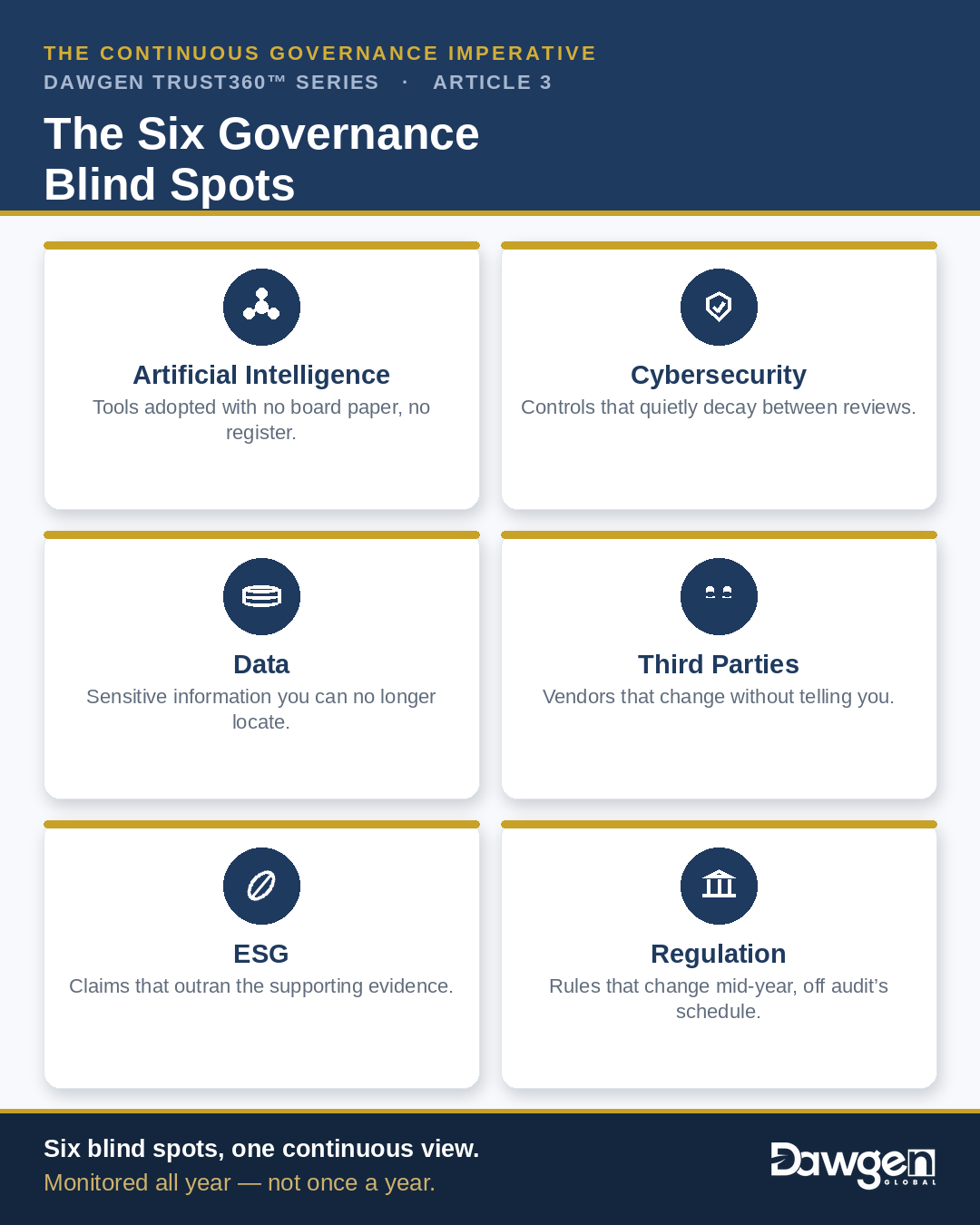
1. Artificial intelligence — the tools no one approved
AI is the fastest-moving blind spot because adoption no longer passes through the board. A team can put a generative or agentic tool into a live process in an afternoon — no paper, no risk assessment, no entry in any register. By year-end the organisation may be relying on models nobody catalogued, drawing on data nobody reviewed, shaping decisions nobody can fully explain. The annual audit was never designed to find a tool that arrived in May and changed behaviour in August. Continuous monitoring keeps an AI use-case register live, watches for model drift and unapproved deployments, and surfaces them while they are still small.
2. Cybersecurity — the control that quietly decayed
Cyber controls do not fail loudly; they decay quietly. A control that was effective at your last review can be undermined by a single configuration change, a new integration, an expired certificate, or a departed administrator whose access was never revoked. None of this announces itself, and none of it waits for audit season — attackers least of all. The real danger is not the absence of controls but the slow, invisible gap between “we have controls” and “our controls still work.” Continuous monitoring closes that gap by watching control health between audits, so decay is caught as drift rather than discovered as a breach.
3. Data — the information you can no longer locate
Most organisations underestimate how quickly they lose track of their own data. New systems, integrations and cloud services each create copies, exports and flows, and sensitive information ends up in places no policy anticipated — sometimes crossing borders into jurisdictions with their own rules. When a customer, a regulator or an incident forces the question “where is our data, and who can reach it?”, the honest answer is too often “we are not certain.” Under Jamaica’s Data Protection Act 2020 and equivalent regional regimes, that uncertainty is itself a liability. Continuous oversight maintains a living picture of where data lives, how it moves, and how quickly it could be located or contained.
4. Third parties — the supplier that changed without telling you
You performed careful due diligence when you onboarded your critical vendor. But due diligence is a photograph, and vendors are films. Between your reviews a supplier can change its subprocessors, move its data, alter its security posture, be acquired, or quietly let its service slip — and you will not be looking again until next year. Add the concentration risk of depending on a handful of providers, and the absence of a tested exit plan, and the third-party domain becomes one of the most consequential blind spots a board carries. Continuous vendor governance keeps the inventory, risk ratings and contract protections current, rather than annual.
5. ESG — the claim that outran the evidence
ESG is where ambition most easily outpaces evidence. Organisations make sustainability and governance commitments faster than they build the data lineage to support them, and the gap between what is stated and what can be proven is precisely where reputational and regulatory risk accumulates. As reporting expectations converge on the ISSB standards — IFRS S1 and S2 — the question is no longer whether you have a good story, but whether you have evidence that survives scrutiny. And ESG evidence cannot be reconstructed retroactively the week before it is requested. Continuous monitoring keeps the evidence packs current and flags the claims running ahead of their support.
6. Regulation — the rule that changed mid-year
Finally, regulation rarely changes on your audit’s schedule. Across the Caribbean, regulators — the Bank of Jamaica, the Financial Services Commission and their regional counterparts — are modernising continuously, and a requirement that did not exist in March can be in force by September. An organisation tracking regulatory change once a year is, by definition, always behind it. The blind spot is not ignorance of the rules but the lag between a rule changing and the board understanding what it means for them. Continuous oversight maintains a live regulatory watchlist and translates change into impact while there is still time to act.
The blind spots are connected
Here is what makes these genuinely dangerous: they do not stay in their lanes. A vendor adopts an AI feature that processes your customers’ data in a new jurisdiction under a regulation that changed last quarter — and in a single sentence you have touched five of the six. Viewed one report at a time, each looks manageable. Viewed together, the interactions are where real exposure lives. This is exactly why fragmented oversight fails: the board that sees these domains in six separate documents, on six separate cadences, never sees the picture they form together.
What good looks like
Closing the blind spots does not require six new departments. It requires one continuous view across all six domains — monitored as they change, reviewed quarterly, and reported to the board in a single coherent pack that shows not just status but trajectory. That is the whole idea behind Dawgen TRUST360™: these six domains are precisely what it watches, continuously, so that what used to go dark between audits stays in view all year.
An exercise for your next committee meeting
So here is a short exercise for your next audit-committee meeting. Take the six — AI, cyber, data, third parties, ESG, regulation — and for each, ask one question: “If something went wrong here next month, how would we know before the next audit?” The domains where the room can answer confidently are your strengths. The ones where it cannot are your blind spots. Finding them is uncomfortable. It is also the most valuable hour your committee will spend this quarter.
About the author
Dr. Dawkins Brown is Executive Chairman and Founder of Dawgen Global, an independent, integrated multidisciplinary professional services firm operating across the Caribbean, and Founding Editor of Caribbean Boardroom Perspectives.
Continue the conversation: dawgen.global · [email protected]
Next in the series — Article 4: “Closing the 11-Month Gap: Continuous Monitoring vs the Point-in-Time Audit.”
About Dawgen Global
Dawgen Global is an independent, integrated multidisciplinary professional services firm headquartered at 47 Trinidad Terrace, New Kingston, Jamaica, serving more than 15 territories across the Caribbean. Founded and led by Dr. Dawkins Brown, Executive Chairman, the firm is independent and not affiliated with any international network. It delivers a full suite of professional services under one roof: audit and assurance; tax advisory; IT and digital transformation; risk management; cybersecurity; actuarial and insurance regulatory advisory; HR advisory; mergers and acquisitions; corporate recovery; business advisory and strategy; accounting BPO and virtual CFO services; and legal process outsourcing.
The proposition is simple: big-firm capability without the big-firm price. Dawgen Global’s integrated approach is built for the specific complexities and opportunities of the Caribbean market, helping organizations make sharper, better-informed decisions that drive measurable progress.
To explore a partnership, reach out:
- Website: dawgen.global
- Email: [email protected]
- WhatsApp (Global): +1 555-795-9071
- Caribbean offices: +1 876-665-5926 | +1 876-929-3670 | +1 876-926-5210


