The audit calendar was built for a slower world. In an era of AI adoption, cloud vendors and near-weekly regulatory movement, governing your organisation once a year leaves an eleven-month blind spot — and boards are accountable for everything that happens inside it.
Let me put a question to every board chair and chief executive reading this. When your last audit closed, you almost certainly received a clean and reassuring picture of your organisation’s controls. Here is the uncomfortable part: that picture had a shelf life. By the time it reached the board, the world it described had already moved. The real question is not whether your governance was sound at year-end. It is whether it is sound today — and whether you would know if it were not.
For most organisations in our region, the honest answer is that they govern on an annual cycle in a world that now changes weekly.
The architecture of the blind spot
The annual governance rhythm is not an accident, and it is not foolish. It grew up around the statutory audit and the financial year, and for a long time it made perfect sense. When the pace of change inside a business was measured in years, a company’s vendors, systems, risks and regulatory obligations were broadly the same in December as they had been in January. An annual checkpoint was a reasonable proxy for continuous oversight.
That world is gone. The cadence of the threats and changes a board must oversee has accelerated dramatically, while the cadence of board oversight has, for most organisations, stayed exactly where it was.
Five forces that now move faster than once a year
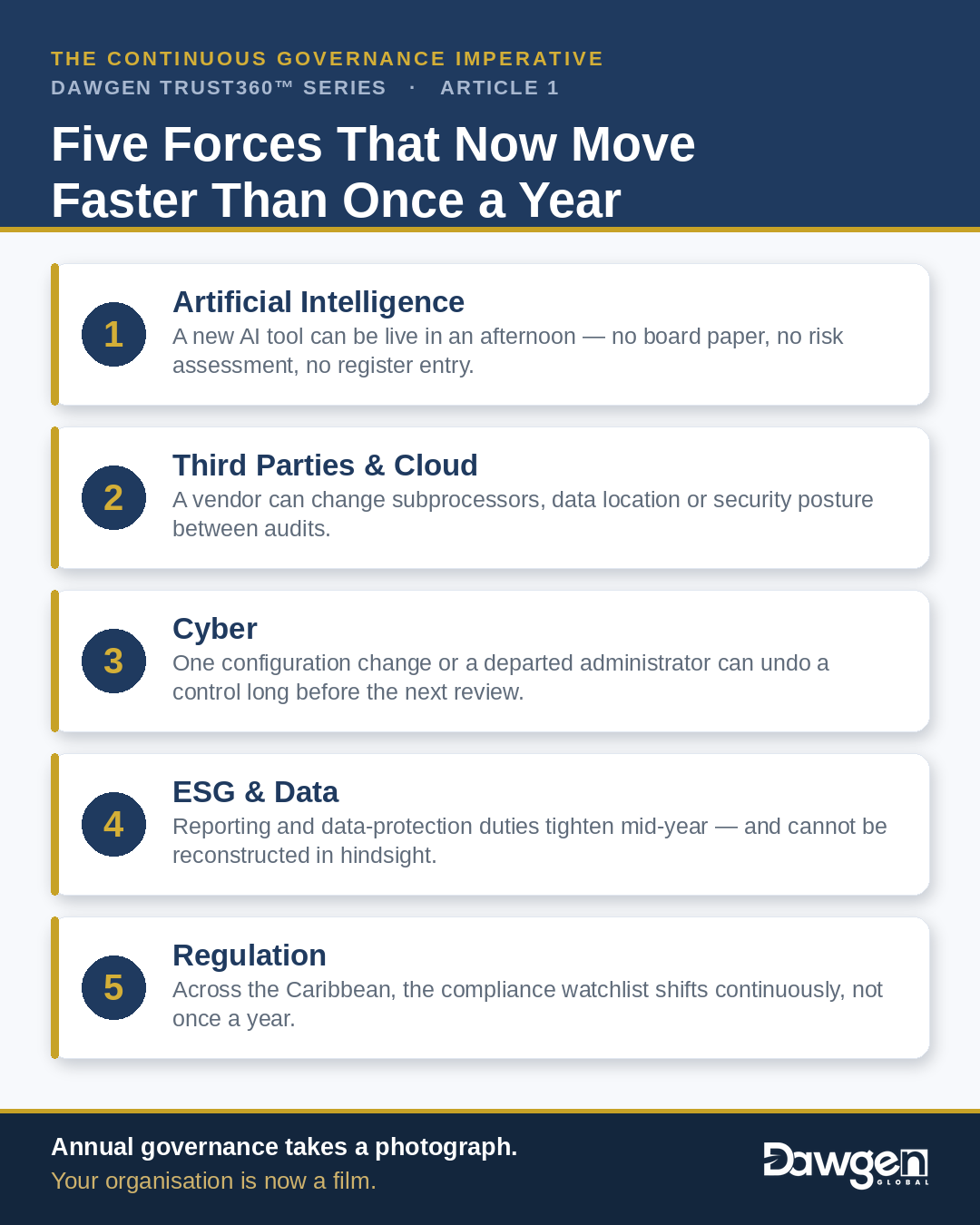
Artificial intelligence. An organisation can adopt a generative or agentic AI tool in a single afternoon — with no board paper, no risk assessment and no entry in any register. By year-end you may be relying on models nobody catalogued, making or shaping decisions nobody can fully explain.
Third parties and cloud. The vendor you onboarded with careful due diligence in March can change its subprocessors, its data location or its security posture in June — and on an annual model you will not look again until next year. Your controls are static; your supply chain is not.
Cyber. Attackers do not consult your audit calendar. A control that was effective at the last review can be undermined by a single configuration change, a new integration or a departed administrator long before anyone formally looks again.
ESG and data. Sustainability reporting expectations and data-protection obligations are tightening across the region. Evidence that did not need to exist last year is expected this year — and it cannot be reconstructed retroactively the night before it is requested.
Regulation. Across the Caribbean, regulators are modernising in parallel — on financial conduct, data, and emerging technology. The compliance watchlist a board should be tracking shifts continuously, not annually.
Each of these moves faster than once a year. Annual governance was designed to take a photograph. The organisation it is governing is now a film.
Why this is a liability, not merely an inefficiency
Here I want to be direct. A gap between audits used to be an operational inconvenience. It is now a governance liability, for three reasons.
First, accountability has caught up. Boards are increasingly expected — by regulators, by stakeholders, and by their own duties — to demonstrate that they exercised oversight continuously, not that they received a report once a year.
“We were compliant at year-end” is no longer a defence for what happened in month four.
Second, the cost of discovery has inverted. The cheapest moment to find a control gap, a drifting AI model or a failing vendor is the moment it appears — not eleven months later as an audit finding, or, worse, as an incident already in the press.
Third, confidence has become a competitive asset. Boards that can answer “how do you know?” in real time move faster, approve initiatives with less hesitation, and raise capital more easily. Continuous oversight is not only defensive; it is an enabler.
The shift: from point-in-time to continuous
The answer is not more audits. Audit does its job well: it provides independent, point-in-time certification, and it remains essential. The answer is to close the gap between audits with continuous governance — a discipline that runs alongside the audit, never in competition with it.
Continuous governance has three moving parts. The first is ongoing monitoring of the domains that change fastest — AI, cyber, vendors, data, ESG and regulation. The second is regular review, quarterly rather than annually, that turns raw monitoring into board-ready conclusions: what the top risks are this quarter, what is being done about them, and what decisions the board must take. The third is a maturity view over time, so the board sees not just a status today but a trajectory — whether the organisation is genuinely getting better.
Done well, it changes the question a board can answer. Instead of “we passed our audit,” the chair can say: “we know where our top governance risks sit this quarter, what is being done about them, and whether we are improving.” That is governance a board can stand behind.
And the Caribbean point
None of this requires building a large internal governance department. For most mid-market and regional organisations, that is neither affordable nor necessary. What it requires is a continuous capability — the right monitoring, the right reviews, the right reporting — delivered with the discipline of a large firm and the understanding of the market you actually operate in.
That last point matters. Caribbean boards do not need a governance model imported wholesale from another jurisdiction. They need continuous oversight calibrated to our regulators, our vendor realities and our scale. This is precisely the gap Dawgen Global built Dawgen TRUST360™ to fill: continuous governance, quarterly review and board-ready confidence delivered as a service rather than as an annual event — Big Firm Capabilities, with Caribbean Understanding.
Over the rest of this series I will unpack how it works, domain by domain — AI, cyber, vendors, ESG, data and regulation — and what board reporting should look like once governance becomes continuous.
Start with one question
The first step, though, costs nothing. At your next board meeting, ask one question: “Between now and our next audit, how would we know if our governance had failed?” If the room goes quiet, you have found your blind spot. The good news is that, in 2026, it is entirely possible to fill it.
Continue the conversation: dawgen.global · [email protected]
About Dawgen Global
Dawgen Global is an independent, integrated multidisciplinary professional services firm headquartered at 47 Trinidad Terrace, New Kingston, Jamaica, serving more than 15 territories across the Caribbean. Founded and led by Dr. Dawkins Brown, Executive Chairman, the firm is independent and not affiliated with any international network. It delivers a full suite of professional services under one roof: audit and assurance; tax advisory; IT and digital transformation; risk management; cybersecurity; actuarial and insurance regulatory advisory; HR advisory; mergers and acquisitions; corporate recovery; business advisory and strategy; accounting BPO and virtual CFO services; and legal process outsourcing.
The proposition is simple: big-firm capability without the big-firm price. Dawgen Global’s integrated approach is built for the specific complexities and opportunities of the Caribbean market, helping organizations make sharper, better-informed decisions that drive measurable progress.
To explore a partnership, reach out:
- Website: dawgen.global
- Email: [email protected]
- WhatsApp (Global): +1 555-795-9071
- Caribbean offices: +1 876-665-5926 | +1 876-929-3670 | +1 876-926-5210


