
The billable hour and the headcount metric were built for the pyramid. In the diamond they break — and the organizations that keep optimizing them will optimize themselves into fragility.
PART III · THE HARD IMPLICATIONS
The measurement built for the wrong shape
This series has changed who creates value in the modern organization — the empowered middle — and how experts are now made — by deliberate design. There is one more hard implication to confront, and it cuts to the commercial core of the firm: how value is priced and measured. The billable hour, the utilisation rate, the headcount target and the leverage ratio were not arbitrary. They were the precise instruments of the pyramid, built to manage a business whose value scaled with hours. The trouble is that the diamond’s value does not scale with hours — and a measurement system built for the wrong shape does not just become useless. It becomes actively misleading.
The pyramid’s input logic
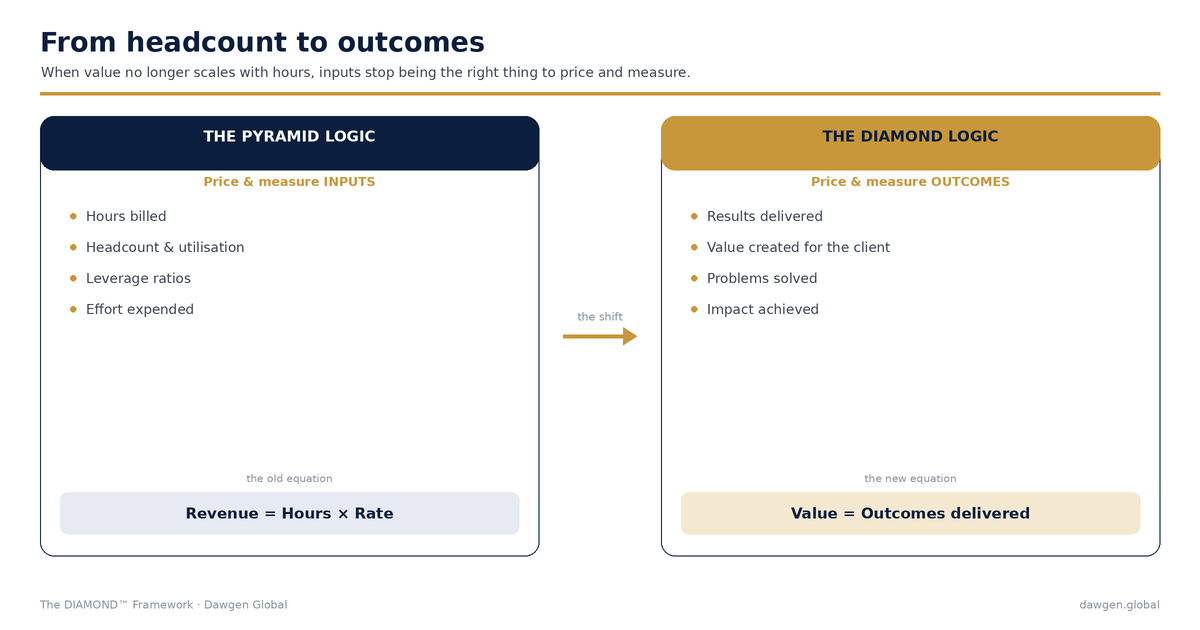
The pyramid ran on a simple, coherent logic: value equalled effort, effort was measured in time, and time was billed by the hour. From that root grew the entire management apparatus of the professional firm. Revenue was hours multiplied by rate. Profit came from leverage — marking up large volumes of junior time. And the metrics that mattered all measured inputs: billable hours, utilisation, headcount, and the leverage ratio of juniors to seniors. It was an elegant, internally consistent system. Every instrument on the dashboard measured how much effort was being expended and how fully it was being sold.
For a hundred years that worked, because in a labour-leveraged business, effort and value really were closely correlated. More hours of competent work genuinely did produce more value. The measurement matched the model.
Why it breaks in the diamond
Automation severs the link between effort and value. When an intelligent system performs in seconds what once consumed hundreds of junior hours, the work that used to generate the most billable time now generates almost none — yet the value delivered to the client is the same or greater. Time and value, once tightly bound, have come apart. And the moment they decouple, every input-based instrument starts to lie.
When value decouples from time, inputs stop being the right thing to price and measure — outcomes take their place.
Bill by the hour, and you are now penalised for efficiency: solve a problem brilliantly in one automated hour and you earn a fraction of what clumsy, manual days would have billed. Measure by utilisation, and you reward people for staying busy rather than for creating value. Manage by leverage ratio, and you optimise for exactly the wide-base structure this series has spent eight articles explaining is obsolete. The pyramid’s instruments do not merely fail to help in the diamond; they steer the organization back toward the pyramid — and, ultimately, toward the hourglass.
When value decouples from time, billing by the hour means charging least for the work that helps most.
Pricing for outcomes, not inputs
If value no longer scales with hours, then value can no longer be priced by hours. The shift is from input pricing to outcome pricing — charging for the result delivered, the problem solved, the risk removed or the value created, rather than for the time spent creating it. This is not a billing mechanic; it is a change in what the client is actually buying. They were never really buying hours; they were buying outcomes, and the hour was simply the proxy we used to meter them. Automation has finally made that proxy untenable.
The transition is genuinely uncomfortable, because it confronts a hard truth: if your work is now faster, you cannot keep charging for the time it no longer takes, yet you also cannot give away the value simply because it arrived quickly. Outcome-based pricing — fixed fees, value-based fees, subscription and retainer models, gain-sharing — reconnects price to the thing the client actually values. It rewards judgment and results rather than hours and effort, which is precisely the right incentive for a diamond.
Measuring for outcomes, not effort
What is true of pricing is equally true of internal measurement. The dashboards that ran the pyramid — utilisation, billable hours, realisation, leverage — measure effort and capacity consumption. In the diamond they must give way to measures of outcome and impact: value delivered to clients, results achieved, problems solved, client outcomes improved. This is the heart of the DIAMOND™ dimension we call Optimize — optimising the organization for outcomes rather than for inputs. The warning is sharp and specific: an organization that automates its base but keeps managing to its old utilisation and leverage targets will use its new tools to chase the wrong goal, and will optimise itself, metric by metric, straight into the hollow-middle hourglass.
Why the change is so hard
None of this is easy, because the billable hour is not only a metric — it is a deeply rooted culture, shared by firms and clients alike. Clients have learned to scrutinise hours and rates; firms have built careers, reward systems and identities around them. Moving to outcomes asks both sides to renegotiate a century-old habit at once. It requires the confidence to articulate and stand behind the value delivered, the discipline to define outcomes clearly enough to price them, and the willingness to absorb the discomfort of a transition that neither clients nor competitors have fully made. It is hard precisely because it is fundamental.
Why this matters for the Caribbean
For regional firms, the shift to outcomes is also an escape route. Competing on hourly rates is a race the Caribbean cannot win — there will always be a cheaper hour somewhere else, and automation drives the price of an hour toward zero. Competing on outcomes changes the contest entirely. It rewards judgment, insight and results — the scarce, high-value capabilities that a deep regional middle can genuinely offer — rather than the commodity of time. A Caribbean firm that learns to price and measure by the value it creates rather than the hours it logs steps off the commodity treadmill and onto the ground where its expertise actually counts.
Pricing and measuring by outcomes raises one final, unavoidable question: if value now comes from the middle and is sold by results rather than hours, how should the rewards be shared? The next article turns to the most sensitive economics of all — reimagining partnership and ownership for the diamond.
Are you still pricing your best work by the hour?
| Reprice your value with Dawgen Global
As automation breaks the link between hours and value, firms that keep billing and managing by time end up charging least for the work that helps most — and steering themselves back toward an obsolete shape. The instruments that ran the pyramid quietly mislead in the diamond. Dawgen Global helps boards and executive teams across the Caribbean move from input-based pricing and metrics to outcome-based models — reconnecting what you charge, and what you measure, to the value you actually create. Through the DIAMOND™ Organizational Diagnostic, our advisors review how you price and measure today, identify where input metrics are misleading you, and design outcome-based pricing and performance frameworks — drawing on our integrated capabilities in Business Advisory & Strategy, Accounting & Virtual CFO, and Risk Management. Request a confidential conversation: info@dawgen.global · dawgen.global |
Dawgen Global — Independent. Integrated. Multidisciplinary.
This article is part of “From Pyramid to Diamond,” a Dawgen Global thought leadership series built on the proprietary DIAMOND™ Framework. Dr. Dawkins Brown is Executive Chairman and Founder of Dawgen Global.
© 2026 Dawgen Global. DIAMOND™ is a proprietary framework of Dawgen Global. dawgen.global | info@dawgen.global
About Dawgen Global
Dawgen Global is an independent, integrated multidisciplinary professional services firm headquartered at Dawgen Towers, 47-49 Trinidad Terrace, Kingston 5, Jamaica, serving more than 15 territories across the Caribbean. Founded and led by Dr. Dawkins Brown, Executive Chairman, the firm is independent and not affiliated with any international network. It delivers a full suite of professional services under one roof: audit and assurance; tax advisory; IT and digital transformation; risk management; cybersecurity; actuarial and insurance regulatory advisory; HR advisory; mergers and acquisitions; corporate recovery; business advisory and strategy; accounting BPO and virtual CFO services; and legal process outsourcing.
The proposition is simple: big-firm capability without the big-firm price. Dawgen Global’s integrated approach is built for the specific complexities and opportunities of the Caribbean market, helping organizations make sharper, better-informed decisions that drive measurable progress.
To explore a partnership, reach out:
- Website: dawgen.global
- Email: info@dawgen.global
- WhatsApp (Global): +1 555-795-9071
- Caribbean offices: +1 876-929-3670 | +1 876-926-5210


