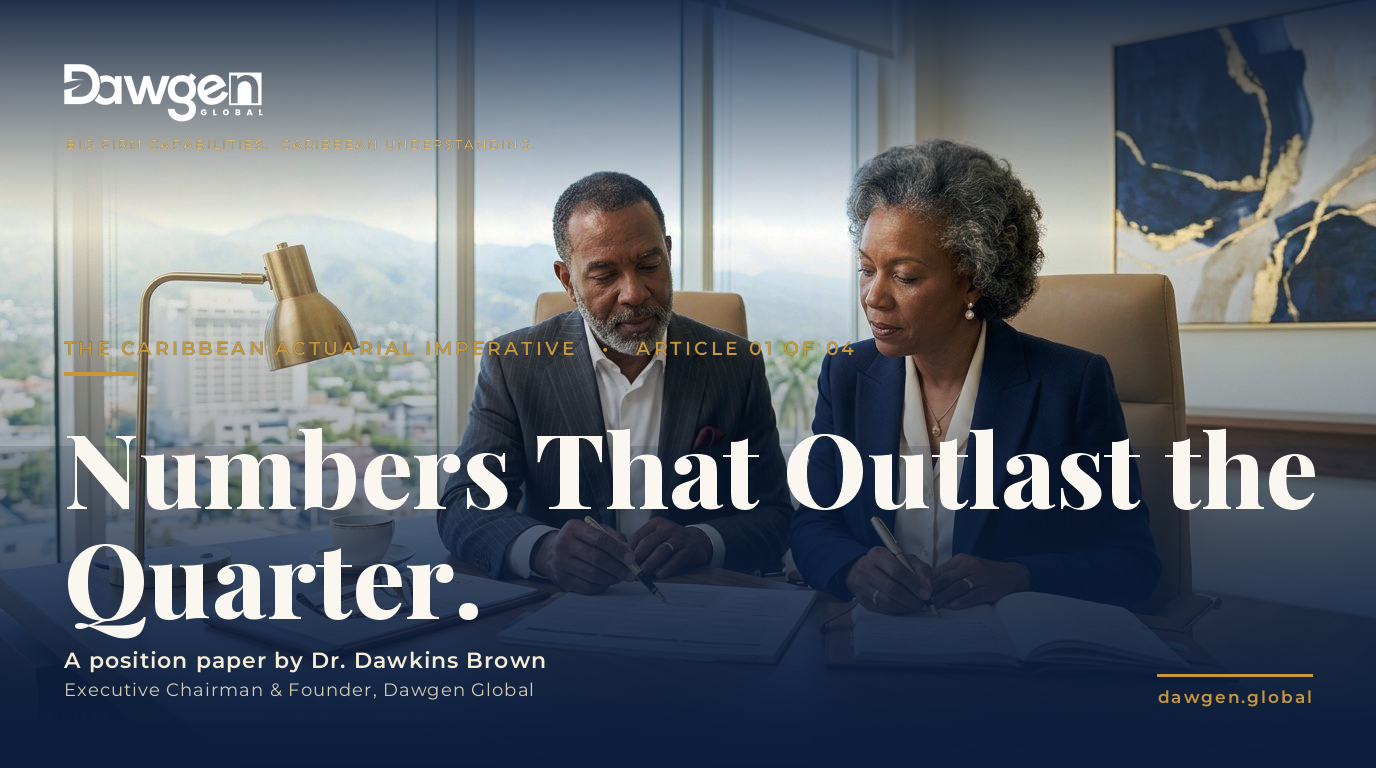
The actuarial perspective on board decisions whose financial consequences will not show up in the next four management reports — and why every Caribbean institution holds more of them than it has measured.
Caribbean boards routinely authorize decisions whose financial consequences will not appear in the next four management reports.
This is the first of four papers in The Caribbean Actuarial Imperative — a new editorial series from Dawgen Global, an independent, integrated, multidisciplinary professional services firm spanning eleven service disciplines across more than fifteen Caribbean territories. The series is written for the decision‑makers whose authorisations create the long‑horizon obligations that this paper is about: directors, chief executives, chief financial officers, audit committee chairs, and trustees.
Most Caribbean management reporting is built around a quarterly cadence. Performance is measured quarterly. Operating decisions are reviewed quarterly. Variances are explained quarterly. The discipline that quarterly reporting imposes on an organisation is, in most respects, a healthy one.
But a large and growing share of the decisions a Caribbean board actually authorises have financial consequences that the quarterly cadence cannot see. The pension obligation a board approved this year produces no variance worth reporting for ten or fifteen years. The warranty programme a manufacturer launched this quarter generates claims patterns that will only stabilise after thirty‑six months of data. The insurance liability a finance company underwrote last month will develop, in claims terms, over a period longer than the tenure of every director who voted to issue the policy. The climate exposure a hotel group accepted when it acquired beachfront real estate will not be priced into the financial statements until a ratings agency, a correspondent bank, or a regulator requires it to be — by which time the exposure is already on the balance sheet.
These are not exotic edge cases. Every Caribbean institution of any size carries decisions of this kind on its books today. They are the decisions where actuarial discipline matters most — and where, in our experience advising boards across the region, actuarial discipline is most often absent.
| “The most consequential financial decisions a Caribbean board makes are rarely the ones that produce the largest variance in the next quarterly report. They are the ones that produce no variance at all — until they do.”
— Dr. Dawkins Brown, Executive Chairman, Dawgen Global |
- What the quarterly horizon cannot see
Quarterly management reporting is designed to measure things that change within the reporting window. It is excellent at this. Revenue movements, cost variances, working‑capital fluctuations, headcount changes, project milestones — the quarterly cadence captures these well, and the management discipline of explaining variance to the board each quarter is one of the most powerful governance tools an organisation has.
What quarterly reporting cannot do is measure obligations whose ultimate cost is uncertain and whose timing extends beyond the reporting window. The accounting treatment of such obligations — the actuarial valuation of a pension scheme, the reserving for incurred‑but‑not‑reported claims, the provisioning for warranty costs, the recognition of decommissioning liabilities — produces a number on the balance sheet. But that number is the *output* of a methodology, and the methodology contains assumptions that the board has typically not interrogated.
When the assumptions are reasonable, the reported number is reasonable. When the assumptions are stale, optimistic, or imported from a different regulatory or demographic environment, the reported number is not. The board that authorised the obligation will have moved on to other quarters. The board that inherits the obligation a decade later will discover that what looked like a settled accounting figure was, in fact, an estimate that has now drifted materially from reality.
This is not a hypothetical pattern. It is the pattern that produced the pension funding crises of the last two decades in jurisdictions where actuarial methods were better established than they currently are in the Caribbean. It is the pattern that produces, with reliable frequency, the discovery that a credit union’s loan loss provisions, a manufacturer’s warranty reserves, or a hotel group’s self‑funded medical scheme are under‑stated relative to the obligations they are supposed to represent. The discovery typically comes during a transaction, a regulatory examination, or a leadership transition — moments when the cost of the discovery is at its highest.
| Boardroom takeaway
If the only financial number a board sees for a long‑horizon obligation is the figure that appears in the audited financial statements, the board is seeing the result of a methodology it has not interrogated. The number is correct in form. Whether it is correct in substance is a separate question — and it is the question this paper is about. |
- What actuarial discipline brings to a board
Actuarial practice is often introduced to non‑specialists as a branch of mathematics. That description is accurate but unhelpful, because it suggests that actuarial work is essentially calculation — and that what the discipline contributes to a board is a more precise number. This is a misunderstanding. Actuarial discipline does produce numbers, but its more valuable contribution is the structured handling of uncertainty over long horizons. The number is the output. The reasoning is the deliverable.
What a board actually receives from a properly scoped actuarial engagement is four things, each of which is difficult to obtain any other way:
- A documented set of assumptions about uncertain future events — mortality, morbidity, claims frequency and severity, asset returns, discount rates, behavioural patterns — against which the obligation has been valued, with each assumption explicitly defended.
- A sensitivity analysis showing how the valuation would change if each assumption were varied within a reasonable range — so the board can see which assumptions the result is most dependent on, and which it is comparatively insensitive to.
- A methodology that is repeatable across reporting periods, so that movements in the valuation can be decomposed into changes in assumption, changes in experience, and changes in the underlying obligation — rather than appearing as an unexplained variance.
- A professional opinion from a credentialled actuary, governed by a recognised standard of practice, that the methodology is appropriate to the obligation and that the assumptions are reasonable. This is the assurance layer — and in many jurisdictions, including increasingly the Caribbean, it is becoming a regulatory expectation rather than a discretionary input.
| TECHNICAL NOTE • From the Actuarial Services Division
What “reasonable” actually means in actuarial practice A reasonable assumption is not the same as a best‑estimate assumption. A best‑estimate is the actuary’s central forecast; a reasonable assumption is one that, given the available data and the relevant standards of practice, would not be successfully challenged by a peer review. The distinction matters because boards often request “our best estimate” and receive, correctly, the actuary’s most central forecast — without the range of equally defensible alternatives that a different actuary might have selected. The methodologies behind a long‑horizon valuation almost always permit a range; understanding that range is more useful to a board than locking onto its centre. |
- The Dawgen Global Long‑Horizon Test
Not every board decision needs actuarial input. Most do not. The discipline is most valuable when applied to a specific category of decision — the category in which the financial obligations are long‑dated, the ultimate cost is uncertain, the obligations are material to the organisation’s financial position, and a misestimate would be difficult to recover from. The four‑question diagnostic below is the framework Dawgen Global uses to identify those decisions in advisory engagements.
| Test | The board should ask: |
| 01
Horizon |
Does this decision create financial obligations, exposures, or commitments that will persist for more than five years — or whose ultimate cost will not be known for more than five years? |
| 02
Uncertainty |
Are those obligations contingent on events with uncertain timing or amount — mortality, morbidity, claims experience, default behaviour, climate events, asset performance, or human behaviour at scale? |
| 03
Materiality |
Are the obligations material relative to the organisation’s capital, reserves, surplus, or operating margin — such that a misestimate would meaningfully change the organisation’s financial position or viability? |
| 04
Recoverability |
If the original estimate proves materially wrong, would the organisation find it difficult, costly, or impossible to recover — because the obligations have already crystallised, the counterparties have already relied on them, or the time to adjust has passed? |
A decision that meets all four tests is one for which actuarial methods are clearly indicated. A decision that meets three of the four is one for which actuarial input would substantially improve the board’s confidence in its authorisation. A decision that meets two or fewer can typically be authorised without specialist actuarial work, although the discipline of asking the four questions is itself useful, because the asking surfaces the obligations the board has not yet identified.
| “Most boards do not under‑use actuarial methods because they have decided against them. They under‑use them because they have not yet asked the four questions that would reveal where the methods belong.”
— The Dawgen Global Long‑Horizon Test Principle |
- Where the Long‑Horizon Test applies in Caribbean institutions
The four‑question test is deliberately abstract. The patterns of obligations to which it applies are, in our advisory experience across the region, far more concrete. Below is an illustrative — not exhaustive — inventory of the long‑horizon decisions Caribbean boards routinely authorise without actuarial input, and which the test would surface:
In financial services
- Pension scheme funding decisions — the choice of valuation basis, the funding methodology, the contribution rate, the recovery plan for any unfunded position. These are explicitly actuarial questions, and they remain among the most under‑advised in the Caribbean market outside the largest schemes.
- Reserving for non‑performing loans, modified loans, and restructured exposures, particularly in credit unions and co‑operative societies, where the supervisory expectation is moving toward methodologies more sophisticated than incurred‑loss accounting permitted.
- Capital adequacy for non‑bank financial institutions, including stress‑testing of the kind that the Twin Peaks supervisory model and similar developments are increasingly expecting Caribbean institutions to perform.
In insurance and risk transfer
- Reserving for incurred‑but‑not‑reported claims, particularly in long‑tail lines — liability, professional indemnity, healthcare — where the gap between policy issuance and ultimate claim payment is measured in years rather than months.
- Pricing and capital adequacy for friendly societies, mutual benefit associations, and captive structures, where the financial soundness of the underlying obligation depends on assumptions the board has typically delegated to a single appointed actuary without independent review.
In corporate finance and treasury
- Long‑tail liabilities embedded in commercial contracts — warranty programmes, performance guarantees, contingent consideration in mergers and acquisitions, environmental remediation obligations, decommissioning liabilities.
- Self‑funded employee benefit schemes, including healthcare and post‑employment medical, where the long‑run cost of the benefit is rarely understood at the point the benefit is established and rarely re‑examined after.
In strategic and regulatory contexts
- Climate risk quantification for institutions whose physical or transition exposure is increasingly being requested by ratings agencies, correspondent banks, and supervisors — a topic the fourth paper in this series will take up in detail.
- Mergers, acquisitions, and demutualisations, where the valuation of long‑horizon obligations on either side of the transaction often determines whether the deal is fairly priced.
- Litigation reserves, class‑action exposure, and contingent liability disclosure, where the magnitude and timing of the obligation is precisely the kind of question actuarial methods are designed to handle.
| A pragmatic test for any Caribbean board
Take the most recent three board agendas. For each item that was approved, apply the four questions of the Long‑Horizon Test. The exercise typically surfaces one or two items per agenda that the board authorised without the actuarial input the test would recommend. The point of the exercise is not retrospective criticism. It is to demonstrate — in the institution’s own decisions, recently made — that the discipline has a regular and previously unrecognised application. |
- The Caribbean actuarial gap, and why it exists
Caribbean institutions are, in international comparison, materially under‑served by actuarial advisory work outside the largest insurance carriers and the largest pension schemes. The gap is not a function of intellectual readiness — Caribbean boards are at least as sophisticated as their counterparts in jurisdictions where actuarial input is routine. The gap is structural, and it has three principal causes.
First, the regional supply of credentialled actuaries is concentrated in a small number of insurance carriers and a small number of sole‑practitioner consultancies. Outside of those settings, an institution that wants integrated, board‑grade actuarial advice has historically had two choices: hire an international firm and accept the cost and the relationship distance that comes with it, or do without.
Second, the structure of Caribbean management reporting — inherited largely from a generation of accounting practice when long‑horizon obligations were a smaller share of the average institution’s balance sheet — has not evolved as quickly as the obligations have. Boards see what their reports show. Reports show what their accounting policies prescribe. Accounting policies are catching up to the actuarial sophistication that institutions in other jurisdictions have already adopted — but the catching‑up is incremental, and during the interim, the gap between reported numbers and actuarially sound numbers can be substantial.
Third, the discipline is poorly explained to non‑specialists. Actuarial science is presented to boards either as impenetrable mathematics — best left to the appointed actuary — or as an opaque sign‑off requirement imposed by regulators. Neither framing equips a board to ask useful questions of the actuary or to know when actuarial input is missing. The discipline is best explained, in our view, not as mathematics but as a structured method for handling uncertainty over long horizons — and Caribbean boards have not yet been offered that explanation systematically.
Each of the three causes is fixable. The third is the one this series is principally addressing. The first will be addressed, in part, by the gradual professional development of regional actuarial capacity — a topic the closing paper of this series will return to. The second is being addressed, slowly, by international accounting and supervisory developments that the Caribbean is progressively adopting. None of the three will resolve quickly. The institutions that benefit most are the ones that move ahead of the resolution — not waiting for the regulator, the auditor, or the ratings agency to require what the institution’s own governance discipline should already provide.
- What good actuarial advisory looks like, in the Caribbean setting
The character of an actuarial engagement matters as much as the credentials of the actuary conducting it. In our experience, the actuarial engagements that produce durable board value share five features:
- They are scoped against a specific decision the board is making — not delivered as a generic technical report that the board then has to translate into its own context.
- They make their assumptions explicit and defensible, rather than burying them in technical appendices, so that the board can see what the result depends on.
- They provide a sensitivity analysis as a standard deliverable, not an optional extra — because the range of reasonable outcomes is more useful to a board than a single point estimate.
- They are integrated with the institution’s other advisory work — the audit, the tax position, the regulatory engagement, the strategy review — so that the actuarial perspective informs and is informed by the broader picture.
- They are delivered by an actuary who can communicate the substance to a non‑specialist board without losing the technical rigour — the rarest and most valuable feature of the five.
| TECHNICAL NOTE • From the Actuarial Services Division
What separates a good actuarial report from a bad one The single most useful diagnostic for the quality of an actuarial report is the section on assumptions and methodology. A poor report buries this material in appendices, presents it in dense technical language, and does not explain the choices made between equally defensible alternatives. A good report places assumptions and methodology near the front of the document, written in language a non‑specialist director can engage with, and is explicit about the alternatives that were considered and rejected. The numerical result is the same in both cases; the board’s ability to use the result is not. |
- Where this series goes from here
This is the first of four papers in The Caribbean Actuarial Imperative. The remaining three will each take up a domain in which the Long‑Horizon Test is most clearly applicable, and which Caribbean boards are most likely to be authorising right now:
- The second paper will examine pension scheme governance — the questions every Caribbean trustee is implicitly answering when they approve a valuation, and the questions they should be asking instead.
- The third paper will examine reserving discipline and long‑tail liability estimation — the audit‑adjacent domain where actuarial methods and financial statement assurance most directly meet.
- The fourth paper will examine climate risk quantification — the forward frontier of Caribbean actuarial work, and the area in which institutional capability will most clearly differentiate the region’s leaders over the next five years.
Each paper will follow the same discipline as this one: written for Caribbean boards, not for actuarial specialists; technically rigorous but accessible; vendor‑neutral and independent; and grounded in the engagements Dawgen Global runs every week with clients across the region.
- How Dawgen Global delivers actuarial advisory
Dawgen Global is an independent, integrated, multidisciplinary professional services firm. Its actuarial work is delivered through the firm’s Actuarial Services Division, which operates within the broader Risk Advisory practice. The Division is led by senior licensed professionals with internationally recognised credentials, and its work covers pension valuation, reserving methodology, capital adequacy and stress testing, climate risk quantification, and the application of actuarial methods to non‑insurance domains. The Division operates alongside the firm’s ten other service disciplines — Audit & Assurance, Tax Advisory, IT & Digital Transformation, Risk Management, Cybersecurity, HR Advisory, M&A Advisory, Corporate Recovery, Business Advisory & Strategy, Accounting BPO and Virtual CFO services, and Legal Process Outsourcing — each of which is similarly led by experienced professionals operating to recognised standards of practice.
The integration is the point. A Caribbean institution that needs actuarial input rarely needs only actuarial input. The pension scheme that needs a valuation usually also needs an audit. The reserving methodology that needs a professional opinion usually also needs to be defended to a regulator. The climate exposure that needs to be quantified usually also needs to be integrated with the institution’s broader risk, capital, and disclosure framework. An independent, integrated, multidisciplinary firm is the natural home for that combination — and the model on which Dawgen Global is built.
The technology layer — the actuarial software, the modelling environment, the data infrastructure — is selected with each client through the firm’s curated network of global partners and vendors, downstream of the strategic and methodological decisions this paper is about. The structural separation between the independent advisor and the technology partner, which the firm has argued for in every edition of its Caribbean AI Realisation Series, applies to actuarial work as well.
| Talk to us
Dawgen Global offers a complimentary, two‑hour Long‑Horizon Diagnostic for Caribbean institutions that would like to understand which of their current obligations would benefit from formal actuarial review. The diagnostic walks the board, audit committee, or executive team through the four‑question test against the institution’s own recent decisions, and concludes with a written briefing identifying the obligations where actuarial input would most materially improve the institution’s position. The diagnostic is delivered by the firm’s Actuarial Services Division within the Risk Advisory practice. To arrange a diagnostic, write to [email protected] or contact the firm’s New Kingston office at 47 Trinidad Terrace. |
About the Actuarial Services Division
The Dawgen Global Actuarial Services Division operates within the firm’s Risk Advisory practice and is led by senior licensed professionals with internationally recognised actuarial credentials. The Division’s work covers pension valuation and scheme governance, reserving methodology and long‑tail liability estimation, capital adequacy and stress testing, climate risk quantification, and the application of actuarial methods to non‑insurance domains including credit unions and co‑operative societies, self‑funded employer benefit schemes, contingent commercial obligations, and merger and acquisition due diligence. The Division operates alongside the firm’s ten other service disciplines and is the institutional home for the firm’s long‑horizon advisory work.
Dawgen Global is an independent, integrated, multidisciplinary professional services firm headquartered at 47 Trinidad Terrace, New Kingston, Jamaica, operating across more than fifteen Caribbean territories. The firm spans eleven service disciplines and works with a curated network of global technology partners and vendors to design, develop, and implement effective client solutions. Dawgen Global is independent and integrated — not affiliated with, a member of, or backed by any external network.
dawgen.global • [email protected] • 47 Trinidad Terrace, New Kingston, Jamaica
This thought leadership paper is published for general information only and does not constitute legal, tax, audit, actuarial, regulatory, or investment advice. The Long‑Horizon Test and the illustrative inventory of applications described above are illustrative of Dawgen Global’s advisory methodology and should be adapted to the specific circumstances, regulatory environment, and risk profile of each institution. Independent professional advice should be obtained before acting on any matter discussed in this paper. © 2026 Dawgen Global. All rights reserved.
About Dawgen Global
“Embrace BIG FIRM capabilities without the big firm price at Dawgen Global, your committed partner in carving a pathway to continual progress in the vibrant Caribbean region. Our integrated, multidisciplinary approach is finely tuned to address the unique intricacies and lucrative prospects that the region has to offer. Offering a rich array of services, including audit, accounting, tax, IT, HR, risk management, and more, we facilitate smarter and more effective decisions that set the stage for unprecedented triumphs. Let’s collaborate and craft a future where every decision is a steppingstone to greater success. Reach out to explore a partnership that promises not just growth but a future beaming with opportunities and achievements.
 Email: [email protected]
  Visit: Dawgen Global Website

 WhatsApp Global Number : +1 555-795-9071
Caribbean Office: +1876-6655926 / 876-9293670/876-9265210  WhatsApp Global: +1 5557959071
USA Office: 855-354-2447
Join hands with Dawgen Global. Together, let’s venture into a future brimming with opportunities and achievements


