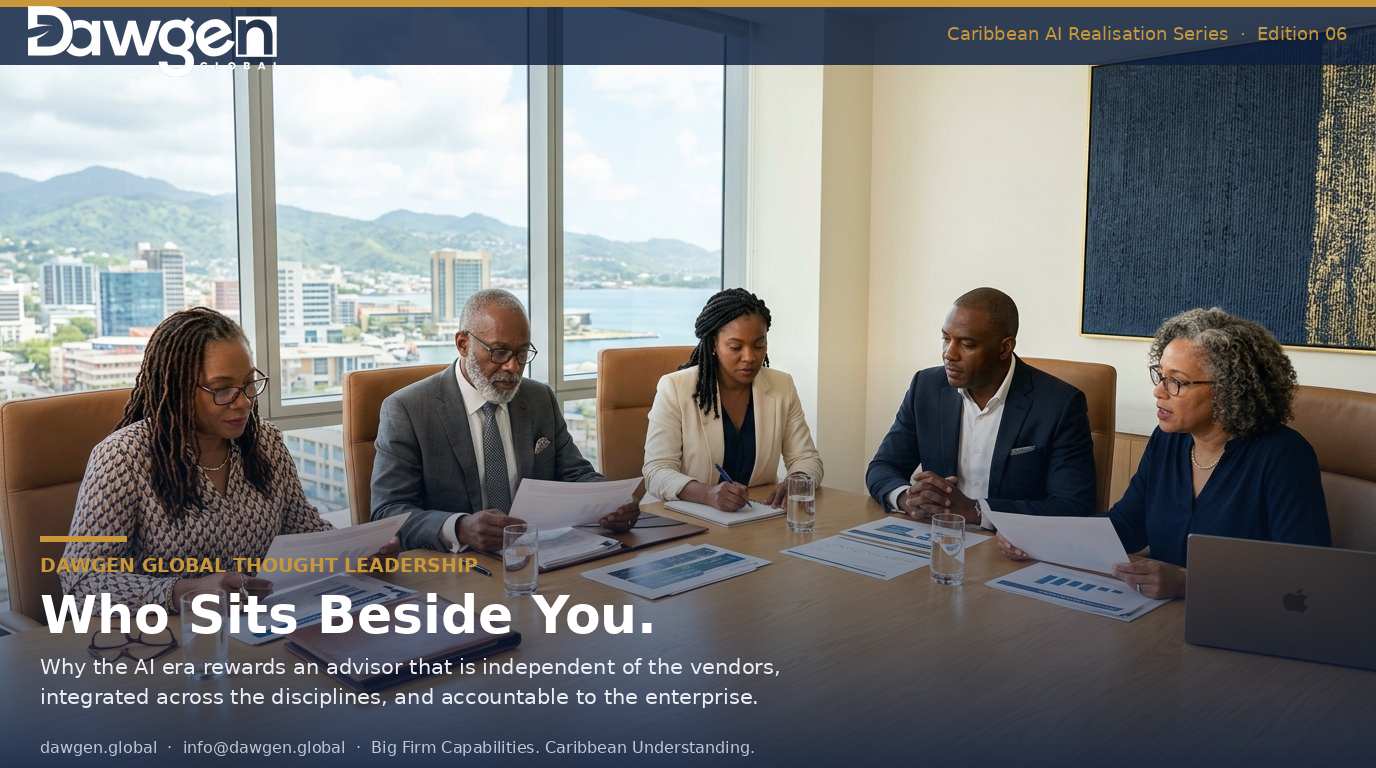
Why the AI era rewards an advisory model that is independent of the vendors, integrated across the disciplines, and accountable to the enterprise — not the technology.
The hardest AI decisions a Caribbean enterprise faces are not single-discipline problems. The advisory model that serves it must not be single-discipline either.
Five editions in, the pattern is hard to miss: the questions AI puts to a Caribbean enterprise refuse to stay inside one department — and refuse to stay neutral about who is advising on them.
This is the sixth paper in Dawgen Global’s Caribbean AI Realisation Series, and it is the one that turns the question back on the advisor. Edition 01 set the discipline for a first pilot. Edition 02 named the use cases worth funding. Edition 03 took up wave two. Edition 04 drew the line between AI that recommends and AI that acts. Edition 05 governed the transition of the workforce those systems change. Across all five, one fact kept asserting itself: none of these decisions is a single-discipline problem, and none of them is well served by an advisor whose interests are tied to a particular technology.
Consider what a single agentic-AI authorisation actually touches. The use case is a strategy and operations question. The authority ladder is a governance question. The kill switch and audit trail are risk and assurance questions. The workforce transition is an HR question. The contracts with the platform and the model provider are legal and commercial questions. The tax and accounting treatment of the investment is a finance question. These are not six conversations to be held in six rooms and reconciled later. They are one decision, and they are routinely handed to advisors who can each see only one face of it.
This paper argues that the AI era specifically rewards an advisory model built on three properties that are easy to state and hard to hold together: independence from the vendors whose products are being evaluated; integration across the disciplines the decision actually spans; and accountability to the enterprise rather than to the technology. It sets out why each matters more in the agentic era than it did before, what the alternatives cost, and how Caribbean enterprises can test the advice they are receiving against this standard.
A necessary disclosure: Dawgen Global is an independent, integrated firm, and this paper describes the model we practise. We have tried to make the argument on its merits rather than as a brochure — the test of independence, after all, is whether a claim survives being stated plainly. Where the paper makes the case for this model, it also names honestly what the model gives up, and where the alternatives are legitimately stronger. A reader should finish it better able to choose, not merely persuaded.
| “In the AI era the most valuable question a Caribbean board can ask its advisor is the oldest one: whose interest does your advice serve — ours, or the product’s? The honesty of the answer matters more now than it ever has.”
— Dr. Dawkins Brown, Executive Chairman, Dawgen Global |
- Why the AI decision outgrew the single-discipline advisor
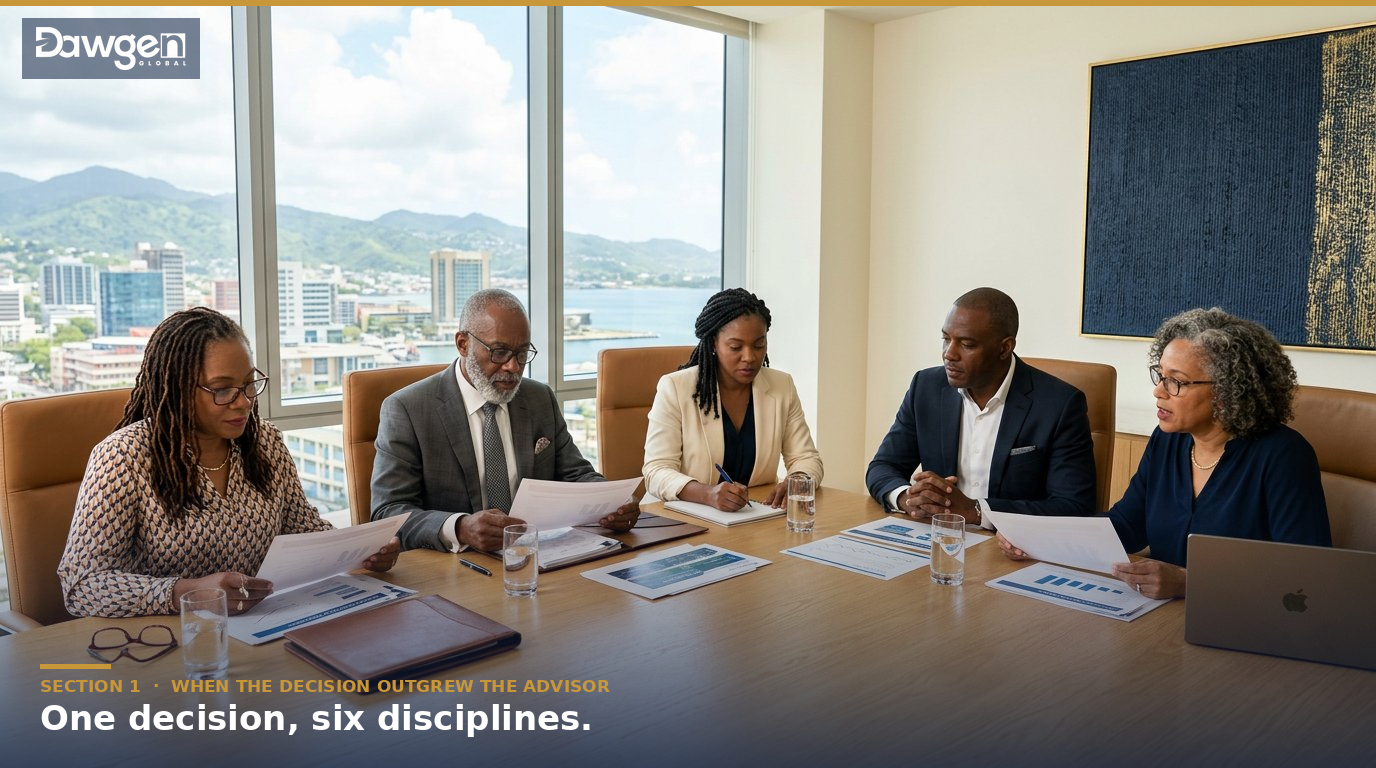
For most of the professional-services era, a Caribbean enterprise could sensibly buy advice one discipline at a time. The auditor audited, the tax advisor advised on tax, the IT consultant scoped the system, the lawyer drafted the contract, and the HR consultant handled the people. The seams between them were real but manageable, because the decisions themselves were largely separable. A new accounting system was mostly an IT-and-finance decision; a restructuring was mostly a legal-and-HR one.
AI broke that separability. A decision to authorise an autonomous agent — to take the example the series has been building toward — is simultaneously a strategy decision, a governance decision, a risk decision, a workforce decision, a legal decision, and a finance decision, and the right answer in any one of those dimensions depends on the answers in the others. The autonomy you grant (governance) changes the assurance you need (risk), which changes the roles your people hold (workforce), which changes the contracts you sign (legal) and the way the investment is treated (finance). Pull one thread and the others move.
When a decision of that shape is advised one discipline at a time, two failures follow predictably. The first is the seam failure: each advisor optimises their own face of the problem, and the gaps between them — precisely where the agentic risks live — belong to no one. The second is the reconciliation tax: the enterprise itself becomes the integrator, spending its own scarce senior attention stitching together advice that was never designed to fit. In larger markets a company can absorb that cost with a big internal programme office. Most Caribbean enterprises cannot, which is exactly why the integration has to come from the advisory model rather than from the client.
| Boardroom takeaway
When the next AI proposal arrives, count the disciplines it actually touches — strategy, governance, risk, workforce, legal, finance — and then count the disciplines your advisors on it can see. If the second number is smaller than the first, the gap is not a detail. It is where the decision will fail, and it is being left for the enterprise to cover itself. |
- The three properties: independence, integration, accountability

The model this paper argues for rests on three properties. Each is valuable alone; the argument is that in the AI era they are only fully valuable together, because each protects against a failure the others cannot reach.
| Property | What it means | The failure it prevents in the AI era |
| Independence | The advisor’s economics are not tied to any platform, model, or vendor being evaluated. Technology is selected for the client through a curated, open field — not sold to them. | Advice shaped by the advisor’s product margin rather than the client’s need — the single largest hidden cost in vendor-led AI engagements. |
| Integration | The disciplines the decision spans — strategy, governance, risk, workforce, legal, finance — sit under one engagement, reconciled before the advice reaches the board. | The seam failures and the reconciliation tax of §1: gaps between siloed advisors that the enterprise is left to discover and pay for. |
| Accountability | The advisor answers to the enterprise for the outcome of the decision — not to the technology for its adoption. One relationship, durable across the life of the system. | The orphaned decision: a system live in production with no advisor who owns whether it was the right call, only vendors who own that it was bought. |
The properties reinforce one another. Independence without integration produces honest advice that is still fragmented — trustworthy on each face, silent on the seams. Integration without independence produces a coherent recommendation that may be coherently steered toward a particular product. Accountability without either is a promise no one is structured to keep. It is the combination that is rare, and the combination that the agentic era specifically rewards.
None of this makes the model costless, and honesty requires naming what it gives up. An independent firm will rarely have the deepest possible bench on any single named platform that a vendor’s own consultancy can field. For an enterprise that has already, irrevocably, committed to one technology stack and wants only the deepest implementation muscle for that one product, a vendor-aligned specialist can be the better choice. The independent, integrated model earns its premium precisely when the decision is still open, spans disciplines, and has to be lived with for years — which is the situation most Caribbean enterprises are actually in.
| “Independence tells you the advice is honest. Integration tells you it is whole. Accountability tells you someone will still own it when the system is live and the vendor has moved on. The AI era needs all three at once.”
— The Dawgen Global Advisory Principle |
- Four advisory models, and what each optimises
It helps to be specific about the alternatives. A Caribbean enterprise buying AI advice is, in practice, choosing among four models — each legitimate, each optimising something different, each with a characteristic blind spot.
| Model | Optimises for | Characteristic blind spot |
| Vendor / platform consultancy | Depth on a single product; fast, expert implementation of that stack. | Independence. The question “is this the right technology at all?” cannot be answered against interest. |
| Single-discipline specialist | Excellence on one face — the best tax, or risk, or HR view available. | Integration. The seams between disciplines, where agentic risk concentrates, fall outside the brief. |
| Global network firm | Brand, scale, and cross-border reach across many markets. | Local accountability and continuity; Caribbean context handled at arm’s length, relationships less durable. |
| Independent, integrated firm | Honest technology selection, cross-discipline coherence, and a durable relationship accountable to the enterprise. | Single-product bench depth; not the right call when one stack is already locked and only implementation muscle is wanted. |
The point of the table is not that one model wins every time. It is that the model should be chosen against the shape of the decision. For an open, cross-disciplinary, multi-year AI decision — the kind this series has been about — the fourth row is built for the job. For a closed, single-stack implementation, the first row may be. The error Caribbean enterprises make is not choosing the wrong model; it is not noticing they are choosing at all, and defaulting to whichever advisor sold them the last thing.
- How the integrated model actually works in a Caribbean engagement
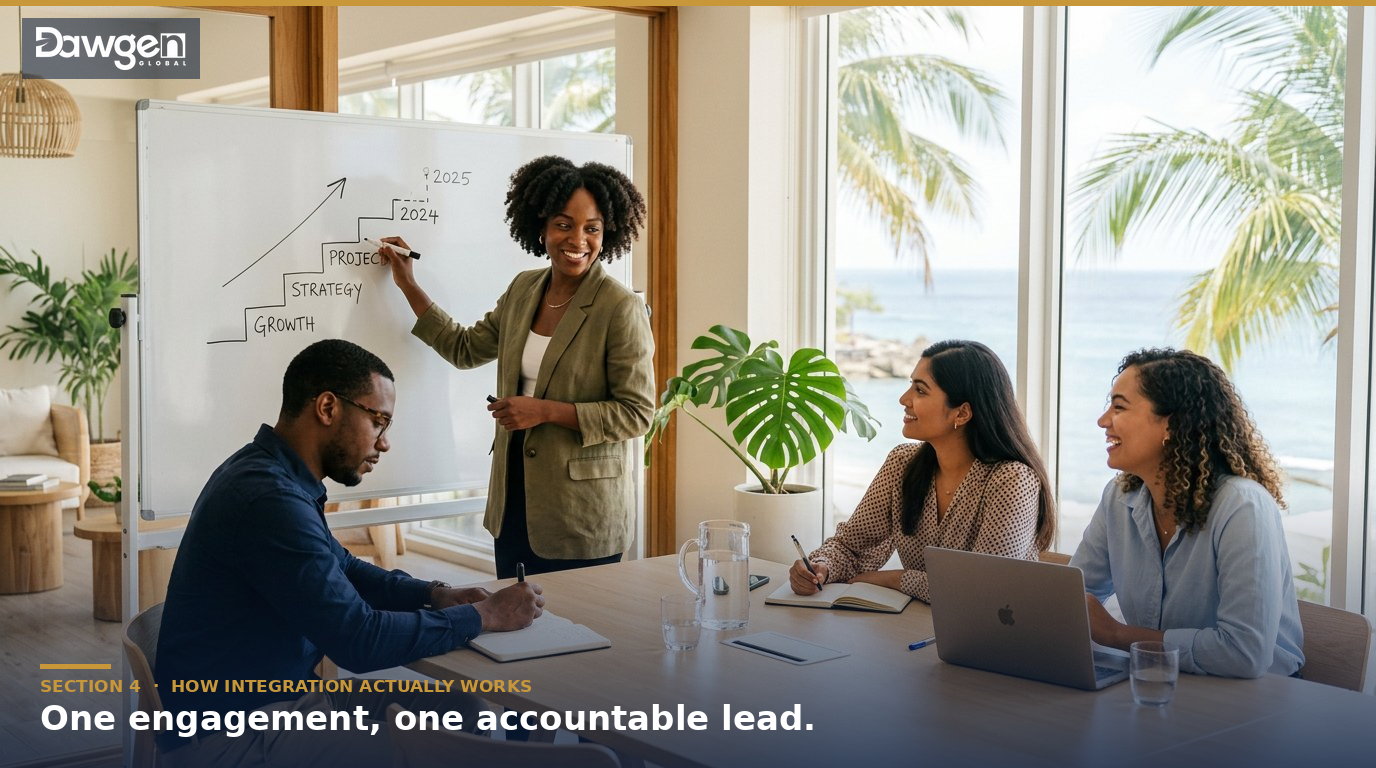
Integration is easy to assert and hard to operate. In Dawgen Global’s Caribbean engagements it rests on three working mechanics, described here so a board can ask whether any advisor — us or anyone else — genuinely has them.
One engagement lead, accountable for the whole decision
A single senior owner holds the entire decision, with the disciplines reporting into that owner rather than to the client separately. The board has one person to hold accountable for whether the seams were covered — not a committee of specialists each accountable only for their own slice.
Vendor selection run as an open, curated process
Because the firm sells no platform of its own, technology is chosen through a curated network of global partners and vendors, evaluated against the client’s requirements rather than the advisor’s catalogue. The deliverable the board sees is a reasoned selection with the alternatives shown — not a single product presented as the only option.
Disciplines reconciled before the board sees the advice
The governance view, the risk view, the workforce view, the legal view, and the finance view are reconciled inside the engagement — their tensions resolved, or at least named, before they reach the boardroom. The board receives one coherent recommendation with the trade-offs surfaced, not five briefs to integrate under time pressure.
| How this connects to Editions 04 and 05
This is the structural reason the earlier editions could treat the system and the workforce as one authorisation. The Authority Ladder (Edition 04) and the Workforce Transition Ladder (Edition 05) are advised by the same engagement, under one accountable lead — so the machine-autonomy decision and the human-transition decision are reconciled rather than made in separate rooms. The integrated model is what makes “one authorisation, considered twice” operationally possible rather than merely aspirational. |
- Five questions a board should ask the advisor
As in every edition, the paper closes with five questions — here, the ones a board should put to anyone advising it on AI, including Dawgen Global. They are designed so that the honest answer reveals the model, whatever the brochure says.
- Do you make money if we choose a particular platform or model?
If yes, the technology advice is not independent — which may still be acceptable, but the board should weight it accordingly. The answer should be specific, not a reassurance.
- Who, by name, is accountable for the whole decision — not just one discipline of it?
If the answer is a set of specialists rather than a single owner, the seams between them are the board’s problem, not the advisor’s. Integration has a name or it does not exist.
- Will you show us the alternatives you rejected, and why?
An advisor confident in its independence shows its working. A single option presented as inevitable is a sales process wearing the clothes of advice.
- Who owns this relationship in three years, when the system is live and the vendor has moved on?
AI decisions are lived with for years. Ask whether the accountability is durable or ends at go-live, and whether the people advising will still be reachable and answerable.
- Can the same team advise on the governance, the workforce, and the contracts together?
If the disciplines cannot sit under one engagement, the enterprise will pay the reconciliation tax of §1 — in its own senior time, at the worst possible moment.
| The test beneath all five
Every one of these questions is a way of asking the single question that matters: when our interests and yours diverge, how is your firm structured to behave? Independence, integration, and accountability are simply three structural answers to that question. A board does not need to take the answers on faith — it needs to see that the structure makes the right answer the natural one. |
- Where the series goes from here
This edition completes the conceptual arc of the series. Editions 01 through 03 took a Caribbean enterprise from a first disciplined pilot to wave two. Editions 04 and 05 governed the two hard frontiers of scaling — the authority delegated to systems that act, and the transition of the workforce those systems change. Edition 06 has stepped back to the advisory relationship that should sit beside the enterprise through all of it.
One paper remains on the path this series has been walking: the consolidation. The final edition will draw every framework, ladder, and checklist from Editions 01 through 06 into a single board-ready Caribbean AI governance and workforce playbook — the complete reference an enterprise can keep beside it as it does this work.
- How Dawgen Global works with Caribbean enterprises
Dawgen Global is an independent, integrated, multidisciplinary professional services firm headquartered in New Kingston, Jamaica, and operating across more than fifteen Caribbean territories. The firm spans the disciplines an AI decision actually touches — Business Advisory, Risk Management, Cybersecurity, HR Advisory, Tax, Audit & Assurance, IT & Digital Transformation, and Legal Process Outsourcing — and selects technology for clients through a curated network of global partners and vendors rather than selling a platform of its own.
That structure is the argument of this paper, lived rather than described: one engagement lead accountable for the whole decision, an open and curated technology selection, and the disciplines reconciled before the board sees the advice. It is how the firm is able to treat the system and the people, the governance and the contracts, as one decision rather than several.
Boards wishing to discuss an integrated AI advisory engagement — or to pressure-test the advice they are currently receiving against the five questions above — can contact Dawgen Global at [email protected].
Dawgen Global • Big Firm Capabilities. Caribbean Understanding.
The Caribbean AI Realisation Series • Edition 06 • “Who Sits Beside You.”
About Dawgen Global
“Embrace BIG FIRM capabilities without the big firm price at Dawgen Global, your committed partner in carving a pathway to continual progress in the vibrant Caribbean region. Our integrated, multidisciplinary approach is finely tuned to address the unique intricacies and lucrative prospects that the region has to offer. Offering a rich array of services, including audit, accounting, tax, IT, HR, risk management, and more, we facilitate smarter and more effective decisions that set the stage for unprecedented triumphs. Let’s collaborate and craft a future where every decision is a steppingstone to greater success. Reach out to explore a partnership that promises not just growth but a future beaming with opportunities and achievements.
 Email: [email protected]
  Visit: Dawgen Global Website

 WhatsApp Global Number : +1 555-795-9071
Caribbean Office: +1876-6655926 / 876-9293670/876-9265210  WhatsApp Global: +1 5557959071
USA Office: 855-354-2447
Join hands with Dawgen Global. Together, let’s venture into a future brimming with opportunities and achievements


