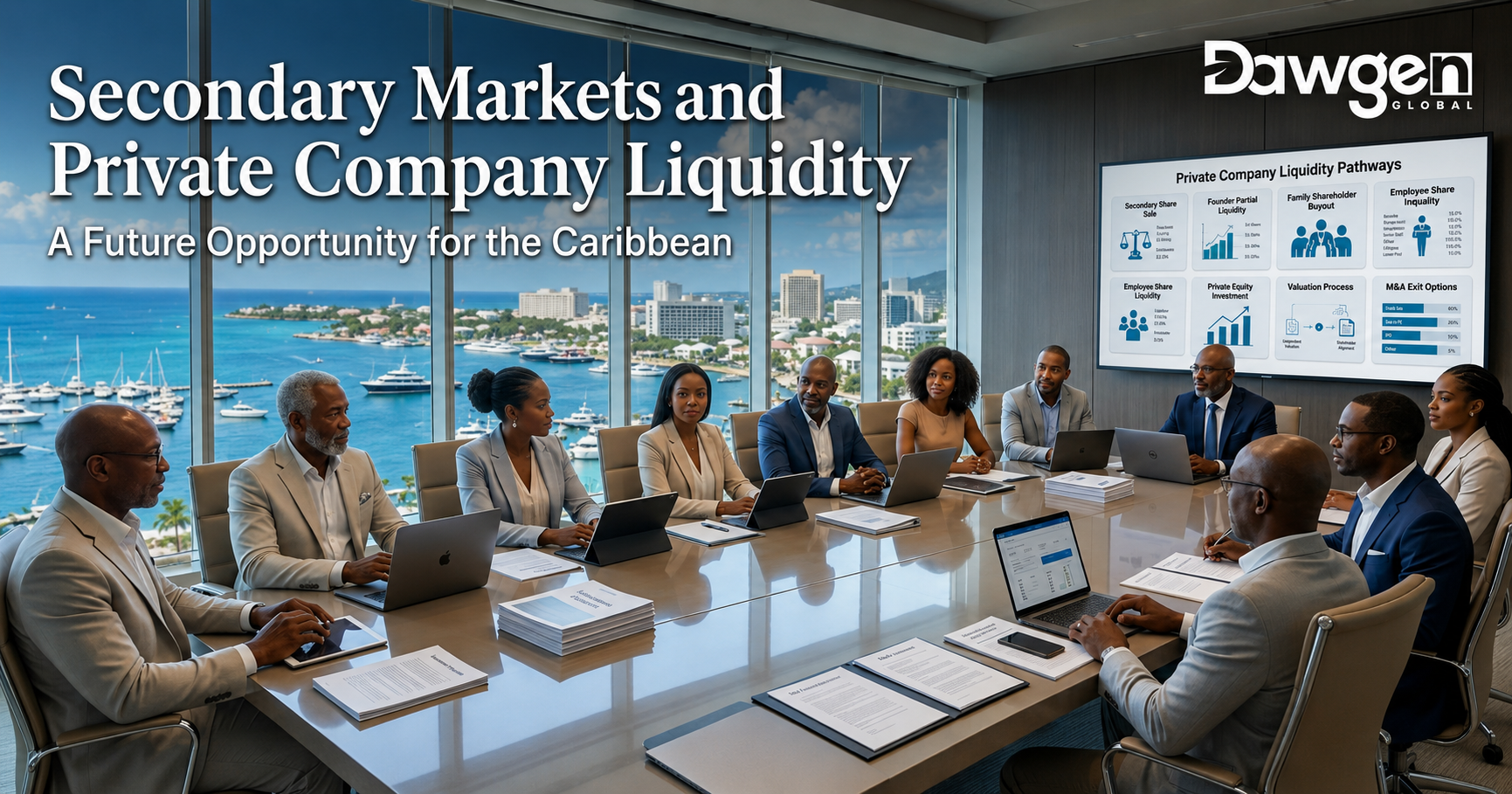
Executive Summary
Private companies across the Caribbean often represent substantial economic value, but that value is frequently locked inside illiquid ownership structures. Founders, early investors, family shareholders, employees, and private capital providers may hold interests in growing businesses for many years without a clear pathway to realize part of that value.
Globally, this liquidity challenge has become a major issue in venture capital and private markets. A recent World Economic Forum report, produced in collaboration with the Stanford Graduate School of Business Venture Capital Initiative, highlights that venture-backed companies are staying private for longer, exits through IPOs and acquisitions have slowed, and secondary markets are becoming increasingly important as a mechanism for restoring liquidity and capital recycling.
For the Caribbean, the lesson is highly relevant. The region may not yet have deep formal secondary markets for private company shares, but the underlying need already exists. Many shareholders in private companies, family businesses, start-ups, and scale-ups need mechanisms for partial liquidity, ownership restructuring, succession, investor exit, employee participation, and capital recycling.
Dawgen Global believes secondary-market thinking should become part of the Caribbean’s private capital development agenda. Properly structured secondary transactions can help unlock trapped value, improve investor confidence, support succession planning, attract private capital, and deepen the region’s innovation finance ecosystem.
However, secondary liquidity must be developed carefully. It requires credible valuation, reliable financial reporting, shareholder agreements, tax clarity, governance standards, investor protection, legal documentation, and appropriate regulatory oversight. Without these safeguards, secondary transactions can create disputes, mispricing, minority shareholder prejudice, tax exposure, and reputational risk.
The Caribbean does not need to copy Silicon Valley. It needs a practical, regionally appropriate approach to private market liquidity.
1. What Are Secondary Markets?
A secondary market allows existing investors or shareholders to sell their ownership interests to another buyer. In public markets, stock exchanges are familiar secondary markets. Investors buy and sell listed shares without the company issuing new shares each time.
In private markets, secondary transactions are more complex. They usually involve the sale of shares or fund interests in privately held companies or private investment vehicles.
The important distinction is this:
A primary transaction brings new money into the company. A secondary transaction allows an existing shareholder to sell to another investor.
For example:
- A founder sells 10% of his or her shares to a family office.
- An early angel investor sells shares to a growth investor.
- A family shareholder exits while other family members remain involved.
- An employee sells vested shares after several years.
- A private equity fund sells part of its position to another investor.
- A pension fund sells an interest in a private fund to rebalance its portfolio.
The company itself may not receive new capital in a secondary transaction. Instead, liquidity is provided to the selling shareholder.
This distinction matters because secondary markets help solve a different problem from fundraising. They help shareholders convert ownership into cash without requiring a full sale of the company.
2. Why Secondary Liquidity Is Becoming More Important Globally
The WEF report explains that the venture capital model historically relied on capital recycling: investors commit capital to funds, funds invest in companies, successful companies exit through IPOs or acquisitions, proceeds are distributed to investors, and those investors recommit capital to new funds.
That cycle has come under pressure because many companies are staying private longer. As exits slow, investors wait longer to receive distributions. This creates what the report describes as a liquidity squeeze and increases interest in secondary markets.
The report also notes that secondary transactions have become a more important part of the venture ecosystem, although liquidity remains concentrated in a relatively small number of large, high-profile private companies.
The global trend is clear: as private companies remain private for longer, shareholders need more flexible liquidity tools.
The Caribbean should pay close attention to this development because many local and regional companies also remain private indefinitely. Unlike large global venture-backed companies, they may not be waiting for an IPO. They may simply have no structured exit pathway at all.
3. Why Secondary Liquidity Matters for the Caribbean
In the Caribbean, private company ownership is often long-term, concentrated, family-based, founder-led, and relationship-driven. This has strengths. It can promote loyalty, continuity, resilience, and long-term commitment. But it can also create illiquidity.
Many shareholders may face questions such as:
- How can I exit without forcing a full company sale?
- How can early investors be rewarded?
- How can family shareholders who want cash be bought out?
- How can employees benefit from equity participation?
- How can founders diversify personal wealth?
- How can new investors enter without destabilizing the company?
- How can capital be recycled into new ventures?
- How can ownership be restructured before succession?
Secondary liquidity provides one possible answer.
A properly structured secondary transaction can allow ownership to evolve without disrupting business operations. It can create flexibility for founders, families, investors, and employees while preserving continuity for the company.
4. The Caribbean’s Private Market Liquidity Gap
The Caribbean’s liquidity gap is not caused by a lack of valuable businesses. Many private companies across the region are profitable, well-established, and strategically important. The issue is that their shares are not easily tradable.
Several factors contribute to this liquidity gap.
Limited Public Market Depth
Regional stock exchanges exist, but many private companies are not ready, willing, or suitable for listing. Listing can bring disclosure obligations, cost, regulatory requirements, and public scrutiny that some companies may not want.
Small Buyer Universe
The number of investors with the capital, expertise, and appetite to purchase minority stakes in private companies may be limited.
Valuation Uncertainty
Private company valuation is difficult without reliable financial information, comparable transaction data, and professional valuation standards.
Share Transfer Restrictions
Shareholder agreements or company articles may restrict transfers, require board approval, or give existing shareholders rights of first refusal.
Family Ownership Complexity
In family businesses, ownership may be tied to family expectations, inheritance, control, and emotion, making transactions more sensitive.
Tax and Legal Uncertainty
Share transfers, capital gains, stamp duties, withholding taxes, and cross-border ownership issues may complicate secondary transactions.
Limited Disclosure Culture
Private companies may be reluctant to share detailed financial information with potential buyers.
Weak Exit Planning
Many companies do not plan for liquidity until a shareholder urgently needs it.
These barriers do not mean secondary liquidity is impossible. They mean the region must build the infrastructure to support it responsibly.
5. Common Types of Secondary Transactions
Secondary liquidity can take several forms. Caribbean businesses and investors should understand the differences.
1. Founder Partial Liquidity
A founder sells a minority portion of shares to diversify personal wealth while retaining control and continuing to lead the company.
This can be useful when a founder has built substantial value but has most personal wealth tied to the business.
2. Early Investor Exit
An early angel investor, seed investor, or minority shareholder sells shares to a new investor after the company has matured.
This can help reward early risk-taking and encourage future angel investment.
3. Family Shareholder Buyout
Some family members may want to exit while others wish to continue operating or owning the business.
A secondary transaction can help avoid disputes and support succession planning.
4. Employee Share Liquidity
If a company has employee share ownership or stock options, secondary liquidity may allow employees to realize some value before a major exit.
This can improve retention and strengthen entrepreneurial culture.
5. Private Equity Secondary Sale
One private equity or growth investor sells to another investor, family office, institutional investor, or strategic buyer.
This may occur when an investor’s fund life is ending or portfolio priorities change.
6. Fund Interest Secondary Sale
An investor in a private fund sells its limited partnership interest to another investor.
This can help institutions rebalance portfolios or manage liquidity needs.
7. Strategic Minority Entry
A new investor buys shares from existing shareholders, gaining exposure to the company without injecting new primary capital.
This may be useful where the company does not need new money but shareholders want liquidity.
6. The Benefits of Secondary Liquidity
Secondary liquidity can provide several benefits for Caribbean private markets.
It Unlocks Trapped Wealth
Founders and shareholders can realize part of the value they have built without selling the entire business.
It Encourages Investment
Investors are more likely to provide capital if they believe there may be a future exit route.
It Supports Succession
Family businesses can manage ownership transition more smoothly when exit mechanisms exist.
It Enables Capital Recycling
Investors who exit one business can reinvest in new ventures, creating a stronger entrepreneurial ecosystem.
It Improves Employee Incentives
Equity-based compensation becomes more meaningful when employees can eventually realize value.
It Attracts Sophisticated Investors
Family offices, private equity investors, and institutional investors may be more interested in Caribbean private companies if liquidity pathways are clearer.
It Reduces Forced Sales
Shareholders needing liquidity may not have to push for a full company sale.
It Supports Market Development
Over time, secondary transactions can generate valuation benchmarks, transaction data, and investor confidence.
7. The Risks of Poorly Structured Secondary Transactions
Secondary liquidity is useful, but it is not risk-free.
If poorly handled, secondary transactions can create serious problems.
Mispricing
Without credible valuation, sellers may accept too little, or buyers may overpay.
Minority Shareholder Disputes
Existing shareholders may object if transfer rights, pre-emption rights, or consent requirements are ignored.
Tax Exposure
Improperly structured transactions may trigger avoidable taxes, penalties, or reporting issues.
Control Conflicts
A new shareholder may have different expectations regarding governance, dividends, strategy, or exit timing.
Information Asymmetry
Buyers may not have enough information to price the investment properly, while sellers may possess material non-public information.
Regulatory Breaches
Private share sales may raise securities law, fund regulation, exchange control, or investor qualification issues.
Reputational Risk
A disputed transaction can damage company credibility and investor confidence.
Employee Misunderstanding
If employee shares or options are involved, unclear communication can create morale problems.
For these reasons, secondary transactions should be professionally advised and properly documented.
8. Valuation: The Heart of Secondary Liquidity
Secondary markets depend on credible pricing. In public markets, prices are visible and constantly updated. In private markets, valuation must be professionally assessed.
A secondary transaction valuation should consider:
- Historical financial performance
- Forecast earnings and cash flows
- Quality of revenue
- Customer concentration
- Market position
- Competitive advantage
- Management depth
- Governance maturity
- Debt levels
- Working capital needs
- Tax exposure
- Regulatory risks
- Country risk
- Liquidity discounts
- Minority interest discounts
- Control premiums
- Comparable transactions
- Strategic value to the buyer
- Exit potential
For start-ups and scale-ups, valuation may also consider:
- Total addressable market
- Revenue growth rate
- Gross margin potential
- Unit economics
- Intellectual property
- Data assets
- Technology scalability
- AI readiness
- Customer retention
- Founder dependency
- Future funding requirements
Dawgen Global believes independent valuation should be a standard feature of any material private secondary transaction.
9. Governance Requirements for Secondary Transactions
A company should not allow secondary transactions to occur casually. Governance is essential.
Key governance questions include:
- Does the company’s articles of incorporation allow the transfer?
- Does the shareholder agreement restrict transfers?
- Do existing shareholders have rights of first refusal?
- Is board approval required?
- Are minority shareholders protected?
- What information will be disclosed to the buyer?
- Will the buyer receive board representation?
- Will the buyer have veto rights?
- Will dividend policy change?
- Will the transaction affect control?
- Are there regulatory approvals?
- Are there tax implications?
- Is the company required to update its beneficial ownership records?
The stronger the governance framework, the less likely the transaction will create disputes.
A modern shareholder agreement should address:
- Transfer restrictions
- Pre-emption rights
- Tag-along rights
- Drag-along rights
- Valuation mechanisms
- Information rights
- Dispute resolution
- Deadlock provisions
- Exit rights
- Founder leaver provisions
- Employee equity treatment
- Confidentiality
- Non-compete and non-solicitation provisions where legally appropriate
Governance converts private share ownership into a more investable asset.
10. Secondary Liquidity and Family Business Succession
Family businesses may benefit significantly from secondary liquidity mechanisms.
A common Caribbean family business challenge is that not all family members want the same thing. Some want to manage the business. Some want dividends. Some want to sell. Some want control preserved. Others want diversification.
Without a liquidity mechanism, these differences can become disputes.
A structured secondary process may allow:
- One family branch to sell to another.
- The company to facilitate a buyback where legally and financially appropriate.
- A family office or private investor to acquire a minority stake.
- Management to acquire shares over time.
- Ownership to be reorganized before generational transition.
- Non-active family shareholders to receive liquidity.
Family businesses should not wait until conflict arises. Liquidity planning should form part of succession planning, estate planning, tax planning, and governance reform.
11. Secondary Liquidity and Employee Ownership
Employee share ownership can help companies attract and retain talent. However, employee equity is less attractive if employees cannot understand how value may eventually be realized.
In mature ecosystems, employees of private companies may sometimes access liquidity through company-approved tender offers or secondary sales. The Caribbean may not have this infrastructure widely available, but the principle is useful.
Companies considering employee equity should define:
- Who is eligible?
- Are shares or options being granted?
- When do rights vest?
- What happens if the employee leaves?
- Can employees sell shares?
- Is company approval required?
- How will shares be valued?
- What tax applies?
- What happens in an acquisition?
- How will minority employee shareholders be treated?
Employee ownership should be designed carefully. Poorly structured plans can create confusion, tax problems, and ownership complexity.
Well-structured plans, however, can help build a culture of shared value creation.
12. Secondary Liquidity and Caribbean Start-Ups
For start-ups, secondary transactions may seem far away. However, ownership decisions made early can affect future liquidity.
Start-ups should think carefully about:
- Founder vesting
- Investor rights
- Share transfer restrictions
- Convertible instruments
- Employee stock options
- Information rights
- Future funding rounds
- Exit expectations
- Valuation methodology
- Board governance
If early documents are poorly drafted, future secondary transactions may become difficult or impossible.
A start-up that wants to attract serious capital should have clean ownership records, professional legal documents, transparent cap tables, and clear investor rights.
The Caribbean needs more start-ups that are built for future investment, not only early launch.
13. Could the Caribbean Develop Formal Secondary Platforms?
In the long term, the Caribbean could explore formal or semi-formal mechanisms for private market liquidity. This could include regulated private markets, exchange-linked private boards, qualified investor platforms, or professionally managed transaction networks.
However, such platforms would require careful design.
Key considerations include:
- Investor qualification standards
- Disclosure requirements
- Valuation policies
- Transfer restrictions
- Anti-money laundering compliance
- Beneficial ownership transparency
- Tax reporting
- Company consent mechanisms
- Dispute resolution
- Custody and settlement arrangements
- Regulatory supervision
- Data privacy
- Minority shareholder protections
A poorly regulated private trading environment could create risk. A well-designed one could support regional capital formation.
The Caribbean should begin by strengthening private transaction standards, investor education, valuation quality, and governance practices. Formal platforms can follow when the market is ready.
14. Policy Priorities for Caribbean Secondary Liquidity
To support responsible secondary market development, policymakers and regulators should consider the following priorities.
1. Clarify Private Placement and Secondary Sale Rules
Businesses and investors need clarity on when private share sales trigger securities regulation, disclosure obligations, or approval requirements.
2. Improve Beneficial Ownership and Share Transfer Processes
Clear ownership records are essential for trust and compliance.
3. Encourage Professional Valuation Standards
Secondary transactions should be supported by credible valuation methods.
4. Support Regional Capital Market Collaboration
Regional exchanges and regulators could explore mechanisms for qualified private market transactions.
5. Modernize Employee Equity Rules
Clear tax and legal treatment of employee stock options can support talent retention.
6. Promote Investor Education
Private investors must understand liquidity risk, valuation uncertainty, minority rights, and governance.
7. Develop Model Shareholder Agreements
Standardized documents could reduce transaction friction.
8. Strengthen M&A and Transaction Advisory Capacity
More professional support is needed to prepare businesses and investors for private transactions.
15. What Caribbean Businesses Should Do Now
Even before formal secondary markets develop, businesses can prepare for future liquidity.
Recommended actions include:
- Review articles of incorporation and shareholder agreements.
- Obtain a professional business valuation.
- Improve financial reporting and management accounts.
- Maintain accurate ownership and cap table records.
- Clarify transfer rights and restrictions.
- Prepare a shareholder liquidity policy.
- Assess tax implications of possible share transfers.
- Build an investor-ready data room.
- Strengthen governance and board oversight.
- Develop a succession and exit strategy.
- Review employee equity arrangements.
- Identify potential strategic, financial, or family office buyers.
- Conduct an investor readiness assessment.
- Seek professional advice before any share sale.
- Communicate clearly with shareholders.
The businesses that prepare early will have more options when liquidity needs arise.
16. How Dawgen Global Can Help
Dawgen Global assists businesses, shareholders, founders, family offices, private investors, pension funds, and boards with private market liquidity planning and transaction readiness.
Our services include:
- Business valuation
- Secondary transaction advisory
- Shareholder restructuring
- Exit planning
- M&A advisory
- Investor readiness assessments
- Financial modelling
- Due diligence support
- Tax structuring
- Legal and compliance advisory
- Corporate governance advisory
- Family business succession planning
- Employee equity advisory
- Private equity and venture advisory
- Audit and assurance
- Accounting and financial reporting
- Risk advisory
- Strategic planning
- Board advisory
Dawgen Global’s multidisciplinary approach helps clients connect valuation, governance, tax, legal, finance, risk, and strategy into a practical liquidity roadmap.
Conclusion: Secondary Liquidity Could Unlock Caribbean Private Market Growth
The Caribbean’s private sector contains significant value, but much of that value is locked in illiquid ownership structures. Secondary liquidity offers a potential pathway to unlock that value without requiring every company to pursue a public listing or full sale.
For founders, it can provide partial wealth diversification. For investors, it can create exit options. For family businesses, it can support succession. For employees, it can make equity participation more meaningful. For the wider economy, it can help recycle capital into new ventures.
However, secondary liquidity must be built on trust. Trust requires valuation discipline, reliable reporting, legal clarity, tax planning, governance, investor protection, and professional transaction support.
Dawgen Global believes the Caribbean should begin building the foundations for responsible secondary liquidity now. The region does not need to wait for perfect market infrastructure. Businesses can start by improving governance, valuation, reporting, shareholder documentation, and exit planning.
Liquidity is not only about selling shares. It is about creating confidence that private enterprise value can be realized, transferred, reinvested, and multiplied across the Caribbean economy.
Next Step!
Is your company considering shareholder restructuring, partial liquidity, secondary share sales, succession planning, private equity investment, valuation, or exit readiness?
Dawgen Global can help you design a practical, well-governed private market liquidity strategy.
Request a proposal from Dawgen Global today.
📧 Email: [email protected]
🌐 Contact Form: https://www.dawgen.global/contact-us/
📞 Caribbean: 876-9293670 | 876-9293870
📞💬 WhatsApp Global: +1 555 795 9071
At Dawgen Global, we help you make smarter and more effective decisions. Let’s have a conversation.
About Dawgen Global
“Embrace BIG FIRM capabilities without the big firm price at Dawgen Global, your committed partner in carving a pathway to continual progress in the vibrant Caribbean region. Our integrated, multidisciplinary approach is finely tuned to address the unique intricacies and lucrative prospects that the region has to offer. Offering a rich array of services, including audit, accounting, tax, IT, HR, risk management, and more, we facilitate smarter and more effective decisions that set the stage for unprecedented triumphs. Let’s collaborate and craft a future where every decision is a steppingstone to greater success. Reach out to explore a partnership that promises not just growth but a future beaming with opportunities and achievements.
 Email: [email protected]
  Visit: Dawgen Global Website

 WhatsApp Global Number : +1 555-795-9071
Caribbean Office: +1876-6655926 / 876-9293670/876-9265210  WhatsApp Global: +1 5557959071
USA Office: 855-354-2447
Join hands with Dawgen Global. Together, let’s venture into a future brimming with opportunities and achievements


