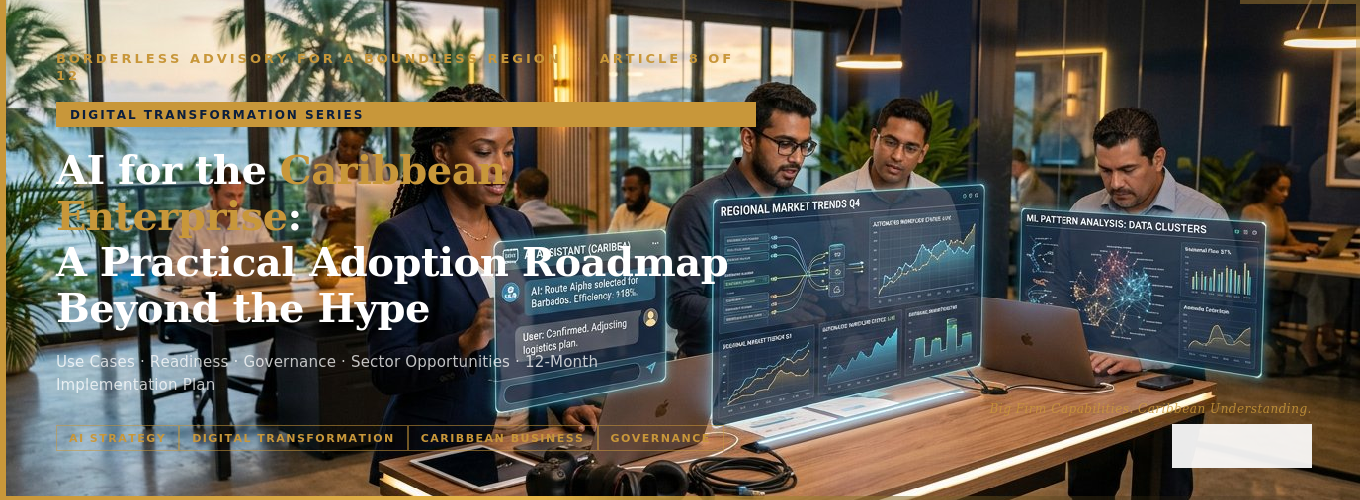
The AI Moment Is Here — But the Hype Is Getting in the Way
Artificial intelligence has arrived in the Caribbean business conversation with the force of a Category 4 hurricane and, unfortunately, much of the same chaos. Boards are receiving presentations from enthusiastic technology vendors promising transformation. Leadership teams are under pressure to demonstrate AI ambition. Employees are experimenting with ChatGPT, Claude, and Gemini in ways that their organisations may or may not be aware of. And somewhere in the middle of this noise, the Caribbean CFO, CEO, and board chair must answer the only question that actually matters: where, specifically, can AI create measurable business value in our organisation, and what do we need to do to capture it?
The global evidence on AI adoption in 2025–2026 is instructive and sobering in equal measure. According to Deloitte’s 2026 State of AI in the Enterprise — surveying 3,235 senior leaders globally — two-thirds of organisations are reporting productivity and efficiency gains from AI, and twice as many leaders as in the previous year are reporting transformative impact. Worker access to AI tools rose by 50% in 2025. The global enterprise AI market is accelerating toward $240 billion. But only 34% of organisations are truly reimagining their business around AI — the majority are extracting incremental efficiency gains without the workflow redesign that captures most of AI’s long-term value. And the AI skills gap remains the single biggest reported barrier to AI integration, ahead of data quality, infrastructure, and governance concerns.
For Caribbean business leaders, the global AI narrative provides context but not direction. The Caribbean’s AI adoption environment has distinctive characteristics — variable digital infrastructure across territories, a skills ecosystem shaped by diaspora brain drain and limited STEM pipeline development, regulatory environments adapting to AI governance at different speeds, and a business economy dominated by small and medium enterprises that face very different AI adoption dynamics than the large multinationals whose experiences dominate global AI discourse. This article cuts through the global hype to provide Caribbean leaders with a practical, specific, and honest guide to AI adoption — where the real opportunities are, what genuine readiness requires, how to govern AI without stifling innovation, and how to build a sequenced roadmap that produces real commercial outcomes rather than impressive slide decks.
| KEY INSIGHT
The most common AI adoption mistake in Caribbean businesses is the same as globally: deploying tools before redesigning the work around them. PwC’s 2026 research identifies the 80/20 rule of AI adoption — technology delivers approximately 20% of an initiative’s value, while 80% comes from redesigning how work is done. Caribbean organisations that install AI tools on top of existing processes achieve marginal efficiency gains. Those that use AI adoption as the catalyst for genuine workflow redesign achieve the transformative productivity improvements that justify the investment. |
Separating Hype from Reality: What AI Can and Cannot Do for Caribbean Businesses
What AI Is Genuinely Good At
Artificial intelligence — in its current generation of large language models, machine learning systems, and agentic tools — is genuinely transformative for a specific and well-defined set of tasks. Caribbean business leaders who understand these task categories clearly are in a position to make sound AI investment decisions. Those who approach AI as a general-purpose solution to all business challenges will inevitably overspend on implementation, undercapture on ROI, and produce the AI adoption failures that are already accumulating as cautionary tales in Caribbean boardrooms.
AI is genuinely excellent at processing and generating language — reading documents, summarising content, drafting text, translating between languages, and answering questions based on large bodies of information. It is excellent at pattern recognition in large datasets — identifying anomalies in financial transactions, predicting customer behaviour from historical data, detecting equipment failure patterns in operational data, and classifying images and documents at scale. It is excellent at automation of repetitive, rule-based tasks — scheduling, data entry, report generation, and compliance checking against defined criteria. And it is increasingly capable of multi-step reasoning and task execution through agentic frameworks that can complete complex workflows with minimal human intervention.
What AI Cannot Do — Yet
AI’s limitations are as important to understand as its capabilities, particularly for Caribbean business leaders making investment decisions. Current AI systems hallucinate — they generate plausible but incorrect information with confidence, in ways that require human verification of any output where accuracy is material. They lack genuine judgment in novel situations — they interpolate from training data rather than reasoning from first principles in the way that experienced human professionals do. They are not reliably safe for high-stakes decisions without human oversight — AI should be in the loop for decision support, not making autonomous high-stakes decisions without human review.
Caribbean businesses that deploy AI without adequate human review processes — in credit assessment, in medical diagnosis support, in legal document review, in compliance determination — are creating liability that the productivity gain does not justify. The governance framework described later in this article is not bureaucratic caution. It is the risk management that makes AI adoption commercially sustainable.
The Caribbean AI Opportunity Map: Eight Use Cases With Proven ROI
The following table maps eight AI use cases with demonstrated commercial return across sectors most relevant to the Caribbean business economy. Each use case is assessed for commercial priority, implementation complexity, and specific Caribbean opportunity — providing a practical starting point for Caribbean business leaders selecting their first or next AI investment.
| AI Use Case | Most Relevant Sectors | Commercial Priority | How It Works in Practice | Implementation Complexity | Caribbean Opportunity |
| Document and Content Generation | All sectors | High — immediate | AI tools (Claude, GPT-4o, Gemini) drafted in minutes what previously took hours: contract first drafts, board reports, client proposals, marketing content, policy documents, compliance summaries, and employee communications. Caribbean professional services firms and corporates already seeing 30–50% reduction in document drafting time | Low — works with existing tools; requires prompt engineering training and quality review processes; no significant infrastructure change | Immediate productivity gain with measurable ROI; Dawgen Global uses AI-assisted document drafting across its service lines — the same capability is accessible to any Caribbean organisation with internet access |
| Customer Service and Support Automation | Financial services; retail; hospitality; utilities | High — proven ROI | AI-powered chatbots and virtual assistants handling routine customer enquiries — account balances, transaction queries, product information, booking management, complaint triage — 24/7 without additional headcount; escalation to human agents for complex cases; significant reduction in call centre volume and cost | Low to medium — requires integration with existing customer systems (CRM, core banking, PMS); conversational AI platforms (Zendesk AI, Intercom, custom LLM-powered agents) available as SaaS products | Caribbean banks, insurance companies, and utilities with high inbound enquiry volumes are immediate candidates; estimated 20–40% reduction in routine enquiry handling cost; improved customer satisfaction from 24/7 availability |
| Financial Analysis and Reporting | Financial services; professional services; corporate finance functions | High — CFO priority | AI-assisted financial modelling; automated variance analysis and commentary generation; intelligent month-end reporting; anomaly detection in financial data; automated reconciliation; predictive cash flow modelling. The Digital CFO transformation described in Article 3 of this series is enabled primarily by AI tools embedded in existing ERP and analytics platforms | Medium — requires clean, structured financial data in accessible systems; best results from organisations that have modernised their finance data infrastructure; Microsoft Copilot in Excel/Power BI, SAP AI, Oracle AI are established platforms | Caribbean CFOs who implement AI-assisted financial analysis reclaim 15–25% of finance team time from routine reporting — time redirected to business partnering, strategic analysis, and value-creation activities that require human judgment |
| AML/CFT and Fraud Detection | Banking; insurance; payments; remittance | Critical — regulatory expectation | AI-powered transaction monitoring replacing rule-based systems that generate excessive false positives; machine learning models identifying unusual patterns across millions of transactions in real time; AI-assisted sanctions screening reducing manual review burden; natural language processing for adverse media screening in customer due diligence workflows | High — requires high-quality transaction data, model validation processes, regulatory compliance of the AI system, and integration with core banking and AML platforms; specialist implementation required | Caribbean financial institutions under CFATF compliance pressure should treat AI-powered AML as both a compliance investment and an efficiency gain — reducing the manual review burden that makes AML compliance operationally unsustainable for many regional institutions |
| HR and Talent Management | All sectors with significant workforces | Medium-High | AI-powered CV screening and shortlisting; interview scheduling automation; onboarding workflow automation; AI-assisted job description writing; skills gap analysis from workforce data; predictive employee attrition modelling; AI-generated training content adapted to role and learning style; performance review drafting assistance | Low to medium — many HR platforms (Workday, BambooHR, Rippling) have embedded AI features; standalone AI recruiting tools accessible as SaaS; requires HR data quality and appropriate data privacy controls | Caribbean HR functions using AI for CV screening and onboarding automation report 40–60% reduction in time-to-hire and significant improvement in candidate experience — directly addressing the talent acquisition challenge described in Article 6 of this series |
| Legal and Compliance Review | Professional services; financial services; large corporates | Medium-High | AI-assisted contract review identifying non-standard clauses, missing provisions, and risk flags; regulatory change monitoring and impact assessment; compliance document drafting (policies, procedures, training materials); legal research and case law summarisation; due diligence document review in M&A transactions | Low to medium — specialist legal AI platforms (Harvey, Kira, ContractPodAi) available as SaaS; general-purpose LLMs effective for drafting and summarisation with appropriate human review | Caribbean law firms and compliance functions using AI for document review report 50–70% reduction in time spent on routine document analysis — enabling the same professional team to handle significantly higher workloads without proportional headcount increase |
| Predictive Analytics and Business Intelligence | Retail; tourism; agriculture; manufacturing; financial services | Medium — growing rapidly | AI-powered demand forecasting for retail and hospitality; predictive maintenance for manufacturing and utilities equipment; customer churn prediction for financial services; yield prediction for agriculture; revenue forecasting models that incorporate weather, event, and macroeconomic data specific to Caribbean conditions | Medium to high — requires historical data of sufficient quality and volume; data preparation and feature engineering are the most time-consuming elements; Power BI with Copilot, Tableau AI, and custom Python/R models are the primary delivery mechanisms | Caribbean tourism businesses using AI demand forecasting report 15–25% improvement in revenue management outcomes; Caribbean agricultural businesses piloting yield prediction models are achieving better crop planning and input purchasing decisions |
| Cybersecurity Threat Detection | Financial services; government; large corporates; critical infrastructure | High — growing threat environment | AI-powered Security Information and Event Management (SIEM) identifying threat patterns across network traffic, user behaviour, and system logs in real time; AI-assisted vulnerability assessment; automated incident triage and response playbooks; natural language generation of security incident reports | High — requires security operations capability and integration with existing IT infrastructure; SOC-as-a-service models make AI-powered security accessible to Caribbean businesses without in-house security operations teams | Caribbean organisations cannot build the cybersecurity defence described in Article 4 of this series without AI-powered threat detection — the volume and sophistication of threats has exceeded the capacity of rule-based and manual security monitoring |
The most important observation from this use case map is that the highest-ROI AI applications for most Caribbean businesses are not the most technically complex. Document generation, customer service automation, and HR process improvement are all accessible through SaaS platforms that require minimal technical expertise and deliver immediate productivity gains. Caribbean business leaders who feel that AI adoption requires a major technology transformation programme are mistaking the enterprise AI landscape for the commercial AI tool landscape — the latter is accessible to any organisation with internet connectivity and basic digital literacy.
AI Opportunities by Sector: Where Caribbean Industries Can Lead
Financial Services: From Rule-Based to Intelligent Compliance
Caribbean financial institutions are uniquely positioned to extract substantial value from AI adoption — they possess the high-quality, structured data that AI systems require and face the compliance, fraud, and customer service challenges that AI addresses most effectively. The AML/CFT application described in the use case table is particularly urgent: Caribbean financial institutions managing thousands of daily transactions with manual or rule-based monitoring systems are generating false positive rates that make compliance operationally unsustainable. AI-powered transaction monitoring, which reduces false positives by 40–60% in comparable deployments, is the most impactful single AI investment available to Caribbean banks, credit unions, and money service businesses.
Credit risk assessment is a second high-value application — AI models trained on historical loan performance data improve credit decision accuracy, reduce default rates, and enable financial institutions to extend credit to thin-file customers (those with limited formal credit history) who are currently excluded from the formal financial system. The financial inclusion dimension of this application is particularly significant in the Caribbean context, where significant proportions of the population remain underbanked. Caribbean financial institutions that deploy AI-assisted credit assessment are simultaneously improving their commercial performance and advancing financial inclusion — an alignment of ESG and commercial objectives that is rare in AI applications.
Tourism and Hospitality: Revenue Optimisation and Guest Experience
Tourism is the Caribbean’s largest and most regionally significant sector — and one of the most data-rich, making it particularly well-suited to AI applications in revenue management and guest experience personalisation. Caribbean hotels and resort groups that implement AI-powered revenue management — dynamically adjusting room rates based on demand signals, competitor pricing, event calendars, and weather forecasts — typically achieve revenue per available room (RevPAR) improvements of 8–15% in comparable markets. Given the thin margins at which many Caribbean tourism properties operate, a 10% RevPAR improvement can be the difference between profitability and loss.
Guest experience personalisation — using AI to tailor dining recommendations, activity suggestions, and service interactions to individual guest preferences — is a second high-value tourism AI application that Caribbean properties can implement through their existing property management system integrations. The data foundation is already there: most Caribbean properties with loyalty programmes have years of guest preference data that AI can activate for personalisation at a scale no human concierge team could match.
Agriculture and Agri-Processing: Precision and Prediction
Caribbean agriculture faces compound challenges — climate change increasing rainfall variability and pest pressure, skilled labour scarcity, supply chain volatility, and thin margins that punish poor production planning decisions. AI applications in agriculture address each of these challenges with tools that are increasingly accessible to Caribbean farmers and agri-processors at scale. Precision agriculture platforms using satellite imagery, drone data, and soil sensors — combined with AI analysis — enable farmers to identify yield-limiting factors at field level and intervene precisely rather than applying uniform inputs across variable conditions. Yield prediction models trained on historical production data, weather patterns, and input variables are enabling Caribbean agricultural businesses to improve crop planning, input purchasing, and supply chain commitments.
For agri-processing businesses, AI applications in quality control — using computer vision to detect defects, grade produce, and ensure consistency at processing speed — are producing labour cost reductions and quality improvements that are material to export market competitiveness. A Caribbean cocoa processor or coffee exporter using AI-assisted quality grading is producing more consistent export grades at lower cost than competitors relying on manual inspection — a competitive advantage that compounds as AI systems learn from each production cycle.
Professional Services: The AI-Augmented Practitioner
Professional services — accounting, audit, tax, legal, and management consulting — are being transformed by AI at a pace that few Caribbean practitioners fully appreciate. Document review that took a junior associate four hours takes four minutes with AI assistance. Tax research that required extensive manual database searches is answered in seconds by AI systems with access to the relevant legislative and case law databases. Audit data analytics that required specialist statistical skills are being democratised by AI tools embedded in audit platforms. And management consulting deliverables that required weeks of research and writing are being drafted in hours with AI assistance, freeing consultant time for the client engagement, judgment, and insight that AI cannot replicate.
Dawgen Global has integrated AI-assisted tools across its service lines — and the productivity gains are real, measurable, and compounding. The same team produces more, at higher quality, in less time — creating capacity for the deeper client engagement, more rigorous analysis, and broader service offering that distinguishes a genuinely advisory relationship from a transactional one. Caribbean professional services firms that do not build AI literacy and AI-assisted workflows into their practices will face a competitiveness challenge in the next five years that their clients will feel before they do.
AI Readiness: The Five Dimensions Every Caribbean Organisation Must Assess
Before selecting an AI tool or launching an AI pilot, Caribbean business leaders should conduct an honest readiness assessment across five dimensions that determine whether AI adoption will produce the returns the investment promises. The table below maps each dimension, why it matters, what to assess, and the specific Caribbean context that shapes the assessment.
| Readiness Dimension | Why It Matters | What to Assess | Caribbean Context |
| Data Quality and Availability | AI systems learn from data — poor data quality produces unreliable AI outputs regardless of model sophistication; Caribbean organisations with fragmented, inconsistent, or siloed data will find AI adoption harder than the tool selection process suggests | Data audit: what data does the organisation hold? In what systems? How clean, consistent, and accessible is it? Data governance: who is responsible for data quality, and what processes maintain it? Data infrastructure: can data be accessed and processed at the speed and volume that AI tools require? | Most Caribbean businesses significantly underestimate how much of their AI adoption challenge is a data challenge rather than a technology challenge; a 12-week data quality improvement programme often produces more AI readiness than a 12-month tool selection process |
| Digital Infrastructure | AI tools require reliable internet connectivity, modern device infrastructure, and often cloud computing platforms — infrastructure that remains uneven across Caribbean territories and within organisations | Internet connectivity assessment: is connectivity sufficient for cloud-based AI tools across all locations? Device infrastructure: do employees have devices capable of running AI-assisted workflows? Cloud readiness: is the organisation using or positioned to move to cloud platforms that AI tools integrate with? | Caribbean organisations with significant rural or multi-territory operations face connectivity constraints that affect AI adoption; bandwidth-intensive AI tools may require infrastructure investment before adoption; low-code and offline-capable AI tools are available for lower-connectivity environments |
| Skills and AI Literacy | The Deloitte 2026 State of AI in the Enterprise identifies the AI skills gap as the single biggest barrier to AI integration; 66% of organisations report productivity gains from AI — those that do not are primarily held back by skills, not tools | Current AI literacy assessment: how many employees are actively using AI tools? How many know what tools are available and how to use them effectively? Training plan: structured AI literacy development for all staff and role-specific advanced training for power users; leadership AI literacy: can the board and senior management evaluate AI investment proposals and governance questions intelligently? | Caribbean organisations that invest in AI literacy before deploying AI tools extract significantly more value from those tools than those that deploy first and train second; a ‘train the trainer’ approach — developing internal AI champions who support broader adoption — is particularly effective in smaller Caribbean enterprises |
| Governance and Ethics | 78% of organisations globally now use AI in at least one business function; those scaling most effectively are those where senior leadership actively shapes AI governance rather than delegating it to technical teams | AI use policy: what is the organisation’s position on which AI tools employees can use, for which tasks, and with what data? Data privacy compliance: are AI tools processing personal data in compliance with applicable data protection legislation? AI risk management: what governance process reviews and approves high-risk AI applications? Bias and fairness assessment: how are AI outputs monitored for bias that could affect Caribbean customers, employees, or communities? | AI governance is not bureaucracy — it is the management discipline that prevents AI adoption from creating regulatory liability, reputational damage, or discriminatory outcomes that undermine the productivity gains AI adoption is intended to deliver |
| Change Management | The biggest AI adoption failures are not technology failures — they are organisational failures: employee resistance, inadequate training, lack of leadership modelling, and performance metrics that do not reflect the AI-assisted workflow redesign that captures most of AI’s value | Leadership modelling: are senior leaders visibly using AI tools in their own work? Communication strategy: has the organisation explained why it is adopting AI, how it will affect different roles, and what support is available? Performance framework: have performance metrics been updated to reflect AI-assisted productivity expectations? Feedback loops: are employees empowered to report AI adoption challenges and to suggest better ways of working? | PwC’s 2026 research identifies the 80/20 rule of AI adoption: technology delivers approximately 20% of an initiative’s value; the remaining 80% comes from redesigning work around AI — a fundamentally human and organisational challenge that requires leadership attention, not just IT investment |
AI Governance: The Framework That Makes Adoption Sustainable
AI governance — the policies, processes, and accountability structures through which an organisation manages its use of artificial intelligence — is the dimension of AI adoption that Caribbean boards most frequently underestimate. The organisations scaling AI most effectively globally in 2026, according to Deloitte’s research, are those where senior leadership actively shapes AI governance rather than delegating it to technical teams. The gap between AI ambition and AI value is most frequently a governance gap.
The Caribbean AI Policy: What Every Organisation Needs
Every Caribbean organisation using AI tools — even informally, even through individual employees using ChatGPT or Claude on their own initiative — needs a documented AI use policy that addresses four fundamental questions:
- What AI tools are approved for use? Which tools have been assessed and approved for use in the organisation? Which tools are prohibited — particularly those with unacceptable data privacy terms or security vulnerabilities? The answer to this question is not ‘all tools are fine’ or ‘no tools are permitted’ — it is a curated list of approved tools for specific use cases, updated as the tool landscape evolves.
- What data can be processed with AI? Personal data of customers, employees, or third parties requires specific governance before it is processed by AI systems — particularly cloud-based AI where data leaves the organisation’s control. Confidential client data, proprietary business information, and regulated data all require explicit handling rules. The default should be conservative: when in doubt, do not input sensitive data into AI systems whose data retention and processing policies are unclear.
- What outputs require human review? AI outputs in high-stakes contexts — credit decisions, medical diagnosis support, legal advice, financial reporting, compliance determinations — must not be presented without human review and validation. The policy must specify which AI outputs require what level of human review before they are acted upon or communicated.
- Who is accountable for AI governance? Accountability for AI policy development, compliance monitoring, and incident response must be clearly assigned — to a named individual or function with the authority, resources, and board access to discharge the governance role effectively.
AI Risk Management: Specific Risks Caribbean Boards Must Address
AI adoption creates specific risks that Caribbean boards must understand and actively manage:
- Hallucination and accuracy risk: AI systems generate incorrect information with the same apparent confidence as correct information. Caribbean organisations that act on unverified AI outputs — in legal, financial, medical, or compliance contexts — face professional liability, regulatory sanction, and reputational damage. The management response is mandatory human review of AI outputs in high-stakes contexts, with clear escalation procedures when AI outputs cannot be verified.
- Data privacy risk: AI tools that process personal data of Caribbean residents must comply with applicable data protection legislation. Cloud-based AI tools that transfer personal data outside the jurisdiction require appropriate legal mechanisms. Caribbean organisations using international AI platforms must assess and document the data protection implications of each tool deployment.
- Bias and discrimination risk: AI systems trained on historical data may embed and amplify historical biases — in credit assessment (discriminating against historically underserved communities), in recruitment (favouring candidates similar to historically successful employees), and in customer service (providing inferior service to certain demographic groups). Caribbean organisations deploying AI in these contexts must assess and monitor for bias, with particular attention to the region’s diverse demographic composition and historical socioeconomic patterns.
- Cybersecurity risk: AI tools, like all software, represent an additional attack surface. AI-generated content (phishing emails, deepfake audio, synthetic identity documents) is already being used in fraud attacks against Caribbean financial institutions. The cybersecurity framework described in Article 4 of this series must encompass AI-specific threats alongside traditional attack vectors.
- Over-reliance and skills atrophy: organisations that deploy AI for tasks previously performed by skilled professionals risk creating over-reliance that degrades the underlying human skills needed when AI fails, produces errors, or is unavailable. Caribbean professional services firms that use AI for all document drafting without maintaining human drafting capability are creating a dependency that becomes a vulnerability.
| AI GOVERNANCE IS AN OPPORTUNITY, NOT JUST A CONSTRAINT
Caribbean organisations that build credible AI governance frameworks — documented AI policies, clear accountability structures, data privacy compliance for AI tools, bias monitoring, and board-level AI oversight — are positioned to communicate their responsible AI adoption to clients, investors, and regulators in ways that build trust. For Caribbean professional services firms, financial institutions, and large corporates seeking international business relationships, demonstrable responsible AI governance is becoming a differentiator — signalling the management quality that sophisticated international partners use to select their Caribbean advisors and service providers. |
The Caribbean AI Adoption Roadmap: A Sequenced 12-Month Action Plan
Caribbean business leaders who have been convinced that AI creates genuine commercial opportunity — but who are uncertain where to begin — should follow a sequenced adoption roadmap that moves from foundation through pilot to scale without the over-commitment of investment and change management resources that characterises most AI adoption failures.
- Month 1–2 — AI Readiness Assessment: Conduct an honest assessment across the five readiness dimensions (data, infrastructure, skills, governance, change management). Identify the two or three highest-priority AI use cases for your sector and organisation size. Commission a staff AI literacy audit — what tools are employees currently using, how, and with what data?
- Month 2–3 — Policy and Governance Foundation: Draft and board-approve an AI use policy covering approved tools, data handling rules, human review requirements, and accountability assignment. Do not wait until you have a comprehensive AI strategy — the policy is the prerequisite for responsible adoption, and it can be drafted in weeks.
- Month 3–6 — Pilot Programme: Select one or two high-priority use cases and implement structured pilots — with defined success metrics, clear timelines, nominated pilot champions, and a feedback collection mechanism. The pilot should be small enough to manage and large enough to produce meaningful data. Document what works, what does not, and what the data and infrastructure constraints are.
- Month 6–9 — Skills and Training Investment: Based on pilot learning, invest in structured AI literacy development for the functions most engaged with AI. Identify and develop internal AI champions who can support broader adoption. Revise performance metrics to reflect AI-assisted productivity expectations in relevant roles.
- Month 9–12 — Scale and Expand: Roll out successful pilots across the relevant function or business unit. Expand to additional use cases based on the data and infrastructure lessons from the initial pilots. Begin planning for the next AI capability tier — from automation to predictive analytics, from individual tool adoption to embedded AI in core business systems.
- Ongoing — Govern and Iterate: Review AI policy quarterly to reflect evolving tool landscape and regulatory requirements. Monitor AI output quality and bias indicators. Report AI adoption progress to the board annually with specific ROI metrics. Stay current on AI capability developments that create new opportunities for Caribbean business advantage.
| THE BOARD QUESTION THAT DETERMINES AI ADOPTION SUCCESS OR FAILURE
The most consequential AI adoption decision a Caribbean board makes is not which tool to deploy — it is whether to treat AI adoption as a technology project or as a business transformation programme. Technology projects are owned by IT, governed by IT timelines and budgets, and measured by technology KPIs. Business transformation programmes are owned by the CEO, governed by business outcomes, and measured by commercial impact. The organisations extracting the most value from AI globally are those whose boards have made the second choice — treating AI as a strategic priority that requires the same executive attention, resource commitment, and accountability as any other major business investment. Caribbean boards that delegate AI adoption entirely to IT and then wonder why the ROI does not appear have made the most predictable mistake in enterprise AI. |
Conclusion: The AI Advantage Belongs to Those Who Act — Not Those Who Wait
The global AI landscape of 2026 is not the speculative frontier of 2022. It is a commercial reality — with 78% of organisations globally using AI in at least one business function, productivity gains documented across industries and geographies, and a widening competitive gap between organisations that have made AI work and those still running disconnected experiments. The Caribbean is not exempt from this dynamic. The organisations that will define Caribbean business leadership in the decade ahead are those that invest in AI literacy, build AI governance, select use cases with disciplined commercial rigour, and execute adoption with the change management discipline that captures AI’s full value.
Dawgen Global’s IT and Digital Transformation Practice is positioned to be the Caribbean’s most trusted AI adoption advisor — combining global AI knowledge with the deep Caribbean business context understanding that distinguishes genuinely useful advisory from globally generic recommendations transplanted into an environment they were not designed for. We help Caribbean businesses cut through the hype to the specific opportunities — and we help them build the governance, skills, and data foundations that make those opportunities commercially sustainable.
In Article 9 — Climate-Proofing Your Balance Sheet: Financial Resilience in the Age of Category 5 Storms — we address the intersection of the Caribbean’s most acute operational risk with the financial planning discipline that enables businesses to survive, recover, and ultimately thrive after climate events. From parametric insurance and business continuity planning through climate-adapted capital structures and resilience investment, we examine how Caribbean business leaders can build financial resilience that is as serious as the climate risk that makes it necessary.
| BUILD A PRACTICAL AI STRATEGY FOR YOUR CARIBBEAN ENTERPRISE
Dawgen Global’s IT and Digital Transformation Practice helps Caribbean businesses cut through the AI noise — identifying the use cases with the highest commercial return, selecting and implementing the right tools, designing the governance frameworks that manage AI risk, and building the AI literacy that enables your people to capture the productivity gains that AI makes possible. Begin the conversation:
|
About Dawgen Global
“Embrace BIG FIRM capabilities without the big firm price at Dawgen Global, your committed partner in carving a pathway to continual progress in the vibrant Caribbean region. Our integrated, multidisciplinary approach is finely tuned to address the unique intricacies and lucrative prospects that the region has to offer. Offering a rich array of services, including audit, accounting, tax, IT, HR, risk management, and more, we facilitate smarter and more effective decisions that set the stage for unprecedented triumphs. Let’s collaborate and craft a future where every decision is a steppingstone to greater success. Reach out to explore a partnership that promises not just growth but a future beaming with opportunities and achievements.
 Email: [email protected]
  Visit: Dawgen Global Website

 WhatsApp Global Number : +1 555-795-9071
Caribbean Office: +1876-6655926 / 876-9293670/876-9265210  WhatsApp Global: +1 5557959071
USA Office: 855-354-2447
Join hands with Dawgen Global. Together, let’s venture into a future brimming with opportunities and achievements


