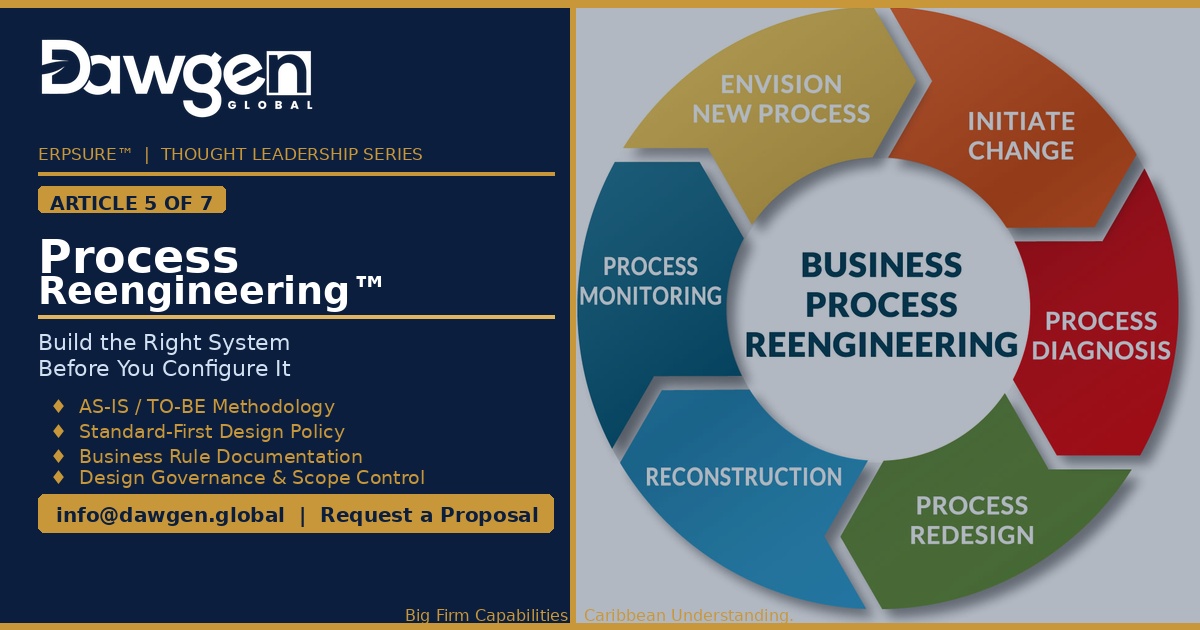
Why the Most Expensive Mistake in ERP Is Automating Your Inefficiencies — and How the ERPSURE™ AS-IS/TO-BE Methodology Ensures Your System Is Built on Optimised Processes, Not the Workarounds of the Past
The invoice approval process had been broken for eleven years. Everyone in the finance department knew it. The process required seven steps, involved four separate departments, generated three paper forms, and took an average of twenty-two days from submission to payment — in an organisation whose vendor contracts specified thirty-day payment terms. By the time an invoice completed the approval circuit, the organisation was already in technical default on its payment obligation.
The process was broken because eleven years earlier, during a period of rapid growth, the organisation had added approval layers in response to a procurement fraud incident, and those layers had calcified into standard operating procedure. They were never reviewed. They were never questioned. They were simply passed down from one finance manager to the next as the way things worked.
When the organisation selected an ERP system, the implementation brief to the vendor was straightforward: replicate our current processes in the new system. The vendor obliged. The ERP went live with a seven-step, four-department, twenty-two-day invoice approval workflow digitised faithfully into the new platform.
The workflow still took twenty-two days. It was now automated. The paper forms had been replaced by digital screens. The process was, in every meaningful sense, exactly as broken as it had always been — just more expensively so.
This is the central pathology of ERP implementation that the ERPSURE™ Process Reengineering™ pillar exists to diagnose and cure: the tendency of organisations to treat ERP configuration as a documentation exercise rather than a transformation opportunity. To say to a vendor, in effect, “here is how we currently work — make the system do this,” rather than asking the far more valuable question: “given what this system can do, how should we work?”
This article — the fifth in Dawgen Global’s ERPSURE™ series — explores why the process-first principle is the single most important design discipline in ERP implementation, how the AS-IS/TO-BE methodology creates the foundation for transformational rather than incremental ERP value, and how the ERPSURE™ Process Reengineering™ pillar guides Caribbean organisations through this critical and chronically underinvested phase of their ERP journey.
| 75%
of ERP customisations exist because organisations replicated flawed processes rather than redesigning them |
3–5×
more expensive to redesign processes post go-live than during the pre-configuration design phase |
40%
average reduction in process steps achievable through systematic TO-BE redesign before ERP configuration |
The Process Paradox: Why Organisations Automate Their Own Inefficiencies
There is a logic to the behaviour, even if the outcome is irrational. When an organisation embarks on an ERP implementation, it is simultaneously managing the intense operational demands of running its business while attempting to design, build, and deploy a new operational platform. Time is scarce. Internal expertise is stretched. The vendor is billing for every day of implementation. Under these conditions, the path of least resistance is irresistible: document the current process, configure the system to match, and move on.
The problem is that the current process almost never represents the organisation’s best thinking about how its work should flow. It represents the accumulated history of decisions made under different circumstances, by people who are no longer with the organisation, in response to problems that may no longer exist, using the workarounds that the previous system required. It is a palimpsest of adaptations layered over adaptations, few of which have ever been reviewed against the question of whether they still make sense.
ERP implementation is one of the rarest opportunities in an organisation’s life to step back from the daily operational current and ask that question systematically. The platform brings a set of best-practice processes embedded in its standard functionality — processes designed from the accumulated experience of thousands of implementations across industries and geographies. The implementation moment is the moment to measure the organisation’s current practices against that standard, identify where the current practice adds genuine business value that the standard does not accommodate, and redesign everything else to match the standard.
Organisations that seize this opportunity emerge from ERP implementation with not just a new system but fundamentally better processes. Organisations that miss it emerge with an expensive digital replica of the same operational inefficiencies they started with.
| “Configuring an ERP system to replicate broken processes does not fix the processes. It fixes the processes in place — permanently, expensively, and in a format that becomes progressively harder to change as the system ages and customisations accumulate.” |
The Cost of Getting This Wrong
The financial consequences of skipping or shortcutting process reengineering before ERP configuration are well-documented and severe. Gartner research estimates that ERP customisations — the vast majority of which exist because standard processes were not accepted and process redesign was not performed — account for between 25 and 40 percent of total ERP implementation costs in failed or distressed projects. They also account for the majority of system upgrade costs, which escalate with every customisation that must be preserved or reworked through each new platform version.
Beyond the direct cost, the opportunity cost is enormous. An organisation that goes live with its current inefficient processes in the new system has paid ERP implementation costs without capturing ERP transformation value. The productivity improvements, cycle time reductions, error rate decreases, and management information quality gains that justified the ERP business case remain unrealised — not because the system is incapable of delivering them, but because the processes the system is running were never designed to produce them.
| PROCESS REENGINEERING™ PRINCIPLE | The business case for ERP investment is built on the assumption of improved processes. If the implementation does not redesign processes before configuration, the business case benefits will not materialise — regardless of how successfully the system goes live. |
The Standard-First Policy: The Foundational Design Discipline of ERPSURE™
Before examining the AS-IS/TO-BE methodology in detail, it is important to establish the foundational design policy that underpins the entire Process Reengineering™ pillar of the ERPSURE™ Framework: the Standard-First Policy.
The Standard-First Policy is a formal design governance rule, agreed by the Executive Steering Committee and signed into the ERP Governance Charter, that states: the organisation will accept and configure to the ERP platform’s standard functionality unless there is a documented, business-case-justified reason to deviate. Deviation from standard requires formal approval through the scope change control process. The burden of proof is on the deviation, not the standard.
This policy matters because the default behaviour in ERP implementation — without an explicit governance rule — is the opposite: the default is to customise the system to match current process, and the burden of proof falls on anyone who argues for accepting the standard. The Standard-First Policy inverts this default, creating an institutional bias toward process adaptation and standard configuration that dramatically reduces customisation complexity, implementation risk, and total cost of ownership.
Why Standard-First Is Not a Compromise
Caribbean organisations sometimes resist the Standard-First Policy on the grounds that their processes are unique — that the specific characteristics of their industry, their market, or their regulatory environment require processes that global ERP platforms do not accommodate. This concern deserves to be taken seriously, because it is sometimes legitimate.
But it is far less frequently legitimate than organisations believe. Dawgen Global’s process reengineering experience consistently finds that between 65 and 80 percent of the processes that Caribbean organisations initially identify as “unique” or “custom” turn out, on analysis, to be standard ERP processes that the organisation has not yet understood — or legacy-system-driven workarounds that are not genuine business requirements at all.
The genuinely unique processes — those that reflect authentic competitive differentiation, specific regulatory obligations, or genuine industry characteristics that the ERP platform does not accommodate — represent a small fraction of the total process landscape. Identifying them accurately, through rigorous gap analysis, is one of the most valuable services that the ERPSURE™ Process Reengineering™ pillar provides. Because knowing which processes genuinely require customisation allows the organisation to invest its customisation budget precisely, rather than spreading it across the entire implementation scope in an undifferentiated wave of configuration complexity.
| “The Standard-First Policy is not an instruction to accept an inadequate system. It is a commitment to understand the system’s standard capabilities fully before concluding that they are inadequate. In Dawgen Global’s experience, that understanding regularly eliminates 60–75 percent of initially requested customisations.” |
The AS-IS Documentation Phase: Seeing the Organisation Honestly
The first phase of the ERPSURE™ Process Reengineering™ methodology is the AS-IS documentation exercise — a structured, facilitated, and independently verified mapping of the organisation’s current business processes across all functions in the ERP implementation scope.
This phase is more difficult than it sounds, for a reason that Caribbean organisations consistently underestimate: the organisation does not actually know how its processes work. Not completely. Not honestly. Not in a form that can be recorded, reviewed, and used as the basis for a design decision.
The Gap Between Official Process and Actual Process
Every organisation has two sets of processes: the official processes — the documented procedures, the policy manuals, the training materials that describe how work is supposed to flow — and the actual processes that staff use every day to get work done in the real operational environment. In most Caribbean organisations, the gap between these two sets is significant, persistent, and largely invisible to senior management.
The official purchase order approval process may specify three approval levels. The actual process may have evolved to five, because a procurement manager added a review step after a supplier dispute three years ago and nobody rescinded it. The official month-end close process may specify five days. The actual process may take eight, because the consolidation team has been working around a legacy system limitation for so long that the workaround has become the process.
AS-IS documentation is not about recording the official process. It is about discovering the actual process — the one that real staff members perform every day, with all its exceptions, workarounds, variations, and informal practices. This requires structured workshops rather than document reviews, because the actual process often does not exist in any document.
ERPSURE™ AS-IS Workshop Methodology
Dawgen Global conducts AS-IS documentation through structured, facilitated workshops with the people who actually perform the process — not their managers, not the policy authors, not the IT team. The people who sit at the desk, open the screen, receive the document, and perform the transaction.
Each workshop covers a defined process area and follows a structured facilitation protocol:
- Process triggering event: What starts this process? What is the specific input or condition that causes this process to begin?
- Step-by-step process walk: Walk through every step in sequence, capturing who does what, what system or document they use, and what happens to the output.
- Exception and variation mapping: What happens when the standard case does not apply? What are the common exceptions, and how are they handled? Who makes exception decisions?
- Workaround identification: Where does the process leave the formal system — into spreadsheets, email threads, verbal agreements, or manual overrides? Why?
- Pain point surfacing: What is frustrating, slow, error-prone, or unnecessarily complex about this process? What would you change if you could?
- Volume and timing data: How many times does this process run per day, week, month? What is the typical cycle time? What are the peak periods?
The workshop outputs are a structured process map, a list of exceptions and variations, a workaround register, and a pain point inventory — all of which feed directly into the gap analysis and TO-BE design phases.
| FACILITATION INSIGHT | The most valuable AS-IS workshop participants are invariably the staff who have been performing the process for the longest time — not because they are the most articulate, but because they carry the most institutional knowledge of why the process works the way it does. Their participation is non-negotiable. |
The Gap Analysis: Measuring the Distance Between Current and Possible
With AS-IS processes documented, the next phase of the ERPSURE™ methodology is gap analysis — a structured comparison of each current-state process against the standard functionality embedded in the target ERP platform, producing a classification for every identified gap.
Gap analysis is the intellectual core of the Process Reengineering™ pillar. Done well, it produces the design decisions that determine whether the ERP implementation will deliver transformational value or merely digitise the status quo. Done poorly — or skipped — it allows the implementation to drift into customisation complexity that adds cost, risk, and long-term maintenance burden without adding business value.
The ERPSURE™ Four-Category Gap Classification
The ERPSURE™ gap classification system sorts identified gaps into four categories, each with a defined design decision protocol:
| Category | Classification | Meaning | ERPSURE™ Design Decision |
| Category A | Standard ERP Fits | The ERP platform’s standard functionality fully meets the business requirement without modification or workaround. | Configure to standard. No custom development. Document the configuration decision and obtain business sign-off. |
| Category B | Process Adaptation Required | Standard ERP functionality meets the business need, but the organisation’s current process must be adapted to align with the system’s standard workflow. | Redesign the business process to accept the standard ERP workflow. Invest in change management to support the adaptation. Do not customise the system. |
| Category C | Configuration or Extension | The ERP platform can accommodate the requirement through configuration parameters, approved bolt-on solutions, or certified extensions within the platform ecosystem. | Configure within platform capabilities. Evaluate approved extensions. Document configuration complexity and maintenance implications. Avoid custom code. |
| Category D | Custom Development Required | The business requirement cannot be met by standard functionality, process adaptation, or approved extensions. Custom development is the only technical solution. | Validate the business case rigorously. Quantify total cost of ownership including upgrade risk and maintenance burden. Explore process redesign alternatives before approving. Requires Steering Committee sign-off. |
The Gap Analysis in Practice
The gap analysis is performed by Dawgen Global’s functional consultants working in partnership with the organisation’s process owners and the ERP vendor’s functional specialists. For each identified gap, the analysis follows a structured assessment:
- Step 1 — Understand the requirement: What is the genuine business requirement underlying the current process step? Strip away the legacy system constraints, the historical workarounds, and the accumulated layers of process addition to identify the core business need.
- Step 2 — Assess standard capability: Can the ERP platform’s standard functionality meet this core business need? This requires genuine expertise in the platform’s configuration capabilities — many gaps that appear to require customisation can be addressed through configuration options that the organisation is not yet aware of.
- Step 3 — Evaluate process adaptation: If the standard functionality meets the business need but requires process adaptation, what would that adaptation involve? What is the change management implication? Is the adaptation genuinely preferable to customisation?
- Step 4 — Assess extension options: If standard functionality does not meet the requirement, are there approved platform extensions or certified add-on solutions that do? These preserve upgrade pathways and reduce custom development risk.
- Step 5 — Quantify customisation cost: If custom development is unavoidable, what is the full cost — initial development, testing, documentation, and the ongoing maintenance and upgrade cost over the expected system life?
The Customisation Budget Discipline
One of the most valuable governance outputs of the gap analysis phase is the customisation budget — a formal, Steering Committee-approved allocation of the maximum customisation investment the organisation is prepared to make. This budget disciplines the design process by forcing explicit trade-offs: if a requested customisation exceeds the available budget, the organisation must either find a process adaptation alternative or defer the requirement to a post-go-live enhancement phase.
Organisations that do not establish a customisation budget invariably discover that customisation requests accumulate throughout the implementation, each individually justified, collectively catastrophic. The ERPSURE™ framework treats the customisation budget as a governance instrument, reviewed at every Steering Committee meeting and managed with the same rigour as the project financial budget.
The TO-BE Process Design: Designing for What the Organisation Should Become
The TO-BE process design phase is where the ERPSURE™ Process Reengineering™ methodology delivers its most distinctive value — and where most ERP implementations invest the least time and thought. The TO-BE design is not a description of how the ERP system will work. It is a description of how the organisation will work when the ERP system is live — and that is a fundamentally different, and far more important, question.
The TO-BE Design Philosophy
TO-BE processes are designed against three principles that the ERPSURE™ framework applies consistently across every process area:
- Design for the business outcome, not the system feature: Every TO-BE process step must be justified by its contribution to a business outcome — faster cycle time, lower error rate, better management information, stronger compliance. Process steps that exist because “the system supports it” rather than because “the business needs it” are eliminated.
- Design for the exception, not the average: The average case is almost always well-served by standard ERP functionality. The design effort must focus on the exceptions — the non-standard transactions, the override scenarios, the cross-jurisdictional variations — because these are where process design decisions have the greatest impact on operational performance.
- Design for the user, not the architect: TO-BE processes must be operable by the actual users who will perform them — with the training that can realistically be delivered in the available time, using the system competency that can be built before go-live. A beautifully designed process that users cannot perform correctly in the live system is worse than a simpler process they can.
TO-BE Workshop Structure
TO-BE process design workshops are structured differently from AS-IS workshops. Where AS-IS workshops are primarily discovery exercises — uncovering what currently exists — TO-BE workshops are co-design exercises: facilitated sessions in which functional business owners, process experts, ERP functional consultants, and change management advisors work together to design the future-state process.
The facilitation protocol for TO-BE workshops follows a structured sequence:
- Anchor in the business outcome: Begin each TO-BE workshop by restating the business outcomes the process must achieve — the KPIs it must support, the compliance requirements it must satisfy, the user experience it must deliver.
- Present the ERP standard: Walk participants through the ERP platform’s standard process for this functional area — what it does, how it flows, what outputs it produces. Many participants will see the standard ERP process for the first time in this session and will discover that it meets more of their requirements than they expected.
- Identify genuine gaps: With the standard clearly understood, identify the gaps between standard functionality and genuine business requirements. Apply the four-category classification to each gap.
- Design the TO-BE flow: With standard functionality as the baseline and gaps clearly classified, design the TO-BE process flow — the precise sequence of steps, system transactions, approval events, and exception handling that will constitute the live operational process.
- Validate and sign off: The functional business owner formally approves the TO-BE process design before the workshop concludes. This approval is the organisational commitment that the configuration team will build to this design.
| “A TO-BE process design that is approved by the business owner before configuration begins eliminates the most expensive category of ERP implementation dispute: the post-configuration claim that the system does not work the way the business expected. If the business designed it, the business owns it.” |
Business Rule Documentation: The Single Source of Truth
Between the TO-BE process design and the configuration build, there is a critical intermediate deliverable that many ERP implementations omit entirely, and that the ERPSURE™ Process Reengineering™ pillar treats as mandatory: the Business Rule Documentation.
Business rules are the specific, granular decisions that determine how the ERP system behaves in every transaction scenario. They include approval thresholds, validation requirements, calculation methods, reporting hierarchies, access control matrices, and integration parameters. In aggregate, they constitute the complete specification of how the system must be configured to support the approved TO-BE processes.
Without documented business rules, configuration becomes a guessing game. Consultants make configuration decisions based on their best understanding of what the organisation needs — an understanding that is inevitably incomplete, inconsistently updated, and potentially misaligned with what functional owners actually agreed to in the TO-BE design workshops. Undocumented configuration decisions cannot be reviewed, audited, or explained to new team members. They create a black box that becomes progressively harder to manage as the system matures.
The ERPSURE™ Business Rule Documentation programme captures every configuration-level decision in a structured register, organised by rule category, with formal sign-off from the responsible functional owner:
| Rule Category | Examples | Documentation & Sign-Off Method |
| Approval Workflows | Purchase order approval thresholds by value and category; credit note authorisation levels; journal entry approval requirements | Approval matrix document — reviewed and signed by Finance Director and relevant functional heads |
| Validation Rules | Mandatory fields on transaction entry; data format requirements; cross-field validation logic; duplicate detection thresholds | Data validation specification — reviewed by IT and functional super users |
| Calculation Logic | Tax calculation rules by jurisdiction; depreciation methods by asset category; cost allocation methods; pricing rules and discount structures | Calculation specification document — reviewed and approved by Finance and Operations leads |
| Integration Rules | Data exchange frequency and trigger conditions; field mapping between systems; error handling and exception management protocols | Integration design document — reviewed by IT architecture lead and functional owners |
| Reporting Requirements | Statutory reporting formats by jurisdiction; management reporting hierarchies; consolidation rules; KPI definitions and calculation methods | Reporting requirements specification — reviewed by CFO and territory finance leads |
| Access Control Rules | Role-based access permissions by function and seniority; segregation of duties requirements; multi-entity access restrictions | Access control matrix — reviewed by Internal Audit and HR |
The Business Rule Document becomes the single source of truth for the configuration build phase. Every configuration decision made by the technical team must be traceable to an approved business rule. Any configuration decision not covered by the business rule document requires a scope change request before it can be implemented.
| GOVERNANCE PRINCIPLE | The Business Rule Document is a living governance instrument, not a one-time deliverable. It is updated whenever an approved scope change modifies a configuration decision, and it is reviewed as part of every Quality Gate Review throughout the implementation. |
The ERPSURE™ Process Reengineering™ Engagement: Phases and Timeline
The ERPSURE™ Process Reengineering™ workstream runs from the pre-configuration design phase through to go-live readiness, with ongoing design governance responsibilities continuing through the build and test phases. The following timeline represents a typical engagement for a mid-sized Caribbean ERP implementation covering four to six functional modules:
| Timeline | Phase | Key Activities |
| Week 1–2 | Process Inventory & Scoping | Identify all processes in ERP scope. Categorise by function and module. Assign process owners. Prioritise workshop sequence by complexity and interdependency. |
| Week 2–5 | AS-IS Documentation Workshops | Structured workshops per process area. Document current-state process flows. Capture exceptions, workarounds, and variations. Identify undocumented practices. Validate with process owners. |
| Week 5–7 | Gap Analysis & Opportunity Assessment | Map AS-IS processes against ERP standard functionality. Classify all gaps (A/B/C/D). Identify improvement opportunities. Quantify complexity and risk of Category C and D items. |
| Week 7–10 | TO-BE Process Design Workshops | Design future-state processes aligned to ERP capabilities. Apply standard-first principle. Resolve Category B adaptations. Obtain business owner approval for all TO-BE designs. |
| Week 10–12 | Business Rule Documentation & Sign-Off | Document all configuration-level business rules. Obtain formal approval from functional owners. Produce Design Document as single source of truth for configuration team. |
| Week 12+ | Design Governance Through Build | Review Change Requests against signed Design Document. Maintain scope discipline. Update documentation when approved changes occur. Prepare process training materials from TO-BE designs. |
Key Roles in the Process Reengineering™ Workstream
- ERPSURE™ Process Lead (Dawgen Global): Senior functional advisor who owns the methodology, facilitates workshops, quality-assures all process documentation, and governs scope change through the Design Document.
- Functional Process Owners (Client): Senior functional managers who carry business authority for process design decisions in their area. Their sign-off is required for every TO-BE process design and every business rule document.
- Process Subject Matter Experts (Client): Experienced operational staff who provide the detailed process knowledge that workshop facilitation surfaces. Non-negotiable participants in AS-IS workshops.
- ERP Functional Consultants (Vendor/Partner): Platform specialists who provide expertise in standard ERP functionality, configuration options, and gap assessment. Work in partnership with Dawgen Global, not independently.
- Internal Audit Representative (Client): Participates in business rule documentation for control-relevant processes — particularly access control, approval workflows, and financial controls. Ensures ERP configuration supports internal control objectives.
Caribbean-Specific Process Reengineering Challenges
The AS-IS/TO-BE methodology is universal in its principles but Caribbean in its application. The ERPSURE™ Process Reengineering™ pillar incorporates specific protocols for the process reengineering challenges that are distinctive to Caribbean organisational contexts:
| Caribbean Challenge | What It Looks Like | ERPSURE™ Response |
| Multi-Jurisdiction Process Variations | Processes that appear uniform at the group level often contain significant jurisdiction-specific variations in tax treatment, approval authority, regulatory reporting, and operational practice. | Workshop each territory separately for high-variation processes. Document group standard versus territory exception. Design the ERP configuration to accommodate legitimate jurisdictional differences without custom development. |
| Undocumented Tribal Knowledge | Critical process knowledge residing exclusively in individual employees — purchase terms negotiated informally, credit decisions made by personal judgement, inventory adjustments performed by institutional habit. | Structured knowledge elicitation sessions with long-tenured staff. Shadow-process documentation where current practice cannot be described verbally. Mandatory participation from process knowledge holders in AS-IS workshops. |
| Informal Process Governance | Many Caribbean organisations operate effective processes without formal documentation, approval hierarchies, or policy frameworks — running on trust, relationship, and accumulated institutional understanding. | Use the ERP implementation as the catalyst to formalise process governance. Document the implicit rules that govern current practice. Obtain formal sign-off from functional owners — often for the first time. |
| Legacy System Process Lock-In | Processes that have evolved to work around the limitations of legacy systems rather than reflecting genuine business requirements — creating artificial process complexity that should be eliminated, not replicated. | Distinguish between legacy-driven process steps and genuine business requirements. Challenge every process step that exists because “the old system required it.” Design TO-BE processes for the ERP, not the legacy. |
| Regulatory Compliance Complexity | Caribbean multi-territory operations face overlapping and sometimes conflicting regulatory requirements that must be reflected in process design — particularly in finance, HR, and supply chain functions. | Engage Dawgen Global’s regulatory advisory practice alongside the process reengineering workstream. Validate all compliance-related process designs against current regulatory requirements in each territory. |
Design Governance: Protecting the Process Design Through the Build Phase
One of the most common — and most costly — failures in ERP implementation is the erosion of process design decisions during the configuration build phase. The pattern is familiar: carefully designed TO-BE processes are approved in workshops, but as configuration proceeds and users begin to see the system taking shape, scope change requests multiply. Each individual request seems reasonable. Collectively, they dismantle the design discipline that the AS-IS/TO-BE methodology was intended to establish.
The ERPSURE™ framework addresses this through a formal Design Governance protocol that operates throughout the build phase. The signed Business Rule Document is the controlling document — any configuration decision that deviates from it requires a formal scope change request, assessed against the four-level change classification:
| Level | Classification | Definition | Approval Protocol |
| Level 1 | Minor | Change affects a single process step, involves no custom development, and has no budget or timeline impact. | Project Manager approval within 48 hours. Document in design register. |
| Level 2 | Moderate | Change affects multiple process steps or a complete process, may require configuration changes, minor budget impact. | Functional lead + Programme Director approval. Steering Committee notification. Design document update. |
| Level 3 | Major | Change affects cross-functional processes, involves custom development, or has material budget and timeline impact. | Full Steering Committee approval required. Business case required. Executive Sponsor sign-off for budget impact. |
| Level 4 | Strategic | Change alters the fundamental scope, objectives, or architecture of the ERP programme. | Emergency Steering Committee session. Full programme re-baseline. Board notification if budget impact is material. |
The Design Freeze Principle
The ERPSURE™ framework establishes a Design Freeze milestone — typically at the transition from the design phase to the build phase — after which all process designs and business rules are formally locked. Post-freeze changes require a Level 2 or above scope change request, regardless of how minor they appear.
The Design Freeze is not a bureaucratic barrier to legitimate improvement. It is a governance mechanism that forces the organisation to be intentional about design changes — to evaluate them formally, approve them deliberately, and implement them in a controlled manner rather than allowing them to accumulate informally throughout the build phase in ways that are impossible to track, test, or document.
Caribbean ERP implementations that lack a Design Freeze discipline consistently experience the same pathology: configuration that starts from an approved design and finishes in an undocumented, partially-tested, informally-agreed state that nobody can fully describe or defend. The Design Freeze prevents this outcome by making design stability a governance obligation, not a hope.
| “In Dawgen Global’s experience, every dollar spent on rigorous AS-IS/TO-BE process design before configuration begins saves between three and eight dollars in configuration rework, scope dispute resolution, and post-go-live process remediation. Process Reengineering™ is not overhead — it is the highest-return investment in the ERP programme.” |
Conclusion: The System Reflects the Thinking That Designed It
The finance team at the organisation we opened this article with eventually fixed their invoice approval process. They did it eighteen months after go-live, during a post-implementation review that identified the process as the primary driver of their vendor relationship deterioration and late payment penalty costs. The fix required reconfiguring four approval workflow modules, retraining the entire finance department, and renegotiating vendor payment terms that had been modified in response to the organisation’s persistent payment delays.
The total cost of that remediation — direct consulting costs, internal staff time, system downtime, and vendor relationship repair — exceeded the cost of a comprehensive AS-IS/TO-BE process reengineering exercise conducted before go-live by a factor of six.
This arithmetic repeats itself, in variation after variation, across Caribbean ERP implementations where process reengineering was skipped, abbreviated, or delegated to the vendor without independent facilitation. The processes that organisations carry into their ERP implementations without examination tend to stay in those systems indefinitely — not because they cannot be changed, but because changing live system processes is orders of magnitude more complex, costly, and disruptive than designing them correctly in the first place.
The ERPSURE™ Process Reengineering™ pillar provides Caribbean organisations with the methodology, the facilitation expertise, and the governance infrastructure to make the right process design decisions before configuration begins. Not to constrain the implementation, but to liberate it — from the accumulated inefficiencies of the past, from the limitations of legacy systems that no longer exist, and from the expensive fiction that an ERP system can deliver transformation without first demanding the transformation of the processes it is built to support.
The system reflects the thinking that designed it. ERPSURE™ Process Reengineering™ ensures that thinking is worthy of the investment.
| “You cannot build a high-performance organisation on a broken process, no matter how sophisticated the system you use to automate it. Process Reengineering™ is where ERP transformation actually begins.” — Dr. Dawkins Brown, Dawgen Global |
| Coming Next: Article 6 of 7
Risk Shield™: Proactive Risk Governance for High-Stakes ERP Projects How the ERPSURE™ Risk Shield™ pillar builds a living, dynamic ERP risk management programme — covering the 120+ risk scenarios that Caribbean implementations face, the contingency playbooks that replace panic with protocol, and the Quality Gate Reviews that give executives the intelligence they need to govern this critical investment. |
| Is Your ERP Process Design Ready for Configuration?
Request a Proposal for a Process Reengineering™ Assessment or Full ERPSURE™ Advisory Engagement Contact Dawgen Global’s ERP Advisory Practice Big Firm Capabilities. Caribbean Understanding. |
Next Step!!Dawgen Global is a multidisciplinary professional services firm headquartered in New Kingston, Jamaica, operating across 15+ Caribbean territories. Our ERPSURE™ Process Reengineering™ engagements are delivered by a team combining ERP functional expertise, business process management, regulatory advisory, and deep Caribbean operational knowledge — the full complement of disciplines that rigorous process design demands. ERPSURE™ and Process Reengineering™ are proprietary trademarks and methodologies of Dawgen Global. All rights reserved. 47 Trinidad Terrace, New Kingston, Jamaica · [email protected] |
About Dawgen Global
“Embrace BIG FIRM capabilities without the big firm price at Dawgen Global, your committed partner in carving a pathway to continual progress in the vibrant Caribbean region. Our integrated, multidisciplinary approach is finely tuned to address the unique intricacies and lucrative prospects that the region has to offer. Offering a rich array of services, including audit, accounting, tax, IT, HR, risk management, and more, we facilitate smarter and more effective decisions that set the stage for unprecedented triumphs. Let’s collaborate and craft a future where every decision is a steppingstone to greater success. Reach out to explore a partnership that promises not just growth but a future beaming with opportunities and achievements.
 Email: [email protected]
  Visit: Dawgen Global Website

 WhatsApp Global Number : +1 555-795-9071
Caribbean Office: +1876-6655926 / 876-9293670/876-9265210  WhatsApp Global: +1 5557959071
USA Office: 855-354-2447
Join hands with Dawgen Global. Together, let’s venture into a future brimming with opportunities and achievements


