| Most Caribbean organisations have a performance management process. They have appraisal forms, rating scales, and annual review cycles. What they do not have is a performance management system — one where goals cascade from strategy to individual, feedback is continuous rather than annual, ratings are calibrated and defensible, consequences are real and visible, and managers have the capability to lead performance conversations that actually change behaviour. This article diagnoses why Caribbean performance management fails, builds the design principles of a system that works, and maps the PEOPLE360°™ Performance Systems pillar that delivers it. |
The Performance Management Paradox
Ask any Caribbean business leader whether their organisation has a performance management process and the answer is almost universally yes. Ask whether that process is driving measurable improvement in individual and organisational performance, and the answer becomes considerably more uncertain.
This is the Caribbean performance management paradox: widespread adoption of the process, widespread frustration with its results. The appraisal cycle runs. The forms are completed. The ratings are distributed. And at the end of it, the organisation’s performance is essentially unchanged — because the process has not changed the behaviour, the capability, or the accountability of the people it was supposed to develop and manage.
The failure is not for want of effort. Caribbean HR professionals work hard to design and run performance management processes. The failure is structural. It lies in five characteristic failure modes that are endemic across the region — and that are present, in some combination, in the vast majority of Caribbean organisations that Dawgen Global encounters in its advisory practice.
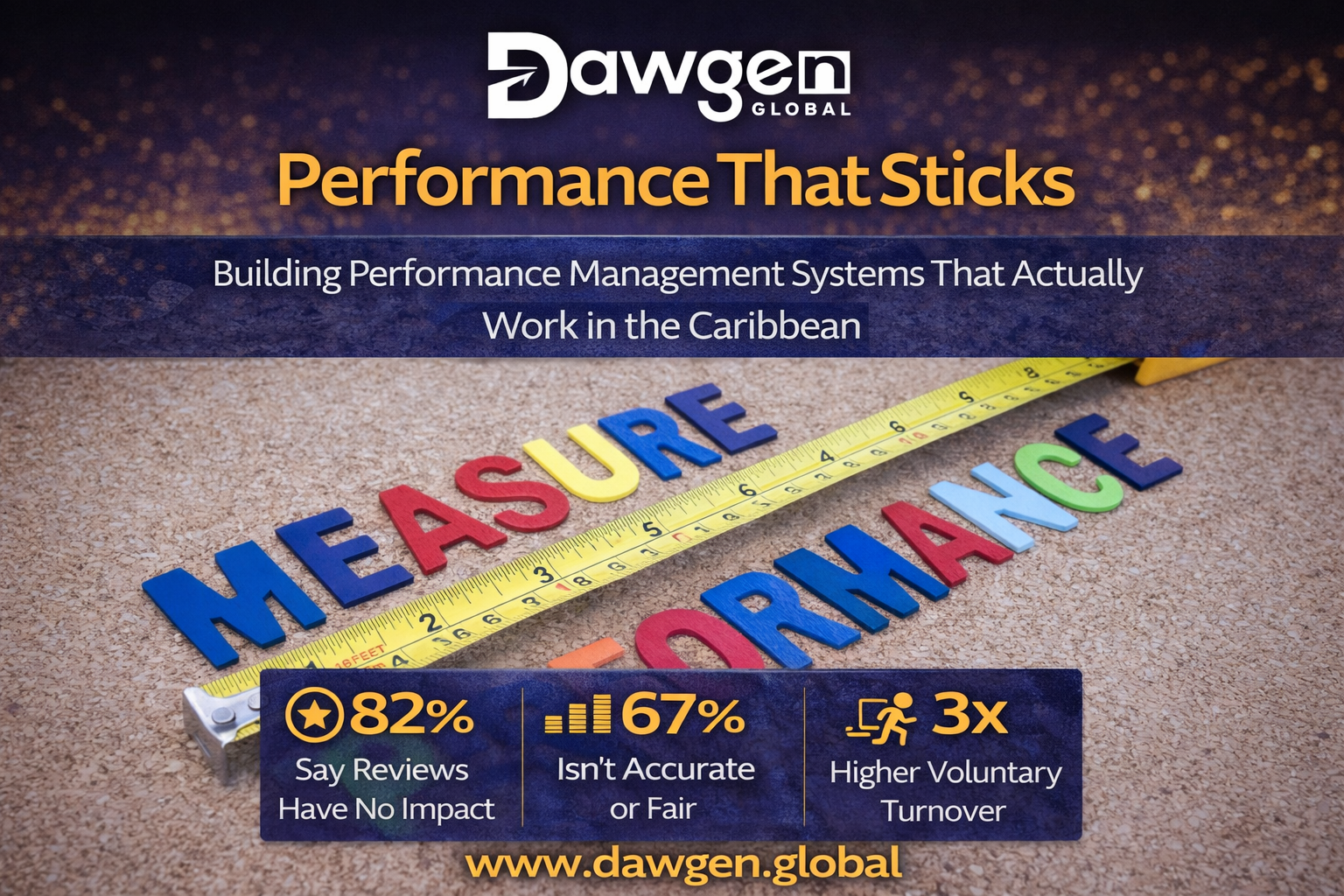
| 82%
of Caribbean employees report their annual review has no meaningful impact on their development (Gallup Caribbean data) |
67%
of HR leaders say their process does not effectively differentiate between high and low performers |
3×
higher voluntary turnover in organisations where performance management is perceived as unfair |
The Five Failure Modes of Caribbean Performance Management
The following diagnostic table maps the five most common performance management failure modes in Caribbean organisations, what each looks like in practice, and the organisational consequences it produces. Most organisations will recognise more than one.
| Failure Mode | What It Looks Like | The Consequence |
| The Annual Ritual | Performance review conducted once a year, disconnected from day-to-day management and compensation decisions. | Employees receive no meaningful feedback for 11 months, then face a rushed appraisal that neither motivates nor develops. High performers disengage. Underperformers are not addressed. |
| The Subjectivity Trap | Ratings driven by personal relationships, recency bias, and manager preference rather than documented evidence. | Legally indefensible dismissals. High performers who lack visibility are under-rewarded. Favouritism embeds in the culture. Tribunal risk escalates with every undocumented rating decision. |
| The Checkbox Process | Appraisal forms completed to satisfy HR rather than to drive performance. Goals are set but never reviewed. | The process consumes management time without producing behavioural change or capability development. Employees lose confidence that the organisation is serious about performance. |
| The Missing Consequence | Performance ratings that have no connection to compensation, promotion, or development decisions. | High performers conclude that results do not matter. They adjust their effort downward or leave. Underperformers remain, because the system creates no accountability for sustained low performance. |
| The Underprepared Manager | Managers promoted for technical competence who have no training in how to set goals, give feedback, or manage a performance conversation. | Performance conversations are avoided, delayed, or handled so poorly that they create grievances. The process breaks down at precisely the point of most value: the manager-employee relationship. |
| THE ROOT CAUSE | The common root cause beneath all five failure modes is the same: performance management has been designed as an HR process rather than as a management system. When the goal of the process is completion — getting the forms filled in and filed — rather than behaviour change and capability development, it will always produce the results described above. A genuine performance management system is designed around a different goal: making the organisation measurably better at delivering its strategy through its people. |
Process vs. System: Understanding the Distinction
The distinction between a performance management process and a performance management system is not semantic. It is the difference between an HR activity and a strategic management tool.
A performance management process has inputs and outputs: goals are set, ratings are assigned, forms are filed. A performance management system has outcomes: individual performance improves, organisational capability grows, high performers are retained and developed, underperformers are either improved or exited, and the connection between individual contribution and organisational results becomes visible and real.
Three design principles separate a system from a process:
Design Principle 1: Continuity Over Periodicity
The most damaging design choice in Caribbean performance management is the annual review cycle. An annual conversation about performance is not a feedback mechanism. It is a documentation event. By the time the annual review occurs, the behaviours that determined the rating happened months ago — and the manager’s recollection of them is distorted by recency bias, relationship dynamics, and the pressure to complete the process quickly.
High-performing organisations manage performance continuously. They hold structured check-in conversations monthly — brief, focused discussions about progress, obstacles, and support needs. They provide real-time recognition when it is earned and real-time correction when it is needed. The annual review becomes a synthesis of a year of documented conversations rather than a substitute for them. This shift alone — from annual to continuous — produces measurable improvement in both performance outcomes and retention.
Design Principle 2: Objectivity Through Calibration
The subjectivity of unmoderated performance ratings is one of the most persistent and legally consequential failures in Caribbean performance management. When each manager rates their team independently — without a calibration process that normalises ratings across the organisation — the distribution reflects managerial personality as much as employee performance. The lenient manager’s team is overrated. The demanding manager’s team is underrated. High performers in demanding managers’ teams receive the same rating as average performers in lenient managers’ teams. The organisation loses calibration between effort, results, and reward.
Calibration sessions — in which managers review each other’s ratings against a common standard, supported by documented evidence — are not bureaucratic overhead. They are the mechanism through which a performance management system maintains its integrity. They also serve a critical legal function: ratings that have been calibrated across managers are considerably more defensible in tribunal proceedings than those that reflect a single manager’s unmoderated judgment.
Design Principle 3: Consequence Clarity
A performance management system without visible, consistent consequences for performance ratings is not a management system. It is a survey. Employees learn very quickly whether performance ratings matter — whether they drive compensation decisions, promotion decisions, and development investment, or whether they are filed and forgotten. In organisations where ratings have no consequences, the rational response for both managers and employees is to treat the process as a compliance exercise. In organisations where ratings visibly drive outcomes, the process becomes meaningful.
Consequence clarity does not mean that every performance conversation is a compensation conversation. It means that the organisation has a documented, communicated policy that connects performance ratings to the outcomes that matter to employees: their pay, their career progression, their development investment, and the organisation’s response to sustained underperformance. When employees can see that connection operating consistently and fairly, the performance management system builds the credibility that drives genuine engagement with it.
The PEOPLE360°™ Performance System: Seven Components
The PEOPLE360°™ Performance Systems pillar designs, implements, and manages a complete performance management system for Caribbean organisations — one built around the three design principles above and operationalised through seven integrated components. The table below maps each component, its design standard, what it delivers, and the PEOPLE360°™ pillars it engages.
| System Component | Design Standard | What It Delivers | PEOPLE360°™ Pillar |
| Goal Architecture | OKRs or SMART goals set at org, team, and individual level; cascaded top-down; reviewed quarterly | Every employee understands how their role connects to organisational outcomes | People Strategy + Performance |
| Continuous Feedback | Structured check-in conversations monthly; real-time recognition; documented feedback log | Performance issues are identified and addressed within weeks, not months | Performance + Engagement |
| Mid-Year Review | Formal progress review against goals; development conversation; compensation preview for high performers | High performers are retained through visible progress and forward-looking investment | Performance + Learning & Dev |
| Annual Calibration | Manager calibration sessions to normalise ratings; evidence-based distribution; peer review input | Ratings are objective, defensible, and perceived as fair by the workforce | Performance + Operations |
| Consequence Framework | Clear link between rating and compensation, promotion, and development outcomes; documented and communicated | Rewards effort and results; creates accountability for sustained underperformance | Performance + 360° Value |
| Manager Development | Annual PM skills training; coaching capability building; 360° feedback on manager effectiveness | Managers have the tools and confidence to lead performance conversations effectively | Learning & Dev + Performance |
| Underperformance Protocol | Structured performance improvement plan (PIP) framework; legal review; documentation standards | Underperformance is managed fairly, consistently, and with minimal tribunal risk | Operations & Compliance |
The seven components are interdependent. A goal architecture without a consequence framework produces well-written goals that no one is accountable for achieving. A calibration process without manager development produces calibrated ratings that managers cannot explain or defend to their teams. An underperformance protocol without a continuous feedback infrastructure produces documentation that is legally necessary but that surprises the employee it concerns — because they never received the ongoing feedback that should have preceded it.
The PEOPLE360°™ system is designed as a whole. Implementation is typically phased — beginning with goal architecture and calibration, then adding continuous feedback infrastructure and manager development, then integrating the consequence framework and underperformance protocol as the system matures — but the interdependencies are maintained throughout.
Getting Goal Architecture Right: The Caribbean Context
Goal setting is the foundation of every performance management system. It is also the component that Caribbean organisations most frequently get wrong — not because they do not try, but because they set goals at the wrong level, in the wrong format, or without the cascading logic that connects individual objectives to organisational outcomes.
The Cascade Imperative
Effective goal architecture begins at the organisational level — with the strategic objectives that the board and executive team have committed to delivering — and cascades downward through departments, teams, and individuals. Each level of the cascade should answer the question: what does this team or individual need to achieve, in the next performance period, for the level above them to hit their targets?
When the cascade is designed correctly, every employee can draw a direct line from their individual goals to the organisational outcomes their work contributes to. This line of sight — the connection between individual effort and organisational purpose — is one of the most powerful drivers of engagement and performance that research has identified. Organisations that establish it retain their people at materially higher rates than those where employees experience their work as disconnected from any larger purpose.
The OKR Framework for Caribbean Organisations
The Objectives and Key Results (OKR) framework — developed at Intel and widely adopted globally — provides a goal architecture model that is particularly well-suited to the Caribbean organisational context. Its structure is simple: each objective is an ambitious, qualitative statement of what the organisation, team, or individual is trying to achieve; each key result is a measurable, time-bound indicator of progress toward that objective.
The OKR framework addresses several of the most common Caribbean performance management failures simultaneously. Its emphasis on ambitious, stretch objectives combats the tendency toward conservative goal-setting that makes appraisals meaningless. Its quarterly review cadence enforces the continuity that annual processes lack. Its public, shared format creates the organisational transparency that drives accountability. And its separation of aspirational objectives from measurable results allows organisations to distinguish between effort and achievement in ways that conventional SMART goal frameworks often do not.
The PEOPLE360°™ Performance Systems pillar designs the OKR or equivalent goal architecture for each client organisation, calibrated to the organisation’s strategic plan, management maturity, and cultural readiness. Implementation is supported by manager training that ensures goals are set at the right level of ambition and that the cascade logic is maintained across all levels of the organisation.
The Underperformance Protocol: Managing Fairly, Legally, and Effectively
No component of performance management is more avoided in Caribbean organisations — or more consequential when mishandled — than underperformance management. The avoidance is understandable: performance conversations are uncomfortable, the legal risk of getting them wrong is real, and the cultural norms of many Caribbean workplaces create additional complexity around direct feedback and accountability.
The consequence of avoidance, however, is worse than the discomfort of the conversation. Unaddressed underperformance is among the most corrosive forces in any organisation. It signals to every high performer that results do not matter. It creates inequity in workload distribution as high performers compensate for their underperforming colleagues. It depresses the engagement and morale of the teams that contain it. And it eventually produces the employment tribunal matter that the avoidance was trying to prevent — but without the documentation that would have made it manageable.
The Three Conditions for Effective Underperformance Management
Effective underperformance management in the Caribbean context requires three conditions to be in place simultaneously. First, the performance expectations must have been clearly communicated, documented, and consistently applied — so that the employee has no reasonable basis to claim they were unaware of what was required. Second, the feedback must have been provided continuously and documented — so that the formal underperformance process is a natural escalation of an ongoing management conversation rather than a surprise intervention. Third, the process must be legally compliant with the jurisdiction’s employment legislation — so that the organisation can defend its actions if the matter proceeds to tribunal.
The PEOPLE360°™ Operations & Compliance pillar provides the legal compliance dimension — reviewing every formal underperformance process against the applicable jurisdiction’s legislation before it is initiated, designing the Performance Improvement Plan (PIP) framework, and providing advisory support through the process and, where necessary, through any subsequent tribunal proceedings. Because this service is delivered within Dawgen Global’s multidisciplinary platform, the HR advisory and legal process outsourcing capabilities work in tandem — ensuring that the performance management process and the legal compliance framework are aligned from the outset.
| THE DOCUMENTATION STANDARD | In every Caribbean employment tribunal matter involving performance-related dismissal, the outcome turns on documentation. Not on whether the employee was actually underperforming — that is often not in dispute. On whether the performance expectations were documented, whether the feedback was documented, whether the improvement opportunity was documented, and whether the process followed the applicable legislative requirements. The PEOPLE360°™ Performance Systems pillar builds the documentation infrastructure that protects organisations before the matter arises — not after. |
Your Performance Management Diagnostic
Use the diagnostic below to assess your organisation’s current performance management maturity. For each question, indicate whether your organisation has this element in place (Yes), has it partially (Partial), or does not have it (No). A preponderance of ‘No’ and ‘Partial’ answers identifies your highest-priority development areas.
| Performance Management Diagnostic Question | Yes | Partial | No |
| Every employee has written, measurable performance goals reviewed at least quarterly. | □ | □ | □ |
| Performance ratings are calibrated across managers before they are communicated to employees. | □ | □ | □ |
| There is a documented, direct link between performance ratings and compensation outcomes. | □ | □ | □ |
| Managers receive formal training on how to conduct performance conversations. | □ | □ | □ |
| Underperformance is addressed through a documented, structured process — not ignored. | □ | □ | □ |
| Exit interview data is systematically analysed for performance management-related drivers of departure. | □ | □ | □ |
| The board receives regular reporting on organisational performance management health. | □ | □ | □ |
| High performers are formally identified and managed through a differentiated retention and development programme. | □ | □ | □ |
| Scoring: 7–8 Yes = strong foundation | 4–6 Yes/Partial = structured improvement needed | 0–3 Yes = high risk — request PEOPLE360°™ diagnostic immediately | |||
If your diagnostic reveals three or more ‘No’ answers, your organisation is carrying performance management risk that is likely to manifest as retention failure, engagement decline, compliance exposure, or strategic underperformance within the next twelve to twenty-four months. The PEOPLE360°™ HR Diagnostic provides a more detailed, independently assessed version of this analysis — with a prioritised remediation plan and a phased implementation roadmap.
From Process to System: Your Next Step
The transition from a performance management process to a performance management system does not require a complete overhaul of everything the organisation currently does. It requires a structured assessment of where the current process is failing, a prioritised design of the components that will address those failures, and a phased implementation that builds manager capability alongside system design.
Dawgen Global’s PEOPLE360°™ Performance Systems pillar provides all three — beginning with the complimentary HR Diagnostic that establishes the baseline and identifies the highest-priority interventions.
| Request your complimentary HR Diagnostic at [email protected] or Download the Caribbean HR Outsourcing Guide at www.dawgen.global/hr-guide. |
Next in The People Advantage Series
Article 7: Learning & Development as a Competitive Advantage — why Caribbean organisations that invest in structured L&D out-retain, out-perform, and out-grow those that do not, and how the PEOPLE360°™ Learning & Development pillar builds the capability pipeline your strategy requires.
About Dawgen Global
“Embrace BIG FIRM capabilities without the big firm price at Dawgen Global, your committed partner in carving a pathway to continual progress in the vibrant Caribbean region. Our integrated, multidisciplinary approach is finely tuned to address the unique intricacies and lucrative prospects that the region has to offer. Offering a rich array of services, including audit, accounting, tax, IT, HR, risk management, and more, we facilitate smarter and more effective decisions that set the stage for unprecedented triumphs. Let’s collaborate and craft a future where every decision is a steppingstone to greater success. Reach out to explore a partnership that promises not just growth but a future beaming with opportunities and achievements.
 Email: [email protected]
  Visit: Dawgen Global Website

 WhatsApp Global Number : +1 555-795-9071
Caribbean Office: +1876-6655926 / 876-9293670/876-9265210  WhatsApp Global: +1 5557959071
USA Office: 855-354-2447
Join hands with Dawgen Global. Together, let’s venture into a future brimming with opportunities and achievements


