Greenwashing has become one of the defining governance and reputational risks of the ESG era. From fashion brands claiming circularity to financial institutions marketing ‘green’ products backed by fossil fuel investments, the gap between sustainability claims and sustainability substance has attracted the attention of regulators, prosecutors, and institutional investors worldwide.
For internal auditors and governance leaders in the Caribbean, greenwashing risk is not merely a reputational concern in the abstract. It is a concrete, auditable exposure — one that manifests in sustainability reports, marketing materials, investor presentations, procurement bids, and ESG-linked financing arrangements. The question is not whether greenwashing risk exists in your organisation. The question is whether your internal audit function is equipped to find it.
| Regulatory Context
The EU’s Green Claims Directive (proposed), the SEC’s ESG disclosure rules, and the UK’s FCA Sustainability Disclosure Requirements (SDR) all create direct consequences for organisations making misleading sustainability claims — including Caribbean organisations with exposure to these markets through exports, listed securities, or institutional investors subject to these regimes. |
What Greenwashing Looks Like in Practice
Greenwashing takes many forms. Understanding the taxonomy is the first step in designing an effective audit programme.
| Hidden Trade-off | Claiming environmental benefit on one attribute while ignoring significant harms in others (e.g. ‘made with recycled materials’ while manufacturing process is highly polluting). |
| Selective Disclosure | Reporting only favourable ESG metrics while omitting unfavourable ones. Disclosing emission reductions in a single business unit while total organisational emissions increase. |
| Unsubstantiated Claims | Using terms like ‘sustainable’, ‘eco-friendly’, ‘green’, or ‘carbon neutral’ without documentary evidence or independent verification. |
| Vague Commitments | Setting ESG targets without baselines, timelines, or measurable milestones. ‘We are committed to a greener future’ with no supporting action plan. |
| False Certification | Misrepresenting certification status or applying certifications to products/services outside the certified scope. |
| Aspirational Framing | Presenting future commitments as if they represent current practice in sustainability reports or investor communications. |
Designing a Greenwashing Audit
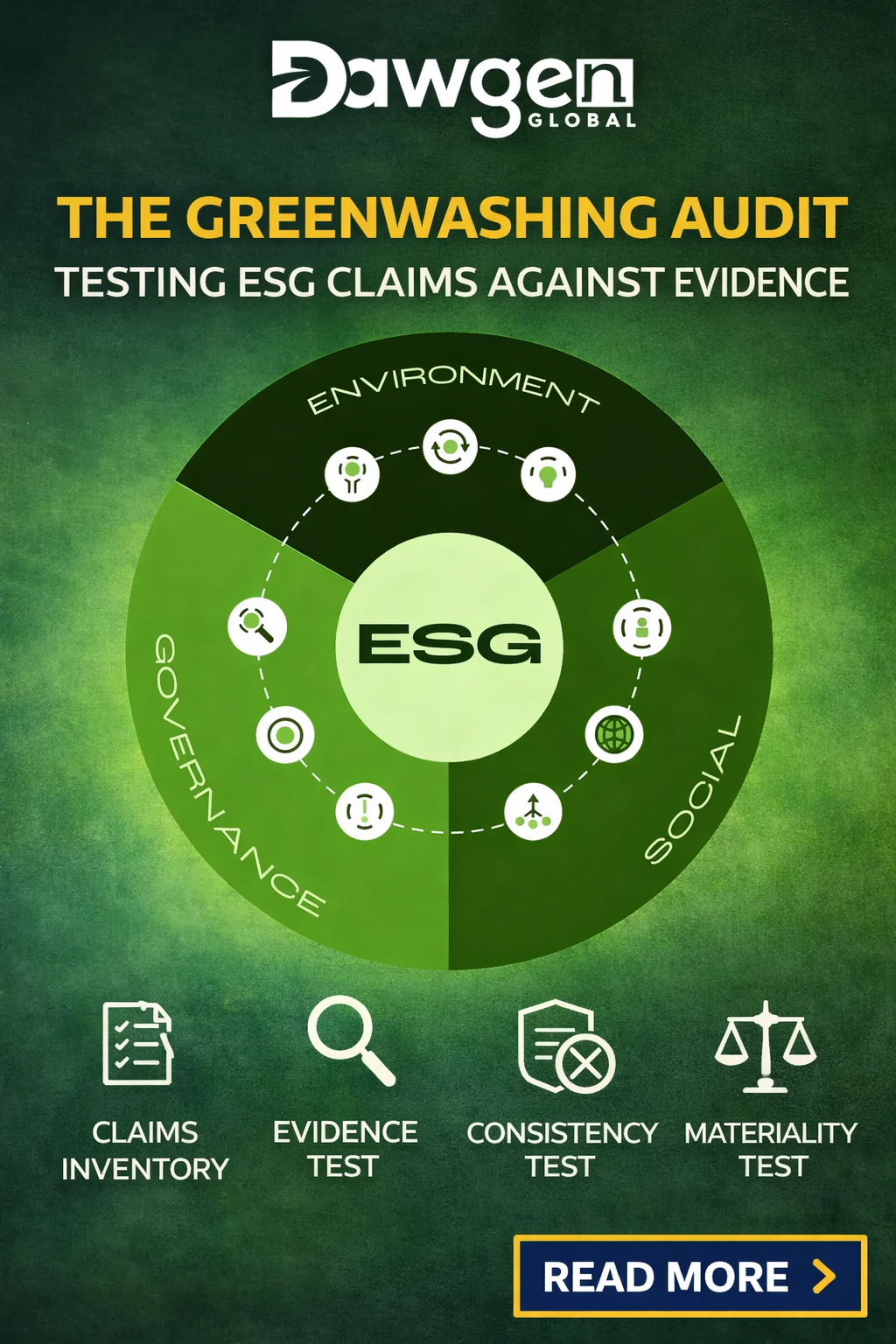
A greenwashing audit is not a single procedure — it is a cross-functional audit programme that examines ESG claims across multiple channels and compares them against underlying evidence. DESGAF™ structures the greenwashing audit around four evidence planes.
| 1 | The Claims Inventory
Compile a complete inventory of all ESG claims made by the organisation across sustainability reports, annual reports, website content, marketing materials, social media channels, investor presentations, RFP responses, and ESG-linked financing documentation. This inventory is the audit universe. |
| 2 | The Evidence Test
For each material claim in the inventory, identify the evidence required to substantiate it. Apply the ‘audit the noun’ principle: if the claim says ‘carbon neutral’, audit the carbon neutrality — the emissions inventory, the offset certificates, the verification statement. If the claim says ‘100% renewable energy’, audit the renewable energy certificates (RECs) and power purchase agreements. |
| 3 | The Consistency Test
Cross-check claims across channels for internal consistency. Does the sustainability report say emissions fell 15% while the annual report to investors cites a different figure? Does the marketing claim ‘zero waste to landfill’ while the environmental data shows a landfill diversion rate of 73%? Inconsistency is frequently the first indicator of greenwashing exposure. |
| 4 | The Materiality Test
Assess whether favourable ESG claims are being prominently communicated while unfavourable performance is being omitted or buried. Apply the GRI concept of balanced reporting: a credible sustainability report presents performance fairly, including where targets have been missed or performance has deteriorated. |
High-Risk Areas for Caribbean Organisations
- Tourism sector: Environmental claims about eco-resort credentials, marine conservation commitments, and waste management practices that are not independently verified.
- Financial services: Green bonds and ESG-linked loans where the use of proceeds or performance conditions have not been audited against the financing documentation.
- Agribusiness: Claims about sustainable farming practices, rainforest protection, or fair-trade certification that are not verified across the full supply chain.
- Energy sector: Claims about renewable energy capacity or transition commitments that are inconsistent with actual capital expenditure plans.
- Manufacturing: Product-level environmental claims (‘biodegradable’, ‘recycled’, ‘sustainably sourced’) that lack third-party certification or independent substantiation.
Reporting Greenwashing Findings
Greenwashing findings are among the most sensitive in an ESG audit. They typically require immediate escalation to senior management and the audit committee, given the regulatory and reputational exposure they create. DESGAF™ recommends the following reporting protocol:
- Rate the finding using the standard four-level scale (Critical, High, Medium, Low) based on materiality, public visibility, and regulatory exposure.
- Document the specific claim, the channel in which it appears, and the evidence gap that constitutes the greenwashing risk.
- Recommend immediate remediation of any public-facing claims that cannot be substantiated, pending evidence collection.
- Recommend a management review of all ESG claims across all channels, supported by a formal sign-off process from legal, compliance, and sustainability functions.
- Consider whether prior period disclosures require correction or retraction and whether regulatory disclosure obligations are triggered.
| Key Principle
Every ESG claim your organisation makes is an audit assertion. Before it is published, it should be supported by evidence that an independent reviewer could examine and confirm. This is the standard to which regulators and sophisticated investors are increasingly holding organisations. DESGAF™ provides the framework to audit to that standard before external scrutiny finds the gaps. |
Dawgen Global is a multidisciplinary professional services firm serving the Caribbean region. He advises boards and audit committees across the Caribbean on ESG governance and disclosure integrity.
| Partner with Dawgen Global for ESG Assurance
Dawgen Global’s DESGAF™ specialists provide comprehensive ESG internal audit support — from governance reviews and controls testing to data verification and disclosure assurance across the Caribbean. Request a Proposal Today Email: [email protected] | Tel: +1 (876) 929-3670 | +1 (876) 665-5926 | US: 1-855-354-2447 www.dawgen.global — Big Firm Capabilities. Caribbean Understanding. |


