

How to stop margin leakage by redesigning delivery, resourcing, and client tiers—without reducing quality (EDGECRAFT™)
Executive summary
In Red Ocean markets, many firms lose profitability not because pricing is wrong, but because cost-to-serve is unmanaged. The same fee can be highly profitable for one client and loss-making for another because of hidden drivers: extra revisions, slow approvals, fragmented data, senior “rescue time,” bespoke reporting, and prolonged billing cycles. When cost-to-serve isn’t engineered, the firm quietly subsidises complexity and rewards the noisiest clients.
This article introduces an EDGECRAFT™ Cost-to-Serve Engineering approach built on five moves: (1) map delivery activities into cost drivers, (2) tier clients by complexity and behaviour (not just revenue), (3) standardise the “core path” while pricing exceptions, (4) redesign resourcing and handoffs to remove waste, and (5) enforce governance through metrics and decision rules. You’ll get practical frameworks, a 15-minute diagnostic, and a 30-day rollout plan.
What you’ll gain
-
A practical way to see where time and margin are really going
-
A client-tier model that stops subsidising high-friction accounts
-
A standardisation playbook that protects quality while reducing effort
-
Simple governance metrics that keep cost-to-serve under control
Point of view: In Red Oceans, firms don’t lose margin in big dramatic moments—they lose it in small, repeated “exceptions” that become normal. Cost-to-serve engineering is the discipline of making those exceptions visible, priced, and governed—so profitability becomes repeatable, not accidental.
1) Why cost-to-serve is the hidden profit lever in Red Oceans
In Red Oceans, price increases are difficult and competitors undercut quickly. That is why the most reliable path to stronger profitability is often engineering cost-to-serve rather than “selling harder.”
Cost-to-serve becomes a problem when these patterns show up:
-
teams are busy but margins are inconsistent
-
some clients consume disproportionate senior time
-
“extras” and revisions are treated as normal
-
invoices are delayed because work is messy or disputed
-
the same service takes wildly different hours across clients
EDGECRAFT™ principle:
In Red Oceans, margin protection is operational, not rhetorical.
2) What cost-to-serve really includes (and why firms underestimate it)
Most organisations think cost-to-serve is “delivery hours.” In reality, it is the full deal-to-cash effort required to win, deliver, and collect.
Cost-to-serve typically includes:
-
pre-sales: discovery, proposals, revisions, meetings
-
onboarding: kickoff, data requests, client education
-
delivery: execution, reviews, rework, escalations
-
governance: status updates, approvals, stakeholder management
-
commercial friction: scope discussions, change requests, renegotiations
-
billing and collections: invoice clarification, dispute handling, follow-ups
If you only measure delivery hours, you miss the real drivers.
3) The EDGECRAFT™ Cost-to-Serve Map (where margin disappears)
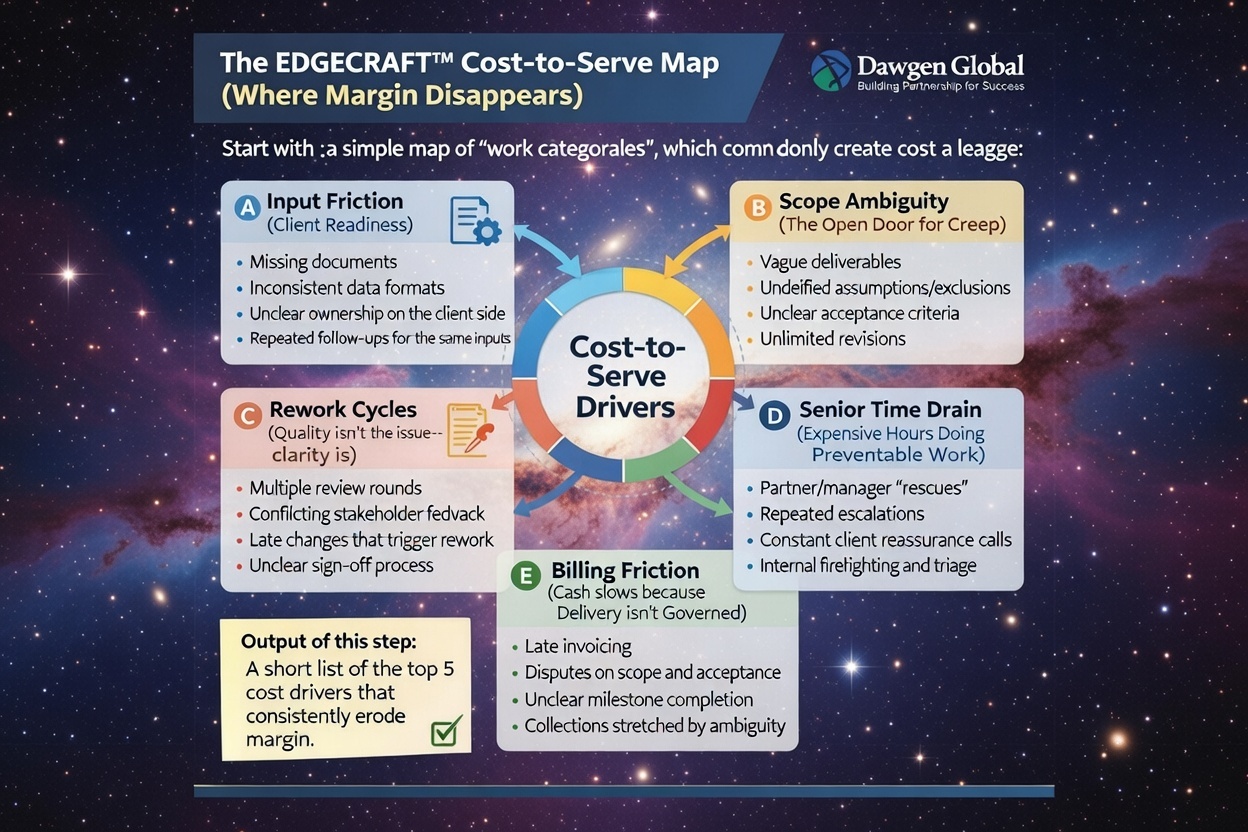
Start with a simple map of “work categories” that commonly create leakage:
A) Input friction (client readiness)
-
missing documents
-
inconsistent data formats
-
unclear ownership on the client side
-
repeated follow-ups for the same inputs
B) Scope ambiguity (the open door for creep)
-
vague deliverables
-
undefined assumptions/exclusions
-
unclear acceptance criteria
-
unlimited revisions
C) Rework cycles (quality isn’t the issue—clarity is)
-
multiple review rounds
-
conflicting stakeholder feedback
-
late changes that trigger rework
-
unclear sign-off process
D) Senior time drain (expensive hours doing preventable work)
-
partner/manager “rescues”
-
repeated escalations
-
constant client reassurance calls
-
internal firefighting and triage
E) Billing friction (cash slows because delivery isn’t governed)
-
late invoicing
-
disputes on scope and acceptance
-
unclear milestone completion
-
collections stretched by ambiguity
Output of this step: a short list of the top 5 cost drivers that consistently erode margin.
4) Client tiering by complexity and behaviour (not revenue)
Many firms tier clients by revenue alone. That is how profitable “quiet” clients subsidise high-friction “difficult” clients.
EDGECRAFT™ tiers clients using two dimensions:
-
Complexity: how hard the work is
-
Friction: how hard the client makes the work
The four-tier view (simple and actionable)
Tier 1: Low complexity / Low friction
-
predictable inputs, fast approvals, minimal scope drift
-
your best margin and easiest renewals
Tier 2: High complexity / Low friction
-
complex but cooperative
-
needs expertise, but stays governed
Tier 3: Low complexity / High friction
-
work is simple, but client behaviour creates cost
-
the most common “silent loss” tier
Tier 4: High complexity / High friction
-
high risk, high variability, high senior time drain
-
only viable with premium pricing + strong terms + governance
EDGECRAFT™ rule:
High-friction clients must either (a) move tiers through governance or (b) pay for the friction.
5) Standardise the “core path” and price exceptions
The goal is not to commoditise. The goal is to create a core delivery path that is consistent, high quality, and efficient—while treating exceptions as priced choices.
Core path standardisation examples
-
standard kickoff and onboarding pack
-
templated data request lists and validation checks
-
defined deliverable formats and review windows
-
standard reporting packs (with optional upgrades)
-
structured acceptance criteria and sign-off steps
Price the exception (“menu pricing” for complexity)
Turn common extras into explicit add-ons:
-
extra stakeholder workshops
-
additional entities/locations
-
board packs or expanded reporting
-
accelerated turnaround
-
extra revision cycles
-
expanded assurance/governance
This does two things:
-
makes the commercial model fair
-
stops teams absorbing complexity silently
Case Study (anonymised)
A mid-sized professional services firm discovered that two “good revenue” clients were generating negative margin because of repeated late inputs, unlimited review cycles, and partner rescue time. After implementing a tiered engagement model, revision limits, and priced add-ons for complexity, the firm reduced unplanned effort materially and restored profitability—without changing its base pricing.
6) Redesign resourcing and handoffs (remove waste that looks like “work”)
A lot of cost-to-serve is not “work.” It is handoff waste.
Common handoff failures:
-
sales promises not reflected in delivery scope
-
unclear internal ownership and review responsibilities
-
late involvement of the right expertise
-
multiple versions of files and duplicated effort
EDGECRAFT™ fixes that deliver immediate savings
-
Sales-to-delivery handover checklist (non-negotiable)
-
RACI for delivery (who owns, who reviews, who approves)
-
Early risk review within the first week of kickoff
-
Single source of truth for documents and versions
-
Defined escalation path to prevent partner time being the default
Result: fewer rescues, fewer reworks, more predictable outcomes.
7) Governance rules: the “minimum controls” that protect margin
Cost-to-serve engineering only works if it is governed.
The four non-negotiables
-
Change control: scope changes are logged and priced
-
Acceptance windows: delivered work is reviewed within a defined time
-
Invoice discipline: milestone delivered → invoice within 48 hours
-
Trade-down language: reduce scope/speed/governance—not price
These controls should be built into templates and weekly operating rhythm (your cadence system).
EDGECRAFT™ metric: Track Price Realisation as Quoted → Billed → Collected and pair it with Cost-to-Serve Variance (planned hours vs actual hours). When either moves in the wrong direction, margin erosion is already underway.
8) The 15-minute Cost-to-Serve Diagnostic
Use these quick checks:
-
Which 20% of clients consume 80% of senior time?
-
Where do delays occur most: inputs, approvals, reviews, billing?
-
What are the top 3 recurring “extras” teams deliver without charging?
-
How many engagements exceed planned hours—and why?
-
How often are invoices delayed because of disputes or unclear completion?
-
Are we tiering clients by behaviour and complexity—or only by revenue?
If you can’t answer these quickly, cost-to-serve is managing you.
9) A practical 30-day Cost-to-Serve Engineering Sprint
Week 1: Map cost drivers
-
categorise work into the five cost driver buckets
-
identify the top leakage patterns
Week 2: Tier clients
-
classify top accounts into the 4-tier complexity/friction grid
-
select 3 high-friction accounts for corrective action
Week 3: Standardise core path + add-ons
-
implement onboarding pack, deliverable templates, review windows
-
create add-on menu for frequent exceptions
Week 4: Enforce governance
-
update SOW language: assumptions, exclusions, revision limits, acceptance
-
implement milestone billing rules
-
embed reporting into weekly commercial/delivery/cash cadence
Outcome: less waste, fewer write-offs, better predictability, stronger margins.
In Red Oceans, profit is engineered—not hoped for
If you treat all clients the same, your best clients pay for your worst behaviours. Cost-to-serve engineering flips the script: it makes delivery predictable, exceptions explicit, and governance real.
EDGECRAFT™ cost-to-serve engineering helps you:
-
stop subsidising friction,
-
protect senior time,
-
standardise excellence,
-
and convert complexity into priced choices.
Next Step!
Cost-to-serve is one of the most controllable profit levers in Red Ocean markets—because it is governed by design choices: client tiering, delivery standards, change control, and billing discipline. If your teams are busy but margins are unpredictable, Dawgen Global can help you identify the real drivers of delivery friction and redesign the operating model to protect margin without reducing quality.
Let’s have a conversation.
? Contact Us: https://www.dawgen.global/contact-us/
? Discover More: https://dawgen.global/
? Email: [email protected]
Telephone Contact Centre:
? Caribbean: 876-9293670 | 876-9293870
? USA: 855-354-2447
WhatsApp Global: +1 555 795 9071
“Embrace BIG FIRM capabilities without the big firm price at Dawgen Global, your committed partner in carving a pathway to continual progress in the vibrant Caribbean region. Our integrated, multidisciplinary approach is finely tuned to address the unique intricacies and lucrative prospects that the region has to offer. Offering a rich array of services, including audit, accounting, tax, IT, HR, risk management, and more, we facilitate smarter and more effective decisions that set the stage for unprecedented triumphs. Let’s collaborate and craft a future where every decision is a steppingstone to greater success. Reach out to explore a partnership that promises not just growth but a future beaming with opportunities and achievements.
 Email: [email protected]
  Visit: Dawgen Global Website

 WhatsApp Global Number : +1 555-795-9071
Caribbean Office: +1876-6655926 / 876-9293670/876-9265210  WhatsApp Global: +1 5557959071
USA Office: 855-354-2447
Join hands with Dawgen Global. Together, let’s venture into a future brimming with opportunities and achievements


