

Great strategies fail for ordinary reasons: they aren’t measured, they aren’t prioritized, and they aren’t executed with a cadence that compounds. The Dawgen Fit Index™ (DFI) fixes that. It is the unifying metric inside the Dawgen Delta Framework™ that quantifies how well your Customers, Company, and Competitors “fit” together to generate economic profit. Raise the DFI and, over subsequent quarters, you raise ROIC—not by magic, but by aligning what customers truly value, what your organization can reliably deliver, and where you hold the line or take ground against rivals.
This article explains how the DFI works, how it predicts ROIC, and how to implement it in 90 days—complete with formulas, scorecards, sector examples, and governance practices that make the number meaningful.
1) Why a Single Number Matters
Executives face an avalanche of KPIs. But when everything is important, nothing is actionable. You need a single leading indicator that:
-
Captures the quality of your strategy now (not last quarter’s P&L).
-
Points to which levers will move performance next.
-
Is simple enough to put on the board agenda and tie to incentives.
The DFI is that number. It distills the health of the 3Cs into a 0–100 score and links it—empirically and causally—to improvements in revenue growth, margins, and capital efficiency, the three drivers of ROIC.
2) The Dawgen Fit Index™—Structure and Logic
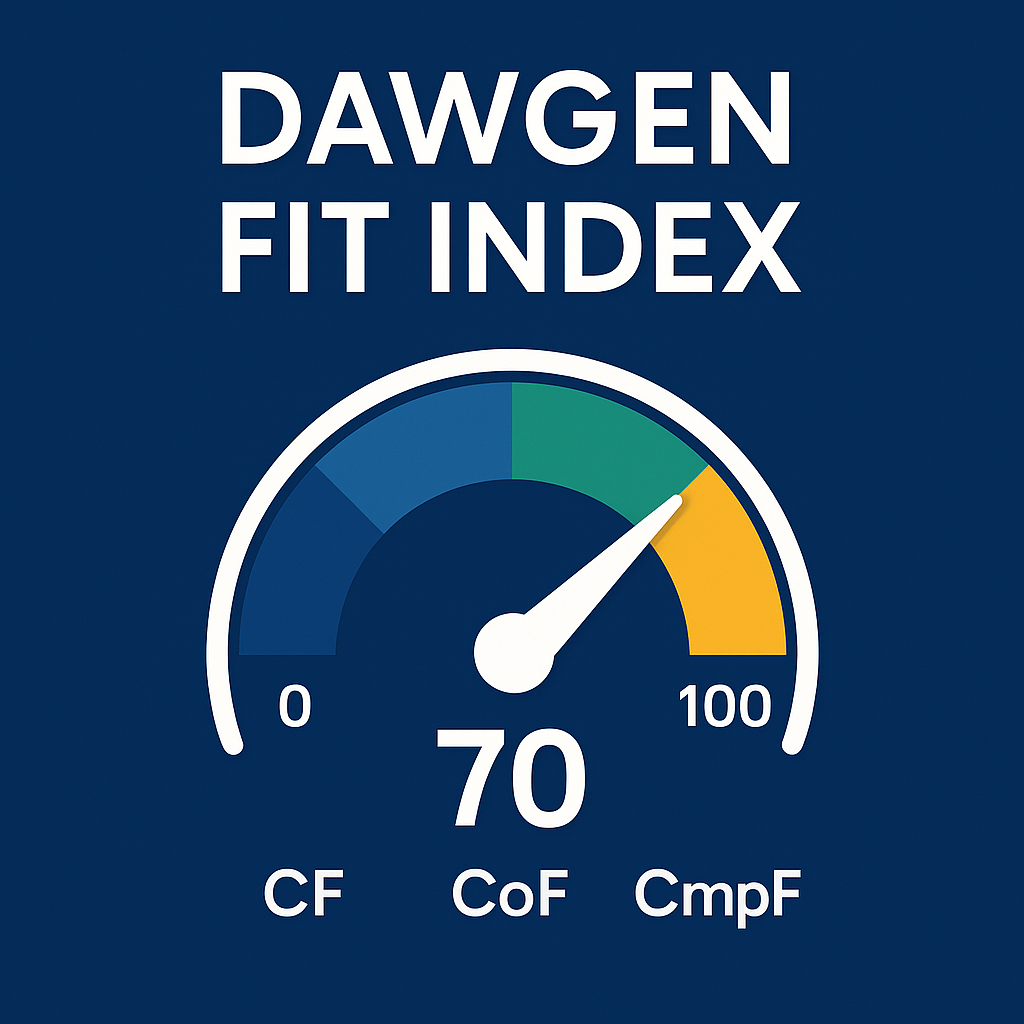
The DFI is the weighted sum of three sub-indices:
-
Customer Fit (CF): Do priority segments get the outcomes they value at a price they accept with a frictionless journey?
-
Company Fit (CoF): Are the critical capabilities, operating model, data, and talent aligned to deliver those outcomes at attractive unit economics?
-
Competitor Fit (CmpF): Are we positioned to win target battles at sustainable price/value with pre-approved counter-moves?
We usually start with equal weights (33⅓% each) and then tailor weights to strategy (e.g., a challenger bank might weight Customer Fit 45%). Each sub-index aggregates a small set of observable metrics standardized to 0–100.
2.1 Customer Fit (example metrics)
-
Outcome NPS by objective segment (not blended NPS)
-
Time-to-First-Value (TTFV) vs benchmark
-
Early churn (first 90 days)
-
Value realization rate (share of customers achieving promised outcome)
-
ARPU vs price fence (willingness-to-pay alignment)
2.2 Company Fit (example metrics)
-
Capability maturity on the 5–7 critical capabilities (1–5 scaled to 0–100)
-
Cycle-time on the critical path (lead-to-cash, issue-to-resolution)
-
Unit economics (gross margin per segment, CAC payback)
-
Data readiness (single customer view, SLA instrumentation)
-
eNPS / critical roles filled (execution capacity)
2.3 Competitor Fit (example metrics)
-
Relative price index (discount/premium vs top 3)
-
Win-rate in target segments / tenders
-
Feature lead-lag (days ahead/behind rivals on must-win features)
-
Partner coverage (ecosystem reach in target verticals)
-
Signal responsiveness (time from competitor signal → action)
3) Making It Quantitative: Scoring and Formula
Each metric is converted to a 0–100 score with transparent scales. (Example: TTFV ≤ 7 days = 100; 8–14 days = 80; 15–30 = 60; >30 = 30.)
Let:
-
CF = weighted average of Customer Fit metrics
-
CoF = weighted average of Company Fit metrics
-
CmpF = weighted average of Competitor Fit metrics
-
Weights: wC, wCo, wCmp (sum to 1)
Dawgen Fit Index™ (DFI) = wC·CF + wCo·CoF + wCmp·CmpF
We then track ΔDFI (q/q) and link it to three ROIC drivers:
-
Growth delta (revenue CAGR in prioritized segments),
-
Margin delta (gross and EBITDA),
-
Capital efficiency delta (NWC turns, capex effectiveness).
Over time, companies establish internal correlations (and sometimes regression models) that show, for example, that +10 points of DFI predicts +180–300 bps in gross margin mix or a 1–2 month reduction in CAC payback, depending on the sector. The goal isn’t a perfect equation—it’s a reliable management signal with action built in.
4) Why the DFI Predicts ROIC (Causal Links)
ROIC = NOPAT / Invested Capital. DFI affects both the numerator (NOPAT) and the denominator:
-
Revenue mix & pricing power (Customer Fit):
-
Outcome-based segmentation and SLA-backed offers increase conversion and ARPU.
-
Reduced early churn stabilizes cohorts, expanding LTV.
→ Higher NOPAT through growth and price realization.
-
-
Unit economics & operating leverage (Company Fit):
-
Faster cycle time, standardized delivery, and automation lift gross margins.
-
Better demand planning and process discipline tighten working capital.
→ Higher NOPAT and lower invested capital.
-
-
Competitive stability (Competitor Fit):
-
Pre-approved counter-moves reduce price wars and protect mix.
-
Partner ecosystems expand access without equivalent capital outlay.
→ Margin defense and asset-light growth.
-
DFI is a leading indicator because you can improve it this quarter through customer journey fixes, coverage redesign, capability upgrades, and wargamed moves—before the full P&L effects show up.
5) A Worked Example (Illustrative)
A regional B2B services company sets equal weights and gathers baseline data.
Customer Fit metrics (weights 20/20/20/20/20):
-
Outcome NPS (by segment): 58
-
TTFV: 14 days → score 80
-
Early churn (90-day): 7.5% → score 65
-
Value realization rate: 68% → score 68
-
ARPU vs price fence: at 92% of target → score 70
CF = (58 + 80 + 65 + 68 + 70) / 5 = 68.2
Company Fit metrics (weights 25/25/20/15/15):
-
Capability maturity (avg on 7 capabilities): 3.1/5 → score 62
-
Cycle-time reduction potential: current 24 days → score 60
-
Unit economics (GM% vs target): 89% of target → score 70
-
Data readiness: partial single view → score 55
-
eNPS / critical roles filled: 71/100 → score 71
CoF = (62·0.25 + 60·0.25 + 70·0.20 + 55·0.15 + 71·0.15) = 63.8
Competitor Fit metrics (weights 25/25/20/20/10):
-
Relative price index: −3% vs rivals → score 68
-
Win-rate in target tenders: 41% → score 62
-
Feature lead-lag: −30 days → score 55
-
Partner coverage: 60% of target → score 60
-
Signal responsiveness: 21 days → score 65
CmpF = (68·0.25 + 62·0.25 + 55·0.20 + 60·0.20 + 65·0.10) = 61.8
With equal weights (wC = wCo = wCmp = 1/3):
DFI₀ = (68.2 + 63.8 + 61.8) / 3 = 64.6
After a 90-day Delta Cadence (SLA-backed offers, onboarding redesign, deal-desk rules, and partner acceleration), the company improves TTFV (to 7 days), early churn (to 5.8%), capability maturity (to 3.4), and win-rate (to 48%). The new DFI is 72.3 (+7.7). Over the next two quarters, the firm observes:
-
Gross margin +210 bps,
-
CAC payback −1.4 months,
-
Working capital days −6,
-
ROIC spread +220 bps over WACC.
6) How to Implement the DFI in 90 Days
Phase 1 (Weeks 1–2): Baseline & Prioritize
-
Define objective segments (what outcomes matter most) and choose the 5–7 critical capabilities.
-
Build the first Value Map™, Coverage Matrix™, and a capability heat map.
-
Collect the minimum viable data for each metric (don’t let perfect be the enemy).
Phase 2 (Weeks 3–4): Design & Instrument
-
Set scales for each metric (what’s 100? what’s 60?) and agree weights.
-
Instrument SLAs and journey analytics (TTFV, FCR, churn triggers).
-
Stand up the Signal Tracker™ (pricing files, hiring, partnerships, IP, regulatory moves).
Phase 3 (Weeks 5–8): Pilot the Levers
-
Launch SLA-backed bundles in two priority segments; enable a simple deal desk with price fences.
-
Redesign onboarding to compress TTFV; add nudges and “first-time-use” checklists.
-
Run the first Wargame Lab™ to test aggressive competitor scenarios.
Phase 4 (Weeks 9–12): Scale & Govern
-
Refresh DFI and publish to the executive scorecard.
-
Convert successful pilots into BAU (pricing guardrails, coverage playbooks).
-
Link incentives: a portion of variable comp tied to ΔDFI (and to customer & financial KPIs).
7) The DFI Scorecard (Template)
Top line: DFI current (q), prior (q-1), delta (Δ), target.
Sub-indices: CF / CoF / CmpF with color coding.
Under each: 3–5 metrics with trends and owners.
Action strip: the three moves this quarter with a named lead and due date.
Rule of three: We never run more than three system-changing initiatives per quarter. Everything else is BAU or local improvement.
8) Sector Playbooks with DFI Levers
Banking & Fintech
-
Customer Fit: “Certainty” segment gets guaranteed settlement windows; digital onboarding reduces TTFV.
-
Company Fit: straight-through processing, fraud analytics, and decision-rights clarity between product/risk.
-
Competitor Fit: partnerships with payment networks; pre-approved play for fee wars.
DFI Levers: SLA instrumentation, onboarding NPS, STP rate, partner coverage.
Professional Services & B2B SaaS
-
Customer Fit: outcome packages (e.g., “Audit-Ready in 30 Days”) with milestone-based fees.
-
Company Fit: shared delivery center, playbooks, utilization and throughput analytics.
-
Competitor Fit: category design content; references and guarantees.
DFI Levers: TTFV, value realization rate, cycle time, win-rate vs top 3.
FMCG & Distribution
-
Customer Fit: e-ordering for long tail, joint business planning for key accounts.
-
Company Fit: demand sensing, route optimization, service-level adherence.
-
Competitor Fit: price pack architecture to avoid blanket discounts.
DFI Levers: OTIF, shelf availability, promo ROI, relative price index.
Energy & Utilities
-
Customer Fit: uptime SLAs, transparent outage communication; affordability bundles.
-
Company Fit: predictive maintenance, crew dispatching, asset health analytics.
-
Competitor Fit: ecosystem deals for devices + finance + service.
DFI Levers: outage TTFV (restoration), SLA compliance, capex stage-gate quality.
9) Governance that Makes the Number Real
-
Monthly Strategy Council: Review DFI, the three “big moves,” and blockers. Decide, don’t discuss endlessly.
-
Quarterly Wargame Lab™: Reset competitor assumptions, rehearse plays, pre-approve thresholds.
-
KPI Tree & Incentives: Tie variable comp for executives and key managers to ΔDFI (e.g., 20%), customer KPIs (e.g., churn, TTFV), and financials (GM, ROIC spread).
-
Data Stewardship: The DFI is only as good as the data; assign owners for each metric and publish definitions.
10) Pitfalls to Avoid
-
Vanity scoring: Calibrate scales against external benchmarks or historical performance, not optimism.
-
Over-engineering: Start with 3–5 metrics per sub-index; add more only if they change decisions.
-
“One and done” cadence: The power is in quarterly repetition—not a single impressive workshop.
-
Misaligned incentives: If leaders aren’t paid on ΔDFI (and ROIC), behaviors won’t change.
-
Ignoring capital: Tie improvements to working capital and capex plans, not just revenue and margin.
11) Frequently Asked Questions
Q: Is the DFI a financial metric?
A: It’s a leading operational strategy index. It doesn’t replace your P&L—it predicts it by quantifying the quality of fit that drives financials.
Q: How fast should we see improvement?
A: Within the first quarter, you should see DFI movements and early operational shifts (TTFV, win-rates). Financial impacts—margin mix, CAC payback, cash—typically show in the next 1–2 quarters.
Q: Can we use the DFI in regulated industries?
A: Absolutely. The Dawgen Assurance Wrap™ adds compliance and risk metrics without dulling the growth edge.
Q: Does every business get the same weights?
A: No. Challengers often overweight Customer Fit; incumbents in price wars may overweight Competitor Fit. Weights evolve with your strategy.
12) The Dawgen Promise
We created the DFI to solve a practical problem: turning strategy into a quarterly habit that outperforms. When you measure fit, design for outcomes, and execute with a 90-day cadence, ROIC follows. Not because we say so, but because the system steadily improves the things that make it inevitable: customer mix, pricing power, cycle time, and disciplined capital.
Ready to Baseline Your DFI and Predict Your ROIC?
Dawgen Global can help you:
-
Establish your DFI baseline in two weeks,
-
Stand up the Value Map™, Coverage Matrix™, TOM Blueprint™, and Signal Tracker™,
-
Run the first Wargame Lab™, and
-
Launch your 90-Day Delta Cadence with clear incentives.
Request a proposal today:
-
? Email: info@dawgen.global
-
? WhatsApp (Global): +1 555 795 9071
Let’s make strategy your competitive habit—the Dawgen Way.
About Dawgen Global
“Embrace BIG FIRM capabilities without the big firm price at Dawgen Global, your committed partner in carving a pathway to continual progress in the vibrant Caribbean region. Our integrated, multidisciplinary approach is finely tuned to address the unique intricacies and lucrative prospects that the region has to offer. Offering a rich array of services, including audit, accounting, tax, IT, HR, risk management, and more, we facilitate smarter and more effective decisions that set the stage for unprecedented triumphs. Let’s collaborate and craft a future where every decision is a steppingstone to greater success. Reach out to explore a partnership that promises not just growth but a future beaming with opportunities and achievements.
✉️ Email: info@dawgen.global ? Visit: Dawgen Global Website
? ? WhatsApp Global Number : +1 555-795-9071
? Caribbean Office: +1876-6655926 / 876-9293670/876-9265210 ? WhatsApp Global: +1 5557959071
? USA Office: 855-354-2447
Join hands with Dawgen Global. Together, let’s venture into a future brimming with opportunities and achievements


