
Executive Summary
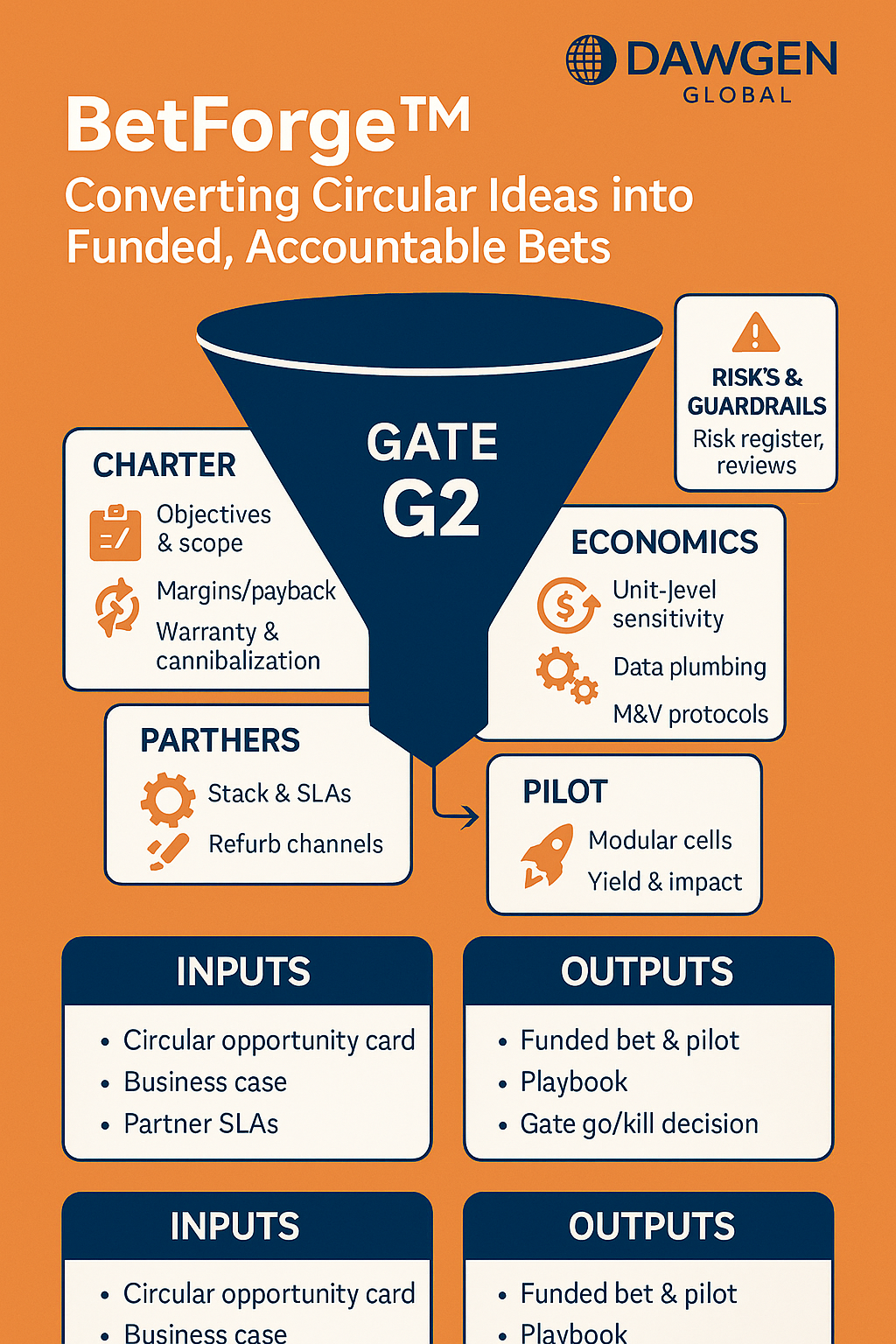
Many organizations discover dozens of circular ideas—yet few translate into funded initiatives with accountable owners and measurable outcomes. BetForge™ is Dawgen Global’s investment discipline for the circular economy. It takes the short‑listed options from LoopSight™ and forges them into funded bets with clear charters, business model blueprints, partner stacks, pilot designs, and measurement & verification (M&V) protocols. BetForge™ is where strategy meets finance: it converts uncertainty into staged capital, aligns incentives across functions, and sets the criteria for the Gate G2 Scale Go/No‑Go decision.
Promise: BetForge™ reduces time to proof, raises investment confidence, and prevents zombie pilots by making exit criteria as explicit as success criteria. The result is a pipeline of circular initiatives that merit enterprise‑level scaling in ScaleGrid™.
Why Ideas Stall: The Investment Gap in Circularity
- Vague ownership. Good concepts lack a single accountable leader with budget authority.
- Blurry economics. Teams model averages, not unit‑level economics; results are hard to compare across opportunities.
- Pilot theatre. Experiments run without success metrics, timelines, or kill rules; resources get trapped in low‑yield efforts.
- Channel friction. Refurbished or PaaS offers are launched without re‑aligning sales incentives, cannibalizing new product targets.
- Partner misfit. Reverse logistics, repairs, recyclers, and marketplaces are added opportunistically—not architected as an ecosystem.
BetForge™ closes these gaps with a repeatable structure for turning options into investable assets.
The BetForge™ Flow
BetForge™ consists of five integrated workstreams. Each yields named deliverables and decisions.
1) Bet Charters: Clarity, Accountability, Evidence
A Bet Charter is a one‑to‑two page contract between leadership and the team. It includes:
- Thesis: the value proposition and loop logic (e.g., “Refurbish 35% of returns, sell certified pre‑owned with 12‑month warranty”).
- Scope & Boundaries: SKUs, geographies, channels, and customer segments included/excluded.
- Unit of One Metrics: return capture rate, triage yield, refurbishment yield, turnaround time, unit margin bands, carbon/virgin displacement per unit.
- OKRs: outcome‑oriented targets for the pilot window.
- Budget & Stage Plan: stage‑gated funding tranches linked to evidence, not effort.
- Exit Criteria: explicit kill/merge conditions (e.g., “if capture rate < 40% at incentive X, terminate”).
- RACI: accountable owner, contributors, approvers; weekly and monthly cadences.
- Risk Register: top five risks with mitigations and early warning indicators.
Decision: Leadership approves the charter; seed funding is unlocked.
2) Business Model Architecture: How the Money Flows
Circular bets fail when the economics are an afterthought. We articulate the model at unit level and portfolio level:
- Offer Design: PaaS subscription tiers, certified pre‑owned pricing, take‑back deposits, buy‑back credits, spare‑parts harvesting.
- Price & Warranty Logic: value‑based pricing, warranty length/limits, and the actuarial reserve for warranty risk tails.
- Cost Stack: intake → grading → refurbishment/reman → QA → logistics → resale/channel commissions → warranty reserve.
- Cash Conversion: collection timing, deposit flows, secondary market settlement, and inventory turns.
- Sensitivity Bands: return rate, grade mix, first‑pass yield, resale price elasticity, logistics cost per unit.
- Capex vs. Opex: lease early (cells, tools), buy later; treat refurb lines as modular assets.
Deliverable: a blueprint that leadership can audit and compare across bets.
3) Partner Stack & SLAs: Build the Ecosystem, Not Just a Pilot
Circular value chains cross corporate borders. We design a Partner Stack with clear interfaces:
- Repair & Refurb Hubs: in‑house vs. contracted; takt time, first‑pass yield, rework limits.
- Reverse Logistics: pickup/drop‑off networks, consolidation hubs, carbon‑aware routing, proof of custody.
- Recyclers/Material Buyers: purity specs, contamination tolerances, and take‑or‑pay terms.
- Digital/IT Partners: material passports, QR/RFID intake, data lake connectors.
- Marketplaces: for certified pre‑owned and by‑products; channel policies to prevent gray market leakage.
- SLAs & Gain‑Share: service levels, penalties, and upside sharing to align incentives.
Deliverable: signed MOUs/SLAs and a RACI across company boundaries.
4) Pilot Design: Proof over Performance Theatre
We treat pilots as decision machines. Design choices:
- Cohort & Geography: representative but manageable volume; avoid edge cases.
- Channels: separate refurbished channels if needed to mitigate cannibalization; counterstaff training and scripts.
- Operational Cell: standardized intake, grading, and triage; instrumented for time, yield, and cost.
- Customer Experience: incentives for returns (deposits, rewards), scheduling convenience, turnaround SLAs, and transparent impact reporting.
- Data Plumbing: minimal viable passports, intake QR/RFID, and events flowing into dashboards.
- M&V Protocols: definitions and formulas for all metrics; sampling plans and third‑party verification where appropriate.
Deliverable: a Pilot Playbook that any site can replicate.
5) Gate G2: Scale Go/No‑Go
At the end of the pilot window, teams present a G2 pack with audited evidence:
- Economics: unit margin vs. hurdle, payback bands, cash conversion cycle.
- Reliability: first‑pass yield, process capability (e.g., Cpk), SLA adherence, supply stability.
- Customer: NPS, attach/retention rates, return participation.
- Impact: verified material recovery rate, virgin displacement, carbon intensity per functional unit.
- Risk & Compliance: incidents, audit results, quality escapes.
Leadership chooses Scale, Iterate (one more pilot), or Stop. Funding then transitions to ScaleGrid™ parameters if approved.
Designing the Economics: From Unit to Portfolio
Unit Level
We model the journey of a single returned unit. Example variables:
- Collection cost and method (mail‑back vs. pickup vs. drop‑off).
- Grading distribution (A/B/C/scrap) and average recovery yield.
- Refurbishment hours, parts replacement rates, scrap recovery value.
- Resale price and channel fee; warranty reserve per unit.
- Processing time (days) and working capital impact.
Portfolio Level
- Mix of SKUs and regions; seasonality of returns.
- Capacity planning of triage cells and refurb lines; takt time and staffing.
- Risk pooling of warranties and failure modes.
- Sensitivity scenarios (P10/P50/P90) and confidence bands.
Decision Hurdles (illustrative): payback ≤ 18 months, gross margin ≥ target +X pp vs. baseline, verified recovery ≥ 70%, NPS ≥ 50, and SLA adherence ≥ 95%.
Incentives & Org Design: Make the Bet Winnable
- Sales & Channel Incentives: tie refurbished/PaaS attach to quota credit; protect reseller margins with differentiated SKUs and clear messaging.
- Service & Field Teams: reward return capture and turnaround; provide script libraries and parts harvesting guides.
- Procurement: favor modular, disassembly‑friendly components; negotiate dual‑sourcing for critical reman parts.
- Finance: stage‑gate capex releases; create a circular capex classification; consider green finance and EPR credits.
- Legal/Compliance: updated warranties, liability caps, and take‑back T&Cs; country‑by‑country EPR mapping.
- Circular PMO: run the cadence—weekly stand‑ups, monthly value council, quarterly portfolio reviews.
Data Architecture & Traceability
- Material Passports: minimum data fields (composition, disassembly steps, hazard flags) and QR/RFID binding.
- Event Streams: intake → grade → refurb → QA → ship; flow into a lakehouse linked to ERP/PLM/CRM.
- Dashboards: real‑time KPIs for yield, cycle time, cost per unit, and warranty tail.
- Assurance: sampling plans; third‑party audits for impact claims; immutable logs for chain of custody.
Risk Register & Guardrails (Illustrative)
- Capture Rate Falls Short
Signal: low returns despite incentives.
Mitigation: increase deposit/credit; expand drop‑off network; targeted outreach; B2B contracts with return clauses. - Grade Mix Worse Than Expected
Signal: spike in C‑grade; high rework.
Mitigation: predictive screening; intake triage upgrades; preventive maintenance packs; upstream design fixes via DfX. - Channel Cannibalization
Signal: new product sales decline in pilot channel.
Mitigation: separate refurbished channels; attach‑rate KPIs; sales enablement content; pricing floors. - Capex Overruns
Signal: vendor quotes exceed plan.
Mitigation: lease early; competitive bids; standardize cell design; reuse equipment. - Compliance/Quality Drift
Signal: audit findings; warranty claims spike.
Mitigation: SOP checklists; quality gates; external audits; stop‑ship triggers.
The Pilot Playbook (What the Team Actually Builds)
- Intake & Grading SOPs: visual work instructions; tool lists; takt time targets.
- Refurb/Reman Cells: layout, skill matrix, spare‑parts kit, calibration schedule.
- Reverse Logistics Design: routes, consolidation hubs, packaging standards, damage thresholds.
- CX Scripts & Offers: return prompts, buy‑back offers, subscription tiers, warranty language.
- Data Collection Kit: scanners, labels, event schema, dashboard templates.
- Training & Safety: EHS procedures; handling of hazardous components; lockout/tagout.
The BetForge™ KPI Tree
Outcome KPIs
- Unit economics (gross margin per unit, contribution margin).
- Payback period and NPV bands.
- Recovery rate (%), virgin displacement (%), carbon intensity change.
- NPS and attach/retention rates.
Process KPIs
- Return capture rate, triage first‑pass yield, refurb first‑pass yield.
- Cycle time (intake → resale), rework rate, scrap rate.
- Reverse logistics cost per unit, damage rate in transit.
Leading Indicators
- Incentive redemption rate, appointment adherence, supplier on‑time, data completeness.
Illustrative Vignette: Funding the Right Bet
A regional telecom gathered 30 circular ideas in LoopSight™. BetForge™ narrowed the field to three funded bets. One charter focused on certified pre‑owned routers:
- Thesis: triage & refurbish home routers; resell with 9‑month warranty; offer subscription upgrades.
- Pilot: 12‑week test in two cities; dedicated refurbished channel; deposit‑back return incentive.
- Results: capture rate 61%; refurb FPY 87%; unit margin +11pp vs. new; NPS +18 vs. baseline.
- Decision: Cleared G2, moved to ScaleGrid™ with modular refurb cells and marketplace integrations.
Two other bets were killed at G2 due to weak return rates and unreliable supply—by design, not failure. Capital was conserved and reallocated to the winning loop.
90‑Day BetForge™ Plan
Weeks 1–2: Charter
- Draft Bet Charters for Top‑3 to Top‑5 options; confirm owners, budgets, and exit criteria.
Weeks 3–4: Economics & Model
- Build unit/portfolio models; run sensitivity and confidence bands; finalize hurdle rates.
Weeks 5–6: Partnering & SLAs
- Negotiate MOUs/SLAs; align data interfaces and chain of custody.
Weeks 7–8: Pilot Design
- Lock scope, cohort, and geography; instrument data plumbing; finalize M&V.
Weeks 9–12: Execute Pilot
- Run playbook; weekly KPI reviews; corrective actions via andon events.
Week 13: Gate G2
- Present audited results; decision: Scale / Iterate / Stop.
Leadership Checklist: Are We BetForge™‑Ready?
- We have a Top‑5 shortlist from LoopSight™ with LoopScore™ and learning outcomes.
- Each bet has a named owner with budget authority and a cross‑functional squad.
- Stage‑gated funding and hurdle rates are agreed.
- Sales/channel incentives and warranty policies have draft updates.
- Partners (repair, logistics, recyclers) are identified with provisional SLAs.
- Minimal viable data plumbing is specified (passports, intake events, dashboard).
If you can tick most of these boxes, you’re ready to forge ideas into real, fundable bets.
Capital with Confidence
Circular ambition becomes performance when ideas meet disciplined investment. BetForge™ is that discipline—turning a ranked list of options into a portfolio of funded bets with clear economics, accountable owners, and decision‑grade evidence. By making exit criteria explicit and aligning incentives across sales, service, supply chain, finance, and partners, BetForge™ accelerates time to proof and protects capital. What clears Gate G2 enters ScaleGrid™ with momentum—and what doesn’t, doesn’t linger.
Fund the Bets that Win
Ready to turn your short‑list into investable circular initiatives with clear economics and decision gates?
Request a proposal today:
Email: info@dawgen.global
WhatsApp: +1 555 795 9071
Dawgen Global | LoopWorks™ — Smarter and More Effective Decisions, by design.
About Dawgen Global
“Embrace BIG FIRM capabilities without the big firm price at Dawgen Global, your committed partner in carving a pathway to continual progress in the vibrant Caribbean region. Our integrated, multidisciplinary approach is finely tuned to address the unique intricacies and lucrative prospects that the region has to offer. Offering a rich array of services, including audit, accounting, tax, IT, HR, risk management, and more, we facilitate smarter and more effective decisions that set the stage for unprecedented triumphs. Let’s collaborate and craft a future where every decision is a steppingstone to greater success. Reach out to explore a partnership that promises not just growth but a future beaming with opportunities and achievements.
✉️ Email: info@dawgen.global ? Visit: Dawgen Global Website
? ? WhatsApp Global Number : +1 555-795-9071
? Caribbean Office: +1876-6655926 / 876-9293670/876-9265210 ? WhatsApp Global: +1 5557959071
? USA Office: 855-354-2447
Join hands with Dawgen Global. Together, let’s venture into a future brimming with opportunities and achievements


