
A ticket from New York to Miami and one from New York to a Caribbean island may cover similar distances, yet the taxes and charges built into those tickets can be dramatically different. The same is true comparing flights within Europe, Africa, Asia or Latin America.
Air transport is a global industry, but air travel taxation is overwhelmingly local. Each country—and often each region—sets its own policy on how much to tax passengers simply for flying. The result is a patchwork of systems where you fly and where you depart from can matter almost as much as how far you travel.
Drawing on recent IATA data on specific taxes on the use of air passenger transport, this article explores these regional disparities, the reasons behind them, and what they mean for airlines, passengers, tourism-dependent economies, and policymakers.
1. One Global Industry, Many Tax Systems
Commercial aviation connects nearly every corner of the world, operating under global safety, security and air navigation rules. But when it comes to taxation, there is no unified framework. Instead, states levy:
-
Specific air passenger taxes – fixed amounts per passenger per flight or per departure/arrival.
-
Tourism or solidarity levies – per-passenger charges earmarked (at least in name) for tourism development or social programmes.
-
Security and border charges – often structured like taxes, though sometimes classified as cost-recovery fees.
These specific taxes are distinct from:
-
Airport charges (which fund infrastructure and services),
-
Fuel excise duties,
-
VAT/sales tax, and
-
Corporate income tax on airline profits.
The IATA study focuses on this narrow but powerful category: specific taxes on the use of air transport as a passenger—fixed amounts added to the ticket purely because someone is flying.
Globally, these taxes raised about USD 60.4 billion in 2024, with an average of roughly USD 12–13 per passenger per flight. But that average hides large regional differences.
2. Regional Averages: A Very Uneven Map
When IATA grouped countries into broad regions and looked at average specific taxes per passenger per flight, the disparities were striking:
-
North America – around USD 30 per passenger per flight (the highest regional average).
-
South & Central America and the Caribbean – about USD 19–20 per flight.
-
Africa – approximately USD 15 per flight.
-
Europe – roughly USD 12 per flight.
-
Asia Pacific – around USD 2 per flight (the lowest regional average).
-
Middle East – in the sample analysed, no specific passenger ticket taxes were levied.
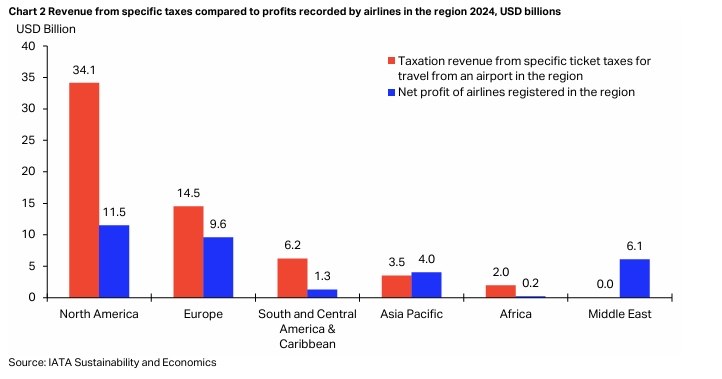
These numbers already show that starting your journey in one region rather than another can mean a 10–15x difference in specific ticket tax, before any distance, cabin class or airport charges are considered.
Why such wide variation? The answer lies in a mix of fiscal structure, political choices, tourism strategy, and institutional history.
3. North America: High Specific Taxes, Huge Volumes
North America stands out for both high average taxes and high aggregate revenue:
-
Average specific tax per passenger per flight: roughly USD 30.
-
Total specific ticket tax revenue (2024): about USD 34.1 billion, or 57% of the global total, despite handling only about a quarter of global passengers.
Much of this comes from the United States, where the ticket price includes several federal and sometimes state-level charges. While many are labelled as “fees” (e.g., security charges, segment fees), in economic terms they function like specific taxes on passenger movements.
North America’s approach reflects several factors:
-
Heavy reliance on user charges and targeted levies rather than broad national consumption taxes,
-
A strong focus on aviation security and infrastructure funding through per-passenger charges,
-
Political preference for taxes that are perceived as being paid by users (including foreign visitors) rather than general taxpayers.
For travellers, this means that even short domestic hops can carry a relatively high fixed tax burden, which is especially significant for low-fare tickets. For airlines, these charges are a key part of route economics and pricing decisions.
4. Europe: A Mix of Environmental and Revenue Motives
Europe displays a complex picture:
-
Average specific tax per passenger per flight: around USD 12.
-
Total specific ticket tax revenue (2024): about USD 14.5 billion.
Multiple European countries impose Air Passenger Duties or similar taxes. The United Kingdom is a prominent example, with a banded system that varies by:
-
Distance (short-haul vs long-haul), and
-
Cabin class (standard vs premium).
Other European states have introduced ticket taxes branded as environmental levies, sometimes alongside participation in emissions trading schemes. The result is:
-
A patchwork of regimes—some countries with high ticket taxes, others with none,
-
Ongoing debate about double-charging where both environmental schemes and ticket taxes apply,
-
Significant complexity for airlines operating across many jurisdictions.
From a passenger’s perspective, flights originating in some European countries can cost noticeably more due to these duties—especially long-haul premium travel—while departures from neighbouring states may be substantially cheaper.
5. South & Central America and the Caribbean: Tourism-Focused but Tax-Heavy
In the combined South and Central America & Caribbean region, specific ticket taxes averaged about USD 19–20 per passenger per flight, but with big differences between countries.
General patterns include:
-
Heavy use of international departure taxes, tourism levies, and solidarity charges.
-
A strong focus on non-resident passengers, as governments see tourists as an attractive tax base.
-
Limited domestic networks in many countries—particularly Caribbean islands—so most revenue is generated on international routes.
For tourism-dependent economies, this creates a delicate balance:
-
On one hand, air travel taxes provide useful revenue that can support public services.
-
On the other, high total ticket costs may reduce visitor flows or shift demand to cheaper destinations.
Caribbean states, for example, compete directly with Florida, Mexico, Central America and other sun-and-sea destinations. If combined outbound and inbound taxes push the airfare too high, the region risks ceding market share—even without changing its natural attractions or hotel product.
6. Africa: Growing Markets Under Heavy Fiscal Pressure
Africa’s average specific ticket tax—about USD 15 per passenger per flight—masks major variation between countries, but several themes recur:
-
Many states face narrow tax bases, significant infrastructure needs, and high debt burdens.
-
Aviation is often viewed as a sector that can bear high charges, particularly for international travellers.
-
Ticket taxes and airport charges together can make African markets some of the most expensive in the world per kilometre flown.
For passengers, this means:
-
High fares relative to income levels;
-
Limited competition and frequency on many routes;
-
Significant costs for regional travel within Africa.
For governments, there is a real trade-off between short-term revenue from high charges and long-term gains from better connectivity, tourism and investment attraction. High taxes may protect immediate revenue but stifle traffic growth and broader economic benefits.
7. Asia Pacific and the Middle East: Low Ticket Taxes, Hub Strategies
At the other end of the spectrum:
-
Asia Pacific has an average specific tax of around USD 2 per passenger per flight—by far the lowest among the major regions.
-
In the sample analysed, Middle Eastern countries did not levy specific passenger ticket taxes at all in 2024.
This largely reflects strategic choices:
-
Several major Asian and Middle Eastern hubs aim to attract traffic and build strong global network positions.
-
Governments may prefer to raise revenue through other tax bases (e.g., VAT, income tax, or fuel-related charges) rather than per-passenger ticket taxes.
-
Many markets focus on cost-competitive long-haul connections, where low ticket taxes are part of their value proposition.
For airlines and passengers, these regions can be attractive for connecting routes, which in turn strengthens the hubs and increases their bargaining power in global aviation.
8. International vs Domestic: Crossing Borders Costs More
Another layer of disparity emerges when comparing domestic and international journeys.
Globally in 2024:
-
International flights generated around USD 38.0 billion in specific ticket taxes, with an average of roughly USD 17.7 per flight.
-
Domestic flights generated about USD 22.4 billion, averaging around USD 8.5 per flight.
International journeys thus face roughly double the specific tax per segment compared with domestic trips, on average.
Regionally, this pattern is strongest in:
-
South & Central America and the Caribbean, where specific ticket tax revenue is overwhelmingly from international passengers, and where average tax per international flight approaches USD 45.
-
Many tourism-dependent or small states, which rarely tax domestic travel but tax international departures and arrivals heavily.
This reinforces the idea that, for many governments, foreign visitors are the primary target of specific ticket taxes. But that approach can boomerang if it dampens tourism demand or diverts visitors to competing destinations.
9. Why These Disparities Exist: Policy and Politics
Regional differences are not random; they reflect different answers to four key policy questions:
1. How Should Governments Raise Revenue?
Countries choose between:
-
Broad-based taxes (VAT, income tax) that spread the burden widely;
-
Narrow excise-type taxes on specific activities like flying, hotels, or fuel.
Where governments lean heavily on narrow bases, air passengers are a tempting target—especially tourists and business travellers perceived as better able to pay.
2. How Important Is Tourism and Connectivity?
Tourism-dependent states and trade hubs must weigh:
-
Revenue from each visitor vs
-
The volume of visitors that can be attracted by more competitive prices.
Regions like Asia Pacific and the Middle East, with strong hub strategies, have tended to keep specific ticket taxes low to support high traffic volumes and connectivity.
3. What Are the Political Optics?
Taxes on air travellers are often politically easier to impose because:
-
They are less visible than headline income tax rates,
-
A high share may be paid by non-voting foreigners,
-
The link to “user pays” or “environmental responsibility” can be emphasised.
This political calculus is particularly evident in Europe and North America.
4. How Are Climate and Environmental Goals Integrated?
Some regions justify ticket taxes partly on climate grounds, but the design often remains:
-
Per passenger rather than per tonne of emissions, and
-
Unconnected to investment in sustainable aviation or climate adaptation.
Others integrate aviation primarily into carbon markets or offset schemes, leaving ticket taxes low or zero.
10. Consequences of Regional Tax Disparities
The uneven map of air travel taxation has several concrete implications:
a) Competitive Advantages and Disadvantages
Low-tax regions can gain a competitive edge as:
-
Preferred locations for hubs and airline bases,
-
Attractive points for connecting traffic,
-
Affordable gateways for tourists.
High-tax regions risk losing:
-
Market share in tourism and business travel,
-
Airline investment and future route development,
-
Economic opportunities linked to connectivity.
b) Distorted Route Networks
Airlines optimise networks based on after-tax profitability. When two routes are similar in distance and demand but one is heavily taxed, capacity will tend to flow to the less taxed option. Over time, this can lead to:
-
Under-served high-tax destinations;
-
Over-concentration in low-tax hubs;
-
Fragmented regional connectivity.
c) Equity Issues Between Regions and Travellers
Travellers in high-tax regions effectively pay more for the same service than those in low-tax regions. For residents of small or remote states, this can feel like a penalty for geography they cannot change.
Moreover, within regions, lower-income travellers are disproportionately affected when fixed taxes make up a large share of ticket cost.
11. Policy Choices: How Regions Can Respond
There is no single “correct” level of air travel taxation, but experience suggests several good practices for managing regional disparities.
1. Benchmark Against Competitors
Governments should regularly benchmark their ticket taxes against:
-
Direct tourism competitors,
-
Neighbouring states and hubs,
-
Other small states with similar development profiles.
If a country is far above peers, it should at least investigate whether that gap is hurting traffic and investment.
2. Use Impact Analysis, Not Assumptions
Before raising or creating new ticket taxes, policymakers should model:
-
Expected demand response (elasticity),
-
Impact on airline route decisions,
-
Net effect on tourism receipts, jobs, and wider GDP.
Sometimes, a lower tax rate that supports more traffic can generate higher overall fiscal revenue through broader economic activity.
3. Simplify Structures
Regions with complex multi-tier systems can gain from:
-
Consolidating overlapping taxes into a single, transparent charge;
-
Reducing the number of bands and exemptions;
-
Maintaining stability so airlines can plan capacity with confidence.
4. Align with Tourism and Connectivity Strategies
Tourism boards, aviation authorities and ministries of finance should coordinate. If one part of government is spending heavily to market a destination while another part quietly raises air travel taxes, the net effect may be zero—or negative.
5. Clarify Climate Instruments
Where climate policy is a genuine objective, taxes should be:
-
Clearly linked to emissions or environmental outcomes, and
-
Complementary to international schemes (like CORSIA), not duplicative.
This helps preserve connectivity while still addressing environmental responsibilities.
12. Your Ticket, Your Region, Your Future
Regional disparities in air travel taxes mean that two passengers flying the same distance can pay very different amounts in specific ticket taxes, depending purely on where they depart from and where they are headed.
For airlines, these disparities shape route decisions, fleet deployment and long-term strategy. For passengers, they determine how affordable it is to visit family, seek opportunities abroad, or explore the world. For governments, they influence tourism, investment and the pace of economic growth.
The lesson is simple: where you fly matters—not just as a destination, but as a fiscal policy choice.
Regions that treat aviation strategically—balancing fair taxation with connectivity, tourism and climate objectives—are more likely to enjoy sustainable growth. Those that treat air travel primarily as a convenient tax target risk losing exactly what aviation was meant to deliver: access, opportunity and shared prosperity across borders.
About Dawgen Global
“Embrace BIG FIRM capabilities without the big firm price at Dawgen Global, your committed partner in carving a pathway to continual progress in the vibrant Caribbean region. Our integrated, multidisciplinary approach is finely tuned to address the unique intricacies and lucrative prospects that the region has to offer. Offering a rich array of services, including audit, accounting, tax, IT, HR, risk management, and more, we facilitate smarter and more effective decisions that set the stage for unprecedented triumphs. Let’s collaborate and craft a future where every decision is a steppingstone to greater success. Reach out to explore a partnership that promises not just growth but a future beaming with opportunities and achievements.
✉️ Email: [email protected] 🌐 Visit: Dawgen Global Website
📞 📱 WhatsApp Global Number : +1 555-795-9071
📞 Caribbean Office: +1876-6655926 / 876-9293670/876-9265210 📲 WhatsApp Global: +1 5557959071
📞 USA Office: 855-354-2447
Join hands with Dawgen Global. Together, let’s venture into a future brimming with opportunities and achievements


