
For the Caribbean, air travel is not a luxury—it’s a lifeline.
Tourism, trade, foreign investment, medical travel, education abroad, and deep family ties to large diaspora communities all rely on reliable and affordable air links. Yet every ticket to and from the Caribbean carries a “hidden price”: a growing layer of specific taxes on air travel that sits on top of airline fares, airport charges, and other fees.
Using insights from recent international data on aviation taxation, this article explores what these taxes are, how large they have become, and why they matter especially for Caribbean economies that depend on tourism and international connectivity.
1. What Exactly Are “Specific Air Travel Taxes”?
When someone in New York, London, Toronto, Kingston or Bridgetown buys a ticket to or within the Caribbean, the total price usually combines several elements:
-
Base fare – the commercial price the airline charges for transporting the passenger.
-
Ancillary fees – optional charges such as checked bags, preferred seats, or onboard services.
-
Airport and aviation charges – passenger service charges, security fees, and other cost-recovery charges set by airports and aviation authorities.
-
General consumption taxes – VAT or sales taxes applied as a percentage of the fare in some jurisdictions.
On top of these sit specific taxes on the use of air transport. These are:
-
Usually fixed amounts per passenger, per departure or arrival;
-
Sometimes differentiated by international vs domestic travel, cabin class, or passenger type;
-
Collected by airlines but passed directly to governments, not to airports or aviation service providers;
-
Often not earmarked for aviation or tourism, but simply flow into the consolidated fund.
That last point is important: from a traveller’s perspective, these taxes are part of the ticket price. From a government’s perspective, they are a convenient way to raise revenue from non-residents and higher-income residents. From an economic perspective, they can distort travel decisions and, in a region as tourism-dependent as the Caribbean, they can shape the trajectory of growth itself.
2. The Global Picture – and Where the Caribbean Sits
Recent IATA data show that specific taxes on airline tickets have become a major global revenue source:
-
In 2024, governments worldwide collected about USD 60.4 billion in specific taxes on the use of air passenger transport.
-
This works out to an average of around USD 29.5 in specific taxes per round trip, or USD 12.6 per flight segment.
-
By comparison, the global airline industry earned roughly USD 32.4 billion in net profit, equivalent to about USD 6.8 of profit per passenger per flight—less than the average tax take per segment.
Put differently, in 2024 governments earned almost twice as much from these specific ticket taxes as airlines earned in net profits.
Country-by-Country: How Big Can the Tax Be?
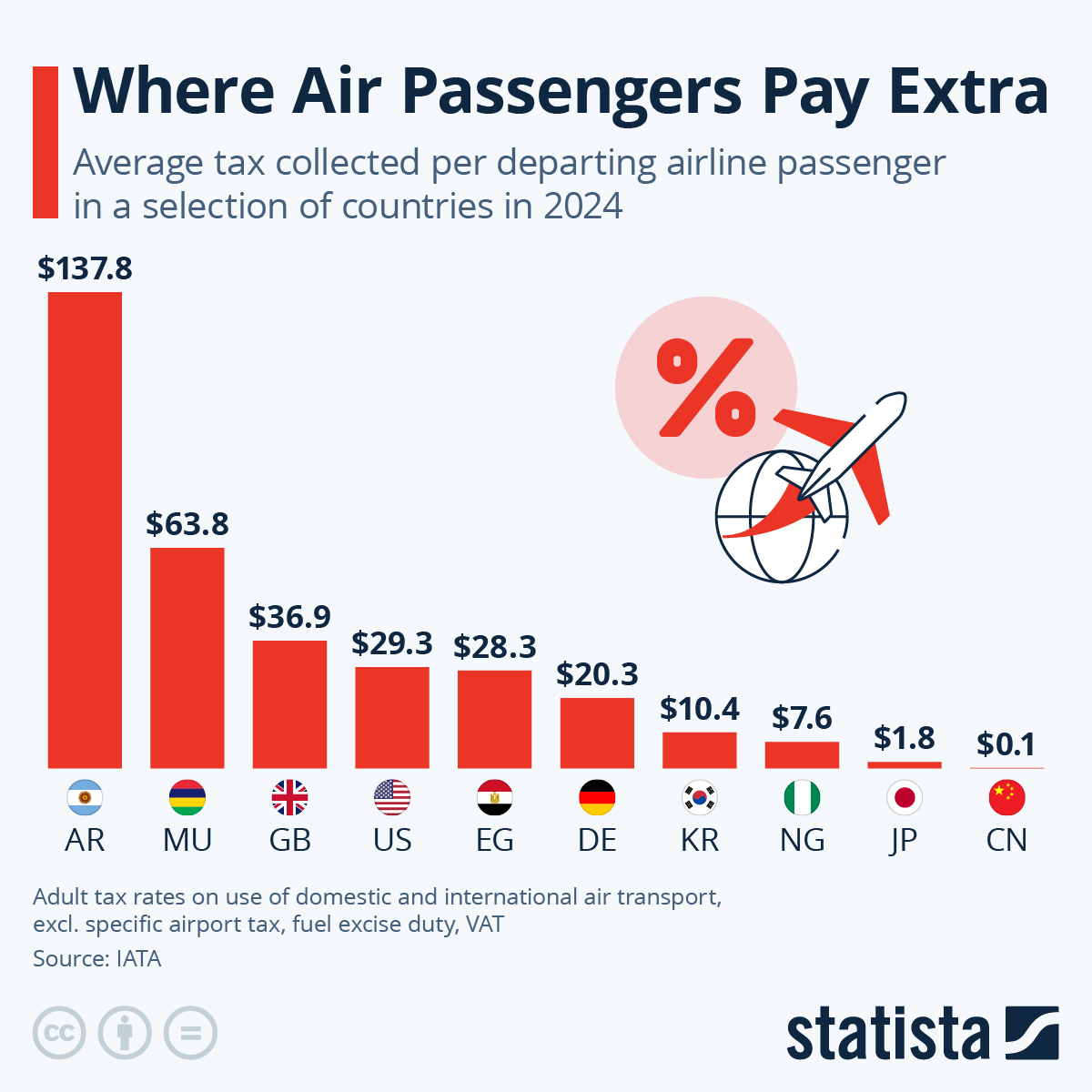
The burden on passengers varies dramatically by country. Based on IATA’s 2024 figures (adult tax rates on the use of domestic and international air transport, excluding specific airport taxes, fuel excise duty and VAT), the average specific tax collected per departing passenger in a selection of markets was:
-
Argentina (AR): USD 137.8
-
Mauritius (MU): USD 63.8
-
United Kingdom (GB): USD 36.9
-
United States (US): USD 29.3
-
Egypt (EG): USD 28.3
-
Germany (DE): USD 20.3
-
Republic of Korea (KR): USD 10.4
-
Nigeria (NG): USD 7.6
-
Japan (JP): USD 1.8
-
China (CN): USD 0.1
These figures highlight just how wide the spread is—from almost zero in some large markets to well over USD 100 per departing passenger in others.
The Caribbean sits in the middle of this global picture. In the combined South and Central America & Caribbean region, average specific taxes are estimated at around USD 19–20 per passenger per flight. Within that average, some individual Caribbean and nearby markets are closer to the higher end of the global scale—for example, the Dominican Republic at about USD 29.5 per departing passenger and Puerto Rico at around USD 7.2.
For a long-haul round trip, it is easy to see how these per-segment amounts add up. A visitor from Europe or North America connecting through a high-tax hub and then into the Caribbean can easily face USD 50–100 or more in specific ticket taxes alone, before airport charges, fuel, or airline margins are even considered.
This global comparison underlines a key point for Caribbean policymakers: air travel taxes in the region are not an isolated issue. They sit within a competitive landscape where other destinations can choose to tax more lightly—or more heavily—and where travelers, airlines and tour operators respond to those differences over time.
3. Why the Caribbean Is Uniquely Exposed
For many large countries, domestic travel can shift partially to road or rail if airfares rise. The Caribbean has no such luxury. Several structural features make the region particularly sensitive to air ticket taxes:
-
Tourism-Dependent Economies
In many Caribbean states, tourism directly and indirectly accounts for a large share of GDP and employment. International arrivals by air are the main gateway. If air travel costs rise due to higher taxes, there is a real risk that marginal tourists choose alternative destinations—Florida instead of The Bahamas, Mexico instead of a smaller island, a cruise instead of a fly-stay holiday. -
Small Island and Archipelagic Geography
Most Caribbean countries are islands or archipelagos. There are no cross-border highways or high-speed rail links. Ferries exist in some places, but they are not substitutes for long-haul access from North America or Europe. Air travel is not discretionary infrastructure—it is essential. -
Diaspora and VFR (Visiting Friends and Relatives) Travel
Caribbean communities abroad are significant: in the US, Canada, and the UK, Caribbean diaspora populations travel home regularly for family events, funerals, holidays, and investments. Ticket taxes raise the cost of staying connected with home, with a disproportionate impact on middle- and lower-income households. -
Limited Airline Competition and High Operating Costs
Thin routes and relatively small markets mean fewer airlines operate on many Caribbean routes compared to large global hubs. With higher fixed operating costs and less competition, added taxes can more easily make a route unprofitable—leading to reduced frequencies or complete withdrawal.
In this context, specific air travel taxes are not just a line on a ticket; they are a policy lever that can accelerate or slow the region’s development.
4. Anatomy of a Caribbean Ticket: How Taxes Show Up
A typical itinerary to the Caribbean—say, New York to Montego Bay, London to Barbados, or Toronto to Kingston—will often include a mix of:
-
Taxes imposed by the country of departure (e.g., security or passenger taxes in the US, Canada, or UK),
-
Airport and regulatory charges in the Caribbean destination,
-
Additional tourism, solidarity, or environmental levies that may be collected per international arriving or departing passenger.
For the passenger, these items are usually grouped under “taxes & fees” on an airline or travel website. Within that bundle, however, several components are government-imposed specific taxes, not airport cost-recovery charges and not VAT.
From a Caribbean government’s standpoint, specific ticket taxes are attractive because:
-
A substantial share of payers are non-residents (tourists),
-
Collection is outsourced to airlines and global distribution systems,
-
Revenues are relatively easy to forecast and administer.
But every dollar added in this way is a dollar added to the total cost of access to the destination.
5. Tourism Competitiveness: When Taxes Tip the Scale
The Caribbean competes in a crowded tourism marketplace:
-
Sun, sea, and sand are available in other regions too: Florida, Mexico, Central America, Mediterranean destinations, Indian Ocean islands, and Southeast Asia.
-
For a typical tourist from Europe or North America, the decision is a trade-off between total cost, travel time, perceived safety, and quality of experience.
In that decision-making process, airfare is a major component of the trip cost—especially for families and long-haul visitors. If specific ticket taxes, added on both sides of the journey, push the all-in airfare above competing destinations, demand can shift over time.
Some key dynamics:
-
Price-sensitive segments – Budget-conscious travellers and large families are acutely sensitive to increases in airfares. A USD 40–70 increase in taxes on a ticket can be the difference between a booking being made or abandoned.
-
Repeat visitors – For visitors who come annually, the perception that “Caribbean flights are getting too expensive” can erode loyalty and encourage experimentation with cheaper destinations.
-
Package holidays and tour operators – In markets like the UK, where packages dominate, higher departure and arrival taxes can push package prices up and make it harder for Caribbean resorts to maintain market share against lower-tax competitors.
Because tourism has extensive linkages—hotels, restaurants, entertainment, transport, agriculture and retail—even small reductions in arrivals can translate into noticeable impacts on employment, foreign exchange earnings, and tax receipts from other sources.
6. Equity and Social Impact: The Cost of Coming Home
Beyond tourism, ticket taxes have a human dimension that is especially sensitive in the Caribbean context.
Caribbean citizens living abroad travel home for:
-
Family events, weddings, funerals, and holidays;
-
Property management and small business activities;
-
Cultural and religious festivals;
-
Retirement planning and long-term return.
Fixed per-passenger taxes are inherently regressive: they take up a larger share of income for someone on a lower wage than for a high-income professional. When those taxes sit on top of relatively expensive long-haul fares, the impact on working-class diaspora families can be significant.
High air travel costs can:
-
Reduce the frequency of visits home;
-
Make urgent travel (for health or family emergencies) financially crippling;
-
Limit exposure of second-generation Caribbean children to their cultural roots.
In island states where international air travel is the only realistic way to leave or return, high specific ticket taxes can be seen as a de facto tax on mobility and opportunity.
7. Balancing the Fiscal Books: Small States, Big Trade-Offs
It would be unrealistic to argue that Caribbean governments should simply abolish air travel taxes and forgo the revenue. Most are small states with narrow tax bases, significant development needs, and high exposure to climate and natural disaster risks.
Specific ticket taxes often form part of a broader mix that includes:
-
VAT or general consumption taxes;
-
Import duties and excises;
-
Corporate and personal income taxation;
-
Tourism-related levies on hotels and services.
The real challenge is not “tax or no tax” but how much, how structured, and how aligned with wider economic goals.
Key trade-offs for Caribbean policymakers include:
-
Short-term revenue vs long-term growth – A higher tax per passenger may yield more revenue per arrival today but discourage arrivals over the medium term, reducing total tourism receipts and related tax collections elsewhere in the economy.
-
Fiscal simplicity vs competitiveness – It is administratively easy to “add a few dollars more” to a departure or arrival tax. It is harder, but often wiser, to structure taxes in a way that preserves competitiveness and minimises distortions.
-
Taxing residents vs non-residents – Many regimes are designed to fall mainly on foreign visitors, but in practice residents and diaspora travellers also pay. Equity considerations should be part of the debate.
For small island developing states, where tourism may contribute a large share of GDP and employment, the wrong calibration of air travel taxes can unintentionally slow growth, erode competitiveness, and ultimately weaken the fiscal position it was meant to protect.
8. Are “Green” Ticket Taxes Really Climate Policy?
The Caribbean stands on the frontline of climate change. Rising sea levels, more intense hurricanes, coastal erosion, and coral bleaching all threaten its economic model and long-term viability.
In this context, it is tempting to see air travel taxes as potential climate instruments—a way to price the environmental cost of aviation and raise funds for adaptation and resilience. But it’s important to distinguish:
-
Genuine carbon pricing mechanisms – where charges are linked explicitly to emissions or fuel burn, creating an incentive to reduce carbon intensity;
-
Generic ticket taxes labelled as “environmental” – fixed per-passenger charges that are not tied to emissions and where revenues are not necessarily used for climate-related spending.
If Caribbean countries want to use aviation as part of their climate financing strategy, three principles are critical:
-
Clear linkage to emissions or climate objectives – Taxes should be designed in a way that reflects actual environmental impact (for example, by distance or aircraft type), rather than simply adding a flat amount per passenger.
-
Transparent earmarking of revenues – Directing a meaningful share of collected funds to climate resilience projects, sustainable aviation fuels, or green infrastructure strengthens the legitimacy of such measures.
-
Avoiding double charging – International schemes like CORSIA already address aviation emissions on certain routes. Layering untargeted “green” ticket taxes on top can hurt connectivity without materially improving environmental outcomes.
Given their extreme climate vulnerability, Caribbean states have a strong moral and practical case for climate finance. But turning generic ticket taxes into de facto climate policy is not necessarily the most efficient or equitable approach.
9. Policy Options for Caribbean Governments
So what can Caribbean policymakers do to manage the “hidden price” of flying without undermining fiscal stability?
Here are several realistic directions:
a) Benchmark and Compare
Caribbean states should benchmark their air travel taxes against:
-
Regional competitors (other Caribbean islands, Mexico, Central America, Florida);
-
Similar tourism-dependent small states elsewhere (e.g., Indian Ocean islands, Mediterranean islands).
This helps identify cases where a country may have drifted into becoming a relatively high-tax destination without fully appreciating the competitiveness impact.
b) Simplify and Consolidate
Where possible, governments can:
-
Replace multiple overlapping small taxes with a single, transparent charge;
-
Reduce complicated banding structures that make system changes costly and hard to understand;
-
Separate cost-recovery charges (for security, airport infrastructure) from pure revenue-raising taxes in public communication.
Simplicity reduces compliance costs for airlines and makes it easier for travellers to see what they are paying for.
c) Calibrate Carefully for International Visitors
Since much of the burden falls on international passengers:
-
Caribbean governments can analyse price elasticity of key source markets (e.g., US, UK, Canada, Europe) to understand how sensitive arrivals are to ticket price changes.
-
For particularly competitive markets, they can consider lower or capped ticket taxes to support volume growth.
-
Seasonal calibration (lower rates in low season) can help smooth demand and support year-round employment.
d) Protect Residents and Essential Connectivity
Some countries introduce exemptions or reduced rates for:
-
Residents travelling within the region;
-
Essential travel (students, medical travel);
-
Regional integration initiatives (e.g., CARICOM travellers on intra-regional routes).
Such measures must be carefully designed to avoid abuse, but they can improve equity and social cohesion.
e) Coordinate at the Regional Level
Regional bodies and groupings (e.g., CARICOM, OECS) can:
-
Encourage dialogue on harmonising aspects of aviation taxation, to reduce destructive competition and large disparities;
-
Explore common principles—for example, avoiding sudden large increases that shock demand;
-
Coordinate on climate-related aviation policies to ensure coherence with adaptation financing and sustainable tourism strategies.
A coordinated Caribbean voice on aviation taxation also carries more weight in global climate and aviation forums.
10. Conclusion: Making Air Travel Taxes Work For the Caribbean
The “hidden price” of flying—the specific taxes on air tickets—may be invisible at first glance, but its effects are very real. For the Caribbean, the stakes are particularly high:
-
Tourism, foreign exchange earnings, and employment depend on affordable and reliable air access;
-
Diaspora communities need fair and feasible access to their home countries;
-
Governments need sustainable revenue without undermining long-term growth;
-
The region must navigate climate vulnerability while staying globally connected.
Specific air travel taxes are not inherently bad. They can play a legitimate role in a balanced fiscal system. But poorly designed or excessive ticket taxes can quietly erode the very foundations of Caribbean prosperity—tourism, connectivity, and human mobility.
A smarter Caribbean approach would:
-
Use data and benchmarking to calibrate taxes at levels that do not damage competitiveness;
-
Simplify and clarify tax structures to minimise administrative burden and passenger confusion;
-
Protect essential connectivity for residents and regional travellers;
-
Integrate aviation tax policy with tourism, trade, and climate strategies rather than treating it in isolation.
In short, the Caribbean cannot afford to ignore the hidden price of flying. Managing it thoughtfully is not just a technical tax issue—it is a core element of the region’s long-term development strategy.
About Dawgen Global
“Embrace BIG FIRM capabilities without the big firm price at Dawgen Global, your committed partner in carving a pathway to continual progress in the vibrant Caribbean region. Our integrated, multidisciplinary approach is finely tuned to address the unique intricacies and lucrative prospects that the region has to offer. Offering a rich array of services, including audit, accounting, tax, IT, HR, risk management, and more, we facilitate smarter and more effective decisions that set the stage for unprecedented triumphs. Let’s collaborate and craft a future where every decision is a steppingstone to greater success. Reach out to explore a partnership that promises not just growth but a future beaming with opportunities and achievements.
✉️ Email: [email protected] 🌐 Visit: Dawgen Global Website
📞 📱 WhatsApp Global Number : +1 555-795-9071
📞 Caribbean Office: +1876-6655926 / 876-9293670/876-9265210 📲 WhatsApp Global: +1 5557959071
📞 USA Office: 855-354-2447
Join hands with Dawgen Global. Together, let’s venture into a future brimming with opportunities and achievements


