Rethinking Business Continuity in a Complex World
In today’s volatile environment, organizations across industries face unprecedented disruptions. Natural disasters, cyberattacks, regulatory changes, pandemics, and reputational crises can all derail business operations in an instant. Traditional risk assessment models, while valuable, often fall short in addressing the interconnected nature of modern risks.
At Dawgen Global, we recognize that continuity is not just about surviving disruptions — it’s about sustaining confidence, protecting stakeholders, and ensuring long-term value creation. This recognition led us to develop the DAWGEN Resilience Matrix (DRM): an advanced model designed to move beyond simple probability and impact scores, offering a multi-dimensional framework for measuring, prioritizing, and mitigating risks.
The DRM is not just a tool; it is a strategic methodology that integrates business impact, digital dependencies, reputational dynamics, and human safety considerations into a single, actionable framework.
Why Traditional Risk Matrices Fall Short
Most organizations rely on a simple two-dimensional risk assessment matrix, plotting probability against impact. While intuitive, this approach presents several limitations:
-
Over-simplification: Complex risks such as cybercrime or reputational crises cannot be adequately captured by only two variables.
-
Static nature: Probability and impact assessments are often updated annually, failing to reflect the dynamic pace of emerging threats.
-
Blind spots: Non-financial risks such as employee well-being, data integrity, and stakeholder trust are not always factored into decision-making.
-
Subjectivity: Traditional models often leave too much room for subjective interpretation, leading to inconsistent results across departments.
To thrive in today’s interconnected landscape, organizations require a richer, multi-axis approach that reflects both quantitative and qualitative dimensions of resilience.
Introducing the DAWGEN Resilience Matrix (DRM)
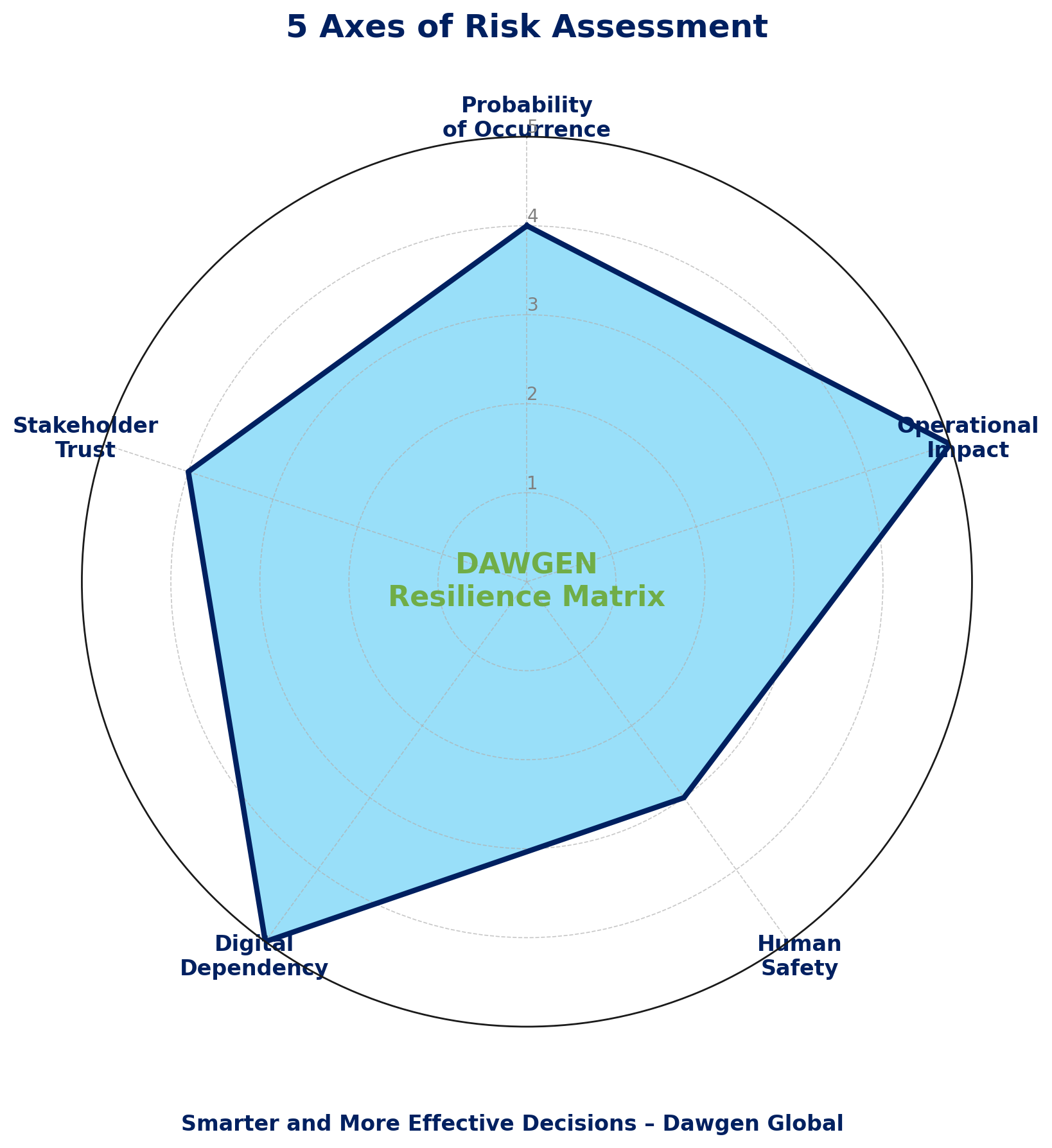
The DRM is a five-axis model that extends beyond probability and impact to capture the full spectrum of business vulnerabilities.
The five axes are:
-
Probability of Occurrence – likelihood of the risk materializing.
-
Operational Impact – effect on critical processes and continuity.
-
Human Safety Impact – risks to employees, contractors, and communities.
-
Digital Dependency Impact – exposure to cyber, IT, and system vulnerabilities.
-
Brand & Stakeholder Trust Impact – potential reputational and regulatory fallout.
Each risk is scored on a 1–5 scale across all axes. These are then weighted using Dawgen’s proprietary Weighted Risk Multiplier (WRM) to generate a composite Resilience Score.
This allows organizations to:
-
Prioritize risks with a holistic perspective.
-
Identify “silent killers” (e.g., reputational damage from a data breach).
-
Balance investments between preventive, detective, and corrective controls.
The DRM Methodology Step by Step
Step 1: Identify Risks
Risks are identified across categories such as:
-
Natural threats (storms, floods, earthquakes).
-
Technological threats (cyberattacks, system outages, data corruption).
-
Operational threats (supply chain breakdown, strikes).
-
Reputational threats (regulatory fines, media crises).
-
Human threats (pandemics, workplace safety).
Step 2: Score Each Axis
Each identified risk is assessed across the five DRM axes, using a structured scoring guideline. For example:
-
Human Safety Impact (4): Pandemic risk may not immediately disrupt systems but can severely impact workforce availability.
-
Digital Dependency Impact (5): Ransomware attack scores highest due to total reliance on digital platforms.
Step 3: Apply the Weighted Risk Multiplier
The WRM introduces weightings based on industry sector and organizational priorities. For example:
-
A financial institution may assign higher weights to Digital Dependency and Stakeholder Trust.
-
A manufacturing company may emphasize Operational Impact and Human Safety.
Step 4: Prioritize and Map Risks
Risks are plotted into a Resilience Heat Map, highlighting which require urgent mitigation versus long-term monitoring.
Step 5: Design Mitigation Strategies
Each prioritized risk is paired with specific controls under three categories:
-
Preventive: controls to reduce likelihood (cybersecurity protocols, redundancy systems).
-
Detective: controls to identify risk early (threat intelligence, monitoring systems).
-
Corrective: controls to recover quickly (disaster recovery sites, communication playbooks).
Practical Application of the DRM
Case Example 1: Cybersecurity in Financial Services
A regional bank applied DRM to assess its exposure to cybercrime. Traditional risk matrices flagged cyberattacks as “high probability, high impact.” But the DRM revealed far more nuance:
-
Human Safety Impact: Low (1)
-
Operational Impact: Very High (5)
-
Digital Dependency Impact: Very High (5)
-
Stakeholder Trust Impact: High (4)
Weighted with the WRM, cybercrime became the #1 priority risk, prompting investment in advanced threat detection and a customer reassurance communication strategy.
Case Example 2: Manufacturing Supply Chain Disruption
A manufacturing firm faced disruptions due to geopolitical tensions. Traditional risk matrices underplayed this as “medium probability, medium impact.” Using DRM:
-
Operational Impact: High (4)
-
Human Safety Impact: Medium (3)
-
Digital Dependency Impact: Medium (3)
-
Stakeholder Trust Impact: High (4)
This pushed supply chain resilience into the top tier of priorities, leading to supplier diversification and digital logistics tracking systems.
Implementing the DRM in Your Organization
Successful adoption of the DRM requires embedding it into broader Business Continuity Management (BCM). Key steps include:
-
Executive Buy-In: Leadership must understand and support the shift from traditional models to DRM.
-
Training: Risk managers and department heads should be trained on DRM scoring and WRM application.
-
Integration: DRM should align with Business Impact Analyses (BIA) and Business Continuity Plans (BCP).
-
Technology Enablement: Dashboards and reporting tools should be used to visualize Resilience Heat Maps.
-
Annual Refresh: Risks and weightings must be revisited annually or after major organizational changes.
Benefits of the DAWGEN Resilience Matrix
Adopting the DRM provides tangible organizational benefits:
-
Holistic Insight: Captures financial, human, digital, and reputational impacts.
-
Strategic Prioritization: Ensures resources target the most critical risks.
-
Flexibility: Customizable weightings reflect industry and organizational realities.
-
Regulatory Confidence: Demonstrates robust, forward-looking risk management.
-
Resilient Culture: Promotes awareness of non-financial risks such as trust and safety.
Overcoming Challenges in Adoption
Transitioning from a traditional matrix to DRM may encounter challenges, such as:
-
Cultural resistance: Some stakeholders may prefer the simplicity of two-axis models.
-
Data availability: Scoring digital and reputational impacts may require new data sources.
-
Integration: DRM must be embedded into existing BCPs and risk reporting processes.
Dawgen Global assists organizations by providing customized implementation support, including workshops, sector-specific weightings, and digital tools for DRM deployment.
The Future of Business Continuity Risk Assessment
As businesses become more digitized and stakeholder expectations rise, resilience will be judged not only by how quickly organizations recover, but also by how responsibly they manage risks before they materialize.
The DRM positions organizations to:
-
Pre-empt risks rather than react.
-
Safeguard brand equity as much as physical assets.
-
Adapt continuously to an evolving risk landscape.
This model reflects Dawgen Global’s belief that risk assessment must evolve into resilience assessment — a forward-looking, stakeholder-centered approach.
Conclusion
The DAWGEN Resilience Matrix offers organizations a breakthrough methodology for risk assessment, transcending the limitations of traditional probability-impact matrices. By considering probability, operational impact, human safety, digital dependency, and stakeholder trust, the DRM ensures that organizations are not just compliant, but genuinely resilient.
In a world where risks are interconnected and disruptions unavoidable, resilience is the true currency of trust and continuity.
Next Step:
At Dawgen Global, we specialize in helping organizations across the Caribbean and beyond build resilient business models that protect value and inspire stakeholder confidence.
👉 Request a Free Consultation Today – Let our experts show you how the DAWGEN Resilience Matrix can transform your risk assessment and continuity planning.
👉 Submit an RFP – Whether you need a full Business Continuity Plan, a customized DRM deployment, or resilience advisory services, Dawgen Global is ready to partner with you.
📧 Connect with Us: [email protected]
🔗 Discover More: https://dawgen.global
📞 Jamaica Caribbean Office: 876-9293670 / 1876-6655926
📞 USA Office: 855-354-2447
💬 WhatsApp Global: +1 555 795 9071
At Dawgen Global, we help you make Smarter and More Effective Decisions.
About Dawgen Global
“Embrace BIG FIRM capabilities without the big firm price at Dawgen Global, your committed partner in carving a pathway to continual progress in the vibrant Caribbean region. Our integrated, multidisciplinary approach is finely tuned to address the unique intricacies and lucrative prospects that the region has to offer. Offering a rich array of services, including audit, accounting, tax, IT, HR, risk management, and more, we facilitate smarter and more effective decisions that set the stage for unprecedented triumphs. Let’s collaborate and craft a future where every decision is a steppingstone to greater success. Reach out to explore a partnership that promises not just growth but a future beaming with opportunities and achievements.
✉️ Email: [email protected] 🌐 Visit: Dawgen Global Website
📞 📱 WhatsApp Global Number : +1 555-795-9071
📞 Caribbean Office: +1876-6655926 / 876-9293670/876-9265210 📲 WhatsApp Global: +1 5557959071
📞 USA Office: 855-354-2447
Join hands with Dawgen Global. Together, let’s venture into a future brimming with opportunities and achievements


