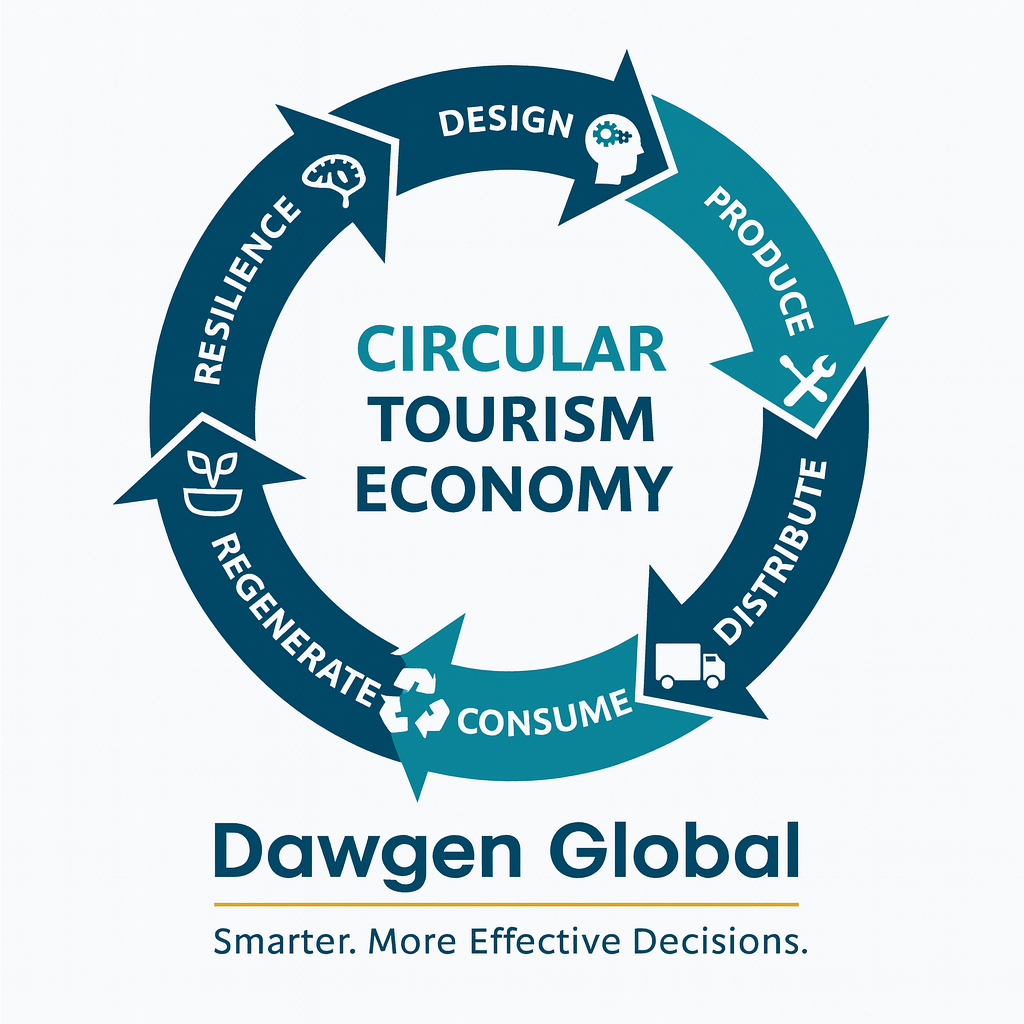
How Jamaica and the wider Caribbean can turn sustainability into margins—while keeping more visitor spend at home
Why resilience and circularity are business imperatives (not PR)
Tourism in the Caribbean is exquisitely exposed: hurricanes, droughts, supply chain shocks, fuel spikes, and disease outbreaks can stall operations overnight. These are not edge cases—they are recurring features of our operating environment. The strategic response is to build resilience (the ability to absorb shocks and continue operating) and adopt a circular economy approach (designing out waste, keeping materials and products in use, and regenerating natural systems). Done properly, resilience and circularity increase local content, reduce costs, and create new revenue streams for Micro, Small and Medium Tourism Enterprises (MSTEs)—expanded here on first use as Micro, Small and Medium Tourism Enterprises.
This article is a practical playbook for ministries, Destination Management Organizations (DMOs)—expanded here as Destination Management Organizations—hotel groups, attractions, and community partners. We define the core opportunities across waste, energy, and water, align them with finance and procurement, and show how to measure results through Monitoring, Evaluation, Accountability, and Learning (MEAL)—expanded here as Monitoring, Evaluation, Accountability, and Learning.
The value thesis: circularity pays three ways
-
Lower operating costs—less energy and water consumption; reduced waste hauling and landfill fees.
-
Higher reliability—onsite or near-site resources (solar, storage, water reuse) cushion supply disruptions.
-
More local value—new demand for local recycling, upcycling, maintenance, and efficiency services grows domestic supply chains.
When circularity underwrites reliability and cost, “sustainability” stops being a compliance line item and becomes a profit-and-loss (P&L) advantage.
A practical framework: WR²E (Waste, Resilience, Renewable, Efficiency)
We organize action into four interconnected workstreams that hotels, attractions, cruise terminals, airports, and tour operators can adopt simultaneously.
-
Waste-to-Value (W→V): reduce, segregate, and convert waste streams (organics, glass, plastics, metals, textiles) into inputs for local enterprises.
-
Resilience (R): build backup capacity and procedures—Business Continuity Planning (BCP) (expanded here as Business Continuity Planning), insurance, diversified suppliers, and logistics fallbacks.
-
Renewable (R): deploy solar photovoltaic and thermal, battery storage, and biogas where feasible.
-
Efficiency (E): optimize energy, water, and materials through audits, retrofits, and operational controls.
Each workstream creates bankable opportunities for MSTEs—maintenance contractors, recyclers, composters, glass upcyclers, water-treatment providers, and efficiency specialists.
Waste-to-Value: from disposal cost to local enterprise
1) Organics → Compost & Biogas
-
Opportunity: Food prep waste, plate scrapings, landscape trimmings.
-
Solution: Source-separated organics collected by certified MSTEs; compost sold to farms and landscaping; high-volume sites may feed anaerobic digesters for biogas.
-
Supplier pathway: Train local operators in safe handling, odor control, and quality specifications; provide micro-grants for bins and collection vehicles via Results-Based Grants (RBGs)—expanded here as Results-Based Grants.
-
Buyer benefit: Lower waste fees; compost closes the nutrient loop with local farms that supply the resort.
2) Glass → Cullets, Tiles, and Hospitality Amenities
-
Opportunity: Bottles from bars and restaurants.
-
Solution: On-site or hub-based crushing; cullet sold to local manufacturers (tiles, terrazzo, glass-sand for landscaping); safe, branded amenity jars for bathrooms.
-
Supplier pathway: Micro-leasing of crushers; quality protocols to avoid contaminants; brand collaboration for upcycled guest-facing goods.
3) Plastics & Metals → Recyclate & Upcycled SKUs
-
Opportunity: PET bottles, HDPE containers, aluminum cans, and kitchen metals.
-
Solution: Segregation stations; baling; sale to local recyclers; upcycled amenities (e.g., dispensers, planters).
-
Supplier pathway: Contracts with Aggregation Hubs (shared logistics) to reach viable volumes; digital weighbridge logs feeding KPIs.
4) Linens & Textiles → Secondary Use
-
Opportunity: Retired sheets, towels, uniforms.
-
Solution: Local cut-and-sew MSTEs convert textiles into cleaning cloths, tote bags, or community products that meet hotel durability standards.
Stock-Keeping Unit (SKU) is expanded here on first use as Stock-Keeping Unit, the unique code for catalogued products.
KPIs to track (definitions below):
-
Waste Diversion Rate (%), Cost per Tonne Managed (US$), Recycled Content in Amenities (%), Local Spend on W→V (US$).
Energy: reliability first, savings always
1) Solar + Storage for Critical Loads
-
Design: Size solar photovoltaic and battery systems to cover critical loads (kitchens, IT, water pumps, emergency lighting) for 4–8 hours.
-
Commercial model: Power Purchase Agreement (PPA)—expanded here as Power Purchase Agreement—with performance guarantees; or capex-light lease-to-own.
-
Local content: MSTEs deliver cleaning, monitoring, and minor maintenance; larger engineering firms handle commissioning.
2) Solar Thermal for Hot Water
-
Use cases: Laundry, kitchens, guest rooms.
-
Quick win: Predictable paybacks, reduces fuel and electricity bills, lowers carbon profile.
3) Building Management System (BMS) & Controls
-
BMS—expanded here as Building Management System—optimizes HVAC schedules, chiller sequencing, and lighting; motion sensors and guest-room controls curb waste.
-
Tiered rollout: Start with high-ROI zones (back-of-house, corridors) before guest rooms.
4) Energy Efficiency Retrofits
-
Measures: LED lighting, efficient chillers, variable speed drives, insulation, door/window seals, kitchen hood controls.
-
MSTE angle: Audits, LED relamping, filter services, and preventive maintenance contracts.
KPIs:
-
Energy Intensity (kWh/occupied room-night), Peak Demand Reduction (%), Renewable Share (%), Avoided Outage Hours (hrs).
Water: security through efficiency and reuse
1) Audit → Fix → Retrofit
-
Baseline: Meter by major uses (laundry, kitchens, pools, irrigation).
-
Fix: Repair leaks, optimize pressure, install low-flow fixtures and pre-rinse spray valves in kitchens.
-
Retrofit: Greywater systems for irrigation; rainwater harvesting where roofs allow.
2) Laundry Optimization
-
Interventions: Ozone systems, heat recovery, right-sized loads, detergent optimization.
-
Supplier model: Local water-efficiency MSTEs provide audits and service contracts.
3) Pools & Landscaping
-
Efficiency: Covers to reduce evaporation; smart irrigation based on soil moisture; native or drought-tolerant plantings.
KPIs:
-
Water Intensity (litres/occupied room-night), Reused/Harvested Water Share (%), Leakage Loss (litres), Water-Related Downtime (hrs).
Resilience: procedures and partnerships that keep doors open
1) Business Continuity Planning (BCP)
-
Scope: Power, water, cold chain, communications, staff safety, and guest evacuation.
-
Drills: Quarterly rehearsals for hurricanes and extended outages; cross-train staff for critical roles.
2) Supplier Diversification and Buffer Stocks
-
Dual sourcing: Maintain two qualified suppliers for high-risk categories (produce, seafood, bakery).
-
Buffer: Aggregation Hubs hold 24–72 hours of critical inputs (packaged water, dry goods, medical kits).
3) Insurance & Risk Transfer
-
Parametric weather insurance: Fast payouts based on windspeed/rainfall thresholds—vital for fisheries and farms.
-
Transit insurance: Protect waste-to-value logistics and cold chain.
KPIs:
-
Days to Operational Recovery, Orders Fulfilled During Shock (%), Insurance Coverage Adequacy (yes/no), BCP Drill Score (0–100).
Procurement that makes circular the default (without raising risk)
-
Category specs: Bake waste, energy, and water requirements into Requests for Quotation (RFQs)—expanded here as Requests for Quotation—and supplier scorecards.
-
Preferred product lists: Refillable amenities, recycled paper, certified compostable liners where appropriate.
-
Service contracts: Multi-year agreements for recycling, compost, solar O&M (operations and maintenance), and water services with Service-Level Agreements (SLAs)—expanded here as Service-Level Agreements.
-
Verification: Third-party audits; digital logs (weights, temperatures, kWh, litres) feeding dashboards.
Finance to scale circular solutions (with performance triggers)
Link the following to verified performance data from the sourcing portal and facility meters:
-
Credit Guarantees (CGs)—expanded here as Credit Guarantees—for MSTEs delivering efficiency or waste services, de-risking bank loans for equipment (crushers, balers, vehicles).
-
Results-Based Grants (RBGs): reimburse certifications (e.g., food safety for compost operations), installation of sub-metering, or commissioning of solar hot water—after verified performance.
-
Invoice Financing (IF)—expanded here as Invoice Financing—for service invoices approved by hotels and attractions, reducing cash-flow stress.
-
Purchase-Order Finance (POF)—expanded here as Purchase-Order Finance—for upfront materials (bins, liners, meters).
-
Micro-leasing: lease-to-own for chillers, pumps, compactors, and solar thermal collectors.
Pricing tiers tied to KPIs: High performers (e.g., ≥95% On-Time In-Full (OTIF)—expanded here as On-Time In-Full—service delivery and verified diversion rates) get lower finance costs.
MEAL for circularity: indicators, data sources, cadence
Key Performance Indicators (KPIs)—expanded here as Key Performance Indicators—with definitions:
-
Waste Diversion Rate (%): (Weight diverted from landfill ÷ Total waste) × 100.
-
Source: Weighbridge tickets, recycler receipts, compost logs.
-
-
Energy Intensity (kWh/occupied room-night): Total electricity ÷ occupied room-nights.
-
Source: Utility meters, sub-meters, Building Management System (BMS) logs.
-
-
Renewable Share (%): (kWh from renewables ÷ total kWh) × 100.
-
Water Intensity (litres/occupied room-night).
-
Reused/Harvested Water Share (%).
-
Avoided Outage Hours (hrs): Hours critical loads kept online by storage/backup during grid failures.
-
Local Circular Spend (US$): Purchases from MSTEs for waste, energy, and water services.
-
Emission Intensity (kg CO₂e/occupied room-night): Optional but valuable, calculated from fuel/electricity usage factors.
-
Guest Experience Score—Sustainability (0–10): Guest survey item; correlate with repeat intent.
-
Supplier Graduation (#): Number of circular-service MSTEs moving to multi-property contracts.
Cadence:
-
Monthly: Ops dashboard (engineering + procurement).
-
Quarterly: Executive dashboard and Learning Review (the “L” in MEAL) to adjust targets and budgets.
-
Annually: Independent evaluation; integrate results into the Tourism Satellite Account (TSA)—expanded here as Tourism Satellite Account—and the public sector Planning, Monitoring, Evaluation, and Reporting System (PMES)—expanded here as Planning, Monitoring, Evaluation, and Reporting System.
Category playbooks (ready to deploy)
A) Kitchens & F&B (Food and Beverage—expanded here as Food and Beverage)
-
Quick wins: LED back-of-house, pre-rinse spray valves, induction cooktops for stations, batch cooking to reduce waste.
-
Waste: Organics segregation; oil recovery to biodiesel suppliers; glass/plastic stations at source.
-
Water/Energy: Heat-recovery from dishwashers; sensor-based hood controls.
B) Housekeeping & Laundry
-
Quick wins: Towel/linen reuse programs (with guest-facing communication), ozone laundry, low-flow showerheads.
-
Waste: Textile upcycling partnerships; refillable amenities.
-
Water: Leak audits, flushometer calibrations.
C) Landscaping & Pools
-
Quick wins: Drip irrigation; evap covers; native plant palette.
-
Waste: Compost from organics; glass-sand for landscaping.
-
Water: Rain harvesting and greywater for irrigation.
D) Tours & Experiences
-
Quick wins: Vehicle maintenance for efficiency; route optimization; refill stations to cut single-use plastics.
-
Waste: Pack-in/pack-out protocols; partnership with recyclers at trailheads.
-
Resilience: Satellite communication kits for remote excursions; safety drills logged in the portal.
Guest engagement that drives adoption (and bookings)
-
Visible commitments: Lobby dashboards showing today’s diversion, renewable generation, and water savings.
-
Choice architecture: Default to reusable bottles and dispensers; single-use only on request.
-
Sense of place: Upcycled glassware and local craft in rooms (labeled with the MSTE partner story).
-
Feedback loop: Net Promoter Score (NPS)—expanded here as Net Promoter Score—items tied to sustainability features; share highlights in pre-arrival emails.
Governance: who does what
-
Ministry/DMO: Set circular standards in category specs; coordinate Aggregation Hubs; publish public dashboards.
-
Hotel/Attraction Groups: Sign multi-year service contracts; standardize bins, labels, and metering across properties; enforce OTIF.
-
Standards Agency: Issue circular quality marks (e.g., audited diversion rates, safe compost operations).
-
Finance Partners: Operate CG/RBG/IF/POF and micro-leasing with Application Programming Interface (API)—expanded here as Application Programming Interface—links to the portal for verification.
-
Supplier Development Centres (SDCs): Train MSTEs on safety, metering, reporting, and bid preparation.
Risk management (designed-in controls)
-
Contamination risk (waste): Clear signage; color-coded bins; periodic audits; penalties for repeated contamination.
-
Under-performance (energy/water): Performance-based contracts; metered baselines and guarantees; corrective-action clauses.
-
Health & safety (organics): Temperature logs; pest management; protective equipment; incident reporting.
-
Data integrity: Automated meter reads where possible; reconciliation routines; third-party verification for public reporting.
-
Cybersecurity (BMS/API): Role-based permissions, Multi-Factor Authentication (MFA)—expanded here as Multi-Factor Authentication—and incident response playbooks.
180-day launch plan
Days 0–30: Baseline & Targets
-
Conduct energy/water/waste audits for top five sites; set Year-1 targets per KPI.
-
Choose two Waste-to-Value categories (organics + glass) and one efficiency retrofit (LED/BMS zone).
Days 31–90: Contracts & Finance
-
Publish RFQs with circular specs; award first recycling/compost contracts with SLAs.
-
Stand up RBG/CG/IF rails with performance triggers tied to verified diversion/consumption data.
Days 91–135: Build & Operate
-
Install segregation stations, metering, and first solar-thermal arrays; launch towel/linen reuse revamp.
-
Train MSTE partners; begin monthly dashboarding; run first BCP drill.
Days 136–180: Scale & Share
-
Add plastics/metal stream; roll out laundry optimization; publish public scorecard; celebrate supplier success stories; adjust targets based on learning.
Frequently asked questions
Will circularity raise costs?
Initial investments may be needed, but most measures pay back fast (LEDs, spray valves, solar thermal). Waste-to-Value lowers hauling fees and can create revenue. With Invoice Financing (IF) and Credit Guarantees (CGs), MSTEs scale without straining cash.
Is quality at risk with upcycled products?
Not if standards are explicit. Pilot runs, durability testing, and Service-Level Agreements (SLAs) keep guest experience paramount.
What if properties lack space for segregation?
Use compact indoor stations and frequent collection to Aggregation Hubs. The constraint is design, not feasibility.
How do we avoid greenwashing?
Meter it, log it, verify it. Publish quarterly dashboards; tie finance pricing to verified performance.
How Dawgen Global helps deliver circular profit
-
Strategy to contract: We convert circular goals into category specs, RFQs, and SLAs buyers can sign.
-
Supplier enablement: We coach MSTEs to bid, comply, and report—turning waste and efficiency into bankable services.
-
Finance structuring: We stand up RBG/CG/IF/POF and micro-leasing with API verification.
-
MEAL & dashboards: We build the data spine, KPIs, and quarterly learning routines that keep improvements compounding.
-
Change management: We align engineering, procurement, housekeeping, and F&B so circularity sticks.
Next Step!
Resilience and circular economy are not side projects—they are how competitive destinations operate. By turning waste into inputs, energy into a predictable cost, and water into a managed cycle, Jamaica and the wider Caribbean can cut expenses, withstand shocks, and create vibrant markets for local enterprises.
If you’re ready to launch a 180-day circularity sprint that leaves behind real contracts, capable suppliers, and verified results, Dawgen Global can blueprint, finance, and operationalize the program—so sustainability shows up where it matters most: on your P&L and in your communities.
About Dawgen Global
“Embrace BIG FIRM capabilities without the big firm price at Dawgen Global, your committed partner in carving a pathway to continual progress in the vibrant Caribbean region. Our integrated, multidisciplinary approach is finely tuned to address the unique intricacies and lucrative prospects that the region has to offer. Offering a rich array of services, including audit, accounting, tax, IT, HR, risk management, and more, we facilitate smarter and more effective decisions that set the stage for unprecedented triumphs. Let’s collaborate and craft a future where every decision is a steppingstone to greater success. Reach out to explore a partnership that promises not just growth but a future beaming with opportunities and achievements.
✉️ Email: [email protected] 🌐 Visit: Dawgen Global Website
📞 📱 WhatsApp Global Number : +1 555-795-9071
📞 Caribbean Office: +1876-6655926 / 876-9293670/876-9265210 📲 WhatsApp Global: +1 5557959071
📞 USA Office: 855-354-2447
Join hands with Dawgen Global. Together, let’s venture into a future brimming with opportunities and achievements


