
The Breach That Crossed Borders
A well-respected corporate law practice in a prominent Caribbean offshore financial centre had advised international clients on corporate structuring, trust administration, intellectual property holding arrangements, and regulatory compliance for over two decades. The firm’s client roster included Fortune 500 corporations, sovereign wealth funds, family offices, and high-net-worth individuals from across three continents. Discretion was not merely a professional obligation — it was the foundation upon which the firm’s reputation and livelihood depended.
The breach began, as many do, with a compromised email account. A junior associate’s credentials were harvested through a phishing email that mimicked a communication from the territory’s bar association. Using the compromised account, the attackers spent four weeks mapping the firm’s internal email communications, identifying high-value client relationships, and accessing documents stored in the firm’s email-based document sharing system — a practice the firm had adopted for convenience despite knowing it fell short of security best practice.
The attackers ultimately exfiltrated approximately 1.2 terabytes of data, including corporate formation documents, trust deeds, beneficial ownership information, board minutes, financial statements, and privileged legal correspondence. Two months later, a selection of these documents appeared on a leak site operated by the attacking group, accompanied by a demand for US$3.5 million to prevent the release of the complete archive.
The fallout was catastrophic and multi-jurisdictional. Clients in Europe, North America, and Asia discovered that their most sensitive corporate and personal financial information had been compromised through a law firm they had trusted with their most confidential affairs. Regulatory investigations were launched in multiple jurisdictions. The territory’s financial services commission opened a formal inquiry into the firm’s data security practices. International media coverage cast the territory’s entire offshore financial services sector in an unflattering light, amplifying concerns about the security of data entrusted to Caribbean service providers.
The compromised law firm, though fictional, represents a scenario that has become an urgent concern across the Caribbean’s offshore financial services industry. The sector’s unique combination of extremely sensitive data, international client bases, regulatory scrutiny, and reputational dependence on confidentiality makes it among the highest-consequence targets for cybercriminals.
The Crown Jewel Target: Caribbean Offshore Financial Services
The Caribbean’s offshore financial services sector represents a critical pillar of economic activity for numerous territories across the region. The Cayman Islands, the British Virgin Islands, Barbados, the Bahamas, Bermuda, and several other jurisdictions host financial services industries that contribute substantially to national revenue, employment, and international economic connectivity.
These centres provide legitimate and essential services to the global economy: corporate structuring for international businesses, investment fund administration, insurance and reinsurance services, trust and estate planning, and wealth management. The data generated and held by the law firms, accounting practices, corporate service providers, registered agents, and financial institutions that constitute this ecosystem is extraordinarily valuable — both to the clients it serves and to the threat actors who would exploit it.
The nature of the data held by Caribbean offshore service providers makes it uniquely attractive to cybercriminals. Beneficial ownership information — the identities of the individuals who ultimately own and control corporate structures — is among the most sensitive categories of financial data globally. Trust documentation revealing family wealth arrangements, succession planning, and asset protection strategies represents information that clients have entrusted to their service providers on the explicit understanding that confidentiality will be maintained absolutely. Legal correspondence protected by attorney-client privilege contains strategic business decisions, regulatory considerations, and dispute-related information that could cause severe harm if disclosed.
For threat actors, this data serves multiple exploitation pathways. It can be used for direct extortion, with the threat of public disclosure compelling payment. It can be sold to intelligence brokers, corporate espionage operators, or hostile litigation parties. It can be used to facilitate identity theft, financial fraud, or social engineering attacks against the individuals and entities whose information has been compromised. And its release can be used as a tool of geopolitical pressure, economic warfare, or journalistic investigation — as several high-profile international leak incidents involving offshore data have demonstrated.
The Threat Landscape for Professional Service Firms
Professional service firms operating in Caribbean offshore financial centres face a threat landscape that combines the general cybersecurity risks faced by all organisations with sector-specific threats driven by the unique value of the data they hold.
Advanced Persistent Threats: The most sophisticated attacks against offshore financial service providers are conducted by advanced persistent threat groups — well-resourced, patient, and technically capable actors who are willing to invest weeks or months in gaining and maintaining access to target networks. These groups may be motivated by financial gain, intelligence gathering, or ideological opposition to offshore financial services. Their patience and capability mean that conventional perimeter defences are often insufficient.
Targeted Ransomware and Extortion: Ransomware operators have recognised that professional service firms holding highly confidential client data are among the most likely to pay ransoms, both to restore operational capability and to prevent data exposure. The double extortion model — encrypting systems while simultaneously threatening to leak exfiltrated data — is particularly effective against firms whose entire business model depends on client confidentiality.
Business Email Compromise: Law firms and corporate service providers routinely send and receive instructions for high-value financial transactions via email. BEC attacks that intercept or spoof these communications can redirect corporate funds, alter banking instructions, or authorise fraudulent transactions. The complexity of multi-jurisdictional corporate structures can make it difficult to verify instructions through alternative channels, creating windows of vulnerability that attackers exploit.
Insider Threats: The high value of the data held by offshore service providers creates insider threat risk. Disgruntled employees, departing staff, or individuals who have been recruited or coerced by external actors may seek to exfiltrate client data for personal gain, competitive advantage, or ideological reasons. In smaller Caribbean firms where access controls may be less rigorously implemented, the insider threat surface can be significant.
Nation-State Espionage: Caribbean offshore financial centres may attract the attention of foreign intelligence services seeking economic intelligence, seeking to identify the financial arrangements of targeted individuals, or seeking to undermine the reputation of competing financial centres. While this threat is difficult to quantify, it represents a credible risk for firms serving internationally prominent clients.
Professional Obligations and Regulatory Expectations
Caribbean offshore professional service firms operate under a complex web of professional and regulatory obligations that increasingly encompass cybersecurity and data protection.
Professional secrecy and confidentiality obligations — derived from common law, statute, and professional codes of conduct — impose affirmative duties on attorneys, accountants, and regulated service providers to protect client information. A cybersecurity breach that results in client data exposure is not merely an operational failure; it is a potential breach of professional duty that can trigger disciplinary proceedings, professional liability claims, and loss of professional standing.
Financial services regulators in Caribbean offshore centres have significantly elevated their cybersecurity expectations for regulated entities. The Cayman Islands Monetary Authority, the British Virgin Islands Financial Services Commission, the Central Bank of the Bahamas, and their counterparts across the region have issued guidance, rules, or regulations that establish specific expectations around cybersecurity governance, risk management, and incident reporting. Registered agents and corporate service providers are subject to anti-money laundering regulations that implicitly require the security of client identification and due diligence records.
International regulatory cooperation means that cybersecurity failures at Caribbean offshore firms can trigger regulatory scrutiny in the jurisdictions where their clients are domiciled. Tax authorities, securities regulators, and financial crime enforcement agencies in the United States, the European Union, and other major jurisdictions may pursue investigations that extend to the Caribbean service provider’s data security practices.
The reputational dimension is perhaps the most powerful driver of all. Caribbean offshore financial centres depend on their reputations for professionalism, regulatory quality, and confidentiality to attract and retain international business. A major cybersecurity incident at a prominent firm can damage the reputation of the entire jurisdiction, affecting all firms operating within it. This shared reputational exposure creates both collective vulnerability and collective incentive for industry-wide security improvement.
The Unique Security Challenges of Professional Service Firms
Professional service firms in Caribbean offshore centres face several security challenges that distinguish them from other organisational types.
Document-centric operations create particular vulnerabilities. Law firms, accounting practices, and corporate service providers produce, store, and transmit enormous volumes of sensitive documents. The need for professionals to access these documents from multiple locations, share them with clients and counterparties, and collaborate on them across time zones creates pressure for convenient document management solutions that may not align with security best practices.
Partnership structures can complicate security governance. In many professional service firms, partners exercise significant autonomy in their practice management, technology choices, and client interaction methods. This autonomy, while important for professional effectiveness, can create inconsistencies in security practices across the firm and make it difficult to enforce uniform security standards.
Client expectations can create security tensions. Clients may demand immediate access to documents, insist on communication through insecure channels, or resist security measures that they perceive as impeding the speed and convenience of service delivery. Balancing client service expectations with security requirements demands diplomatic skill and clear communication about why security measures serve client interests.
Cross-border collaboration requirements introduce complexity. Multi-jurisdictional transactions require the sharing of documents and information across borders, involving counterparty firms, regulatory authorities, and financial institutions in multiple territories. Each sharing event creates potential exposure points that must be managed through appropriate security controls.
Dawgen Global’s Offshore Financial Services Cybersecurity Programme
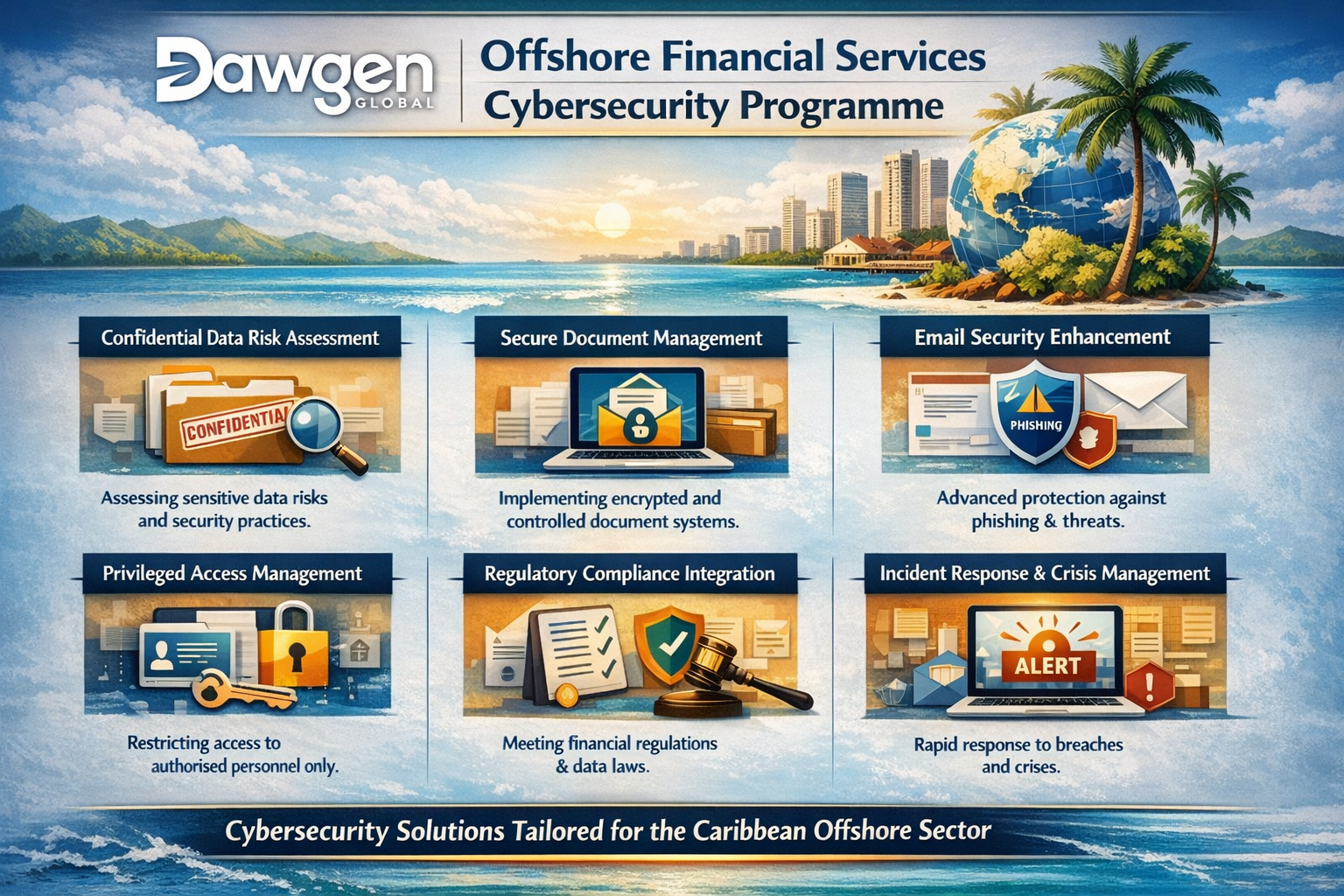
Dawgen Global has developed a cybersecurity programme specifically designed for the Caribbean offshore professional services sector, recognising the unique data sensitivity, regulatory complexity, and reputational stakes that characterise this industry.
Confidential Data Risk Assessment: Dawgen Global conducts assessments specifically designed for professional service environments, evaluating document management security, email communication protections, client portal implementations, remote access configurations, and the physical security of premises where confidential information is handled.
Secure Document Management Implementation: Dawgen Global advises on and helps implement secure document management and collaboration platforms that provide the convenience professionals require while maintaining encryption, access controls, audit trails, and data loss prevention capabilities appropriate to the sensitivity of the data being handled.
Email Security Enhancement: Recognising that email remains the primary communication and document sharing channel for most professional service firms, Dawgen Global implements advanced email security solutions that protect against phishing, impersonation, and interception while maintaining the usability that professional practice demands.
Privileged Access Management: Dawgen Global designs and implements access management frameworks that ensure client data is accessible only to authorised personnel, with monitoring and audit capabilities that detect and alert to anomalous access patterns that may indicate insider threat or compromised credentials.
Regulatory Compliance Integration: Dawgen Global ensures that cybersecurity measures are designed to satisfy the specific requirements of applicable financial services regulations, professional conduct rules, and data protection legislation, creating a unified compliance framework rather than siloed regulatory responses.
Incident Response and Crisis Management: Dawgen Global develops incident response plans tailored to the professional services context, including client notification protocols, regulatory reporting procedures, media handling strategies, and professional indemnity insurance coordination.
Protecting the Caribbean’s Reputation
The cybersecurity of Caribbean offshore professional service firms is not merely a matter of individual firm risk management — it is a matter of national and regional economic security. The international business that sustains Caribbean financial centres will flow to jurisdictions that can demonstrate the highest standards of data protection and cybersecurity. Those that cannot will see their competitive position erode as clients migrate to centres where they have greater confidence in the security of their most sensitive information.
The fictional scenario of the compromised law firm illustrates the speed with which a cybersecurity failure at a single firm can escalate into a jurisdiction-wide reputational crisis. In an industry built entirely on trust and confidentiality, the cost of failure is not merely financial — it is existential.
Caribbean offshore professional service firms have the opportunity to differentiate themselves through demonstrable cybersecurity excellence — signalling to international clients that their data is not merely legally protected but technically secured to the highest standards. Dawgen Global is committed to helping the Caribbean offshore financial services sector seize this opportunity and defend the trust that millions of international clients have placed in Caribbean professional service providers.
The data entrusted to Caribbean offshore firms represents the financial lives of individuals and institutions across the globe. Protecting that data is not optional — it is the foundational obligation upon which the entire industry depends.
Take the First Step
The threats facing Caribbean organisations are real, evolving, and increasingly sophisticated. Waiting for an incident to force action is a strategy that no responsible institution can afford.
Safeguard client confidentiality and regulatory standing. Request a tailored cybersecurity proposal from Dawgen Global for your offshore practice or financial services operation.
Email: [email protected] | Visit: www.dawgen.global
This article is part of the “Securing the Caribbean Digital Frontier” series by Dawgen Global, examining cybersecurity risks and solutions across key Caribbean industries. All scenarios described are fictional constructions based on observed threat patterns and are used for illustrative purposes only.
About Dawgen Global
“Embrace BIG FIRM capabilities without the big firm price at Dawgen Global, your committed partner in carving a pathway to continual progress in the vibrant Caribbean region. Our integrated, multidisciplinary approach is finely tuned to address the unique intricacies and lucrative prospects that the region has to offer. Offering a rich array of services, including audit, accounting, tax, IT, HR, risk management, and more, we facilitate smarter and more effective decisions that set the stage for unprecedented triumphs. Let’s collaborate and craft a future where every decision is a steppingstone to greater success. Reach out to explore a partnership that promises not just growth but a future beaming with opportunities and achievements.
 Email: [email protected]
  Visit: Dawgen Global Website

 WhatsApp Global Number : +1 555-795-9071
Caribbean Office: +1876-6655926 / 876-9293670/876-9265210  WhatsApp Global: +1 5557959071
USA Office: 855-354-2447
Join hands with Dawgen Global. Together, let’s venture into a future brimming with opportunities and achievements


