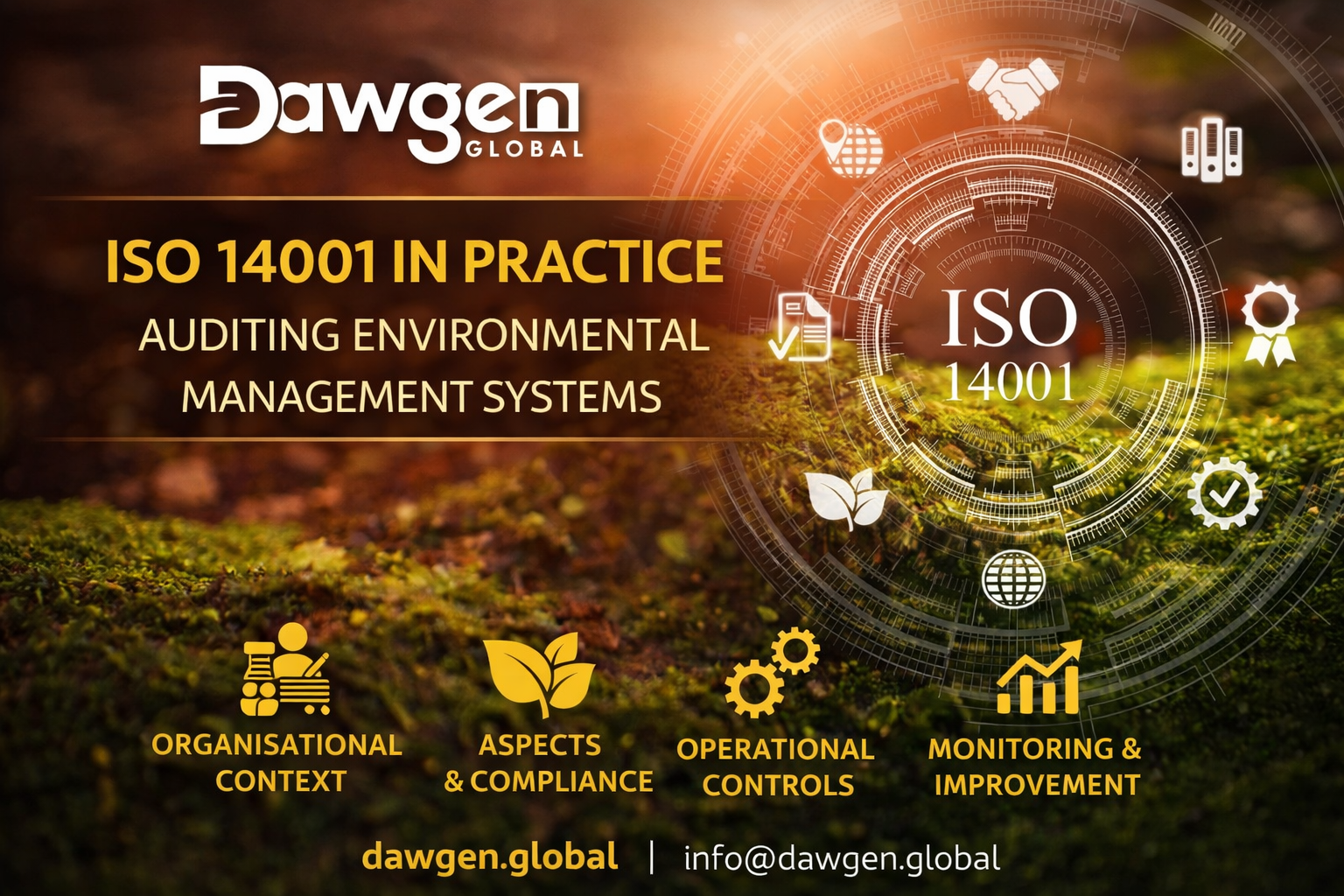
ISO 14001:2015 is the world’s most widely adopted environmental management system (EMS) standard. It provides a structured, Plan-Do-Check-Act framework that organisations use to identify, manage, and continually improve their environmental performance. For internal auditors, ISO 14001 is both an audit criterion — a standard against which an organisation’s EMS can be evaluated — and an audit methodology, embodying the systematic thinking that good environmental audit practice requires.
In the Caribbean, where environmental licences, tourism certification, and export market requirements frequently reference ISO 14001, the ability to audit an EMS credibly is a core competency for ESG assurance practitioners. This article walks through the ISO 14001 clause structure as an audit framework, identifying the key procedures and evidence requirements at each stage.
| ISO 14001:2015 Structure
The standard follows the high-level structure common to all ISO management system standards: Clause 4 (Context), Clause 5 (Leadership), Clause 6 (Planning), Clause 7 (Support), Clause 8 (Operation), Clause 9 (Performance Evaluation), Clause 10 (Improvement). The auditor evaluates each clause for the existence, implementation, and effectiveness of required elements. |
Clause 4: Understanding Organisational Context
ISO 14001 requires organisations to determine the external and internal issues that affect their ability to achieve the intended outcomes of their EMS, and to identify interested parties and their relevant requirements. For Caribbean organisations, external context includes climate regulatory developments, export market environmental requirements, tourism certification standards, and regional environmental licensing regimes.
Audit Procedures
- Obtain the organisation’s documented context analysis. Confirm it has been reviewed within the past 12 months and reflects current regulatory and stakeholder requirements.
- Assess whether climate change — both as a physical risk and a regulatory transition risk — is reflected in the external context analysis.
- Confirm that interested parties (regulators, communities, investors, customers, employees) are identified and that their relevant ESG requirements are documented.
Clause 5: Leadership and Environmental Policy
Top management commitment is the foundation of an effective EMS. ISO 14001 requires the organisation to have an environmental policy that is appropriate to the context, includes commitments to pollution prevention and continual improvement, and is communicated to all persons working under the organisation’s control.
Audit Procedures
- Obtain the environmental policy. Confirm it is current, signed by the CEO or equivalent, and publicly available.
- Assess whether the policy commitments are reflected in the environmental objectives established under Clause 6.
- Confirm through interviews with frontline workers that the policy has been communicated and is understood.
- Evaluate whether environmental responsibilities are integrated into relevant job descriptions and performance objectives.
Clause 6: Environmental Aspects, Impacts & Legal Compliance
This is the analytical core of ISO 14001 — where organisations identify their environmental aspects (the elements of their activities, products, or services that interact with the environment) and assess the associated impacts to determine which are significant.
| Clause Element | What to Audit | Common Findings |
| Aspects & Impacts Register | Is it comprehensive? Does it cover all activities, products, and services? Has it been reviewed within 12 months? | Missing aspects from new activities; outdated assessment; no consideration of lifecycle perspective |
| Significance Determination | Is the methodology for determining significance documented and consistently applied? | Arbitrary significance ratings; no documented criteria; all aspects rated low |
| Legal Register | Is it current? Does it include all applicable environmental legislation and permit conditions? | Missing regulations; not reviewed following legislative changes; permit conditions not monitored |
| Compliance Evaluation | Are compliance evaluations conducted at defined intervals with documented results? | Annual compliance evaluation not conducted; gaps identified but not actioned |
Clause 8: Operational Controls & Emergency Preparedness
Operational controls are the practical mechanisms through which significant environmental aspects are managed. ISO 14001 requires organisations to establish controls to ensure processes are carried out under specified conditions and to prevent environmental incidents.
- Obtain the list of significant environmental aspects and confirm that a documented operational control exists for each.
- For a sample of controls, verify implementation through site observation, procedure review, and worker interviews.
- Assess the emergency preparedness and response plan. Confirm it covers all credible environmental emergency scenarios (spill, fire, flood) and has been tested within the past 12 months.
- Evaluate contractor management — are environmental requirements communicated to contractors and subcontractors, and is compliance monitored?
Clause 9: Monitoring, Measurement & Management Review
Performance evaluation is where EMS effectiveness becomes measurable. The auditor evaluates whether environmental monitoring programmes are functioning, whether data quality is sufficient for decision-making, and whether management review is substantive.
- Obtain the environmental monitoring programme. Confirm parameters, frequencies, and responsibilities are documented and being executed.
- For a sample of monitored parameters (e.g. effluent quality, energy consumption, waste volumes), trace reported figures from monitoring records to management reports. Verify mathematical accuracy.
- Review the most recent management review record. Confirm it addresses all required inputs (audit results, compliance status, environmental performance trends, corrective actions) and produces documented outputs with actions assigned.
Clause 10: Nonconformities and Continual Improvement
The corrective action system is the self-healing mechanism of an effective EMS. The auditor evaluates whether nonconformities are being identified, investigated, and corrected, and whether the system is driving genuine continual improvement.
- Obtain the nonconformity and corrective action register. Assess whether it is current, whether root cause analysis has been performed for significant nonconformities, and whether corrective actions are tracked to closure with evidence.
- Cross-check the corrective action register against environmental monitoring data and incident records. Are monitoring exceedances and incidents being captured as nonconformities?
- Assess the trend in nonconformities year-on-year. Increasing nonconformities may indicate a deteriorating EMS; consistently zero nonconformities may indicate an ineffective identification system.
| Audit Insight: The Certification Trap
ISO 14001 certification confirms that an EMS exists and was functional at the time of the certification audit. It does not provide continuous assurance that the EMS is effective in practice. Internal audit’s role is to fill the gap between certification cycles — testing whether the certified system is being maintained and operated as designed, and whether environmental performance objectives are actually being achieved. |
Dawgen Global is a multidisciplinary professional services firm serving the Caribbean region. DESGAF™ integrates ISO 14001 audit methodology into the DAWGEN ESG Assurance Framework™ to provide structured environmental controls assurance.
| Partner with Dawgen Global for ESG Assurance
Dawgen Global’s DESGAF™ specialists provide comprehensive ESG internal audit support — from governance reviews and controls testing to data verification and disclosure assurance across the Caribbean. Request a Proposal Today Email: [email protected] | Tel: +1 (876) 929-3670 | +1 (876) 665-5926 | US: 1-855-354-2447 www.dawgen.global — Big Firm Capabilities. Caribbean Understanding. |
About Dawgen Global
“Embrace BIG FIRM capabilities without the big firm price at Dawgen Global, your committed partner in carving a pathway to continual progress in the vibrant Caribbean region. Our integrated, multidisciplinary approach is finely tuned to address the unique intricacies and lucrative prospects that the region has to offer. Offering a rich array of services, including audit, accounting, tax, IT, HR, risk management, and more, we facilitate smarter and more effective decisions that set the stage for unprecedented triumphs. Let’s collaborate and craft a future where every decision is a steppingstone to greater success. Reach out to explore a partnership that promises not just growth but a future beaming with opportunities and achievements.
 Email: [email protected]
  Visit: Dawgen Global Website

 WhatsApp Global Number : +1 555-795-9071
Caribbean Office: +1876-6655926 / 876-9293670/876-9265210  WhatsApp Global: +1 5557959071
USA Office: 855-354-2447
Join hands with Dawgen Global. Together, let’s venture into a future brimming with opportunities and achievements


