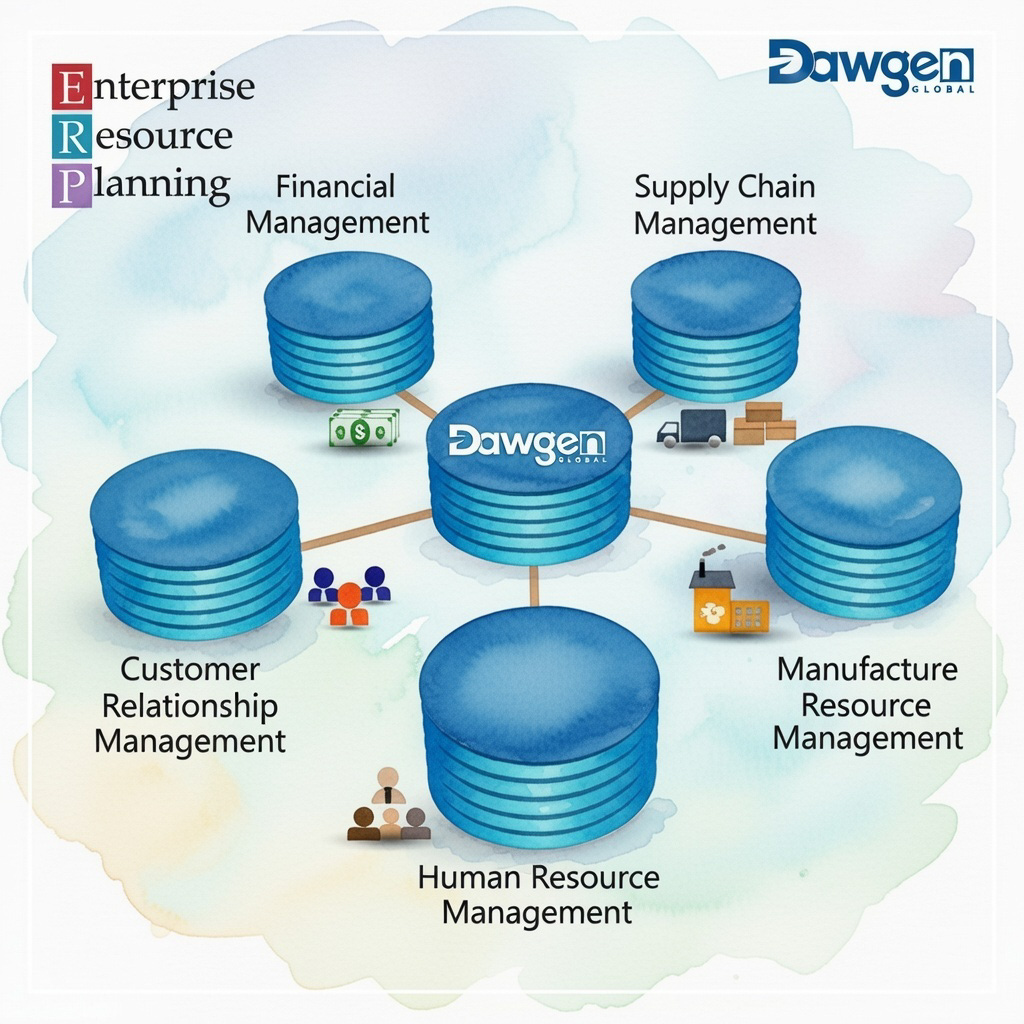
For many SMEs, “inventory” is where profitability quietly leaks: stockouts that lose sales, overbuying that ties up cash, write-offs from expiry or damage, and pricing decisions made without reliable cost and margin data. An ERP-enabled inventory and supply chain module set changes that by creating one source of truth across purchasing, receiving, warehousing, production (where relevant), sales fulfillment, and finance. The result is not just operational control; it’s improved reporting integrity—cleaner cost of sales, more credible gross margins, faster period close, and audit-ready supporting schedules for stock, payables, and working capital.
This article explains how modern ERP inventory and supply chain capabilities work in practice, the reporting value they unlock (stock valuation, landed cost, COGS accuracy, margin by product/customer, slow-moving and obsolescence exposure), and the controls that prevent common losses (unauthorized purchasing, miscounts, phantom stock, duplicate suppliers, and inconsistent item masters). We also provide a practical module-by-module view, a “minimum viable design” for SMEs, and implementation guardrails that protect the integrity of financial and management reporting—without naming any specific software vendor.
Why inventory is a reporting problem (not just an operations problem)
Inventory sits at the intersection of operational execution and financial reporting. When inventory records are weak, it distorts:
-
Cost of Sales (COGS): If receipts, issues, returns, and adjustments are not accurately captured, COGS becomes a balancing figure rather than a measured outcome.
-
Gross margin credibility: Margin reporting by product line, channel, or customer becomes unreliable—leading to “growth” that is actually value destruction.
-
Working capital and cash flow: Excess stock consumes cash; stockouts reduce cash generation.
-
Audit and compliance: Stock counts, valuation methods, goods-in-transit, and write-downs require defensible evidence.
-
Decision-making: Reorder points, promotions, supplier negotiations, and pricing depend on accurate demand and cost signals.
An ERP inventory and supply chain stack addresses these issues by linking transactions end-to-end—from purchase requisition to goods receipt, from warehouse transfer to sales delivery, and from stock valuation to financial statements—with consistent master data and controlled workflows.
What “inventory & supply chain” means inside an ERP
When SMEs say they want “inventory,” they often mean different things:
-
Stock visibility: What do we have, where is it, and is it available to promise?
-
Procurement control: Who can buy, from whom, at what price, and under what approvals?
-
Warehouse execution: How do we receive, put away, pick, pack, ship, and transfer stock?
-
Costing accuracy: Do we know true product cost—including freight, duties, handling, and wastage?
-
Demand and replenishment: Are we buying based on actual demand patterns and lead times?
-
Reporting outcomes: Can we trust stock valuation, COGS, margins, and aging?
A strong ERP design typically includes these building blocks:
-
Item master & data governance (foundation)
-
Purchasing / procurement
-
Receiving & put-away
-
Inventory management (stock ledger)
-
Warehouse management (optional, but powerful)
-
Costing (standard/average/FIFO as applicable) + landed cost
-
Sales order fulfillment (connected module)
-
Planning / replenishment (MRP or simpler rules)
-
Returns, quality, and traceability (as needed)
-
Analytics & reporting (dashboards, KPIs, and audit schedules)
The reporting value: how ERP inventory changes the numbers you report
1) Cleaner stock valuation and faster closing
When inventory transactions are captured in real time (or near-real time), finance teams spend less time reconciling spreadsheets and more time validating results. ERP produces:
-
Inventory valuation reports by warehouse, item group, category, and aging
-
Goods receipt/issue registers supporting audit testing
-
Movement reports supporting slow-moving/obsolete provisions
-
Cutoff support for goods-in-transit and returns
Close impact: The month-end close improves because the inventory subledger is aligned to GL postings with traceable documents.
2) More accurate COGS and margin reporting
When the ERP connects receipts, issues, and sales deliveries to costing methods and landed costs, you gain:
-
COGS by item/customer/channel
-
Gross margin reports you can trust
-
Profitability analysis by product mix
-
Visibility into discounting that destroys margin
This matters for SMEs: a small improvement in gross margin accuracy often unlocks immediate pricing, product rationalization, and supplier negotiation actions.
3) Working capital clarity
Inventory is usually one of the largest working-capital items. ERP improves:
-
Inventory days (DIO) and cash conversion cycle tracking
-
Stock cover vs lead times
-
Reorder effectiveness (reducing emergency purchases and stockouts)
-
Visibility into dead stock and near-expiry exposure
4) Stronger audit trail and control environment
ERP inventory modules improve audit readiness through:
-
Documented approvals for purchasing and adjustments
-
Role-based permissions for sensitive actions (price changes, write-offs, stock corrections)
-
Timestamped, user-attributed transactions
-
Standard supporting schedules for inventory and COGS
Module-by-module: what each component does and how it adds value to reporting
A) Item Master Data (the non-negotiable foundation)
What it does: Centralizes item codes, units of measure, categories, tax rules, costing method, reordering parameters, and tracking requirements (batch/serial/expiry).
Reporting value: If master data is inconsistent, every report is suspect. A clean item master makes valuation, margin analysis, and procurement reporting credible.
Key controls
-
Approval workflow for creating or changing items
-
Standard naming conventions and categories
-
Locked unit-of-measure conversions
-
Mandatory fields for tax, costing, and GL mappings
Common SME risk: Duplicate items and inconsistent units (“case” vs “box” vs “unit”), producing phantom variances and margin confusion.
B) Purchasing & Procurement (spend control + supply reliability)
What it does: Manages supplier records, price lists, purchase requisitions, purchase orders, approvals, and contract terms.
Reporting value: Procurement data feeds payables accuracy and supports cost governance—especially when linked to receiving and invoice matching.
Key reporting outputs
-
Spend by supplier/category
-
Price variance vs contract price
-
Supplier performance (lead time, fill rate)
-
Open PO commitments (important for cash planning)
Key controls
-
Approval thresholds and segregation of duties
-
Vendor onboarding rules (duplicate prevention, banking validation)
-
Three-way match rules (PO–GRN–Invoice)
C) Receiving & Put-Away (the truth moment)
What it does: Records goods received, discrepancies, damages, and quality checks; directs stock to bins/locations when warehouse features are enabled.
Reporting value: Receiving is where inventory becomes “real.” Strong receiving controls reduce disputes and support accurate cutoff.
Key controls
-
Mandatory referencing of PO
-
Tolerance rules (over/under delivery)
-
Exception handling for damages and short shipments
-
Proof-of-receipt and user accountability
D) Inventory Management (stock ledger)
What it does: Maintains the perpetual inventory ledger: receipts, issues, transfers, adjustments, and counts.
Reporting value: This is the source for stock valuation, movement, and aging reports.
Core reports
-
Stock on hand by location
-
Inventory movements by period
-
Inventory aging and slow-moving
-
Adjustment logs (who changed what and why)
Controls that protect the ledger
-
Adjustments require reason codes and approvals
-
Cycle count rules and variance investigation workflow
-
Role-based permissions for write-offs and negative stock prevention (where appropriate)
E) Warehouse Management (optional, but high leverage)
What it does: Enhances receiving, put-away, picking, packing, and shipping—often with barcode support and bin-level accuracy.
Reporting value: Improves data quality by reducing manual entry and shrinkage; strengthens audit evidence via scan histories.
Where it pays off quickly
-
Multi-warehouse operations
-
High SKU counts
-
High picking volume
-
Regulated or high-shrink environments
F) Costing & Landed Cost (where margin truth is built)
What it does: Applies costing method (e.g., FIFO, weighted average, standard cost) and captures landed costs (freight, duty, clearing, handling) into item cost.
Reporting value: Correctly allocated landed cost improves COGS accuracy and gross margin integrity.
Good practice for SMEs
-
Define a consistent costing policy
-
Determine landed cost allocation logic (by value, weight, volume, or quantity)
-
Keep audit-friendly documentation for landed cost components
Common SME problem: Freight and duty posted as period expense when they should be inventory cost—distorting both profit and stock valuation.
G) Replenishment & Planning (MRP or simplified rules)
What it does: Uses demand, lead times, reorder points, and safety stock to recommend purchases or production.
Reporting value: Supports better forecasting and prevents working-capital waste.
Practical SME approach
-
Start with reorder points + minimum/max rules
-
Progress to demand planning and MRP once transaction data stabilizes
-
Use ABC classification (A items tightly controlled, C items simpler rules)
H) Integration with Sales & Fulfillment (inventory meets revenue)
What it does: Links sales orders to availability, picking/dispatch, invoicing, and returns.
Reporting value: Prevents revenue leakage and supports accurate revenue recognition workflows and customer profitability analysis.
Key outcomes
-
Availability-to-promise reduces missed deliveries
-
Delivery and invoicing alignment improves AR accuracy
-
Returns captured properly prevents hidden margin erosion
What “good” looks like: a minimum viable ERP design for SMEs
Not every SME needs advanced planning on day one. A strong “minimum viable” setup often includes:
-
Clean item master + chart of accounts mappings
-
Purchasing with approvals + supplier governance
-
Receiving tied to PO + discrepancy workflow
-
Perpetual inventory ledger with controlled adjustments
-
Basic landed cost allocation
-
Cycle counts + variance investigation
-
Standard dashboards for stock, margin, and working capital
Once stable, add:
-
Bin-level warehouse processes
-
Barcoding
-
Demand planning/MRP
-
Batch/serial traceability
-
Advanced analytics and cost-to-serve modeling
Controls and governance: protecting inventory integrity and audit readiness
Inventory is vulnerable to both error and fraud. A well-designed ERP environment implements:
Segregation of Duties (SoD)
-
Buyers shouldn’t be able to approve supplier creation and process payments
-
Warehouse users shouldn’t be able to post unrestricted write-offs
-
Pricing changes should be controlled and logged
Approval workflows
-
Purchase requisitions and POs by value thresholds
-
Stock adjustments above tolerance require finance review
-
Item master changes require governance approval
Exception reporting (what you monitor weekly)
-
Negative stock events
-
Adjustments and write-offs by user
-
Slow-moving and obsolete exposure
-
Price variances and invoice mismatches
-
Stockouts and backorders
-
Supplier lead time breaches
Implementation guardrails: how to avoid the most common ERP inventory failures
-
Don’t automate bad processes. Map the actual “as-is” flow and redesign it before configuration.
-
Master data first. A rushed item master creates years of reporting pain.
-
Define costing policy early. Costing is not a “later” decision.
-
Train by role and scenario. Receiving and issuing stock must be second nature.
-
Start with measurement. Agree baseline KPIs (stock accuracy, fill rate, inventory days, write-offs).
-
Plan the cutover properly. Opening stock quantities and values must reconcile to audited/validated figures.
KPI dashboard: what SMEs should track after go-live
A practical inventory & supply chain dashboard includes:
-
Stock accuracy % (counted vs system)
-
Fill rate / service level
-
Stockouts and backorder days
-
Inventory days (DIO) and cash conversion cycle
-
Slow-moving/obsolete % of stock
-
Write-offs and adjustments by category
-
Gross margin by product line and variance vs target
-
Supplier lead time adherence and price variance
-
Purchase price variance (PPV) and landed cost variance
These KPIs translate operational data into board-ready insights.
Inventory excellence is reporting excellence
For SMEs and growing organizations, inventory and supply chain capabilities inside an ERP are not “nice to have.” They directly determine how credible your management reporting is, how accurate your financial statements are, and how confidently you can scale operations without scaling chaos. When implemented with the right master data discipline, controls, and workflows, ERP turns inventory from a risk area into a performance engine—improving cash flow, margin, service levels, and audit readiness.
Next Step: (RFP-friendly, not salesy)
If your organization is evaluating an ERP to strengthen inventory control, improve gross margin integrity, and produce more reliable management reporting, Dawgen Global can support you with a structured, vendor-neutral approach—requirements definition, process redesign, vendor evaluation, implementation governance, and post-go-live controls.
Invite a proposal:
-
Request a formal proposal (RFP response) for an ERP readiness assessment and implementation roadmap.
-
Or request a discovery workshop to clarify scope, reporting requirements, and module priorities.
Contact Dawgen Global
🔗 https://dawgen.global/
📧 [email protected]
📞 Caribbean: 876-9293670 | 876-9293870
📞 USA: 855-354-2447
WhatsApp Global: +1 555 795 9071
About Dawgen Global
“Embrace BIG FIRM capabilities without the big firm price at Dawgen Global, your committed partner in carving a pathway to continual progress in the vibrant Caribbean region. Our integrated, multidisciplinary approach is finely tuned to address the unique intricacies and lucrative prospects that the region has to offer. Offering a rich array of services, including audit, accounting, tax, IT, HR, risk management, and more, we facilitate smarter and more effective decisions that set the stage for unprecedented triumphs. Let’s collaborate and craft a future where every decision is a steppingstone to greater success. Reach out to explore a partnership that promises not just growth but a future beaming with opportunities and achievements.
 Email: [email protected]
  Visit: Dawgen Global Website

 WhatsApp Global Number : +1 555-795-9071
Caribbean Office: +1876-6655926 / 876-9293670/876-9265210  WhatsApp Global: +1 5557959071
USA Office: 855-354-2447
Join hands with Dawgen Global. Together, let’s venture into a future brimming with opportunities and achievements


