A Practical Playbook for Value-Protected, Sustainable Cost Reduction Across the Value Chain
Executive Summary
Organisations across the Caribbean and beyond are facing a new profitability reality: input costs are rising, revenue growth is harder to achieve, and the cost of capital has increased. In that environment, cost reduction is not a discretionary exercise—it is a strategic capability that can determine which firms win market share, protect margins, and invest in innovation.
Yet many cost programmes fail because they are executed as short-term “budget cuts” rather than as value-chain transformation. Savings evaporate, service levels deteriorate, risk increases, and the organisation rebounds to old spending patterns.
To address this, Dawgen Global has developed the Dawgen V.A.L.U.E.-Chain Cost Advantage Framework™, a proprietary model designed to help leaders identify, quantify, prioritise, and deliver sustainable cost reduction across the end-to-end value chain—without sacrificing customer experience, operational resilience, or compliance.
In this article, we introduce the V.A.L.U.E.™ Framework and explain:
-
Why cost is the most directly controllable lever of profitability in today’s economic climate
-
How the V.A.L.U.E.™ method creates a disciplined pathway from diagnosis to delivery
-
What “value-protected” cost reduction means in practice (and why it matters)
-
The governance and controls required to prevent savings from evaporating
-
How organisations can begin a structured cost opportunity scan within weeks
The New Profitability Reality: Why Cost Advantage Matters Now
Cost has always mattered, but today it matters differently.
Across many sectors, organisations are contending with a combination of pressures:
-
Persistent cost inflation in materials, logistics, and utilities
-
De-globalisation trends that can increase sourcing and trade friction, raising input costs even when demand is stable
-
Stagnated or uneven revenue growth, where price increases are constrained by consumer sensitivity and competitive intensity
-
Higher capital costs, which penalise inefficiency, slow cash conversion, and underperforming assets
-
More demanding customers who expect value for money, reliability, and consistency—while shopping across broader competitive sets than ever before
This is the environment in which cost reduction becomes a strategic differentiator. The organisations that succeed will not be those that “cut the most,” but those that cut intelligently, protect value, and redeploy freed resources into capability-building—technology adoption, service improvements, product innovation, and market expansion.
In a margin-constrained economy, the ability to continuously improve cost competitiveness becomes as fundamental as sales capability, brand strength, or operational excellence.
Why Many Cost Reduction Programmes Fail
Despite the urgency, cost programmes often deliver disappointing results. Three failure patterns are common:
1) “Across-the-board cuts” that damage value
When leadership mandates uniform cuts (e.g., “reduce overhead by 10%”), teams respond by deferring maintenance, reducing training, stripping customer support, and pausing critical initiatives. In the short term, numbers look better. In the medium term, service declines, risk rises, downtime increases, and customers leave.
2) Savings evaporation (“paper savings” vs real savings)
Many programmes identify “opportunities” but fail to lock them into the operating system. Without controls, benefits tracking, and clear accountability, savings leak away through:
-
off-contract purchasing
-
“maverick spend”
-
uncontrolled overtime
-
rising wastage or rework
-
scope creep in service levels
-
supplier performance decay
3) Focusing on spend, not cost drivers
Cutting spend is often easier than fixing the underlying drivers of cost. But sustainable advantage comes from addressing root causes:
-
complexity and low-value SKUs
-
unprofitable customers or channels
-
inefficient processes
-
weak planning and inventory policies
-
poor asset utilisation
-
misaligned operating models and governance
The result is predictable: the organisation reduces spend temporarily, then rebounds as old behaviours return.
This is precisely the gap the Dawgen V.A.L.U.E.™ Framework is designed to close.
Introducing the Dawgen V.A.L.U.E.-Chain Cost Advantage Framework™
The Dawgen V.A.L.U.E.-Chain Cost Advantage Framework™ is a structured, repeatable approach to cost reduction that works across industries because it focuses on what matters most: the end-to-end value chain and the drivers that create cost.
At its core, the framework is built on one principle:
Cost reduction must be value-protected.
If savings undermine customer experience, operational resilience, compliance, or long-term growth capacity, they are not strategic savings—they are deferred costs.
V.A.L.U.E.™ provides a practical method to:
-
quantify cost pressure and margin erosion
-
map cost across the value chain
-
identify opportunities across procurement, operations, logistics, commercial, and SG&A
-
prioritise actions with a disciplined value/risk lens
-
execute with governance, controls, and measurable value capture
-
sustain gains and embed continuous improvement
The V.A.L.U.E.™ Method Explained
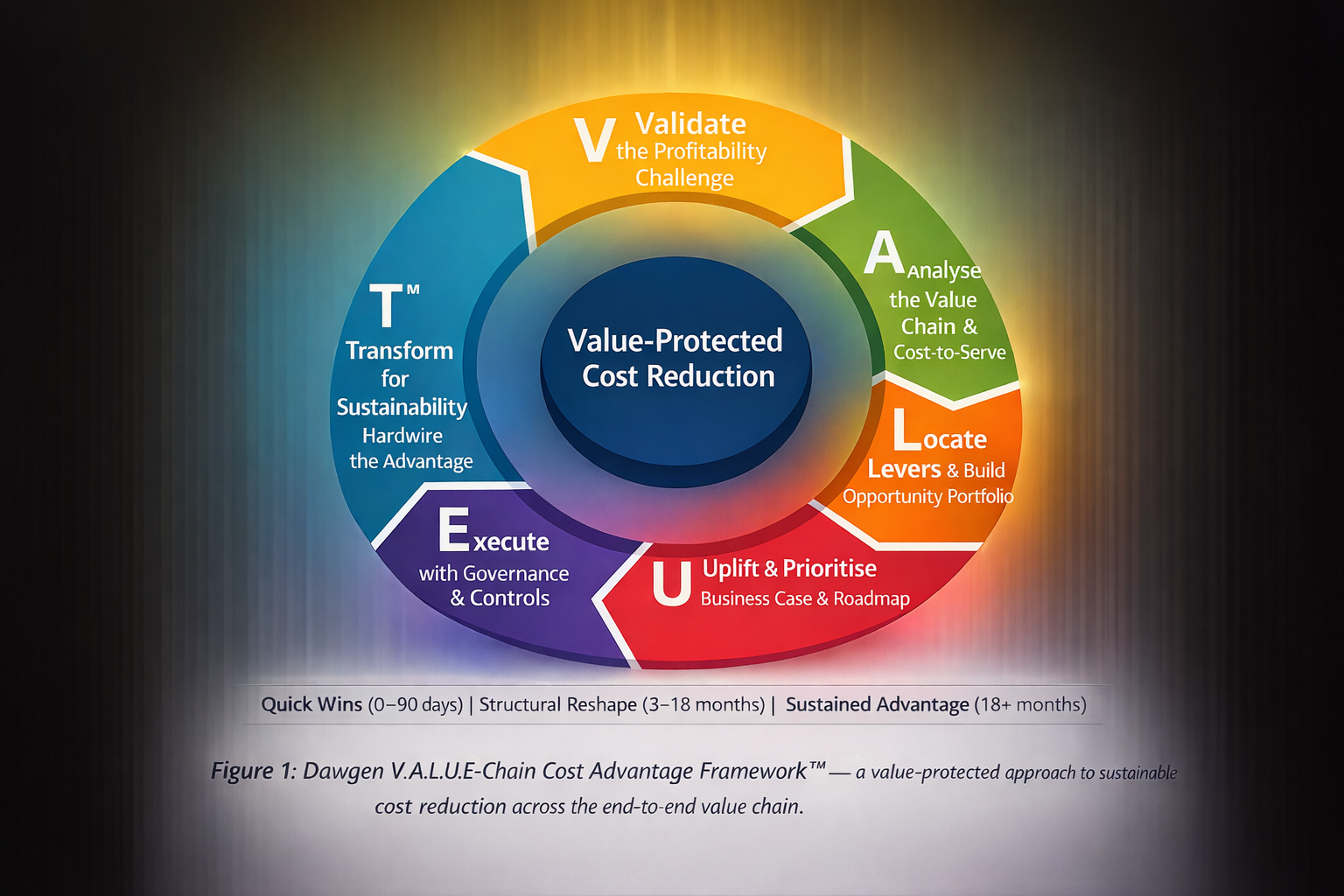
V — Validate the Profitability Challenge
Cost reduction begins with clarity. Before selecting levers, leadership must understand why profitability is deteriorating and where the pressure is concentrated.
In this phase, we build a disciplined baseline:
-
A margin bridge that shows how profitability shifted (price, volume, mix, costs, FX, financing, one-offs)
-
A cost baseline distinguishing fixed vs variable, controllable vs structural
-
A first-pass view of complexity cost (SKUs, suppliers, customers, channels, locations)
-
A “leakage scan” to identify operational and commercial cost drains
The objective is not to produce a perfect model; it is to establish a defensible starting point that prevents the programme from becoming speculative.
Output: a shared fact-base: what’s happening, what’s driving it, and what must change.
A — Analyse the Value Chain and Cost-to-Serve
Many organisations “see costs” in departmental budgets, but the real savings live across the value chain—where costs accumulate, multiply, and hide.
In this phase, we map cost across:
-
Source (procurement, imports, supplier terms, specifications)
-
Operate (production/service delivery, quality, maintenance, labour)
-
Deliver (logistics, warehousing, route planning, inventory)
-
Sell/Service (channel economics, returns, support costs, trade spend)
-
Support (SG&A, shared services, technology, governance)
Critically, we introduce cost-to-serve thinking:
Two customers with identical revenue can produce radically different profit outcomes depending on delivery frequency, returns, credit terms, service requirements, and complexity.
Output: a value-chain cost heatmap and cost-to-serve visibility that shows where to target first.
L — Locate Levers and Build the Opportunity Portfolio
Once cost is visible end-to-end, the programme can move beyond “cutting” into lever-based optimisation.
Levers typically fall into five families:
-
Procurement and sourcing optimisation
-
Operations/service delivery efficiency
-
Logistics and inventory redesign
-
Commercial effectiveness (profitable growth + service rationalisation)
-
SG&A and operating model redesign
The key here is disciplined quantification: each lever is sized with ranges (low/base/high), assumptions, dependencies, and required enablers.
Output: an opportunity portfolio (a structured “savings bank”) with owners, effort, timing, and confidence levels.
U — Uplift and Prioritise (Business Case + Roadmap)
Not all savings are equal. Some are fast but fragile; others are slower but structural. V.A.L.U.E.™ uses a prioritisation approach that balances:
-
magnitude and speed of savings
-
customer/service impact
-
operational and compliance risk
-
complexity and capability requirements
-
cash impact (especially working capital and capex requirements)
This is where leaders choose a realistic programme design:
-
Quick wins (0–90 days): leakage reduction, compliance to buying channels, terms enforcement, inventory release, overtime governance
-
Structural reshape (3–18 months): specification changes, network redesign, operating model restructure, automation and control enhancements
-
Sustained advantage (18+ months): embedded governance, continuous improvement cadence, re-approval cycles for spend
Output: a sequenced roadmap, backed by a business case, with value capture measures built in from the start.
E — Execute with Governance and Controls
Execution is where cost programmes succeed or die.
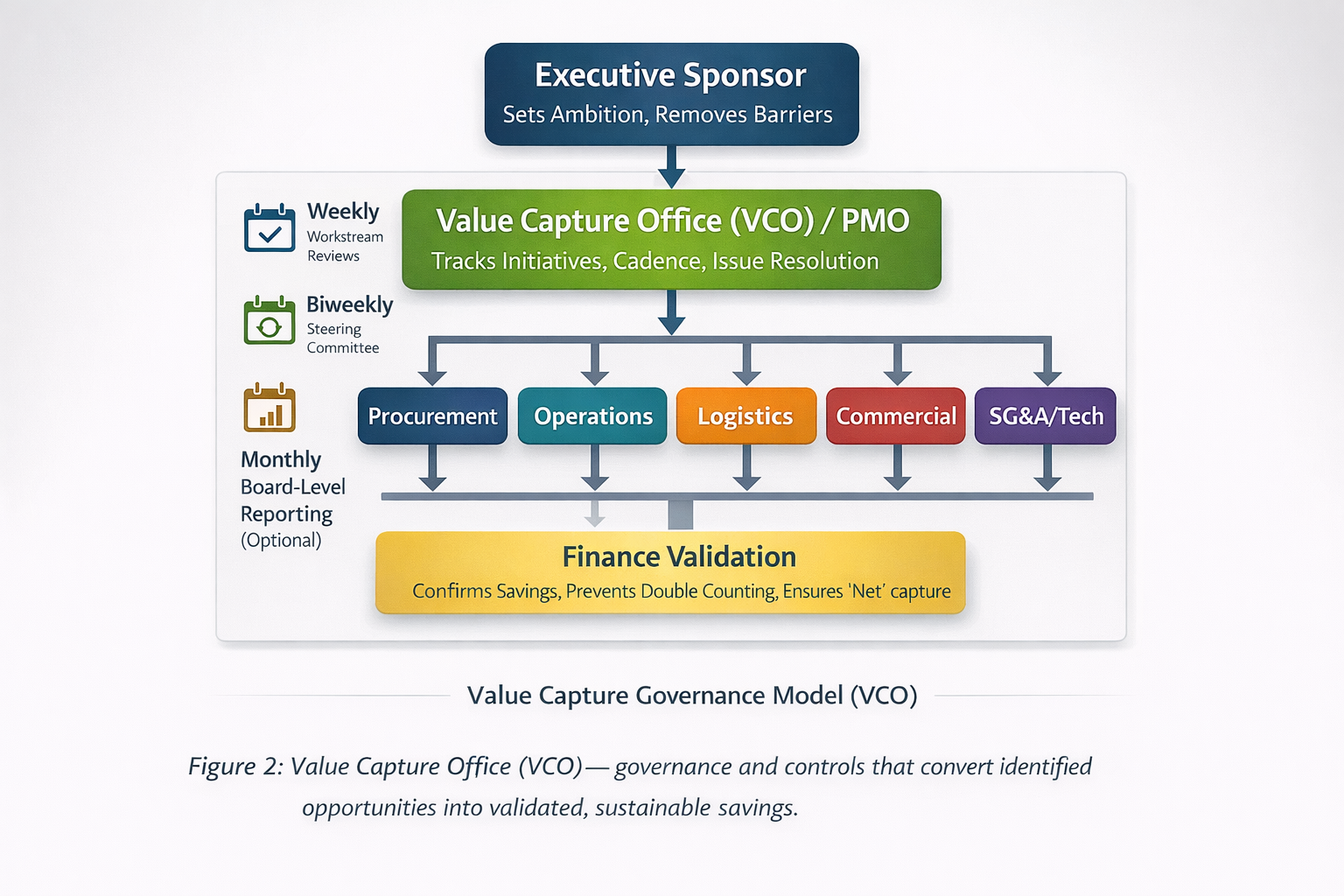
The V.A.L.U.E.™ approach treats delivery as a formal change programme:
-
workstream charters with measurable deliverables
-
weekly value capture cadence
-
finance-validated savings tracking (gross to net to run-rate)
-
decision forums that unblock issues rapidly
-
controls that prevent reversion
This phase introduces the concept of a Value Capture Office (VCO)—a light but disciplined governance mechanism that ensures savings become real.
Output: implemented initiatives, validated savings, and controls that lock in benefits.
™ — Transform for Sustainability (Hardwire the Advantage)
The final phase is what turns a cost programme into a cost advantage.
Sustainability is achieved through:
-
embedding KPIs and accountability into performance management
-
reinforcing policies and automated controls
-
supplier performance management disciplines
-
periodic re-forecasting and spend “re-approval” cycles in key categories
-
a continuous pipeline of improvement initiatives
Output: a cost advantage operating system—capable of sustaining savings and funding growth.
What “Value-Protected Cost Reduction” Looks Like in Practice
“Value-protected” does not mean slow or conservative. It means disciplined.
In practice, it means:
-
You do not reduce costs by degrading reliability or safety.
-
You do not reduce costs by underinvesting in controls and compliance.
-
You do not reduce costs by stripping customer value indiscriminately.
-
You do reduce cost by eliminating waste, complexity, leakage, and non-value activities.
-
You do redesign service levels where they are mispriced or misaligned—with commercial discipline, not silent erosion.
Cost reduction should strengthen the organisation—making it faster, more consistent, and more resilient.
Case Snapshot: What V.A.L.U.E.™ Can Unlock
Consider a regional company operating with rising input costs, FX volatility, and increasing finance costs.
Using a V.A.L.U.E.™ approach, opportunities often emerge in multiple layers:
Quick wins (0–90 days):
-
1–3% savings from purchase compliance and supplier term enforcement
-
1–2% margin improvement from claims/returns reduction and leakage controls
-
cash release through inventory rationalisation (often material when capital costs are high)
Structural opportunities (3–18 months):
-
3–6% savings from strategic sourcing, specification rationalisation, and supplier performance management
-
2–5% savings from operations efficiency and downtime reduction
-
2–4% savings from logistics network optimisation and route consolidation
-
SG&A redesign opportunities that improve effectiveness while removing duplication
Sustainment (18+ months):
-
reduced “savings evaporation” through policies, automated controls, and governance
-
continuous improvement pipeline that prevents cost creep
The point is not the exact percentage; it is the pattern: sustainable savings come from end-to-end levers, executed with discipline, and locked in through controls.
How to Get Started: A Practical Entry Point
For leaders considering a structured approach, the best starting point is a short diagnostic that answers three questions:
-
Where are the biggest cost pools across the value chain?
-
Which costs are truly controllable—and what drives them?
-
What is the highest-confidence portfolio of levers we can execute in 90 days and 12 months?
A well-run initial scan typically produces:
-
a defensible baseline
-
an opportunity heatmap
-
a prioritised portfolio with savings ranges
-
an execution roadmap with governance built in
Cost Advantage Is Strategy
In the coming years, competitive advantage will be shaped not only by what organisations sell, but by how efficiently and resiliently they operate.
Cost reduction is no longer a one-off initiative. It is a capability—one that allows organisations to:
-
protect margin under volatility
-
price competitively without destroying profitability
-
fund innovation and digital adoption
-
improve operational performance and customer outcomes
-
strengthen resilience in uncertain markets
The Dawgen V.A.L.U.E.-Chain Cost Advantage Framework™ is Dawgen Global’s practical, value-protected approach to helping organisations across the Caribbean and beyond move from cost pressure to cost advantage.
Next Step!
Ready to uncover value-protected cost reduction across your value chain?
Email [email protected] with the subject line “V.A.L.U.E. – Cost Opportunity Scan” to request an initial discussion and our data intake checklist.
WhatsApp Global: +1 555 795 9071 | Contact form: https://www.dawgen.global/contact-us/
“Embrace BIG FIRM capabilities without the big firm price at Dawgen Global, your committed partner in carving a pathway to continual progress in the vibrant Caribbean region. Our integrated, multidisciplinary approach is finely tuned to address the unique intricacies and lucrative prospects that the region has to offer. Offering a rich array of services, including audit, accounting, tax, IT, HR, risk management, and more, we facilitate smarter and more effective decisions that set the stage for unprecedented triumphs. Let’s collaborate and craft a future where every decision is a steppingstone to greater success. Reach out to explore a partnership that promises not just growth but a future beaming with opportunities and achievements.
 Email: [email protected]
  Visit: Dawgen Global Website

 WhatsApp Global Number : +1 555-795-9071
Caribbean Office: +1876-6655926 / 876-9293670/876-9265210  WhatsApp Global: +1 5557959071
USA Office: 855-354-2447
Join hands with Dawgen Global. Together, let’s venture into a future brimming with opportunities and achievements


