
HomeCategory

Jamaica

IFRS 20 and EBITDA: Why Lenders, Investors and Boards Must Pay Attention

Executive Summary IFRS 20, Regulatory Assets and Regulatory Liabilities, will not merely change technical accounting for rate-regulated entities. It may also change how performance is measured, interpreted, financed, and communicated. For many regulated companies, IFRS 20 may affect reported revenue, operating profit, EBITDA, funds from operations, working capital, leverage ratios, interest cover, return measures, and...

Who Will Be Most Affected by IFRS 20? Utilities, Energy, Transport and Infrastructure in Focus

  Executive Summary IFRS 20, Regulatory Assets and Regulatory Liabilities, will have its greatest impact on companies operating under rate-regulated frameworks — entities whose prices, tariffs, fees, or charges are determined, approved, or influenced by a regulator through enforceable regulatory agreements. The sectors most likely to be affected include utilities, electricity providers, water and sewerage...

IFRS 20 Explained: What Regulated Companies Need to Know Before 2029

Executive Summary The IASB has issued IFRS 20, Regulatory Assets and Regulatory Liabilities, introducing a comprehensive financial reporting framework for entities subject to rate regulation. Effective for annual reporting periods beginning on or after 1 January 2029, with earlier application permitted, IFRS 20 supersedes IFRS 14 and is a significant development for utilities, energy, transportation,...

D·ASSURE™ Whitepaper: Dawgen Global’s Seven-Pillar Framework for Modern Caribbean Audit Quality

The methodology is here. The framework is yours to apply. Dawgen Global has released the D·ASSURE™ Whitepaper, the standing companion to Article 12 and the series finale of The Caribbean Audit Imperative. The Whitepaper presents D·ASSURE™ — the Dawgen Assurance Standard for Unified Risk-based Engagements — Dawgen Global’s proprietary seven-pillar methodology for conducting modern audit...

The D·ASSURE™ Framework: Dawgen Global’s Seven-Pillar Methodology for Modern Caribbean Audits

This series began with the observation that the Caribbean audit profession is being reshaped by a confluence of forces — revised international standards, sharpened quality-management frameworks, the digitisation of audit techniques, the intersection of cybersecurity with assurance, the arrival of sustainability reporting and its associated assurance regime, and the heightened scrutiny that all of these...

Sustainability Assurance Arrives: What Caribbean Boards Must Know About ISSA 5000, IFRS S1 and IFRS S2

Of all the changes reshaping audit and assurance in this decade, none will land harder on Caribbean boards than the one this article addresses. Until very recently, sustainability reporting in the Caribbean was a voluntary activity — a corporate social responsibility statement, an annual report chapter on community engagement, a chairman’s narrative on environmental stewardship....

Group Audits and Cross-Border Engagements: What Caribbean Holding Companies Must Know About ISA 600 Revised

The modern Caribbean economy is, in significant measure, a network of conglomerates. A holding company headquartered in Kingston operates subsidiaries in Trinidad and the Eastern Caribbean. A Bahamian financial group runs operations through entities in Cayman and Barbados. A regional retail group consolidates results from operating subsidiaries across a dozen territories. Tourism groups, financial groups,...

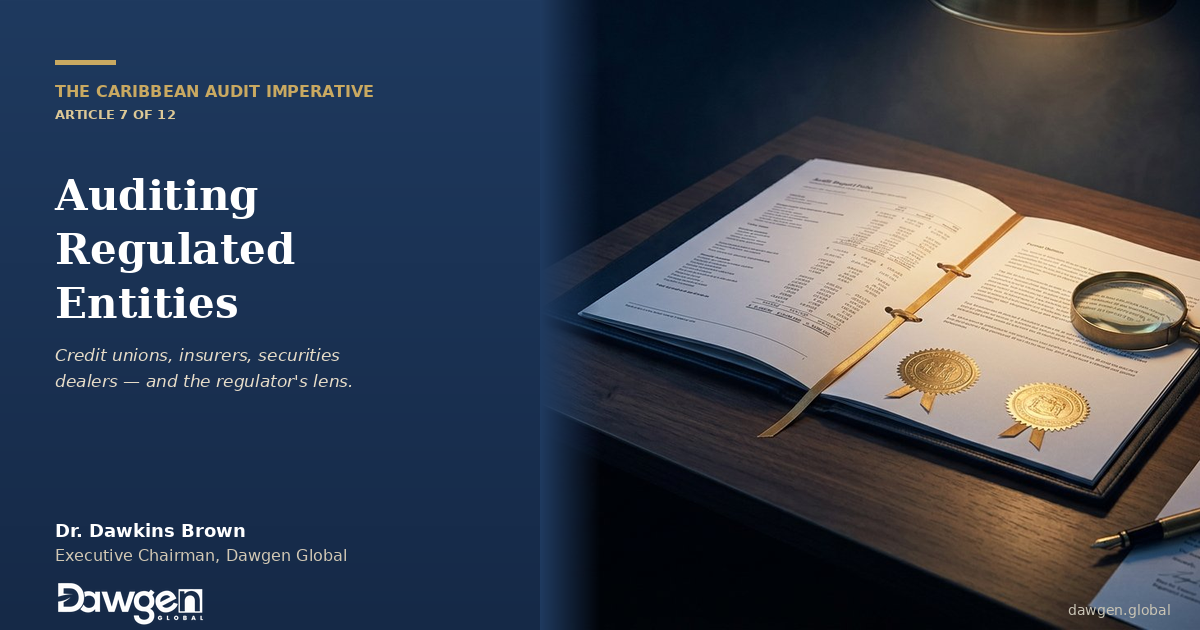
Auditing Regulated Entities: What Caribbean Boards Must Know About the Regulator’s Lens

In an ordinary audit, the audit opinion is the principal output and the audit file is the auditor’s working record. In an audit of a regulated entity — a credit union, an insurance company, a securities dealer, a pension fund administrator, a money services business, a bank — the picture changes. The audit opinion is...

The Quality Management Shift: What Caribbean Audit Committees Must Know About ISQM 1 and ISQM 2

Audit committees have spent years learning to evaluate audits. The standards on what a competent audit must do — ISA 315 (Revised), ISA 330, ISA 600 (Revised) — are now reasonably well understood at the board level. But there is a second, quieter set of standards that audit committees across the Caribbean have not yet...

Foo-WLogo

Dawgen Global is an integrated multidisciplinary professional service firm in the Caribbean Region. We are integrated as one Regional firm and provide several professional services including: audit, accounting, tax, IT, risk, HR, performance, M&A, corporate recovery and other advisory services

Where to find us?
img-footer-map
Dawgen Social links
Stay ahead of Caribbean business
Receive our latest insights on tax, regulation, technology and the economy across the region.


    © 2026 Copyright Dawgen Global. All rights reserved.  ·  Privacy Notice  ·  Cookie Policy  ·  Website Terms  ·  Accessibility

    Talk to us