

C | Context
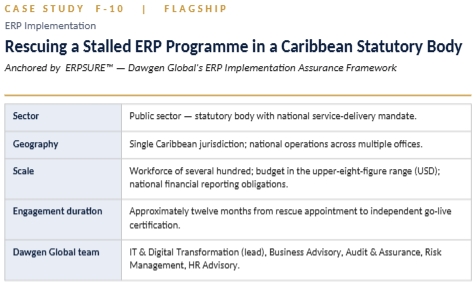
A Caribbean statutory body — a parastatal entity with a national service-delivery mandate, reporting to a line ministry and accountable to both Cabinet and Parliament for its financial stewardship — was two years into an ERP implementation programme that had materially overshot both its original timeline and its original budget. Four successive ‘final go-live’ dates had been missed. A change of Chief Executive had occurred during the programme’s second year. A forensic-style review commissioned by the board had concluded that the programme’s difficulties were not technology failures in the narrow sense — the selected platform was fit for purpose and the implementation partner was competent — but governance failures: unclear ownership, weak requirements discipline, inadequate data migration rigour, testing shortcuts, and the cumulative effect of scope creep that had never been formally re-baselined.
The board’s decision-set was stark. Cancel the programme, and the statutory body would be left with a partially-deployed platform, significant sunk cost, no path to modern financial management, and an uncomfortable explanation to offer Cabinet. Continue the programme on its existing trajectory, and the board had no basis for confidence that the next go-live date would hold either. The third option — bringing in an independent assurance advisor to rescue the programme, re-baseline its governance, and steer it to a credible go-live — was the option the board chose. Dawgen Global was appointed as the independent ERP programme rescue advisor.
A | Approach — ERPSURE™ in Rescue Configuration
Dawgen Global deployed ERPSURE™, its proprietary ERP Implementation Assurance Framework, in its Rescue Configuration — a specific variant of the framework designed for programmes that have already suffered material slippage and require independent re-baselining before they can be salvaged. ERPSURE™’s seven assurance domains are retained, but the sequence is altered: Readiness & Design is re-opened, not assumed; Benefits Realisation is moved forward, not deferred; and a new governance baseline is established before any further technical work proceeds.
| 1. Readiness & Design
Re-opened: business case re-underwritten, chart-of-accounts re-assessed, target operating model re-validated. |
2. Data Migration
Data migration track re-architected from scratch, with formal rehearsal cycles and reconciliation evidence. |
3. Controls by Design
Segregation-of-duties matrix, configurable controls, and integration with internal audit established pre-go-live. |
| 4. Testing Assurance
New test strategy with exit-criteria discipline and defect-triage governance replacing previous informal approach. |
5. Change & People
Stakeholder engagement rebuilt, change network re-established, role-based training re-designed — via PEOPLE360°™. |
6. Cutover & Hypercare
Formal go/no-go gating, cutover war-room protocol, and structured hypercare with stabilisation triggers. |
| 7. Benefits Realisation
Moved forward: benefits re-underwritten at rescue start and tracked as the programme’s definition of success. |
S | Solution
Re-opening Readiness & Design
The rescue engagement began with a disciplined and, for many stakeholders, uncomfortable step: re-opening Readiness & Design. A programme that has been in flight for two years carries significant institutional momentum in a particular direction, and stopping to re-examine design fundamentals is often resisted on the grounds that it will cost further time. Dawgen Global’s position, firmly held, was that no further technical work could sensibly proceed until the programme had a re-underwritten business case, a re-validated target operating model, and a rationalised chart of accounts. Four weeks were invested in these three outputs.
The re-underwritten business case was particularly consequential. The original business case had assumed benefits that, on re-examination, had either not been quantified with discipline or had been partially delivered by changes the statutory body had implemented outside the ERP programme during the intervening two years. The re-underwritten business case produced a credible, quantified, measurable set of benefits against which the rescue could be held to account. The chart-of-accounts rationalisation, previously attempted but not completed, was finished — producing for the first time a single financial taxonomy suitable for national reporting under the statutory body’s mandate. The target operating model was re-validated with the new Chief Executive and made consistent with the body’s current, rather than historical, organisational structure.
Re-architecting Data Migration
The data migration track had been a principal source of the programme’s prior difficulties. The rescue rebuilt the data migration approach from first principles, using the standard ERPSURE™ discipline: four formal rehearsal cut-overs before the real cut-over, with each rehearsal producing reconciliation evidence that could withstand external audit. Each successive rehearsal closed the gap between source system and target system balances. Critically, rehearsals were run under the governance of a joint data migration steering group that included representation from the statutory body’s internal audit function and the external auditors — meaning that by the time the real cut-over occurred, the methodology was already familiar and acceptable to the auditors who would subsequently rely on the migrated opening balances.
Controls by Design and the pre-go-live control build
A distinctive failure mode of stalled ERP programmes is the deferral of controls work to post-go-live, on the grounds that ‘we’ll fix it once we’re live’. Dawgen Global’s rescue configuration refuses this compromise. The Controls by Design domain produced, pre-go-live, a defensible segregation-of-duties matrix, an inventory of appropriate automated and configurable controls, and a clean linkage between the configured controls and the internal audit function’s ongoing testing programme. This ensured that the statutory body went live with an audit-ready control environment, not a control backlog.
Testing Assurance and exit-criteria discipline
The Testing Assurance domain introduced rigorous exit-criteria discipline. No phase of testing was permitted to close until its defined exit criteria had been evidenced, regardless of schedule pressure. Defects were triaged under formal governance, with severity classifications that explicitly linked to readiness for the next phase. A distinctive feature of the rescue engagement was that Dawgen Global itself — not the implementation partner — chaired the defect triage meetings and issued the formal exit-criteria decisions, on the grounds that independent governance of testing exits had been absent in the prior two years and was a precondition for rescue.
Change & People in a rescue context
Stakeholder fatigue is a real and material risk in a stalled ERP programme. Staff who have been told four times that a go-live is imminent, and who have been trained four times on evolving system configurations, are no longer straightforwardly receptive to a fifth training cycle. The Change & People domain, delivered using the PEOPLE360°™ HR Advisory framework, rebuilt the change network from first principles, re-engaged stakeholders under a new narrative anchored in the re-underwritten business case, and delivered a fresh, role-based training curriculum that was explicit about what had changed since prior training rounds. A key element was honesty: the statutory body’s staff were told, plainly, that the prior programme had failed in specified ways, that the rescue was addressing those specific failures, and that the new go-live date carried the independent assurance of Dawgen Global.
Cutover and Hypercare
Cutover itself was executed under a formal war-room protocol with clearly defined go/no-go criteria and a chaired decision. The go/no-go criteria had been set months in advance and were unambiguous: certain thresholds of data reconciliation had to be met, certain critical defects had to be closed, and certain operational readiness evidence had to be produced. The decision to proceed was taken on the basis of evidence, not schedule pressure. Hypercare was structured as a four-week period with daily morning standups, evening decision points, and a formal stabilisation review at the end of the period before the programme was transitioned to business-as-usual. Stabilisation triggers had been defined in advance: the programme would not be declared stabilised until specified metrics on financial close speed, user issue volumes, and data reconciliation had been demonstrably met.
Benefits Realisation activated from day one
ERPSURE™’s distinctive discipline of moving Benefits Realisation forward to the rescue start, rather than deferring it to post-go-live, was executed in full. The re-underwritten business case was converted into a live benefits tracker with explicit owners, measurement cadences, and reporting cycles. The board received, from hypercare onward, quarterly benefits realisation reporting against the re-underwritten business case. This discipline closed the door on the most common post-ERP failure mode, in which programmes are quietly declared successful without evidence that the benefits for which they were approved have actually been delivered.
E | Effect
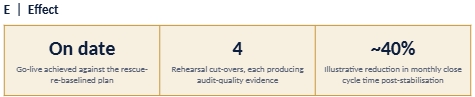
The statutory body went live on the rescue-re-baselined date — the first ERP go-live in the programme’s life that had held to its committed schedule. Opening balances were accepted without material audit finding at the subsequent external audit. Monthly close cycle time reduced materially against the legacy baseline, with corresponding improvements in management reporting timeliness. The benefits tracker established during the rescue continued as the statutory body’s principal post-implementation governance mechanism, providing the board and, through it, the line ministry, with documented evidence that the benefits for which the ERP programme had been approved were actually being delivered. The rescue methodology has since been cited by the statutory body in its engagement with sister parastatals as a model for future major technology programmes in the public sector.
Insight Lens — From the Engagement Partner
| The ERP rescue lesson
Stalled ERP programmes are not saved by working harder on what was already being done. They are saved by having the discipline to stop, re-open design fundamentals, and re-establish governance before any further technical work proceeds. The hardest conversation in an ERP rescue is always the same: explaining to stakeholders who have already invested two years of their professional lives that the next six weeks must be spent re-opening decisions they thought had been settled. ERPSURE™ in rescue configuration exists because we have learned, repeatedly, that this uncomfortable conversation is the conversation on which rescue success depends. Skip it, and the fifth go-live date joins the previous four. |
Cross-disciplinary Footprint
- Business Advisory — business case re-underwriting, target operating model re-validation, and benefits realisation tracker.
- Audit & Assurance — independent verification of data migration reconciliation and opening-balance acceptance.
- Risk Management — programme risk register re-architecture and board-level programme reporting.
- HR Advisory (PEOPLE360°™) — change network re-engagement, role-based retraining, and stakeholder trust restoration.
- Internal Audit — controls-by-design integration and post-go-live audit programme alignment.
Take the next step with Dawgen Global
| THE SIGNAL
If you are a board director, Chief Executive, Permanent Secretary, or Chief Financial Officer of a Caribbean organisation whose ERP programme has missed more than one committed go-live date, or whose programme governance no longer commands board confidence — the situation does not self-correct. Programmes that have slipped continue slipping until independent assurance is introduced. The longer that introduction is delayed, the higher the sunk cost and the more expensive the eventual rescue. THE OFFER Dawgen Global offers a confidential ERPSURE™ Programme Rescue Diagnostic: a structured four-to-six-week engagement that independently assesses your current programme’s health across all seven ERPSURE™ assurance domains, identifies the specific governance failures that are driving slippage, and produces a structured rescue plan with a defensible revised go-live date. The diagnostic is delivered under confidentiality and without obligation to proceed. THE CHANNEL Email [email protected]
|
About Dawgen Global
“Embrace BIG FIRM capabilities without the big firm price at Dawgen Global, your committed partner in carving a pathway to continual progress in the vibrant Caribbean region. Our integrated, multidisciplinary approach is finely tuned to address the unique intricacies and lucrative prospects that the region has to offer. Offering a rich array of services, including audit, accounting, tax, IT, HR, risk management, and more, we facilitate smarter and more effective decisions that set the stage for unprecedented triumphs. Let’s collaborate and craft a future where every decision is a steppingstone to greater success. Reach out to explore a partnership that promises not just growth but a future beaming with opportunities and achievements.
 Email: [email protected]
  Visit: Dawgen Global Website

 WhatsApp Global Number : +1 555-795-9071
Caribbean Office: +1876-6655926 / 876-9293670/876-9265210  WhatsApp Global: +1 5557959071
USA Office: 855-354-2447
Join hands with Dawgen Global. Together, let’s venture into a future brimming with opportunities and achievements


