
A Practical Guide to Zero-Income-Tax Jurisdictions—and Everything You Should Know
For as long as modern tax systems have existed, people have asked a deceptively simple question: “Is there anywhere I can live and not pay personal income tax?” The short answer is yes—a small set of jurisdictions levy no personal income tax on salaries, wages, or investment income earned by individuals. Many of them are small island nations in the Caribbean and the Pacific; a cluster are energy-rich states in the Middle East; and a few outliers exist in Europe and Asia.
But the complete answer is more nuanced. Where you live is only one pillar of your tax reality. Your citizenship, source of income, residency tests, treaty positions, and substance (the real-life facts of where you work and manage your affairs) also matter. Duties, social security contributions, consumption taxes (VAT), real-estate taxes, and immigration constraints still apply. In other words, “zero income tax” does not mean “zero tax,” nor does it automatically mean “right for you.”
This article explains which places have no personal income tax, why they can afford that policy, what trade-offs to expect, how the rules interact with your home country’s tax system, and how to make a compliant, well-planned move if you’re considering relocation. Throughout, we’ll flag common pitfalls and share practical checklists drawn from advisory experience across the Caribbean and beyond.
The Map at a Glance
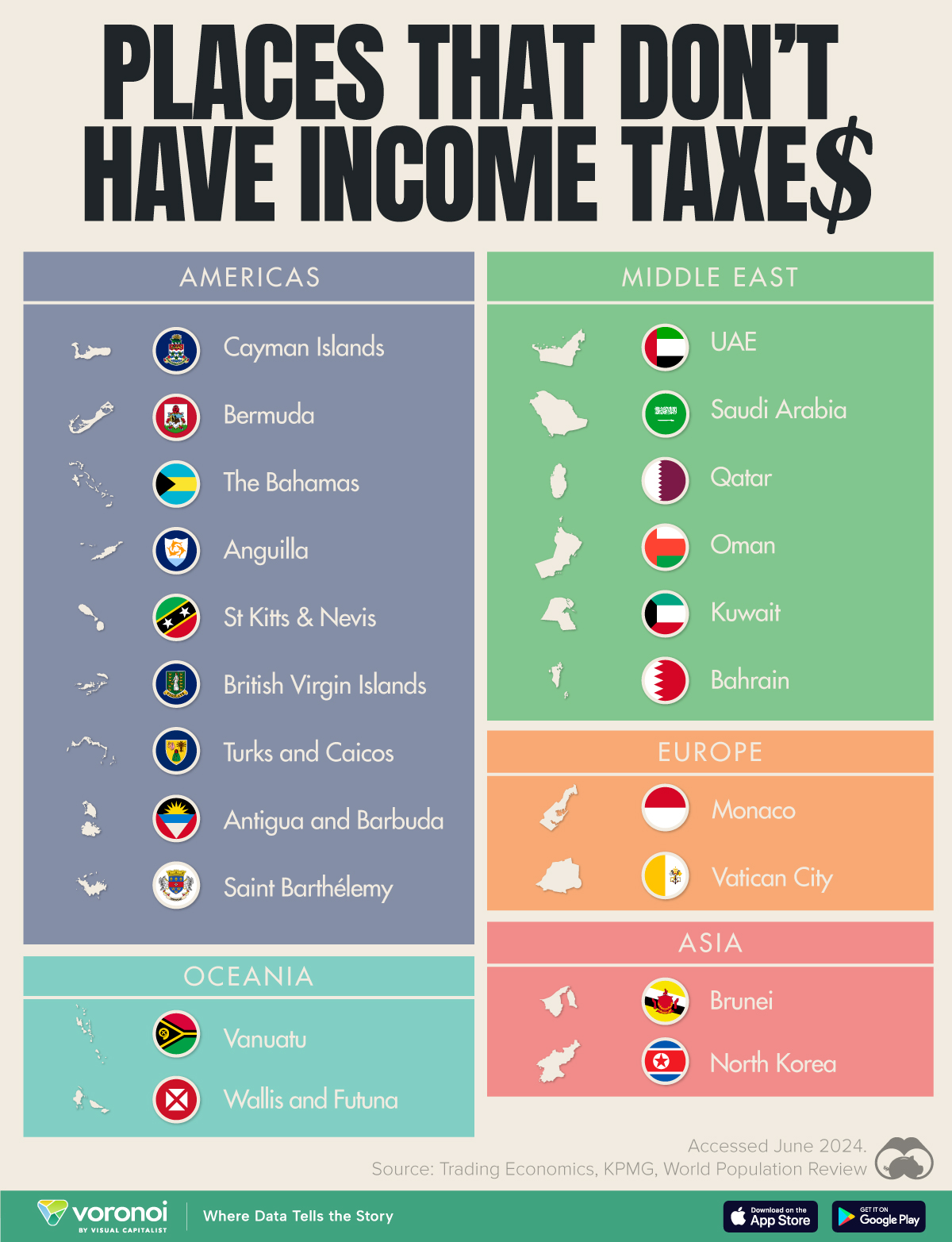
No Personal Income Tax—By Region (as shown in the attached graphic):
Americas
-
Cayman Islands
-
Bermuda
-
The Bahamas
-
Anguilla
-
St. Kitts & Nevis
-
British Virgin Islands
-
Turks & Caicos
-
Antigua & Barbuda
-
Saint Barthélemy
Middle East
-
United Arab Emirates (UAE)
-
Saudi Arabia
-
Qatar
-
Oman
-
Kuwait
-
Bahrain
Europe
-
Monaco
-
Vatican City
Asia
-
Brunei
-
North Korea* (see important caveat below)
Oceania
-
Vanuatu
-
Wallis & Futuna
North Korea officially abolished taxes in 1974, but citizens can be compelled to contribute labor—an obligation that functions like a tax. For obvious reasons, this is not a destination we advise anyone to consider.
Why Do Some Places Have No Personal Income Tax?
Most zero-income-tax jurisdictions fund government through other revenue sources:
-
Natural-Resource Rents:
Gulf economies—UAE, Saudi Arabia, Qatar, Oman, Kuwait, Bahrain—have historically relied on oil and gas revenues (though diversification is accelerating, and some now have corporate taxes and various fees). -
Tourism & Hospitality:
Caribbean islands—Bahamas, Turks & Caicos, Antigua & Barbuda, Anguilla, St. Kitts & Nevis, BVI, Cayman, Bermuda—derive significant income from tourism (hotel occupancy taxes, departure taxes), import duties, real-estate stamp duties, and license fees. -
Offshore Financial Services:
Some jurisdictions are established wealth and corporate hubs. They levy registration fees, license charges, and indirect taxes instead of personal income tax, while imposing economic-substance rules to align with international standards. -
Consumption Taxes & Fees:
Even where there’s no income tax, governments may collect VAT/GST, customs duties, property taxes, municipal fees, and social insurance contributions. The absence of income tax is often offset by higher cost of living or elevated indirect taxes.
Zero Income Tax ≠ Zero Tax: What Else Might You Pay?
Before you fall in love with a picturesque bay or a gleaming skyline, check the total tax burden and recurring costs:
-
VAT / GST / Sales Tax: Applies to goods and services. Rates and exemptions vary widely.
-
Customs Duties & Import Levies: Island economies often rely on customs duties, which can raise the cost of cars, electronics, and even groceries.
-
Property Transfer Taxes & Stamp Duties: Real-estate transactions typically incur one-off or recurring levies.
-
Municipal Fees & Utility Surcharges: Waste collection, water, telecom, and electricity can be more expensive than you expect.
-
Social Insurance / Health Contributions: Some states collect payroll-like charges even without an income tax.
-
Corporate Taxes: Several “no personal income tax” jurisdictions now do levy corporate income tax (e.g., UAE corporate tax for many businesses), economic-substance requirements, and transfer-pricing compliance.
Residency Is a Legal Test, Not a Feeling
To benefit from a zero-income-tax regime, you must usually become a tax resident there—and, crucially, cease to be tax resident somewhere else. Each country defines tax residency differently:
-
Day-Count Tests: Many places use 183 days in a calendar year, but some use 90 days with tie-breakers, or a “center of vital interests” test.
-
Ordinary Residence / Domicile: A few systems focus on where your life is ordinarily situated (home, family, economic interests) rather than just day counts.
-
Remittance & Territorial Systems: Some countries tax only income sourced locally or remitted into the country. That’s not the same as “no tax,” but it can be very favorable when managed correctly and compliantly.
Tie-breaker rules in double-tax treaties can help determine which country gets primary taxing rights when two claim you as resident. If your home country lacks a treaty with your destination (common between many Caribbean states and certain larger economies), you’ll need to rely on domestic rules—requiring even more careful planning.
Citizenship Complications: The U.S. Example
Most countries tax based on residency, not citizenship. The United States is the major exception, taxing citizens on their worldwide income regardless of where they live (with some exclusions/credits, like the Foreign Earned Income Exclusion and foreign tax credits). Renouncing citizenship is a profound, personal decision that can involve exit tax. If you’re a U.S. citizen considering a move to a no-tax jurisdiction, specialized advice is essential.
A few other countries impose departure taxes on unrealized capital gains or have continuing reporting requirements for former residents. Again, planning ahead prevents nasty surprises.
Economic Substance & Anti-Avoidance: The New Normal
International tax cooperation has tightened dramatically:
-
Economic Substance Laws (ESR): In many offshore hubs, companies undertaking “relevant activities” must demonstrate real local activity—people, premises, and decision-making in the jurisdiction.
-
CFC (Controlled Foreign Company) Rules: Your home country may attribute the profits of low-taxed foreign subsidiaries back to you.
-
BEPS, CRS, FATCA: Cross-border information sharing (Common Reporting Standard) and U.S. FATCA mean banks report account details to tax authorities.
-
GAAR / Anti-Avoidance: If your arrangement lacks commercial substance and exists primarily to avoid tax, authorities can recharacterize it.
Takeaway: It’s not enough to open a company or rent a PO box. If you say you live in Cayman or Dubai, your digital footprint, travel history, lease, utility bills, school enrollments, medical providers, and—most tellingly—where you actually work should be consistent with that claim.
Living in a Zero-Income-Tax Jurisdiction: Lifestyle & Practicalities
Beyond tax, you’re choosing a home. Consider:
-
Cost of Living:
-
Bermuda, Cayman, Monaco: World-class amenities with world-class price tags.
-
UAE: Broad range—Dubai/Abu Dhabi can be expensive, but choice abounds; tax savings can outweigh costs for many professionals.
-
Bahamas, BVI, TCI, Anguilla: Imported goods raise prices; budgeting for flights and medical evacuation plans may be wise.
-
-
Healthcare & Insurance:
Private coverage is common. Check local hospital capacity, medical evacuation options, and visa insurance requirements. -
Education:
International schools exist in major hubs (UAE, Monaco). Smaller islands may have limited options; boarding or online schooling could be considerations. -
Connectivity & Transport:
Airport access matters for global businesses. The Bahamas and Cayman have excellent connections to North America; UAE is an intercontinental hub. -
Safety & Governance:
Stability, rule of law, and regulatory predictability should weigh heavily in your decision. Many Caribbean and Gulf jurisdictions rank well on business environment metrics; always review current advisories. -
Community & Culture:
Island life can be idyllic but quieter. The UAE offers a bustling cosmopolitan scene. Monaco provides European elegance with a tight-knit community. Fit matters.
Highlights & Distinctive Pathways
Cayman Islands
Known for financial services, dive sites, and quality infrastructure. No personal income tax, no corporate income tax, but ESR and international compliance standards apply. Residency by investment options exist via real estate thresholds and substantial business presence programs.
The Bahamas
No personal income tax; revenue from VAT, customs duties, and tourism. Permanent Residency can be obtained through qualifying real-estate investment; the Annual Residence Permit is another route. Proximity to the U.S. is a practical advantage.
Bermuda
High cost of living, strong insurance and reinsurance sector, robust professional community. No personal income tax, but payroll tax (employer-side and sometimes employee contribution) and other levies apply. Work permits and housing restrictions must be understood.
Monaco
No personal income tax for most residents (French nationals face special rules). Extremely high living costs and a premium property market, offset by safety and European connectivity. Banking relationships and KYC are stringent.
UAE (Dubai/Abu Dhabi)
No personal income tax (note payroll-like social charges for GCC nationals and some emirate-level fees). UAE Corporate Tax now applies to many businesses; 0% Free Zone regimes can be available if qualifying activities and conditions are met. Golden Visas, freelance permits, and business licenses provide multiple entry points. World-leading air connectivity, modern infrastructure, and a deep professional ecosystem make the UAE a practical base for many entrepreneurs and executives.
St. Kitts & Nevis / Antigua & Barbuda / Dominica (nearby non-zero-tax peers)
While this article focuses on no-income-tax states, note that the Caribbean also features citizenship-by-investment (CBI) programs (terms evolve). CBI is not the same as tax residency—but can simplify travel and relocation strategies when paired with a proper residency plan.
Vanuatu
No personal income tax; revenue via VAT and duties. Several residency and citizenship pathways exist but must be navigated carefully to ensure international banking acceptance and compliance.
Case Studies (Hypothetical but Realistic)
1) The Remote Tech Founder Moving from a High-Tax City to Dubai
Profile: 36, owns 100% of a SaaS company with global customers, currently taxed on worldwide income in a high-tax jurisdiction.
Plan:
-
Obtain a UAE residence visa (e.g., through a free-zone company or property investment).
-
Become UAE tax resident (day counts, home, business activity).
-
Re-incorporate or restructure group to align with UAE Corporate Tax and—if beneficial—qualifying free-zone regime, ensuring substance and transfer-pricing documentation.
-
Exit former country’s residency cleanly (closing home, deregistration where applicable, treaty tie-breaker if available).
-
Continue banking with CRS-compliant reporting, robust bookkeeping, and audited financials where needed.
Outcome: Personal income is untaxed in the UAE, corporate profits potentially at preferential rates if conditions met. Compliance is deeper than before, but overall effective tax rate drops significantly while maintaining global market access.
2) The Caribbean Returnee Choosing The Bahamas
Profile: 52, investment professional with portfolio income, seeking proximity to U.S. financial centers and lifestyle benefits.
Plan:
-
Acquire qualifying real estate and apply for Permanent Residency.
-
Restructure investment holding to avoid CFC traps in former home country; ensure non-resident status there (and no ongoing domicile taxes).
-
Accept VAT and customs duty costs as part of the living budget; retain international health cover.
Outcome: No personal income tax on portfolio gains; predictable proximity to U.S. markets; lifestyle trade-offs understood and priced in.
3) The European Entertainer Considering Monaco
Profile: 29, touring artist with volatile income.
Plan:
-
Lease or purchase a Monaco residence and demonstrate genuine center of life there.
-
Coordinate touring contracts so that source taxes in performance locations are properly withheld and credited (or minimized under treaty rules).
-
Maintain rigorous travel logs and professional management to handle multi-jurisdiction withholding.
Outcome: Monaco residency reduces home-country personal tax exposure; but performance income remains subject to source-country tax. Net position still meaningfully improved.
Common Pitfalls (and How to Avoid Them)
-
Counting Days but Ignoring “Center of Vital Interests.”
If your family, home, and economic ties remain in your old country, that authority may still claim you. Solution: align facts with your new life—housing, schooling, club memberships, doctors, utilities, and local business presence. -
Using a Shell Company Without Substance.
Substance rules and CFC legislation will likely undo the benefit. Solution: hire locally, lease premises, keep minutes, and make key decisions where your company is taxed. -
Confusing Citizenship with Tax Residence.
U.S. citizens, for example, remain fully taxable. Solution: get advice before relocating. -
Forgetting Source Tax.
You can live in a zero-income-tax state and still owe taxes where your money is earned (e.g., rental properties abroad, touring income, employment physically performed elsewhere). Solution: map source rules for each income stream. -
Banking & KYC Friction.
Some banks restrict clients from certain nationalities or jurisdictions. Solution: pre-qualify banking relationships and maintain transparent, well-documented funds. -
No Exit Strategy from the Old Country.
Skipping deregistration, breaking lease late, or keeping the family home can undermine your case. Solution: follow a checklist and keep proof.
A Step-by-Step Relocation Framework
-
Define Objectives: Tax savings, lifestyle, schooling, time zone, flight connectivity, and community.
-
Residence & Immigration Pathway: Investor visa, employment pass, freelance permit, or property-linked residency.
-
Tax Feasibility Study:
-
Day counts and residency tests (old vs. new).
-
Treaty analysis and tie-breaker availability.
-
Source-of-income mapping (employment, dividends, IP, capital gains).
-
CFC, transfer pricing, ESR, and anti-avoidance exposure.
-
-
Corporate & Holding Structure: Where will value creation occur? Which entity earns what? Align with substance.
-
Wealth & Estate Planning: Trusts, foundations, prenups/postnups, forced-heirship issues (civil-law jurisdictions), and succession.
-
Banking & Payments: Choose banks comfortable with your profile and jurisdictions; expect detailed KYC/AML.
-
Insurance & Healthcare: Private medical, evacuation cover, liability, and key-person insurance if you run a business.
-
Property & Housing: Understand stamp duties, rent caps, and homeowners’ fees.
-
Operational Set-Up:
-
Local accountants and registered agents
-
Audit requirements and bookkeeping systems
-
Payroll and HR if hiring locally
-
Annual filings, license renewals, and ESR reports
-
-
Documentation & Evidence: Keep travel logs, lease agreements, utility bills, school enrollments, and board minutes—this is your defense file if challenged.
How Much Can You Really Save?
Consider a senior professional earning US$500,000 in a high-tax city with a top marginal rate of ~45%. Even after deductions and planning, they might remit US$175,000–225,000 annually in income taxes and social contributions. Relocating to a no-income-tax jurisdiction could eliminate that personal tax bill—if they truly become non-resident of the former country and if their income is not taxed at source elsewhere.
However, don’t ignore the replacement costs:
-
Increased rent or property purchase price
-
School fees for international curricula
-
Private medical and evacuation cover
-
Higher consumer prices due to imports or VAT
-
Corporate tax and compliance under newer regimes (e.g., UAE)
-
Professional fees for setup and ongoing governance
For many mobile professionals and founders, the net still strongly favors relocation. For others—especially those whose income is largely source-taxed elsewhere—the benefit may be smaller. A tailored projection clarifies the true delta.
Ethics, Reputation, and ESG Considerations
Today’s leaders think beyond tax savings. Investors, customers, and employees increasingly scrutinize governance choices. A move to a no-income-tax base can be a positive, transparent decision when paired with real substance, clear compliance, and community contribution. Many jurisdictions actively court high-value residents who build in the local economy—creating jobs, supporting education, and backing cultural life.
Quick Notes on Each Region
Caribbean Cluster (Bahamas, Cayman, Bermuda, BVI, TCI, Anguilla, Antigua & Barbuda, St. Kitts & Nevis, St. Barthélemy):
-
Pros: Proximity to the Americas, English widely used, established financial services, lifestyle appeal.
-
Cons: Hurricanes (insurance!), high import costs, limited medical capacity on smaller islands, flight frequency to secondary cities.
-
Watch-outs: ESR for companies, property acquisition rules for non-citizens, and evolving economic programs.
Gulf States (UAE, Saudi, Qatar, Oman, Kuwait, Bahrain):
-
Pros: World-class infrastructure, global flight connections, fast-growing markets, English widely used in business.
-
Cons: Climate, cultural adaptation, and in some cases sponsorship systems for employment.
-
Watch-outs: Corporate tax in the UAE and transfer-pricing documentation; ensure visa status aligns with your work practices.
Europe (Monaco, Vatican City):
-
Pros: Safety, lifestyle, art and culture, EU-adjacent access (Monaco).
-
Cons: Extremely high housing costs and limited space.
-
Watch-outs: Special rules for French nationals in Monaco; careful treaty reviews for performance/professional income earned outside Monaco.
Asia & Oceania (Brunei, Vanuatu, Wallis & Futuna):
-
Pros: Calm pace (Brunei, Vanuatu), zero income tax; low population density.
-
Cons: Limited flight connectivity, narrower professional ecosystems, and in some cases restricted social life for expatriates.
-
Watch-outs: Banking access and international perception—ensure strong documentation and compliant wealth structuring.
Frequently Asked Questions
Q: If I move to a zero-income-tax country, can I still work for my foreign employer?
A: Possibly—but confirm permanent establishment and payroll implications for the employer, immigration rules for you, and source-of-income consequences. Many employers now support Employer of Record (EOR) solutions to simplify cross-border payroll and compliance.
Q: What if my old country thinks I still live there?
A: That risk is real. Build a defense file: lease or deed, utility bills, local club memberships, medical providers, schooling, travel logs, and board minutes showing management decisions in your new home. If a treaty exists, tie-breaker rules may apply.
Q: Is buying a passport the same as reducing my taxes?
A: No. A passport or second citizenship can help with mobility and residency options, but tax outcomes depend on residency and source—not just nationality (with U.S. citizenship as the well-known exception).
Q: Do I need economic substance if I’m just an individual?
A: Substance rules target entities. But as an individual, the same concept applies informally: authorities will ask where you actually live and work. Your facts should match your filings.
When a Move Makes Sense
Relocation is most compelling when you can:
-
Truly live and work in the new country (not just vacation there),
-
Re-anchor your business substance and client base where permitted,
-
Avoid source-tax leakage from old markets,
-
And value the lifestyle as much as the tax policy.
If your income remains heavily source-taxed elsewhere (e.g., on-site professional services, rental real estate in your old country), or if your family, schooling, and home ties remain where you used to live, the benefit diminishes—and the risk of dual residency increases.
What Dawgen Global Can Do for You
As an integrated, Caribbean-based professional services firm, Dawgen Global advises entrepreneurs, executives, families, and investors on tax-efficient, fully compliant cross-border lifestyles and business structures. Our multidisciplinary team covers tax advisory, corporate structuring, accounting, audit, legal and compliance, and business coaching—so your plan works on paper and in real life.
Our typical engagement includes:
-
Residency & Treaty Feasibility – Determining whether you can become non-resident of your current country and resident in a zero-income-tax jurisdiction without unintended consequences.
-
Structure Design – Aligning companies, IP, and investments with substance, ESR, and transfer-pricing norms.
-
Compliance Setup – Banking, bookkeeping, payroll/EOR, licenses, filings, and annual returns.
-
Risk Management – GAAR/anti-avoidance reviews, defense files, and ongoing monitoring as rules evolve.
-
Lifestyle Integration – Schools, medical cover, insurance, and relocation partners—because success is holistic.
Final Word
Living where there’s no personal income tax is real—and for thousands of globally mobile professionals, founders, and families, it’s a sustainable, ethical choice when backed by genuine residency, economic substance, and transparent compliance. It can also be a superb lifestyle upgrade: sunshine, safety, connectivity, and a vibrant international community.
But a move of this magnitude deserves a professional plan. The jurisdictions on the map are the starting line, not the finish. Let data, law, and lived reality guide you.
Speak with Dawgen Global’s Tax Advisory Team
If you’re exploring a move—or you simply want to benchmark your current setup against what’s possible—let’s talk.
📧 Email: [email protected]
💬 WhatsApp (Global): +1 555 795 9071
At Dawgen Global, we help you make Smarter and More Effective Decisions. Share your situation, goals, and timelines, and we’ll outline a clear, compliant path tailored to you.
About Dawgen Global
“Embrace BIG FIRM capabilities without the big firm price at Dawgen Global, your committed partner in carving a pathway to continual progress in the vibrant Caribbean region. Our integrated, multidisciplinary approach is finely tuned to address the unique intricacies and lucrative prospects that the region has to offer. Offering a rich array of services, including audit, accounting, tax, IT, HR, risk management, and more, we facilitate smarter and more effective decisions that set the stage for unprecedented triumphs. Let’s collaborate and craft a future where every decision is a steppingstone to greater success. Reach out to explore a partnership that promises not just growth but a future beaming with opportunities and achievements.
✉️ Email: [email protected] 🌐 Visit: Dawgen Global Website
📞 📱 WhatsApp Global Number : +1 555-795-9071
📞 Caribbean Office: +1876-6655926 / 876-9293670/876-9265210 📲 WhatsApp Global: +1 5557959071
📞 USA Office: 855-354-2447
Join hands with Dawgen Global. Together, let’s venture into a future brimming with opportunities and achievements


