Virtual accounting services and remote bookkeeping in the Caribbean
Proximity in accounting was physics, not preference — four physical constraints that have all since dissolved. This article sets out what severed them, what the habit of paying for distance still costs a regional business, and the short honest list of work that genuinely still has to happen in the building.
IN SHORT
| Proximity in accounting was structural, not preferential. The ledger was a physical object in a room, documents arrived as paper, the software ran on one machine, and approval required a body and a pen. All four constraints have gone. What still genuinely requires presence is a short list — cash handling, stock and asset verification, some relationship work, and specific statutory requirements. Everything else can be performed anywhere, and the question becomes whether the work is documented, controlled and delivered on a calendar. |
SECTION 1
The pattern
For most of accounting history, the finance function had to be where the business was. This was not a preference or a management philosophy. It was physics.
Four constraints held it in place, and each of them was absolute.
The ledger was an object. A book, and later a filing cabinet of printed reports. There was one of it. Whoever needed to write in it had to be in the room with it, and two people could not use it at once.
Documents arrived as paper. Invoices, statements, delivery notes, cheque stubs. They were delivered to an address, they accumulated in a tray at that address, and processing them meant handling them.
The software ran on one machine. A licence tied to a computer under a particular desk, with the data file on its hard drive and a backup on a tape or a memory stick in a drawer beside it. The system was a place.
Approval required a body. A signature on a cheque, an initial on a voucher. Authority was expressed physically, so the person holding it had to be reachable in person.
Every one of those four has dissolved. Bank feeds deliver transactions in machine-readable form without anybody collecting a statement. Documents are captured as images at the point they arrive and attached permanently to the entries they support. The ledger is a service reachable from any device by anyone permitted to reach it. Approval is a permission setting with a name and a timestamp attached, which is a considerably better record than an initial in a margin.
The assumption outlived the constraints, which is ordinary. Nobody revisits a limitation once it has stopped biting; it simply becomes how things are done. So finance functions continue to be built around a physical requirement that expired some years ago.
| THE PROXIMITY AUDIT — list everything your finance function does, then ask of each task: does this require someone physically present, and present with what? There are only three honest answers. Present with the money or the goods. Present with the people. Present nowhere. The third category is larger than almost anyone expects, and always was — it simply could not be moved before. |

One objection deserves a straight answer rather than a rebuttal: I like being able to walk down the hall and ask. That is a real want, and it is worth taking seriously. But what is actually wanted is responsiveness and visibility, and adjacency was only ever a proxy for both — and a fairly poor one. The colleague down the hall is frequently the same person who cannot state the receivables position without three days of work. Being able to ask quickly is not the same as being able to find out quickly.
SECTION 2
The Caribbean variant

Nowhere does the collapse of distance matter more than in a region of small, separated markets. Six conditions make the regional case sharper than the general one.
The talent pool is no longer island-shaped. A business in Saint Lucia, Dominica or rural Jamaica competes for finance staff within a radius of a few miles. Once the work can be performed from anywhere, that business can reach depth — IFRS judgement, multi-currency treatment, group consolidation — that simply does not reside in its own town at any price.
Fifteen territories, one set of numbers. A regional group has historically needed a finance person in each jurisdiction, each maintaining their own basis, with consolidation assembled by hand at the centre. Where the ledger is one system reachable from everywhere, the entities report on one basis because they are literally in one place.
A time zone that is an advantage rather than a handicap. The Caribbean sits inside North American business hours. Work performed here is performed during the client’s working day, not overnight and not answered twelve hours later. Businesses that have used distant offshore providers know precisely what that lag costs; it does not arise here.
Hurricane season makes continuity a finance question. A ledger held on a machine in an office is exposed to whatever the building is exposed to. Records in the cloud, replicated and backed up, survive a season that the server under the desk does not — and the finance function continues from wherever its people can work, which after a storm is rarely the office.
Connectivity has crossed the threshold. The binding constraint in regional digital delivery used to be bandwidth. It is now process. Where a business still cannot operate a cloud ledger, the obstacle is almost always an undocumented workflow rather than a connection.
Statutory presence requirements are narrower than assumed. A registered office, resident directors in certain jurisdictions, and specific record-retention rules are real obligations and must be met precisely. They are also a short and specific list. Most of what businesses believe must be done locally is habit rather than law, and the two are worth separating deliberately.
SECTION 3
What it costs
Maintaining proximity that is no longer required has a price, and it is paid quietly. The figures below are indicative, drawn from advisory experience across the region rather than from survey.
A location premium paid for availability, not ability. Where the pool is a town rather than a region, the business pays a scarcity premium to secure whoever is present — which is a premium for proximity rather than for capability, and it renews with every counter-offer.
Sub-scale hiring, repeated per territory. A group operating in four jurisdictions frequently employs four finance people where the actual work amounts to perhaps two. The excess is not inefficiency by anyone involved; it is the minimum granularity of a physical hire.
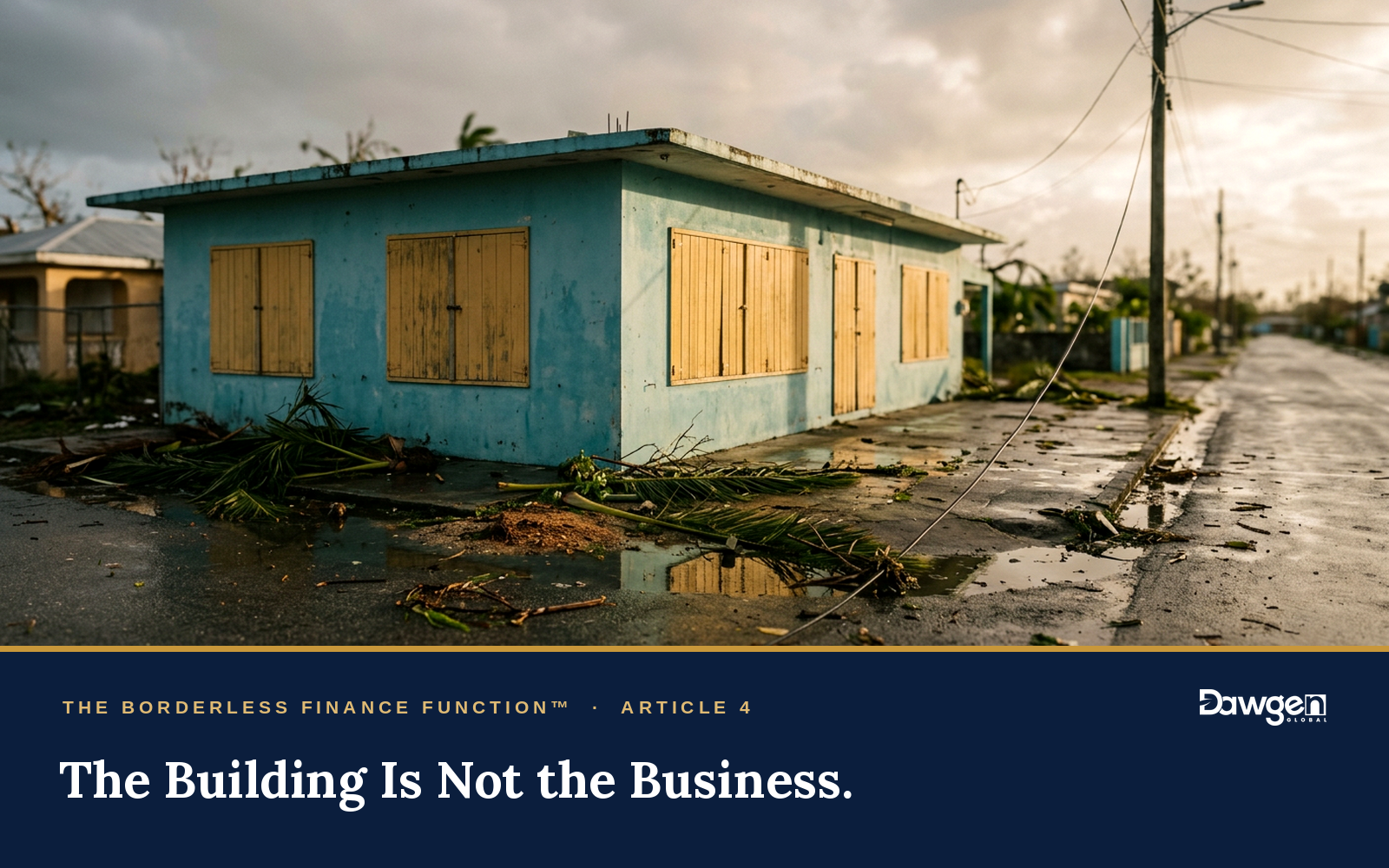
Continuity exposure concentrated in one building. Where the records, the system and the only person who understands both are at a single address, the business has an operational risk it has never priced — and in this region it is priced for them, once every few years, by the weather.
Filings that run at the speed of the slowest territory. When each jurisdiction depends on its own local person, the group’s compliance position is only ever as current as the least-resourced office. Penalties tend to arise in the same territory repeatedly, for that reason.
The competitive gap. The businesses that have removed the constraint are now running finance functions with depth their local competitors cannot hire at all. That gap does not show up as a cost. It shows up later, in the quality of decisions taken on either side of it.
| The question was never where the work is done. It is whether the work is documented, controlled, and delivered on a date you were told in advance. |
SECTION 4
What the capability actually does
Eight mechanisms sever the link between location and finance work. The ninth item is the more important one, and it runs the other way.
Bank and card feeds replace statement collection. Transactions arrive in the ledger directly from the institution, daily, without anybody visiting a branch, downloading a file or carrying paper between buildings. The most location-bound task in traditional bookkeeping is now the least.
Document capture replaces the tray and the courier. A supplier invoice is photographed or forwarded on the day it arrives, read, and attached to the transaction permanently. The physical document can stay exactly where it is; nobody needs to be near it again.
The platform replaces the machine under the desk. Access is a permission rather than a location. Two people in two territories work in the same ledger at the same time, which was never possible with a data file on a hard drive, whoever was sitting in front of it.
Approval becomes a permission with a name and a timestamp. Authority is exercised from wherever the authorised person is, and the record of who approved what is more complete than a signature ever was. Payment runs stop waiting for a director to return from Miami.
Live dashboards replace walking down the hall. Cash, receivables, payables and margin are readable on any day by anyone permitted to see them. The question that used to require finding a colleague now requires opening a screen, and the answer is current rather than remembered.
One ledger replaces a file passed between people. No emailed spreadsheet, no version conflict, no reconciliation between two copies of the truth. Everyone is looking at the same record, which removes an entire category of dispute.
Continuity by architecture rather than by hope. Hosted, replicated and backed up off-island. If the building is unusable, the finance function is not — it continues from wherever its people are. In this region that is a substantive control, not a technical footnote.
Consolidation without a person per territory. Entities, currencies and jurisdictions report into one structure. Group position is a report rather than an assembly exercise, and it is available on the same date every month regardless of which islands were busy.
And the honest half of the argument, which any credible proposal should state without being asked:
| WHAT GENUINELY STAYS LOCAL — cash handling and the banking mandate. Stock counts, fixed-asset verification and anything requiring somebody to look at a physical thing. Supplier and customer relationships that are conducted face to face. Registered office, resident-director and record-retention obligations specific to each jurisdiction. Any provider who tells you the list is empty is not describing your business. |
SECTION 5
How the Accounting Services BPO Division delivers it
Removing distance as a constraint is only useful if what replaces proximity is better than proximity was. Six things do that.
Work is performed where the capability is, on one calendar. Processing, reconciliation and close are carried out by people who do that work continuously, wherever they sit, against fixed dates. The client experiences a schedule rather than a location.
Responsiveness by design rather than by adjacency. A named engagement manager, a named reviewer, scheduled contact and a stated forty-eight-hour maximum response on any query. That is a firmer commitment than the ability to walk down a hall and find somebody out at lunch.
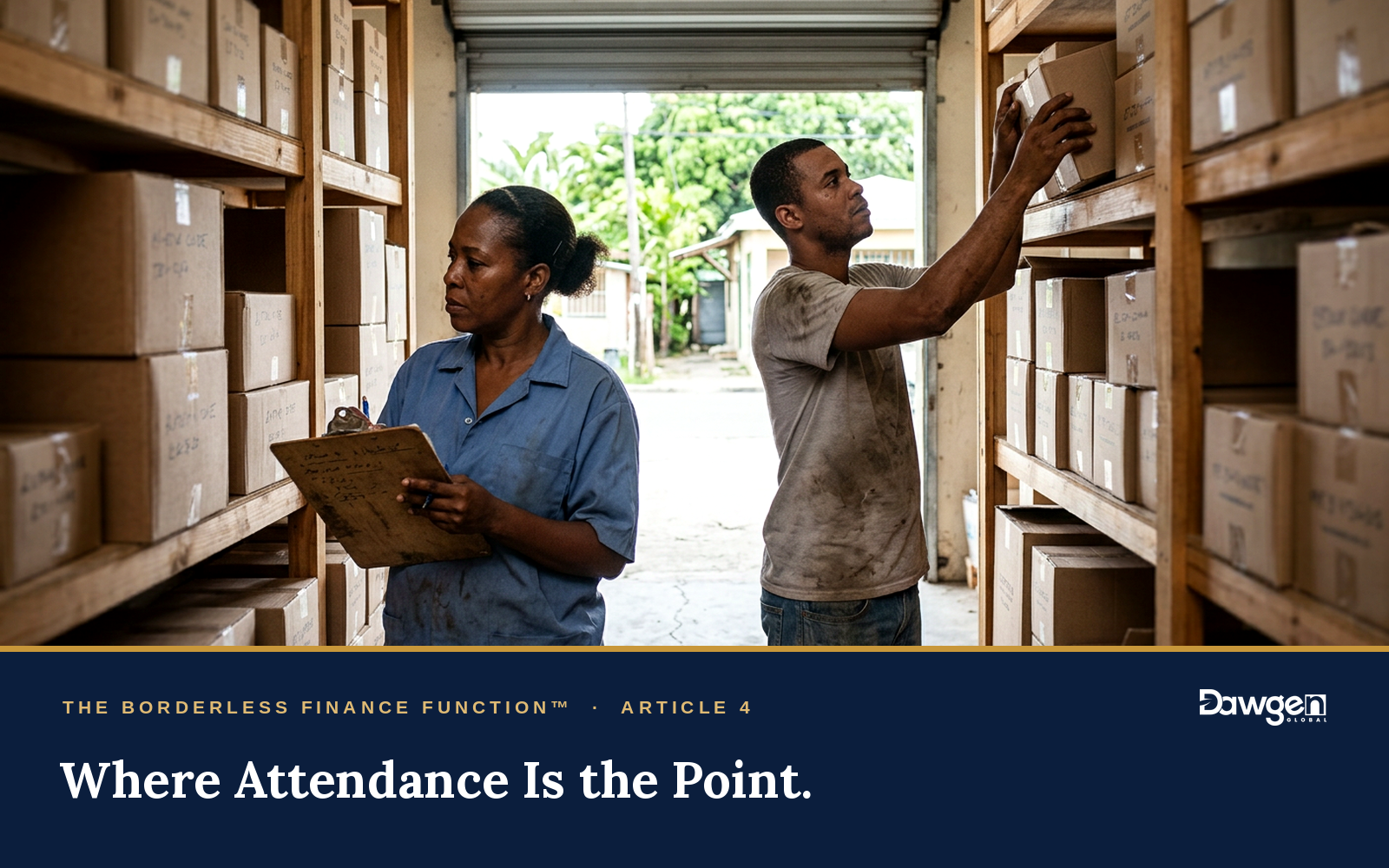
Onsite when onsite is genuinely required. Stock counts, fixed-asset verification, transition and year-end work happen in the building. The division operates across fifteen-plus territories and attends where attendance is the point.
Territory-specific knowledge held by people who use it weekly. Payroll regimes, filing calendars and tax treatment differ by jurisdiction, and are handled by specialists who meet those rules regularly rather than by a generalist encountering them once a year.
Data residency, access control and continuity stated in writing. Where the data sits, who may reach it, how access is logged, how it is backed up and what happens in a disruption — documented at the outset rather than discussed after an incident.
Service levels replace the comfort of the next office. Nine days to close and issue. A defined output set. A quarterly scope review. These are testable, which adjacency never was.
SECTION 6
Where to start

In the next thirty days. Run the proximity audit. List every recurring finance task and mark each one as requiring presence with the money or goods, presence with people, or presence nowhere. Do it honestly and do it with the person who performs the work. The third column is usually between sixty and eighty per cent of the total, and seeing it written down changes the conversation more than any argument does.
In thirty to ninety days. Move the third column first, and move the most location-bound task in it before anything else — bank reconciliation, almost always. Leave the first two columns entirely alone at this stage. Attempting everything at once is the most common reason these transitions stall.
Beyond ninety days. Apply the continuity test: if this building were unusable for a month, could the finance function continue? Where the answer is no, the exposure is not really about distance at all — it is about having a single copy of something. Distance is the constraint that removing it happens to fix.
| Distance stopped being a cost some years ago. What remains is the habit of paying it — in salary premiums, in sub-scale hires per territory, and in the depth a business could have had and did not. |

REFERENCE
Frequently asked questions
What are virtual accounting services?
Accounting work — processing, reconciliation, payables and receivables, payroll, statutory filing and the monthly close — performed on a cloud platform by a team that is not physically in your office, to a fixed calendar with defined outputs. Approvals, banking mandates and commercial decisions remain with the client throughout.
Does remote bookkeeping work for a Caribbean business?
Particularly well. Regional businesses are the ones most constrained by a local talent pool, and the Caribbean sits inside North American business hours, so work is performed during the client’s working day rather than overnight. Cloud-held records also survive a hurricane season that an office server does not.
What finance work still has to be done on site?
Cash handling and the banking mandate; stock counts and fixed-asset verification; relationship work conducted face to face; and jurisdiction-specific obligations such as registered office, resident directors and record retention. Everything else can be performed anywhere. Any provider claiming the list is empty is not describing a real business.
Is our financial data safe if it is not in our building?
It is generally safer. Enterprise cloud hosting provides replication, off-site backup, access logging and role-based permissions that a single office machine does not. The controls worth insisting on are documented data residency, stated access rights and a written continuity position.
How do we get quick answers without someone in the next office?
Through live dashboards and stated service levels rather than through proximity. Cash, receivables and margin are readable on demand, and a named engagement manager responds within a stated window. In practice this is faster than asking a colleague who then needs three days to find out.
We operate in several territories. Do we still need someone in each one?
For finance processing, generally no — one ledger reachable from everywhere removes the need for a person per jurisdiction and produces one reporting basis rather than several. Statutory presence requirements are separate, specific and must still be met in each territory.
Continue reading: “The bookkeeper who leaves takes the system with her.” · “Your data left the building years ago. Nobody wrote it down.” · “Every territory has its own tax. The group should still read as one set of numbers.”
About Dawgen Global
Dawgen Global is an independent, integrated multidisciplinary professional services firm headquartered at 47 Trinidad Terrace, New Kingston, Jamaica, serving more than 15 territories across the Caribbean. Founded and led by Dr. Dawkins Brown, Executive Chairman, the firm is independent and not affiliated with any international network. It delivers a full suite of professional services under one roof: audit and assurance; tax advisory; IT and digital transformation; risk management; cybersecurity; actuarial and insurance regulatory advisory; HR advisory; mergers and acquisitions; corporate recovery; business advisory and strategy; accounting BPO and virtual CFO services; and legal process outsourcing.
The proposition is simple: big-firm capability without the big-firm price. Dawgen Global’s integrated approach is built for the specific complexities and opportunities of the Caribbean market, helping organizations make sharper, better-informed decisions that drive measurable progress.
To explore a partnership, reach out:
- Website: dawgen.global
- Email: [email protected]
- WhatsApp (Global): +1 555-795-9071
- Caribbean offices: +1 876-665-5926 | +1 876-929-3670 | +1 876-926-5210


