Framework: RAMP™ = Relevance → Attraction → Monetization → Propulsion
Where we are: Part 1 established that most marketing fails because Relevance is undefined. Part 2 showed how to define your ICP like a revenue scientist. Now Part 3 addresses the next pillar of Relevance—the one that directly determines pricing power:
Positioning.
If ICP answers who you serve, positioning answers why you—and why a buyer should choose you without needing a discount, a long negotiation, or a referral “push.”
Positioning is not a logo, a tagline, or a brand refresh.
Positioning is the set of strategic choices that shape how a market perceives you—so buying feels obvious.
And when buying feels obvious, margins improve.
Why Price Competition Is Usually Self-Inflicted
Most businesses believe price competition is caused by:
-
“the economy,”
-
“cheap competitors,”
-
“customers who don’t value quality,”
-
or “the market being saturated.”
Sometimes those factors exist.
But in practice, price competition is often self-inflicted because the business has not built a clear position that signals:
-
Distinct value
-
Specialized relevance
-
Credible proof
-
Low risk of choosing you
When those signals are weak, the buyer does what buyers are rationally supposed to do: compare price.
Because if two providers look similar, price becomes the only visible difference.
Positioning is what stops you from looking similar.
The Dawgen Rule: If You’re Fighting on Price, You’re Probably Selling a Category, Not a Point of View
Many companies describe themselves by category:
-
“We’re a marketing agency.”
-
“We’re consultants.”
-
“We do strategy.”
-
“We help businesses grow.”
-
“We provide solutions.”
That’s not positioning. That’s classification.
And if a buyer only sees you as a category provider, you become a commodity:
-
“Send your rates.”
-
“What’s your fee?”
-
“We’re looking at 3 firms.”
Positioning requires a point of view—a distinct way of solving a painful problem for a specific buyer.
That is why Dawgen uses RAMP™: it’s not just a service menu, it’s a commercial method that buyers can understand and trust.
What Positioning Actually Is (In Business Terms)
Positioning is the strategic decision of:
-
What you will be known for
-
Who will value it most
-
Why your approach is superior
-
How you will prove it
-
What you will refuse to be
The most important part of that list is the last one:
Positioning requires refusal.
If you try to be everything to everyone, you position as “generic.”
Generic is cheap.
The Dawgen Positioning Triangle
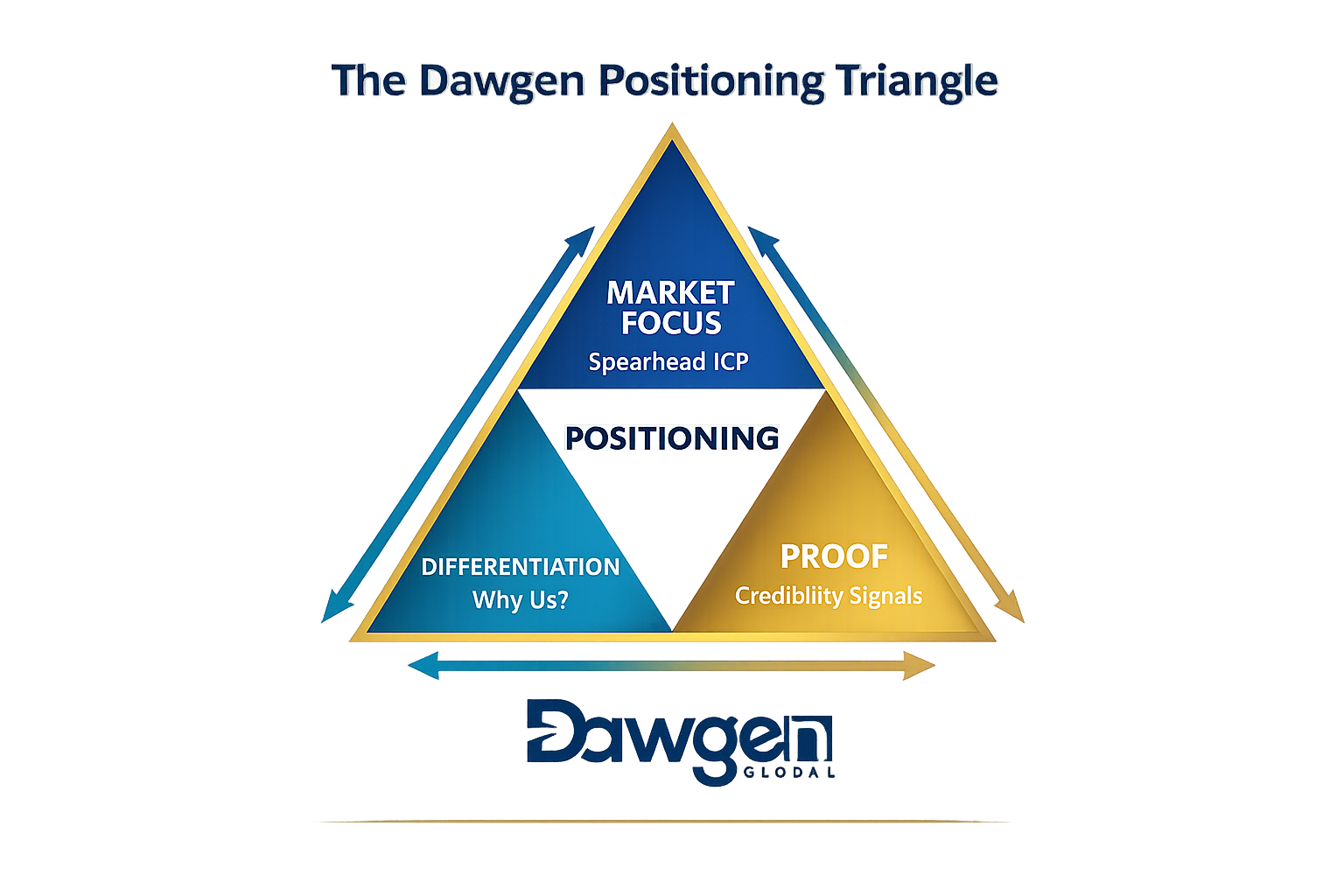
To make positioning practical, Dawgen uses a simple triangle:
Positioning = Market Focus + Differentiation + Proof
If any side is weak, pricing power collapses.
1) Market Focus (Spearhead ICP)
This is what we defined in Part 2: a target segment you can win repeatedly.
Without focus:
-
your message becomes watered down,
-
your content becomes random,
-
your case studies become scattered,
-
and your campaigns underperform.
2) Differentiation (the “why us” that matters)
Differentiation is not “we’re better.”
It is a meaningful difference the market cares about:
-
speed,
-
certainty,
-
risk reduction,
-
superior outcomes,
-
specialized expertise,
-
stronger methodology,
-
better economics (ROI),
-
or a unique operating model.
3) Proof (credibility that reduces risk)
Proof makes differentiation believable.
Proof includes:
-
quantified case studies,
-
before/after metrics,
-
recognizable client logos (when permitted),
-
process artifacts (frameworks, playbooks, diagnostics),
-
testimonials tied to outcomes,
-
and thought leadership that demonstrates insight.
The 5 Positioning Plays That Create Pricing Power
Let’s get highly practical. Here are five positioning strategies that reliably increase pricing power—especially for services firms and complex B2B sales.
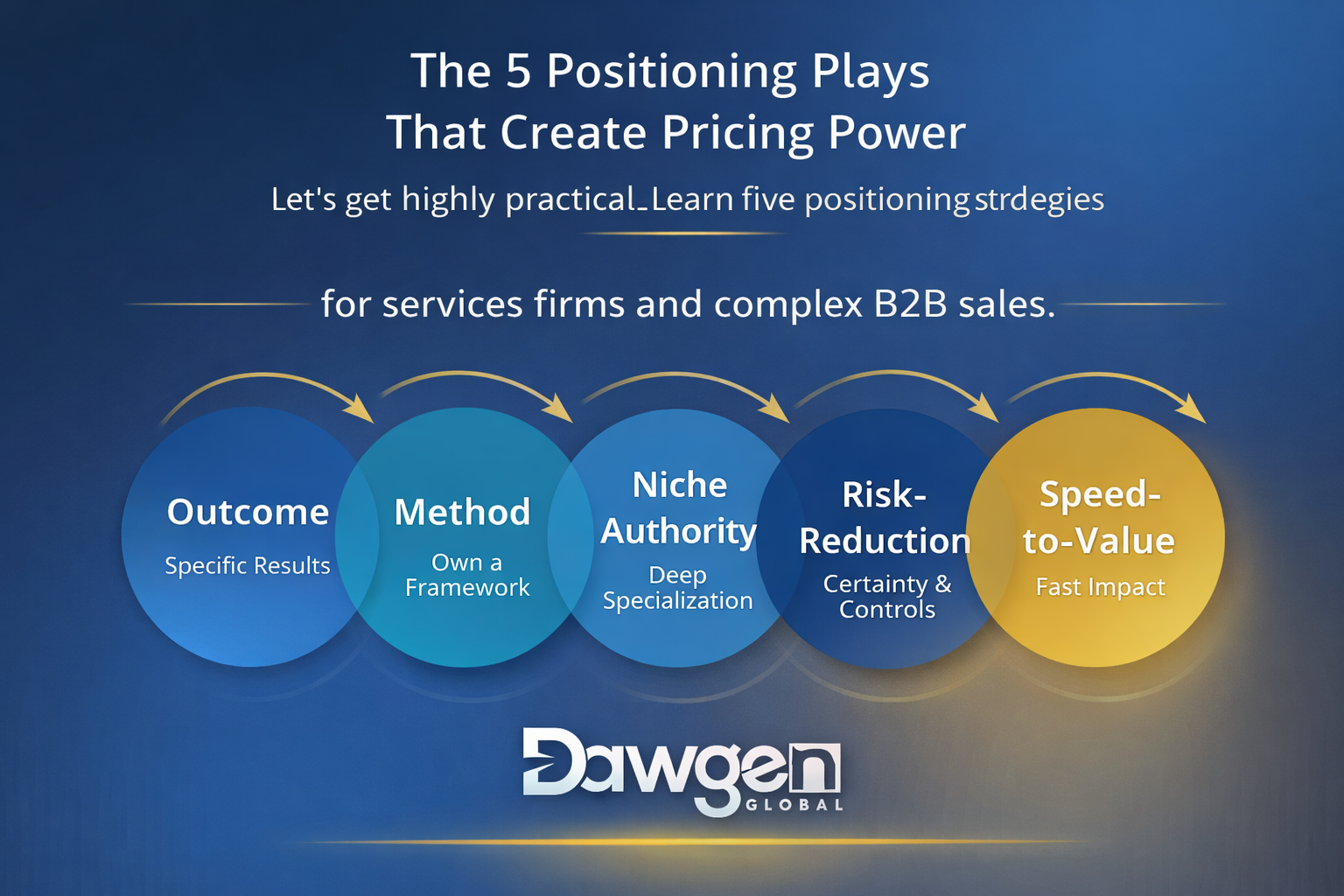
Play 1: Outcome Positioning
You position around a specific measurable outcome.
Examples:
-
“Increase qualified pipeline”
-
“Improve lead-to-close conversion”
-
“Reduce churn and increase expansion revenue”
-
“Shorten time-to-revenue for new offers”
Outcome positioning works because buyers don’t want activity; they want change.
Dawgen angle: “From Marketing to Money” is outcome positioning. It frames marketing as a commercial engine.
Play 2: Method Positioning (Own a Framework)
You position around a unique method that creates predictability.
This is exactly what RAMP™ is designed to do:
A buyer doesn’t just hire “marketing help”—they buy a system.
Framework-based positioning works because it:
-
reduces perceived risk,
-
makes the process tangible,
-
and creates confidence that you are not improvising.
If you can name the method, you can sell the method.
If you can sell the method, you can protect margin.
Play 3: Niche Authority Positioning
You position around deep specialization in a segment.
Examples:
-
“Marketing strategy for regulated financial services”
-
“Growth systems for mid-sized professional services firms”
-
“Go-to-market for Caribbean SMEs expanding regionally”
Niche authority makes you comparable to fewer competitors.
Fewer comparisons = less price pressure.
Play 4: Risk-Reduction Positioning
You position around certainty, controls, and low downside.
This matters in high-stakes categories where buyers fear failure.
Examples:
-
“Audit-ready marketing measurement”
-
“Conversion playbooks tied to sales enablement”
-
“Deliverable-based engagement with acceptance criteria”
Risk reduction works because buyers pay premiums to avoid regret.
Dawgen advantage: deliverable-based pricing signals seriousness and accountability.
Play 5: Speed-to-Value Positioning
You position around fast time-to-impact.
Speed is not rushing. It is structured execution.
Examples:
-
“Relevance Reset in 10 business days”
-
“Demand Launch Kit in 14 days”
-
“Offer architecture built in 21 days”
Speed works when paired with proof and a method. Otherwise it looks like hype.
The Positioning Statement Formula (Dawgen Standard)
A positioning statement should be clear enough to guide marketing and sales.
Use this structure:
For [Spearhead ICP] who struggle with [expensive problem], Dawgen delivers [unique method/approach] to achieve [outcome], backed by [proof].
Example for this series:
For growth-minded service firms that rely too heavily on referrals, Dawgen’s RAMP™ Revenue System installs a relevance-to-revenue engine that improves pipeline quality, conversion, and pricing power—backed by a deliverable-based methodology and measurable performance metrics.
That’s positioning. It tells the market:
-
who it’s for,
-
what it solves,
-
how it works,
-
and why it’s credible.
Positioning vs Messaging (Don’t Confuse Them)
Positioning is the strategy.
Messaging is how you communicate it.
If you change your messaging without changing your positioning, you are just rephrasing the same generic claim.
The market doesn’t reward rephrasing.
It rewards distinct choice.
The “Positioning Audit” (Quick Self-Diagnosis)
Run these five questions on your website and pitch deck:
-
Can a stranger tell who you’re for in 10 seconds?
-
Can they tell what problem you solve that’s expensive to ignore?
-
Can they tell what makes you different (not just “better”)?
-
Can they see proof quickly?
-
Do you have a clear next step (CTA) that matches your positioning?
If you score weak on any, price pressure is predictable.
Why Thought Leadership is a Positioning Weapon
Thought leadership is not “posting ideas.” It is a positioning tool when it:
-
frames the problem in a unique way,
-
teaches a method,
-
challenges old assumptions,
-
and makes your approach the obvious solution.
This series—Dawgen RAMP™ Decoded: From Marketing to Money—is not just content. It is a positioning asset.
Each article:
-
demonstrates your point of view,
-
builds trust through clarity,
-
and makes your framework real.
When your market learns your method, they pre-sell themselves.
What Comes Next in Part 4
In Part 4 we move from positioning strategy to persuasion execution:
Messaging that converts: building a proof-led story buyers trust.
Because even with good positioning, you still need to translate it into:
-
headlines,
-
offers,
-
case study proof,
-
objection handling,
-
and call-to-action clarity.
Next Step: Book the RAMP™ Relevance Reset (ICP + Positioning + Messaging)
If your market is pressuring you on price, the solution is rarely “lower your fees.”
The solution is to become less comparable.
Dawgen’s RAMP™ Relevance Reset installs the foundations that create pricing power:
-
Spearhead ICP definition and segment prioritization,
-
positioning narrative and differentiation,
-
proof-led messaging built to convert.
To get started, email [email protected] or message Global WhatsApp: +1 555 795 9071 and ask for the RAMP™ Relevance Reset.
About Dawgen Global
“Embrace BIG FIRM capabilities without the big firm price at Dawgen Global, your committed partner in carving a pathway to continual progress in the vibrant Caribbean region. Our integrated, multidisciplinary approach is finely tuned to address the unique intricacies and lucrative prospects that the region has to offer. Offering a rich array of services, including audit, accounting, tax, IT, HR, risk management, and more, we facilitate smarter and more effective decisions that set the stage for unprecedented triumphs. Let’s collaborate and craft a future where every decision is a steppingstone to greater success. Reach out to explore a partnership that promises not just growth but a future beaming with opportunities and achievements.
 Email: [email protected]
  Visit: Dawgen Global Website

 WhatsApp Global Number : +1 555-795-9071
Caribbean Office: +1876-6655926 / 876-9293670/876-9265210  WhatsApp Global: +1 5557959071
USA Office: 855-354-2447
Join hands with Dawgen Global. Together, let’s venture into a future brimming with opportunities and achievements


