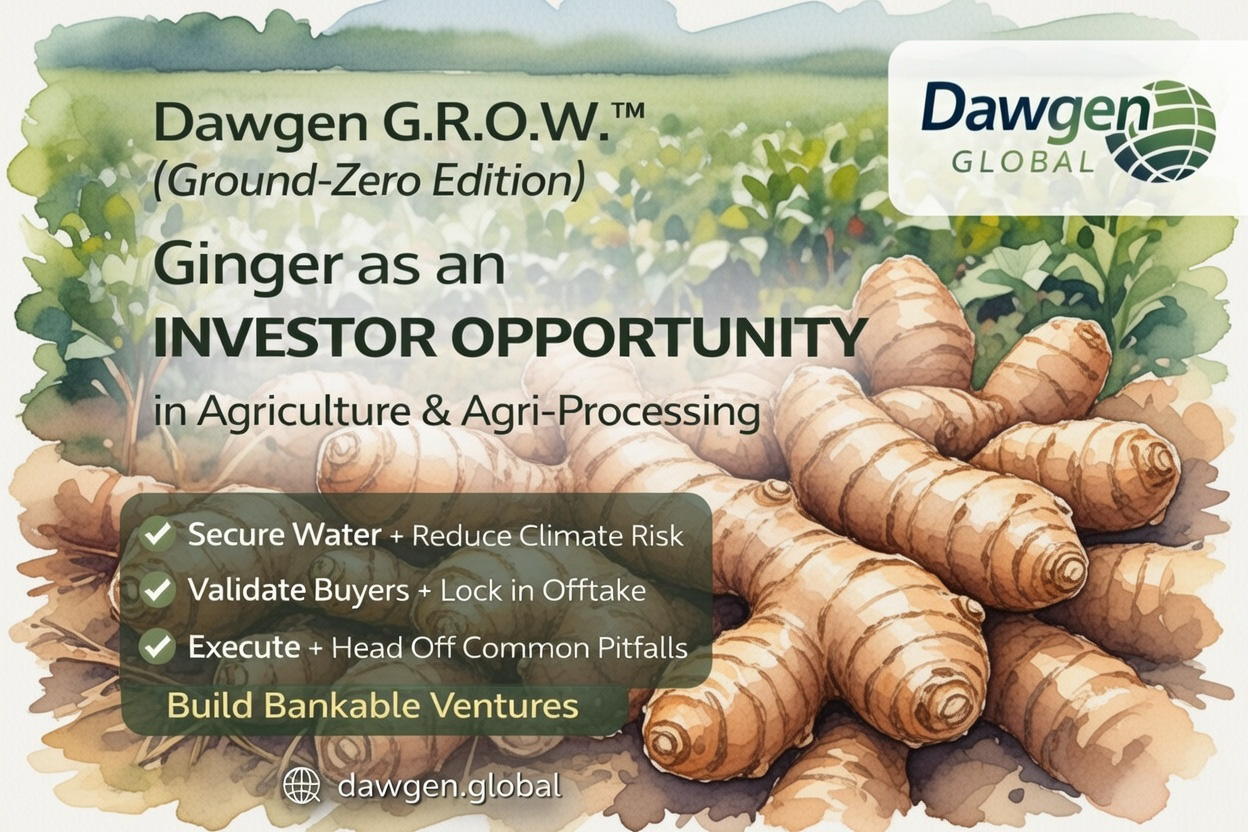
Ginger is not just a spice crop. It is a high-value agricultural input with a proven role in food, beverage, nutraceutical, hospitality, and personal-care supply chains. For investors, it sits in a rare position: it can be profitable as a fresh crop and becomes significantly more scalable when structured as a processing-led value chain.
Yet ginger projects frequently underperform—often for reasons that have nothing to do with market demand. They fail because land and water are not engineered, seed rhizomes are inconsistent, disease risk is underestimated, post-harvest handling is weak, or the route-to-market depends on spot buyers rather than defined programs.
At Dawgen Global, we approach ginger as a bankable venture, not a seasonal farming activity. This article applies Dawgen G.R.O.W.™ (Ground-Zero Edition)—our proprietary investor model designed to build investable agriculture and agri-processing projects from scratch:
-
G — Ground: build the production platform (land, water, access, control)
-
R — Returns: prove unit economics and stress-test downside
-
O — Offtake: validate the route to cash (buyers, specs, contracts)
-
W — Wins: install the operating system (SOPs, KPIs, controls, governance)
This is Article 4 in the Dawgen G.R.O.W.™ series, and it is written for investors who want disciplined execution and scalable pathways into processing.
Why Ginger Can Be Investor-Relevant
1) It is a “value-dense” crop
Ginger is typically sold by weight, and it carries meaningful unit value relative to many staples. That makes it attractive where investors want stronger revenue per acre—provided costs are controlled and quality is consistent.
2) It supports multiple market routes
Ginger can be monetized through:
-
fresh markets (retail, wholesale, hospitality)
-
export programs (where standards and logistics are strong)
-
processors and manufacturers (beverages, sauces, seasonings, bakery, teas)
-
value-added retail products (powder, paste, dried slices)
The diversity of routes reduces overreliance on one channel—if the project is designed for flexibility.
3) Processing can stabilize demand and lift margins
Fresh ginger is vulnerable to price swings and buyer inconsistency. Processing can:
-
extend shelf life and reduce post-harvest loss
-
monetize off-grade ginger
-
create repeatable, brandable products
-
convert seasonal production into year-round revenue
For investors, ginger becomes most powerful when designed as a fresh + processing portfolio, not an “either-or” choice.
Dawgen G.R.O.W.™ for Ginger (Ground-Zero Edition)
The ground-zero concept matters: we assume the investor is starting from scratch—identifying land, designing water access, building operational control, and then scaling into consistent market supply and processing.
We also apply G.R.O.W. Gates to prevent premature investment:
-
Gate 1 (Ground): land, water, access, and disease-risk controls are investable
-
Gate 2 (Returns): unit economics work under stress
-
Gate 3 (Offtake): buyers and specifications are validated
-
Gate 4 (Wins): execution system is installed and repeatable
G — Ground: Build a Disease-Resilient Production Platform
Ginger is not a “plant anywhere” crop if the goal is investor-grade predictability. It is sensitive to:
-
waterlogging and drainage issues
-
inconsistent moisture
-
disease pressure (particularly when seed material is poor or rotations are weak)
-
weak field hygiene and post-harvest handling
What “Ground” means for ginger investors
Ground is the set of conditions that make production controllable:
Land control & rotation logic
-
Investors need clear land tenure and a rotation approach that reduces disease carryover.
-
Ginger cannot be treated as “repeat planting in the same plot forever” if long-term viability matters.
Water strategy
-
Ginger projects benefit from reliable water access, but also from drainage discipline—standing water and poor drainage can be devastating to quality and plant health.
Seed rhizome strategy
-
Seed quality is often the hidden driver of success. Investors must decide early whether they are:
-
purchasing certified/verified planting material
-
building a controlled seed bank as part of the venture
-
Access and logistics
-
Ginger is bulky at harvest and can be damaged easily.
-
Harvest logistics, wash/clean zones, and controlled packing areas should be designed up front.
Security and shrinkage controls
-
High-value crops require controls for theft, leakage, and inventory reconciliation—especially during harvest and transport.
Dawgen deliverable: Ground Readiness Pack (Ginger)
Dawgen Global typically supports investors by producing an investor-grade Ground pack that includes:
-
site suitability screening (soil, slope, drainage, access)
-
water availability and irrigation feasibility logic
-
disease-risk governance plan (rotation, hygiene, input standards)
-
seed strategy design (quality controls and sourcing)
-
minimum capex required to reach first-plant readiness
GATE 1 — Ground Decision:
We do not proceed until land, water/drainage, seed quality approach, and baseline controls are defined. Ginger’s downside risk is too high to “start and fix later.”
R — Returns: Prove Unit Economics and Protect the Downside
Ginger is attractive—but it can also be expensive to grow if planting material, labor, and post-harvest handling are not planned properly. That is why Dawgen starts with unit economics and builds up to the full investment case.
What Dawgen models (the investor-grade way)
A ginger Returns Case should include:
Direct production costs
-
land preparation
-
planting material (seed rhizomes)
-
inputs (fertility and crop protection)
-
irrigation and energy (where applicable)
-
labor (planting, weeding, hilling, harvesting)
Post-harvest and compliance costs
-
washing/cleaning
-
sorting/grading
-
packaging
-
transport logistics
-
storage (if used)
Yield and price assumptions
-
Base case vs conservative case yields
-
Fresh price vs processing price logic (they differ)
-
Quality discount assumptions (and rejection rates)
The three Returns Cases investors should consider
To avoid confusing “farm profits” with “value chain profits,” Dawgen recommends three views:
-
Farm-only Returns
-
Selling fresh ginger only, with basic handling.
-
Farm + Program Supply Returns
-
Selling fresh ginger into defined buyers with specs and delivery cadence.
-
Integrated Processing Returns
-
Owning processing and capturing margin from powders, pastes, dried products, beverages, etc.
Many investors choose a phased pathway:
-
Phase 1: farm + contracted offtake
-
Phase 2: pilot processing
-
Phase 3: scaled processing and brand distribution
Stress tests (non-negotiable)
A credible Returns Case must test:
-
price decline in fresh markets
-
yield shortfall
-
labor cost spikes
-
disease event impact
-
higher rejection rates due to quality/spec non-compliance
-
transport/logistics disruptions
GATE 2 — Returns Decision:
We proceed only when the downside case remains survivable—and when working capital needs are realistic. Ginger fails quickly when cashflow planning is weak.
O — Offtake: Validate Buyers Before Scaling
Ginger projects become bankable when offtake is engineered. This is where many ventures go wrong: they assume demand will always translate into predictable cash. It won’t—unless you match buyer requirements consistently.
Ginger market routes (practical investor view)
-
Fresh wholesale / retail supply
-
easier entry, more price volatility
-
-
Hospitality and food service programs
-
steadier demand, specification discipline
-
-
Export programs
-
higher compliance and logistics intensity, but can be scalable
-
-
Processors and manufacturers
-
can stabilize demand and reduce price swings, but require consistency
-
What “validated offtake” looks like
Dawgen considers offtake validated when the investor has:
-
buyer specifications (size, cleanliness, moisture, packaging)
-
trial supply performance (small volumes delivered successfully)
-
clear pricing logic and payment terms
-
a delivery plan aligned to production cycles
-
rejection and dispute-management rules
Processing as an Offtake “anchor”
Processing can play two roles:
-
Primary business (you process most output)
-
Shock absorber (you process overflow, seconds, and off-grade)
Either way, processing adds resilience—if designed with realistic product choices and distribution channels.
GATE 3 — Offtake Decision:
We scale only after the buyer pathway is proven—through trial supply, LOIs, or contracts—and the venture is operationally capable of meeting specs.
W — Wins: Install the Operating System That Makes Results Repeatable
In ginger, “Wins” is where investors earn predictability. This is not about working harder. It’s about building the systems that prevent failure.
The Dawgen Wins System for ginger
Operating playbooks
-
documented crop calendar and input schedule
-
clear field hygiene routines
-
standardized harvesting and handling instructions
KPIs that matter
-
cost per acre
-
yield per acre (base vs conservative)
-
rejection rate
-
labor productivity
-
post-harvest loss rate
-
on-time delivery performance
-
buyer satisfaction / repeat orders
Controls and governance
-
procurement controls (input quality and pricing discipline)
-
inventory controls (harvest reconciliation and dispatch visibility)
-
cashflow governance (working capital discipline)
-
risk register (disease, theft, weather, market changes)
Processing readiness as a capability stack
If processing is part of the plan, Wins includes:
-
food safety pathway (basic QA, hygiene controls, and documentation)
-
consistent raw material flow
-
packaging and labeling discipline
-
distribution channels (not just production)
GATE 4 — Wins Decision:
We treat success as a system. Gate 4 is met when SOPs, KPIs, controls, and governance routines are installed and used—so performance becomes repeatable.
The Dawgen Advantage: How We Support Ginger Investors
Dawgen Global’s consulting value in agriculture and agri-processing is that we integrate the disciplines investors actually need—strategy, financial modeling, operating systems, and market design.
For ginger ventures, Dawgen support typically includes:
-
Ground Readiness & Risk Screening
-
land suitability, water/drainage logic, disease-risk governance, seed strategy
-
-
Feasibility & Investor Modeling
-
unit economics, downside stress tests, working capital planning, scale scenarios
-
-
Offtake & Market Strategy
-
buyer mapping, specification design, contracting readiness, export/channel strategy where applicable
-
-
Execution System Design
-
SOPs, KPIs, governance cadence, cost controls, field-to-market operating blueprint
-
-
Processing Feasibility
-
product pathway selection, cost structures, QA standards, packaging and route-to-market
-
Investors do not just need agronomy. They need bankability. That is what Dawgen structures.
Investor Roadmap: What to Do Next
If you are exploring ginger as an investment, we recommend this disciplined sequence:
-
Define your position in the chain: fresh supply, program supply, processing, or integrated
-
Identify land and validate water/drainage and disease-risk controls (Ground)
-
Build the Returns Case and stress-test it (Returns)
-
Validate buyers and specs with trial supply or LOIs (Offtake)
-
Install the operating system and governance routines (Wins)
-
Scale only after all four Gates are satisfied
Next Step: Request Investor Assistance from Dawgen Global
Want to build a ginger venture with execution certainty?
Ginger can be a high-value opportunity—but only when it is engineered properly. Dawgen G.R.O.W.™ (Ground-Zero Edition) helps investors build bankable agriculture and agri-processing ventures from scratch—ground platform, returns logic, offtake certainty, and the execution system that makes performance repeatable.
Dawgen Global can support you with:
-
ginger feasibility and investor modeling
-
land/water and disease-risk screening
-
offtake strategy and contracting readiness
-
execution playbooks, KPIs, and governance controls
-
processing feasibility and scale strategy
To request assistance, share:
-
your land location or target area,
-
intended scale (acres / volume), and
-
preferred market route (fresh / contract / processing / integrated).
🔗 https://dawgen.global
📧 [email protected]
📞 Jamaica Caribbean Office: 1876-6655926 / 876-9293670
📞 USA Office: 855-354-2447
WhatsApp Global: +1 555 795 9071
About Dawgen Global
“Embrace BIG FIRM capabilities without the big firm price at Dawgen Global, your committed partner in carving a pathway to continual progress in the vibrant Caribbean region. Our integrated, multidisciplinary approach is finely tuned to address the unique intricacies and lucrative prospects that the region has to offer. Offering a rich array of services, including audit, accounting, tax, IT, HR, risk management, and more, we facilitate smarter and more effective decisions that set the stage for unprecedented triumphs. Let’s collaborate and craft a future where every decision is a steppingstone to greater success. Reach out to explore a partnership that promises not just growth but a future beaming with opportunities and achievements.
 Email: [email protected]
  Visit: Dawgen Global Website

 WhatsApp Global Number : +1 555-795-9071
Caribbean Office: +1876-6655926 / 876-9293670/876-9265210  WhatsApp Global: +1 5557959071
USA Office: 855-354-2447
Join hands with Dawgen Global. Together, let’s venture into a future brimming with opportunities and achievements


