
Artificial Intelligence (AI) has transitioned from the realm of theory to practical business impact. Once seen as the domain of futurists and researchers, AI is now reshaping industries across finance, healthcare, logistics, retail, and professional services. Yet, many organizations continue to struggle with one critical question: How do we adopt AI in a structured, value-driven, and risk-aware manner?
At Dawgen Global, we believe the answer lies not in adopting AI piecemeal, but in embracing a progressive roadmap. To this end, we developed the Dawgen AI Capability Spectrum (DACS), a proprietary framework that provides organizations with a structured path for understanding, implementing, and scaling AI across their operations.
This article introduces the DACS framework in depth, explores its application across industries, and provides practical guidance for leaders seeking to maximize AI’s transformative potential.
Why a New Framework?
Most conversations about AI fall into two extremes: either oversimplified hype about “robots taking over” or highly technical discussions inaccessible to executives. Neither perspective provides clarity to decision-makers responsible for aligning AI investments with corporate strategy.
DACS was designed to solve three key challenges:
-
Clarity – Simplify AI into progressive capability levels that executives can understand.
-
Strategic Alignment – Ensure that AI adoption supports organizational goals, not just technology trends.
-
Risk Mitigation – Provide a structured pathway that balances innovation with governance.
By reframing AI adoption as a spectrum of capability, organizations can position themselves for sustainable transformation rather than one-off experiments.
The Dawgen AI Capability Spectrum (DACS)
The DACS framework defines three progressive levels of AI capability:
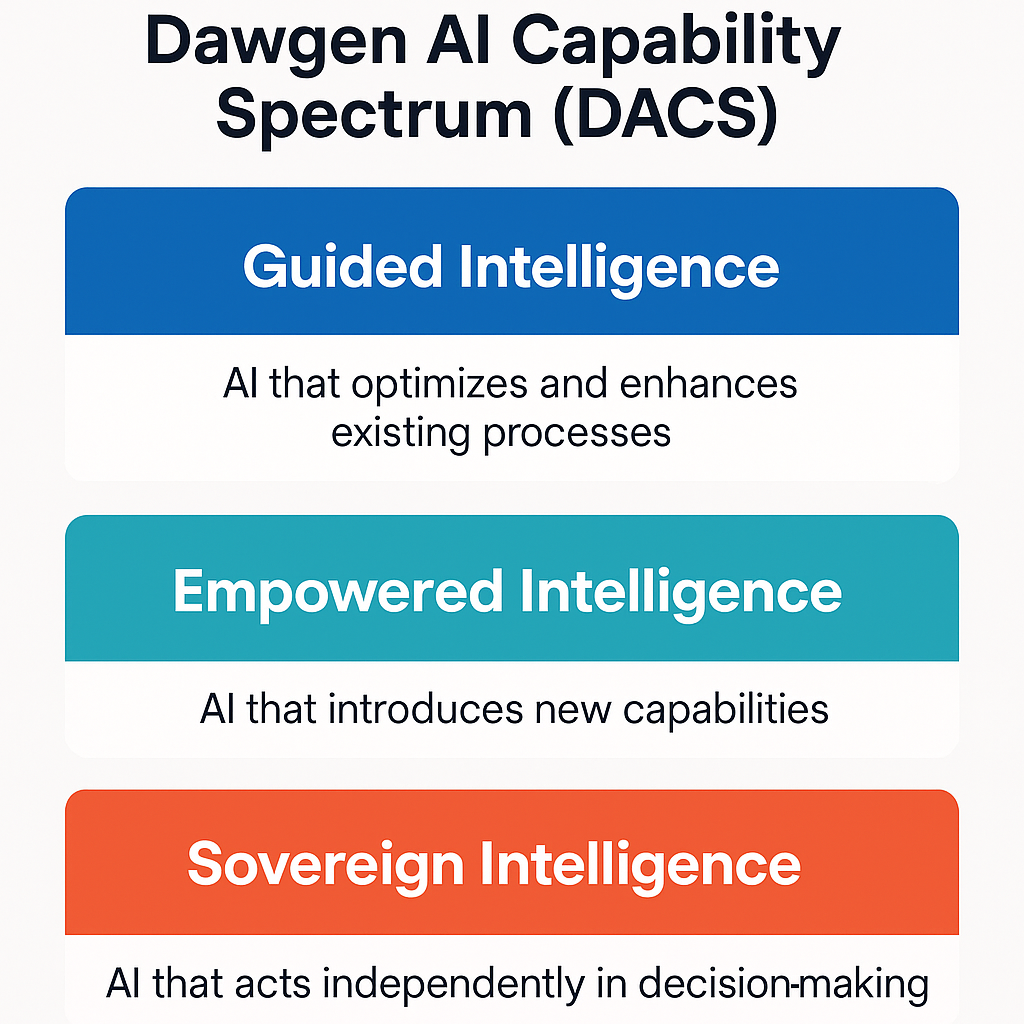
1. Guided Intelligence (GI)
Definition: AI that optimizes existing processes and enhances efficiency.
-
Characteristics:
-
Automates rule-based, repeatable tasks.
-
Improves productivity without fundamentally changing business models.
-
Provides measurable cost and time savings.
-
-
Examples:
-
Robotic Process Automation (RPA) for invoice processing.
-
Chatbots answering FAQs in customer service.
-
Automated compliance checks in finance and banking.
-
-
Business Impact:
-
Reduction in error rates.
-
Faster turnaround times.
-
Improved employee productivity by freeing staff from repetitive tasks.
-
-
Case Study:
A Caribbean financial services firm implemented Guided Intelligence through automated Know Your Customer (KYC) verification. The system reduced onboarding time by 60%, cut compliance costs by 30%, and freed analysts to focus on fraud detection.
2. Empowered Intelligence (EI)
Definition: AI that introduces new capabilities and allows organizations to do things that were previously impossible.
-
Characteristics:
-
Based on machine learning and natural language processing.
-
Enables predictive, personalized, and adaptive services.
-
Creates opportunities for business model innovation.
-
-
Examples:
-
Predictive analytics to forecast consumer behavior.
-
AI-driven talent recruitment tools that identify cultural fit.
-
Personalized product recommendations in retail.
-
-
Business Impact:
-
Enhanced customer experience.
-
New revenue streams through AI-enabled services.
-
Accelerated innovation cycles.
-
-
Case Study:
A regional healthcare provider deployed Empowered Intelligence by using AI to analyze patient data for personalized treatment plans. The system improved patient outcomes by 25% and reduced hospital readmissions, leading to significant cost savings and stronger patient trust.
3. Sovereign Intelligence (SI)
Definition: AI that acts independently, making and executing decisions within defined goals.
-
Characteristics:
-
Self-directed decision-making.
-
Operates with minimal human intervention.
-
Represents the future of AI-driven business ecosystems.
-
-
Examples:
-
Autonomous vehicles in logistics.
-
AI-driven financial trading algorithms.
-
Self-learning diagnostic systems in healthcare.
-
-
Business Impact:
-
Transformational shifts in industries.
-
Creation of entirely new markets.
-
Potential disruption of traditional roles and models.
-
-
Case Study:
A global logistics company piloted Sovereign Intelligence with autonomous delivery drones. This reduced delivery times in urban areas by 40% and cut last-mile logistics costs dramatically. Though regulatory challenges remain, the project demonstrated the disruptive power of autonomous AI.
The DACS Implementation Methodology
Adopting AI without a structured approach leads to wasted resources, fragmented initiatives, and heightened risks. DACS provides a four-step methodology for organizations to adopt AI progressively:
Step 1: Assess Current Maturity
-
Conduct an AI readiness assessment across technology, data infrastructure, workforce skills, and governance.
-
Map current initiatives to the DACS spectrum.
-
Identify quick wins (Guided Intelligence) and long-term opportunities (Empowered or Sovereign).
Step 2: Identify Strategic Use Cases
-
Select use cases that align with corporate goals.
-
Balance between efficiency-driven initiatives (cost savings) and innovation-driven initiatives (revenue growth).
-
Prioritize use cases that can deliver measurable outcomes within 6–12 months.
Step 3: Pilot and Scale
-
Launch pilot projects to test feasibility.
-
Develop KPIs linked to productivity, customer satisfaction, or revenue impact.
-
Scale successful initiatives enterprise-wide, embedding them into business processes.
Step 4: Measure and Optimize
-
Implement a continuous improvement loop.
-
Collect feedback from both systems and employees.
-
Regularly update governance frameworks to address evolving risks.
Key Challenges in Implementing DACS
-
Data Quality and Availability
-
Poor data undermines AI effectiveness.
-
Organizations must invest in data governance, cleansing, and integration.
-
-
Workforce Resistance
-
Employees may fear job loss.
-
Leaders must emphasize upskilling and human-AI collaboration.
-
-
Governance and Ethics
-
Autonomous AI raises questions about accountability and transparency.
-
Robust governance ensures trust, compliance, and societal acceptance.
-
-
Scaling Beyond Pilots
-
Many organizations succeed at pilots but fail at scale.
-
DACS helps by ensuring alignment with strategy and governance from the start.
-
Industry Applications of DACS
-
Banking and Finance
-
Guided: Automated regulatory reporting.
-
Empowered: AI-driven fraud detection.
-
Sovereign: Autonomous trading platforms.
-
-
Healthcare
-
Guided: AI for appointment scheduling.
-
Empowered: Personalized treatment pathways.
-
Sovereign: Autonomous diagnostic systems.
-
-
Retail
-
Guided: Inventory automation.
-
Empowered: AI-driven dynamic pricing.
-
Sovereign: Fully autonomous supply chain systems.
-
-
Public Sector
-
Guided: Automated citizen service portals.
-
Empowered: Predictive analytics for urban planning.
-
Sovereign: AI-driven disaster response systems.
-
DACS and the Fourth Industrial Revolution
The World Economic Forum refers to our current era as the Fourth Industrial Revolution (4IR)—a fusion of digital, physical, and biological technologies. AI is at the heart of this transformation.
-
Guided Intelligence allows organizations to catch up with digital transformation.
-
Empowered Intelligence helps them compete in new markets.
-
Sovereign Intelligence positions them to lead in the industries of tomorrow.
By adopting DACS, organizations not only navigate AI adoption but also position themselves as future-ready enterprises.
Next Step
AI adoption is not about chasing hype—it is about creating value. The Dawgen AI Capability Spectrum (DACS) provides a clear, structured, and actionable framework for organizations to move from basic automation to transformative autonomy.
At Dawgen Global, we partner with organizations across the Caribbean and beyond to design AI strategies that are aligned with corporate goals, risk-aware, and innovation-driven. Whether you are just beginning with Guided Intelligence or exploring the future of Sovereign Intelligence, our advisory services ensure that your AI journey is smarter, more effective, and future-ready.
🚀 Call to Action
At Dawgen Global, we help you make Smarter and More Effective Decisions. Let’s have a conversation about how the DACS framework can transform your business. Connect with us today:
🔗 Discover More: https://dawgen.global
📧 Email: [email protected]
📞 Jamaica Caribbean Office: 1876-6655926 / 876-9293670
📞 USA Office: 855-354-2447
💬 WhatsApp Global: +1 555 795 9071
About Dawgen Global
“Embrace BIG FIRM capabilities without the big firm price at Dawgen Global, your committed partner in carving a pathway to continual progress in the vibrant Caribbean region. Our integrated, multidisciplinary approach is finely tuned to address the unique intricacies and lucrative prospects that the region has to offer. Offering a rich array of services, including audit, accounting, tax, IT, HR, risk management, and more, we facilitate smarter and more effective decisions that set the stage for unprecedented triumphs. Let’s collaborate and craft a future where every decision is a steppingstone to greater success. Reach out to explore a partnership that promises not just growth but a future beaming with opportunities and achievements.
✉️ Email: [email protected] 🌐 Visit: Dawgen Global Website
📞 📱 WhatsApp Global Number : +1 555-795-9071
📞 Caribbean Office: +1876-6655926 / 876-9293670/876-9265210 📲 WhatsApp Global: +1 5557959071
📞 USA Office: 855-354-2447
Join hands with Dawgen Global. Together, let’s venture into a future brimming with opportunities and achievements


