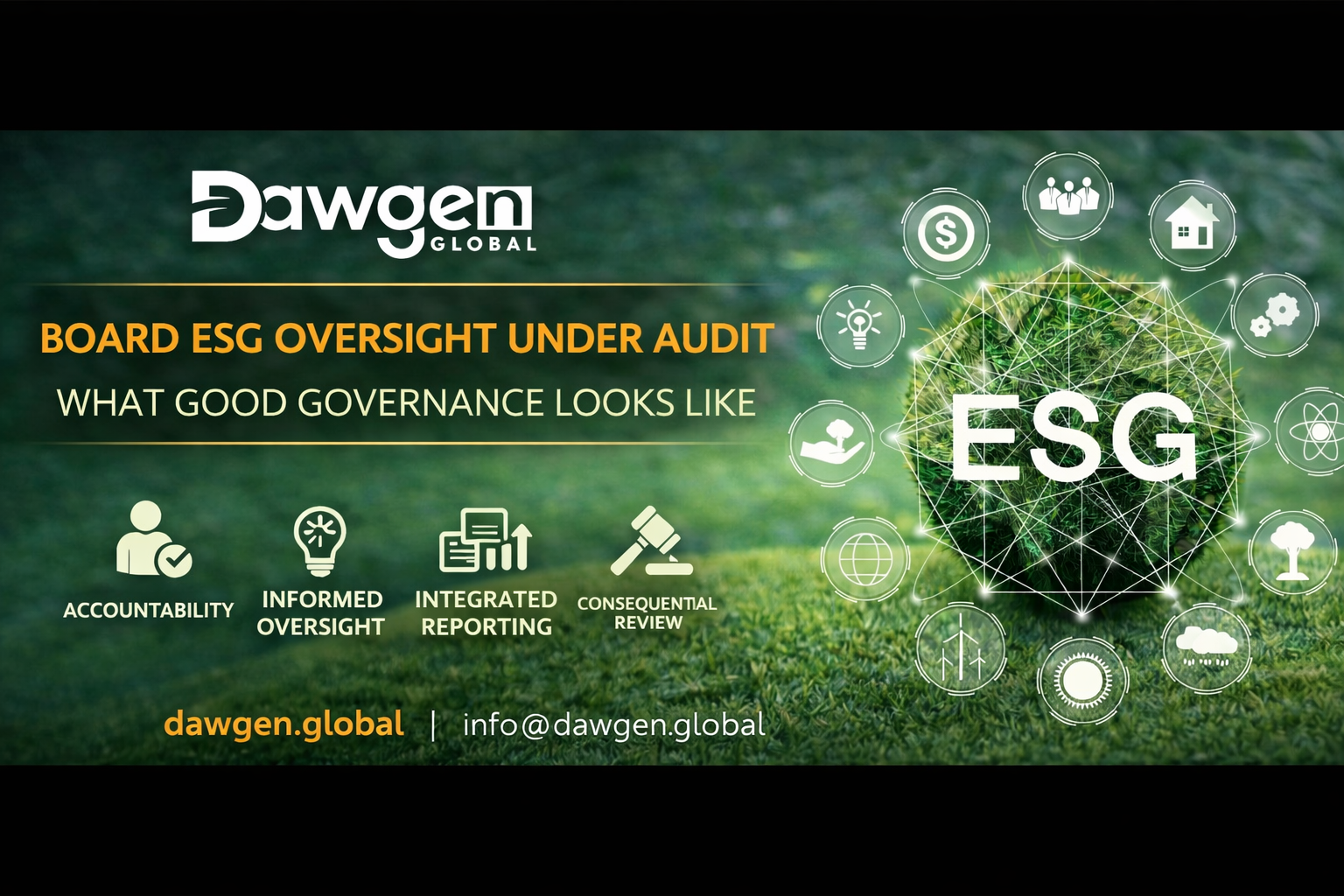
The question I am asked most often by board members across the Caribbean is a variation of this: ‘We have approved an ESG policy, we get quarterly sustainability updates, and we have a board committee responsible for ESG. Is that enough?’
My answer is consistent: it depends entirely on whether those structures are functioning as designed. A board committee that meets once a year and receives a summary report is not ESG governance — it is ESG theatre. And the distinction matters enormously, because when ESG disclosures are challenged by regulators, investors, or journalists, the board’s ability to demonstrate that its oversight was substantive, informed, and consequential is the difference between a credible governance narrative and a critical failure.
This article sets out what good board ESG oversight looks like, how internal audit evaluates it, and what the most common governance failures look like when examined under audit scrutiny.
| IFRS S1 Governance Requirement
IFRS S1 requires organisations to disclose information about the governance processes, controls, and procedures used to monitor, manage, and oversee sustainability-related risks and opportunities — including the body or individual responsible, how oversight is exercised, and how sustainability considerations are integrated into organisational strategy and major transactions. |
The Five Hallmarks of Effective Board ESG Oversight
| 1 | Designated Accountability
Effective ESG governance begins with explicit board-level accountability. This means a designated committee — whether a standalone Sustainability Committee, or an Audit and Risk Committee with a formally documented ESG mandate — with terms of reference that specify ESG oversight responsibilities, meeting frequency, and reporting obligations. |
| 2 | Informed Oversight
Board members exercising ESG oversight must have sufficient knowledge to engage critically with management’s ESG reporting. This does not require every director to be a climate scientist. It does require that the board has access to independent expertise, that directors receive structured ESG orientation, and that management reporting is designed to enable challenge rather than merely inform. |
| 3 | Integrated Reporting
ESG information reported to the board must be integrated with financial and operational reporting — not siloed as a sustainability annex. Climate risk, for example, should appear alongside other material risks in the enterprise risk report presented to the board, with likelihood and impact quantified to the extent possible. |
| 4 | Consequential Review
Board ESG oversight is consequential when it leads to decisions: approving revised targets, directing management to address control deficiencies, endorsing ESG-linked capital allocation, or challenging the credibility of performance data. Oversight that merely receives and notes information is not governance — it is passive acceptance. |
| 5 | Independent Assurance
Effective boards do not rely solely on management for ESG information. They commission independent internal audit reviews of ESG governance and controls, and for material disclosures, they seek external assurance. This independence is the governance safeguard that gives external stakeholders confidence that ESG disclosures reflect reality. |
How Internal Audit Evaluates Board ESG Governance
The DESGAF™ governance audit does not take management’s word for the effectiveness of board ESG oversight. It tests it. The primary evidence sources are board and committee minutes, management reporting packs, and the governance documentation framework.
Governance Audit Procedures
- Obtain board and ESG committee minutes for the full audit period (typically 12 months). Review for evidence of substantive ESG discussion — challenge of management positions, decisions taken, and follow-up actions assigned.
- Review the information pack provided to the board for ESG matters. Is it quantified? Does it include trend data? Does it highlight areas of underperformance? Does it include internal audit findings? A polished narrative without performance data is a governance red flag.
- Assess the committee’s terms of reference. Are ESG responsibilities explicitly documented? Is the committee composition appropriate — do members have the skills to discharge the mandate?
- Evaluate management’s disclosure about board ESG competencies against the actual professional backgrounds of committee members. Is the disclosed competency claim substantiated?
- Confirm that material ESG risks are reflected in the enterprise risk register and that the board has reviewed the risk register within the audit period.
- Assess whether ESG-related internal audit findings have been reported to the board and whether management responses have been reviewed and accepted by the committee.
The Most Common Governance Audit Findings
| Finding | Risk Implication | Recommended Remediation |
| ESG committee has never convened despite being disclosed as the oversight body | Disclosure of non-existent governance mechanism constitutes potential misrepresentation | Immediately convene committee; establish quarterly meeting schedule; document terms of reference |
| Board receives annual ESG summary only; no climate risk in enterprise risk register | Board cannot exercise meaningful oversight on annual cadence; climate risk invisible to risk framework | Move ESG reporting to quarterly; incorporate material ESG risks into ERM |
| ESG policy approved 4+ years ago and not reviewed | Policy may be misaligned with current frameworks (IFRS S1/S2, GRI 2021) | Annual policy review cycle; board reapproval following material updates |
| Internal audit has never reviewed ESG governance or controls | No independent assurance that ESG disclosures reflect underlying performance | Commission DESGAF™ ESG governance audit; include ESG in internal audit annual plan |
| Executive ESG KPIs disclosed but not linked to remuneration outcomes | ESG accountability mechanism is cosmetic, not consequential | Remuneration committee to formally link ESG KPI outcomes to variable pay decisions |
A Message to Board Members
The regulatory direction is clear. IFRS S1 requires governance disclosure. ESG assurance mandates are coming. Investor ESG due diligence is intensifying. In that environment, a board that cannot demonstrate substantive, informed, and consequential ESG oversight faces both regulatory risk and the deeper risk of being caught on the wrong side of a disclosure failure that, in retrospect, a functioning governance mechanism should have prevented.
The good news is that the gap between governance theatre and governance substance is closeable, with the right advisory support and the discipline to hold the standard. Dawgen Global’s DESGAF™ governance audit is designed to identify that gap clearly, so that boards have the information they need to close it before it becomes a crisis.
Dawgen Global is a multidisciplinary professional services firm serving the Caribbean region. He advises boards and audit committees across the Caribbean on ESG governance, disclosure integrity, and internal audit strategy.
| Partner with Dawgen Global for ESG Assurance
Dawgen Global’s DESGAF™ specialists provide comprehensive ESG internal audit support — from governance reviews and controls testing to data verification and disclosure assurance across the Caribbean. Request a Proposal Today Email: [email protected] | Tel: +1 (876) 929-3670 | +1 (876) 665-5926 | US: 1-855-354-2447 www.dawgen.global — Big Firm Capabilities. Caribbean Understanding. |
About Dawgen Global
“Embrace BIG FIRM capabilities without the big firm price at Dawgen Global, your committed partner in carving a pathway to continual progress in the vibrant Caribbean region. Our integrated, multidisciplinary approach is finely tuned to address the unique intricacies and lucrative prospects that the region has to offer. Offering a rich array of services, including audit, accounting, tax, IT, HR, risk management, and more, we facilitate smarter and more effective decisions that set the stage for unprecedented triumphs. Let’s collaborate and craft a future where every decision is a steppingstone to greater success. Reach out to explore a partnership that promises not just growth but a future beaming with opportunities and achievements.
 Email: [email protected]
  Visit: Dawgen Global Website

 WhatsApp Global Number : +1 555-795-9071
Caribbean Office: +1876-6655926 / 876-9293670/876-9265210  WhatsApp Global: +1 5557959071
USA Office: 855-354-2447
Join hands with Dawgen Global. Together, let’s venture into a future brimming with opportunities and achievements


