
A company with two billion dollars of assets can discover it has seven hundred million of security. The gap is not an accounting error. It is five questions nobody asked.
The Endurance Capital Series, Part Four · The Dawgen Endurance Capital Framework™
An owner sits down to list what his company owns, because he has been asked what he can offer as security. The exercise takes twenty minutes and produces a confident number.
There is the commercial property the business trades from, built fifteen years ago and worth seven hundred million dollars today. There is a second property, let to a tenant, worth eight hundred. There is land the family has held for three generations, worth two hundred. And there is a fleet of delivery trucks, forklifts and sales vehicles that cost three hundred million and still runs well.
Two billion dollars. He is not exaggerating and he is not mistaken. Every figure is defensible and a valuer would support most of them.
Against a long-dated instrument, that two billion dollars supports seven hundred and seventy-one million of security. Not because the assets are worth less than he thinks, but because three of the four answer the wrong question.
The gap is not a haircut applied by a cautious lender. It is the difference between what an asset is worth and what an asset can carry — and until an owner understands which of his assets can carry a fifteen-year obligation and which cannot, he is negotiating in the dark.
The framework this test belongs to
The question of which assets qualify is the first pillar of a framework built to solve a specific problem, and the problem is worth stating for readers meeting it here.
Across Jamaica and the wider Caribbean, enterprises are built from sweat equity and personal savings, and then grown on borrowed money that was never designed for the purpose to which it is put. A company borrows to build a warehouse, a plant or a piece of land that will produce economic value for thirty years or more. It repays that money in five to seven, because five to seven years is what a commercial bank funded by short deposits can prudently write. The repayment schedule bears no relationship to the life of the thing it financed, or to the maturity of the earnings that must service it. It reflects the maturity of the lender’s deposit book. And the security is most often the founder’s residential home, because that is the only titled property with clean unencumbered value the company can offer.
When profit falls by half — a lost customer, a currency move, a storm season — the obligation does not fall by half. It does not fall at all. A solvent enterprise is liquidated by its capital structure rather than by its operations, and the founder loses the business and the house together.
Endurance Capital™ is the alternative: long-dated capital, secured on a qualifying appreciating asset, serviced by interest alone through a defined growth phase, sized so that interest remains covered after a fifty per cent decline in earnings, and conditioned on a binding compact governing what leaves the business for the life of the instrument.
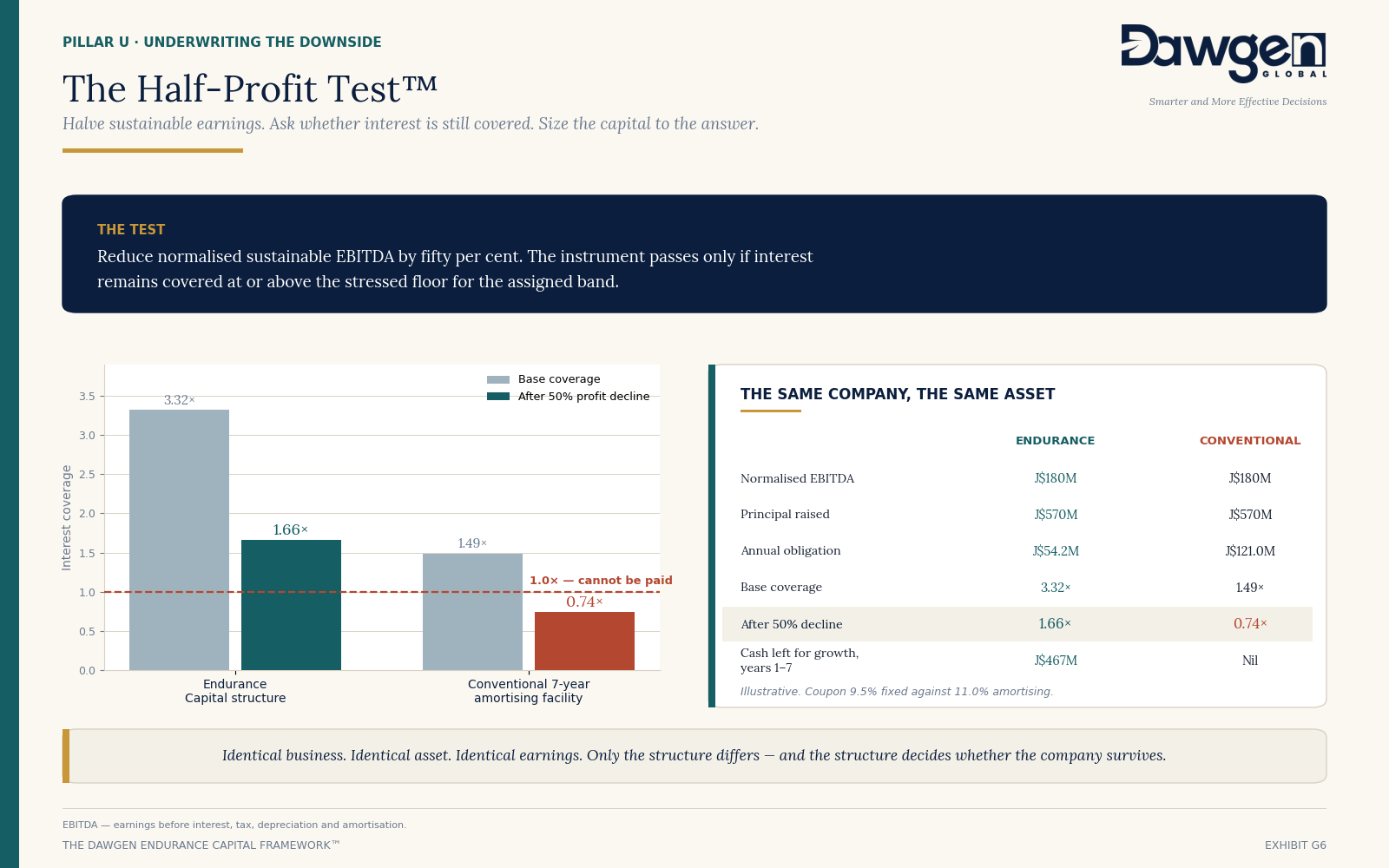
The arithmetic is worth seeing once. Take a composite distributor with normalised earnings before interest, tax, depreciation and amortisation (EBITDA) of J$180 million and a commercial property independently valued at J$1.2 billion, needing J$570 million to expand. Raised conventionally — seven years, amortising, at 11 per cent — annual debt service is about J$121 million, which is coverage of 1.49 times. Halve the earnings and coverage is 0.74 times: arithmetically impossible.
Raised as endurance capital — fifteen years against the same property, interest only for twelve — the annual obligation is J$54.2 million. Coverage today is 3.32 times, and after the same halving it is 1.66 times. The company pays its interest and keeps trading.
The framework that produces this is organised as six pillars, under the acronym ENDURE: the eligible asset base, normalised earnings capacity, duration architecture, underwriting the downside, the redemption runway, and an enforceable governance compact.
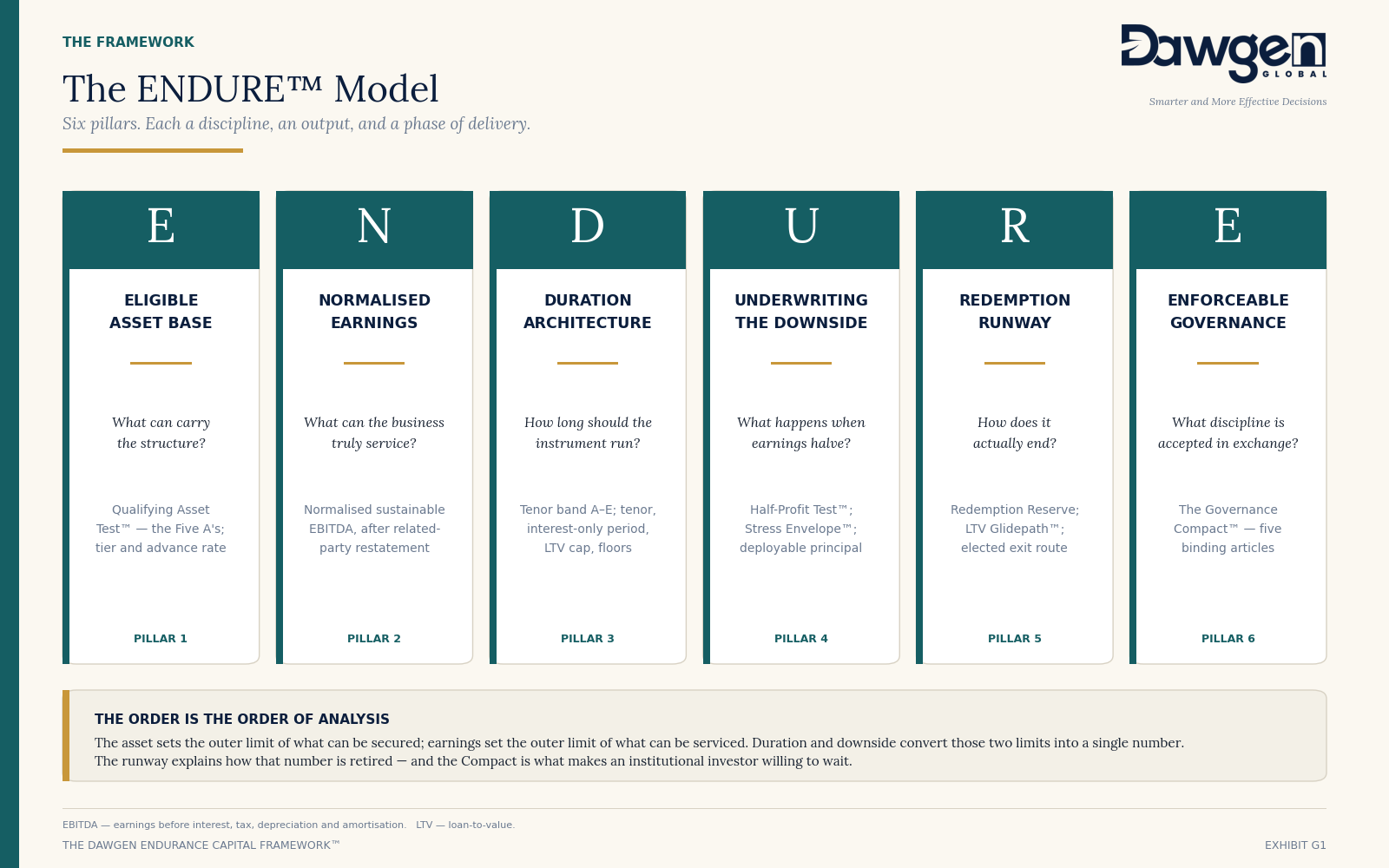
The first pillar comes first for a reason. The asset sets the outer limit of what can be secured, and no amount of earnings capacity, governance discipline or structuring ingenuity moves that limit. A company with excellent earnings and no qualifying asset cannot raise endurance capital, and should be told so in the first fortnight rather than the fourth month.
Why “what is it worth” is the wrong question
Valuation asks what an asset would fetch. Security asks something harder: whether this asset can support a fifteen-year obligation without the structure failing at any point in those fifteen years, including the years when the company is struggling and the property market is soft.
Those are different questions, and an asset can answer the first well and the second badly. A specialised piece of plant may be worth a great deal to the company that uses it and almost nothing to anyone else. A parcel of land may be worth exactly what the valuer says and be legally impossible to charge. A building may be both valuable and transferable, and still be poor security because taking it would destroy the business that was meant to pay the interest.
An asset qualifies not according to what it is worth, but according to whether it can still be relied upon in the year the borrower cannot pay.
The Qualifying Asset Test™ asks five questions, each scored from zero to four, for a maximum of twenty points. Fourteen or above qualifies an asset as core security. Ten to thirteen permits inclusion as supplementary security only, capped at a fifth of the total pool. Below ten, the asset is excluded.
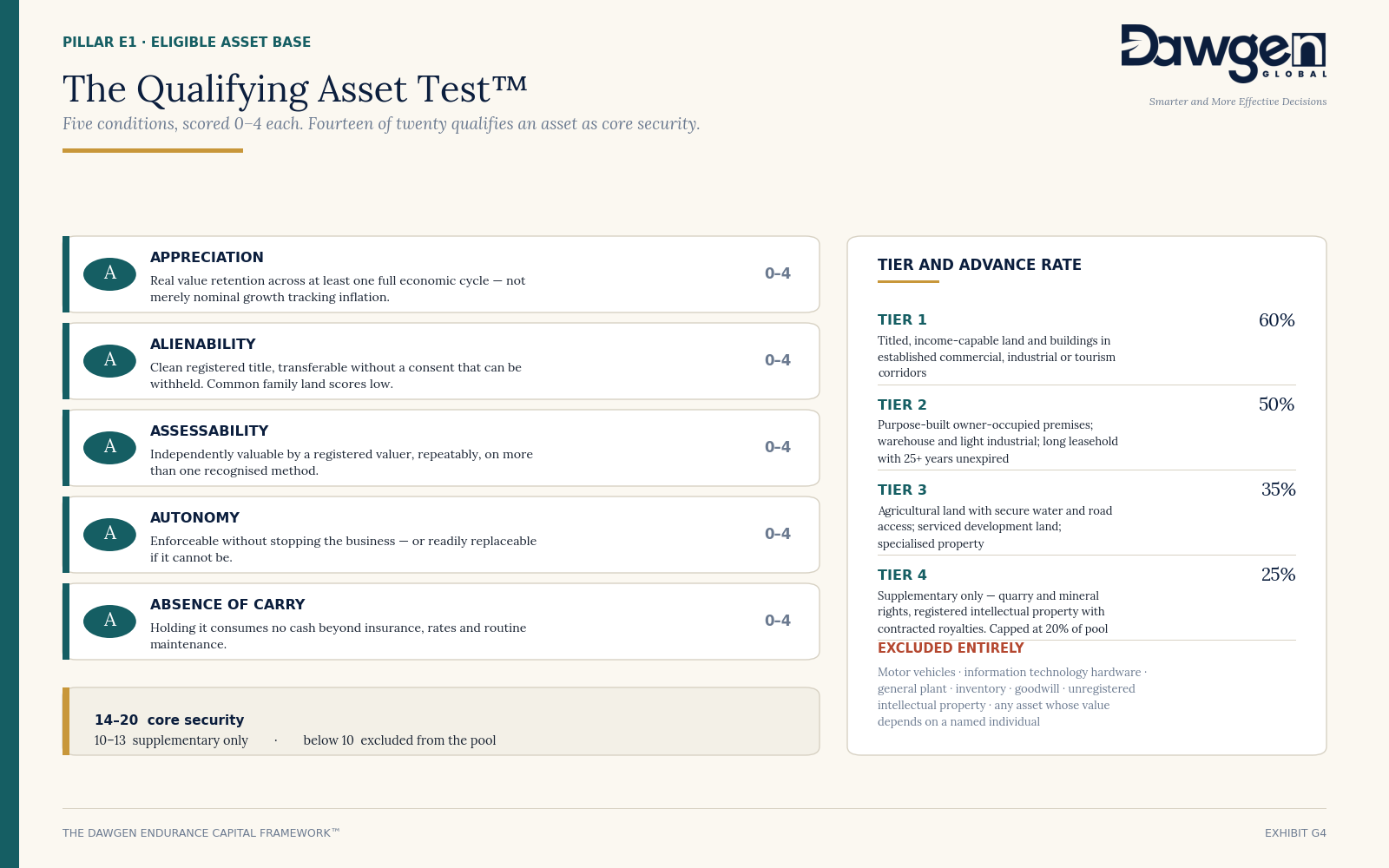
Appreciation. Is there evidence of value retention in real terms across at least one full economic cycle? Nominal growth that merely tracks inflation scores two. Demonstrable real appreciation scores four. An asset that depreciates in use scores nothing, and this is where most of what sits on a balance sheet falls out.
Alienability. Is title clean, registered and transferable without a consent that can be withheld? This is the question that most often surprises. Family land held in common, unregistered interests, restrictive covenants and undivided shares all reduce the score sharply, and none of them reduces the asset’s worth by a dollar.
Assessability. Can the asset be independently valued by a registered valuer, on a repeatable basis, using more than one recognised method? An asset that can only be valued by reference to a transaction that has not occurred is weak security regardless of its worth, because there is no way to demonstrate at year seven that the position is still sound.
Autonomy. Can the security be enforced without stopping the business — or is the asset readily replaceable if it cannot? This is the least intuitive of the five and the most important.
Absence of carry. Does holding the asset consume cash beyond insurance, rates and routine maintenance? An asset requiring continuous capital injection to retain its value is not a store of value. It is a commitment.
The result that surprises every owner
Score the four assets on the owner’s list and the ranking inverts almost everything he expected.
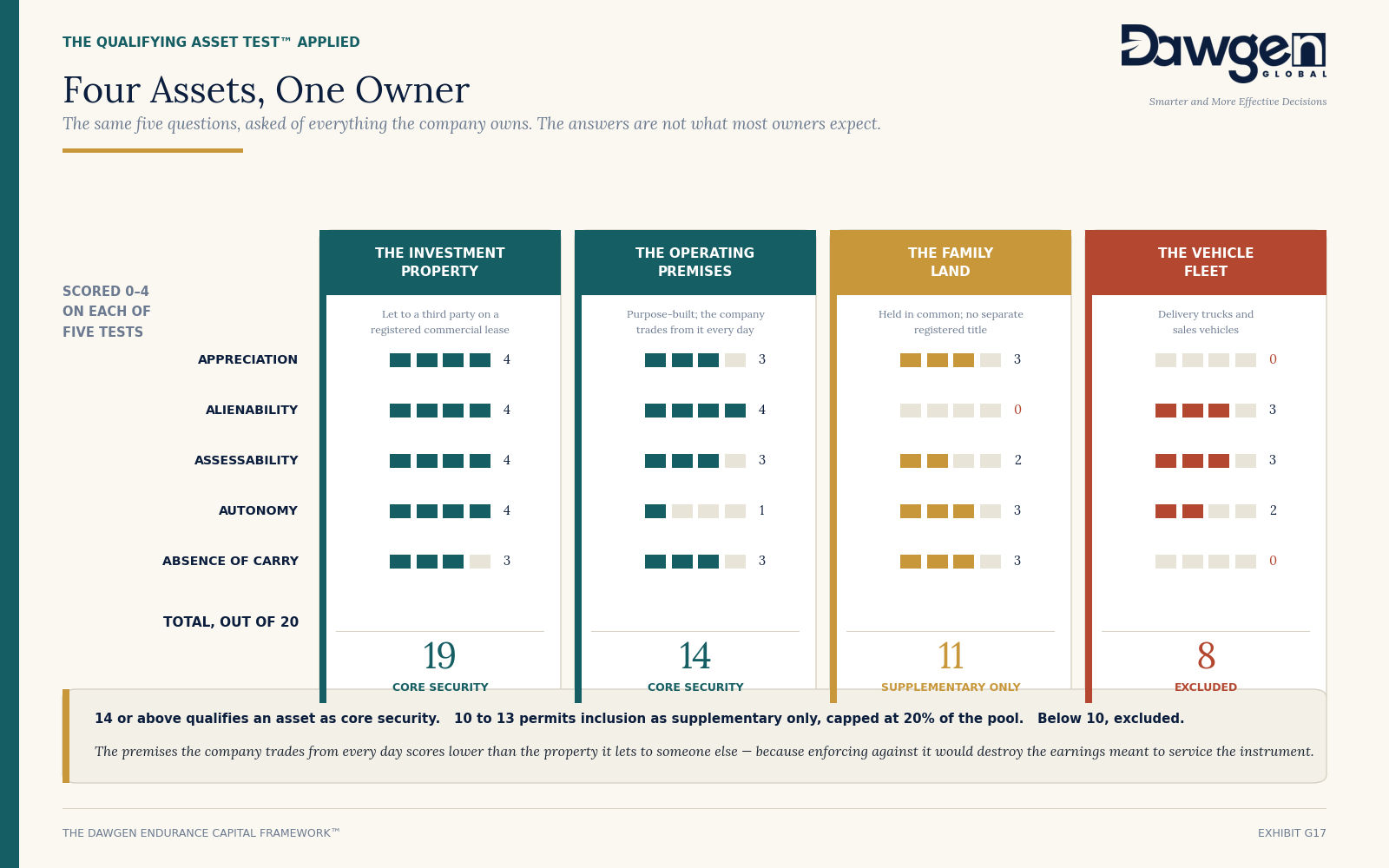
The investment property scores nineteen out of twenty. It appreciates, its title is clean, it can be valued three ways, it is let to an unconnected tenant, and it costs nothing to hold. It is close to perfect security.
The operating premises scores fourteen — core security, but only just, and the whole of the gap sits in one line. On autonomy it scores one, because enforcing against the building the company trades from every day would stop the trading that was supposed to service the instrument. A lender holding that security has a remedy he cannot use without destroying the thing he is trying to be repaid from.
The premises the company operates from is weaker security than the property it lets to somebody else. Every owner finds this counterintuitive, and every experienced lender already knows it.
The family land scores eleven. It appreciates, it costs nothing to hold, and it could be enforced against without touching the business. But it is held in common with no separate registered title, and on alienability it scores nothing at all. It is supplementary security at best, and it will remain so until the title position is resolved — which is a legal exercise, not a financing one, and one that can take years.
The vehicle fleet scores eight and is excluded outright. It depreciates from the day it is bought, it consumes cash to hold, and its value is a function of use. Three hundred million dollars of genuinely useful, genuinely owned equipment contributes nothing whatsoever to the security pool.
From qualifying asset to advance rate
Passing the test establishes that an asset can carry long-dated capital. It does not establish how much. That is a function of tier, of the tenor band the company sits in, and of how current and how rigorous the valuation is.
| Tier | Description | Maximum advance rate |
| Tier 1 | Titled, income-capable land and buildings in established commercial, industrial or tourism corridors | 60% |
| Tier 2 | Purpose-built owner-occupied premises; warehouse and light industrial; long leasehold with 25+ years unexpired | 50% |
| Tier 3 | Agricultural land with secure water and road access; serviced development land; specialised property | 35% |
| Tier 4 | Supplementary only — quarry and mineral rights, registered intellectual property with contracted royalties | 25% |
The applicable rate is the lower of the tier rate and the loan-to-value cap for the company’s tenor band — 40 per cent for an emerging business, rising to 65 for an institutional issuer. A Tier 1 asset in the hands of a young company is capped by the band, not by the tier, and the tier rate becomes available only as the company matures.
Then the valuation itself is discounted, according to how current and how rigorous it is. This is a direct response to a regional condition: independent valuation capacity exists but is thin, valuations are not always refreshed on a schedule, and single-method valuations are common.
| Valuation basis | Haircut |
| Full valuation by a registered valuer, two or more methods, less than 12 months old | 0% |
| Full valuation 12–24 months old, or current but single-method | 10% |
| Desktop or indexed valuation | 20% |
| Valuation more than 24 months old | Not admissible |
| The cheapest thing on this page
A current, two-method valuation by a registered valuer costs a fraction of one per cent of the capital it supports, and it removes a ten or twenty per cent haircut from the security value. On a J$800 million property, closing a ten per cent haircut releases J$40 million of additional security. It is the highest-return professional fee an owner will pay in the whole exercise, and it is almost always the one deferred longest. |
Two billion in assets, seven hundred in security
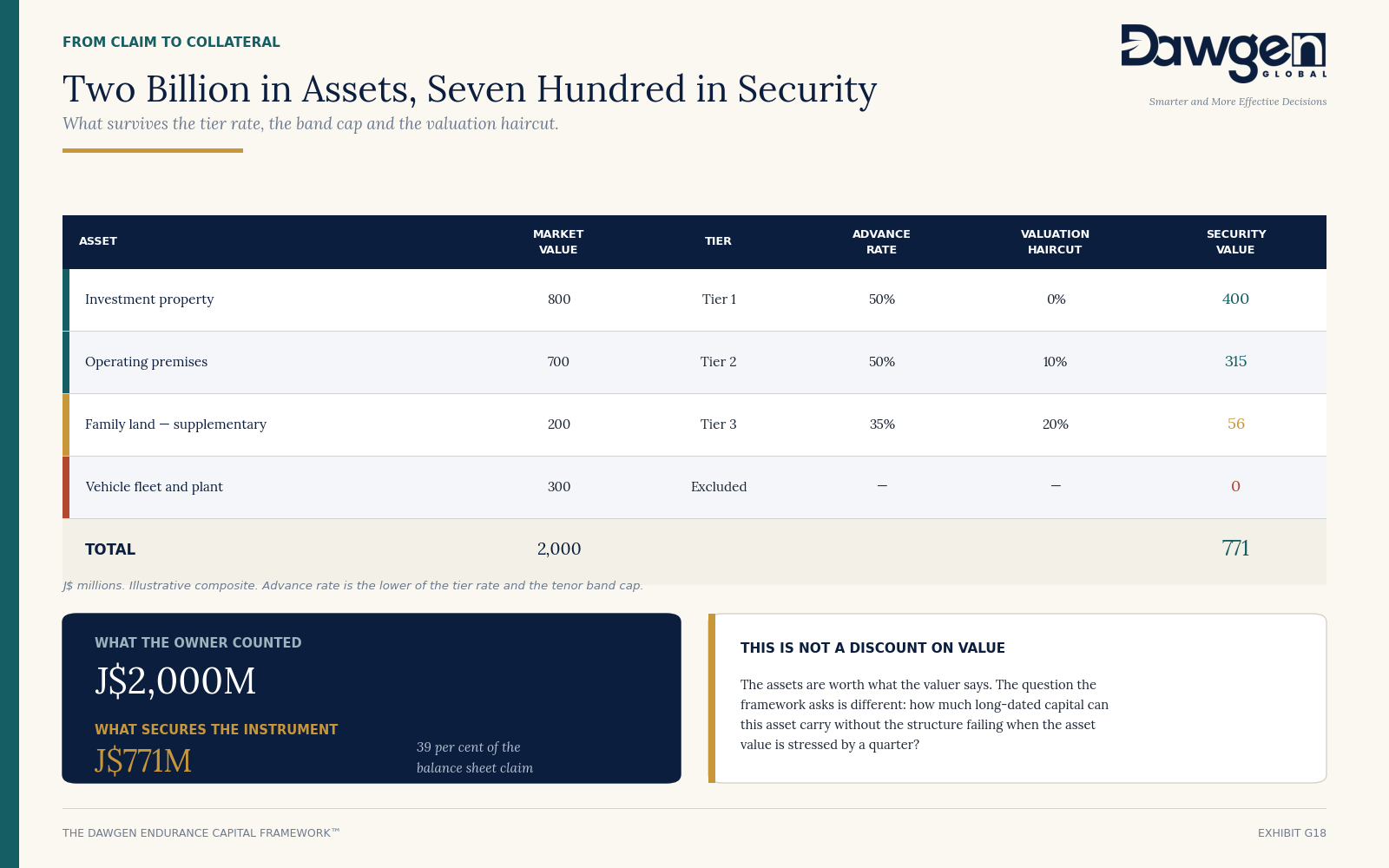
Run the owner’s list through tier, band cap and haircut and the two billion becomes seven hundred and seventy-one million. Thirty-nine per cent of the balance sheet claim.
Notice where it goes. The vehicle fleet loses all three hundred million, because it never qualified. The family land loses three quarters of its two hundred, partly to a Tier 3 rate and partly to a desktop valuation. The operating premises loses ten per cent to a valuation eighteen months old and prepared on a single method — the only one of the four losses that could be reversed inside a fortnight.
And the investment property, the asset the owner thought of last, contributes more than any other.
This is not a discount on value. The assets are worth what the valuer says they are worth. The framework is asking a different question: how much long-dated capital can each of these carry without the structure failing when the asset value is stressed by a quarter and the earnings by a half at the same time?
And the security pool is only half the answer
One further point, because owners who have absorbed everything above sometimes draw the wrong conclusion from it and go looking for more property.
Under the framework, deployable capital is the lesser of two independent limits: what the earnings can service, and what the asset can secure. Never the higher, and never an average.
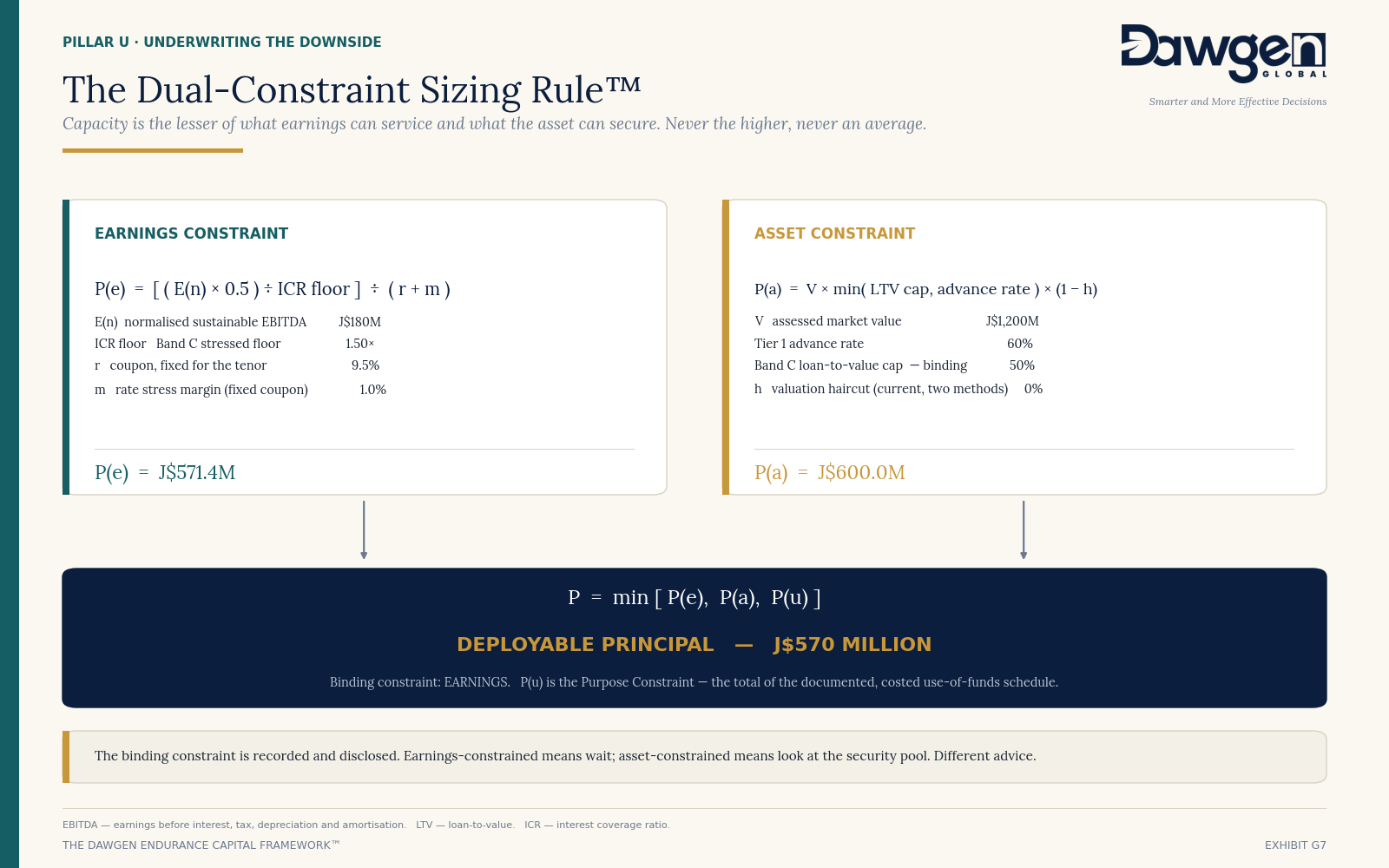
Which of the two binds is itself diagnostic, and the two situations call for opposite advice. Where the earnings constraint binds, the company is asset-rich and earnings-thin; adding more security achieves nothing at all, and the correct counsel may be to wait. Where the asset constraint binds, the company can service more than it can secure, and the conversation is about the security pool — resolving a title, refreshing a valuation, or bringing an asset into the company that has been sitting outside it.
The binding constraint is recorded and disclosed in every capacity assessment, because an owner who does not know which of the two is limiting him will spend money solving the wrong problem.
What this means before you raise anything

The useful feature of this pillar is that almost all of it can be acted on before a company approaches anybody for capital, and most of the actions are cheap.
Title work is slow, so start it first. Land held in common, unregistered interests and undivided shares are the single most common reason a valuable asset scores zero on alienability. Resolving title is a legal exercise measured in months or years, and it cannot be compressed by urgency. An owner who intends to raise long-dated capital in two years should begin the title work now, and an owner who begins it when the opportunity appears has already lost.
Valuations are fast, so time them properly. A current two-method valuation removes the haircut entirely. But it also ages, and nothing over twenty-four months is admissible at all. The discipline is to hold a valuation cycle rather than to commission one in a hurry, because a valuation obtained under time pressure tends to be single-method, and a single-method valuation carries a ten per cent haircut whether it is a week old or a year.
Assets outside the company are not the company’s security. It is common for the most qualifying asset in a family group to sit in a partnership, a trust or an individual’s name rather than in the trading company. That is often sensible for other reasons, and it is not an argument for moving it — but it must be known, because it changes what the company can raise on its own balance sheet, and the tax and duty consequences of moving it late are materially worse than the consequences of planning it early.
Score what you have, before anyone else does. The five questions take an afternoon. The answers do not change according to who is asking them, and finding out that the vehicle fleet contributes nothing is considerably less expensive in your own boardroom than in a lender’s.
Where to start
- List every asset the company owns above a material threshold, and score each one out of twenty on the five questions. Be honest about autonomy — it is the line owners consistently overstate.
- For every asset scoring below fourteen, identify which single criterion is holding it down. In most cases it is one, and in most cases it is alienability or assessability, both of which are fixable.
- Check the date and the method of every valuation you hold. Anything over twenty-four months old is not admissible; anything single-method is carrying a ten per cent haircut.
- Establish where each asset legally sits. Company, partnership, trust, or an individual — and whether anything is charged already.
The framework, and the hundred-point Endurance Readiness Score™ that accompanies it, set out the full method — the tenor bands, the sizing rule, the redemption architecture and the governance compact that conditions the whole structure. But this pillar rewards attention earlier than any of the others, because its remedies are slow and its diagnosis is quick.
This is the fourth article in the Endurance Capital Series. The first, A Seven-Year Loan Against a Thirty-Year Asset, sets out the framework in full.
|
The Dawgen Endurance Capital Framework™ is proprietary to Dawgen Global. All figures in this article are illustrative and constructed to demonstrate the methodology. They are not drawn from any client engagement and do not represent market pricing. Valuations supporting any security pool are obtained from independent registered valuers; the firm does not value the asset it is helping to finance. This article does not constitute investment, legal or valuation advice.
About Dawgen Global
Dawgen Global is an independent, integrated multidisciplinary professional services firm headquartered at Dawgen Towers, 47-49 Trinidad Terrace, Kingston 5, Jamaica, serving more than 15 territories across the Caribbean. Founded and led by Dr. Dawkins Brown, Executive Chairman, the firm is independent and not affiliated with any international network. It delivers a full suite of professional services under one roof: audit and assurance; tax advisory; IT and digital transformation; risk management; cybersecurity; actuarial and insurance regulatory advisory; HR advisory; mergers and acquisitions; corporate recovery; business advisory and strategy; accounting BPO and virtual CFO services; and legal process outsourcing.
The proposition is simple: big-firm capability without the big-firm price. Dawgen Global’s integrated approach is built for the specific complexities and opportunities of the Caribbean market, helping organizations make sharper, better-informed decisions that drive measurable progress.
To explore a partnership, reach out:
- Website: dawgen.global
- Email: [email protected]
- WhatsApp (Global): +1 555-795-9071
- Caribbean offices: +1 876-929-3670 | +1 876-926-5210


