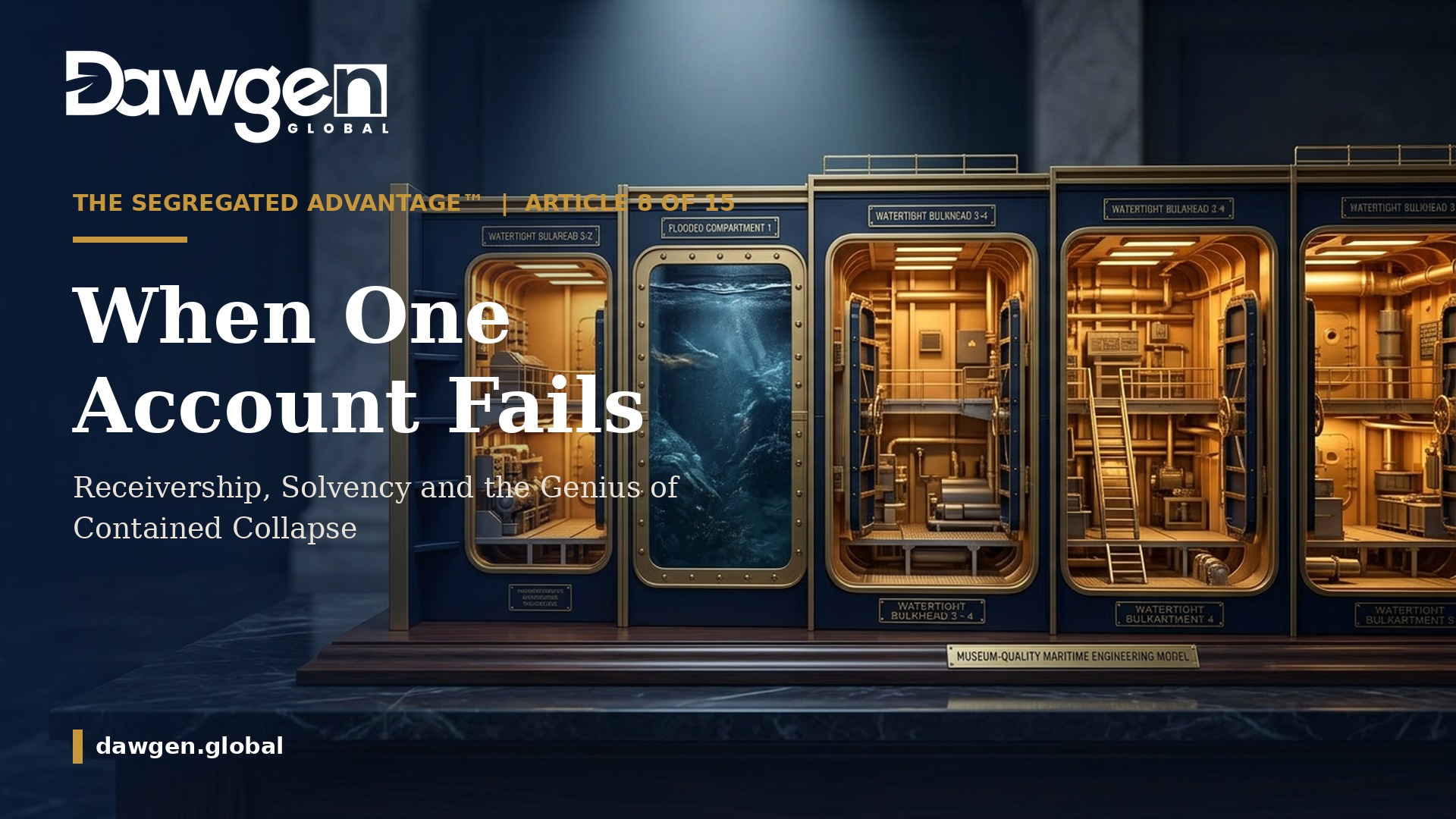
Most corporate structures are designed for success and merely endure failure. The segregated accounts company (SAC) is different: it was designed, from its first principles, for the day something fails. Every rule this series has examined — the linking of Article 4, the gateway of Article 5, the governing instrument of Article 6, the directors’ disclosure discipline of Article 7 — exists to make one promise credible: that when a segregated account collapses, the collapse stays inside that account. This article, which closes the series’ arc on the rules, examines the machinery that keeps the promise — account-level solvency testing, the receivership order, and the winding-up regime — as built in the regional model on which Jamaica’s Segregated Accounts Companies Act, 2024 is based. It is here, in the insolvency provisions, that the SAC either earns its keep or does not; and the regional draftsmen understood that perfectly.
Failure Without Contagion: The Design Objective
Recall the third article’s second lesson from two decades of Caribbean practice: insolvency machinery makes the promise credible. In an ordinary company, financial distress is systemic by construction — one failed division drags the whole estate into liquidation, one pool of creditors shares one pool of assets, and the healthy businesses inside the company are liquidated alongside the sick one. Contractual ring-fencing, as Article 2 showed, dissolves at exactly this moment. The SAC’s answer is to make insolvency itself modular. Distress is diagnosed account by account; the remedy is administered account by account; the costs are borne account by account; and the death of an account is, by design, a non-event for its neighbours. The market phrase for this is contained collapse, and it is the single feature that lets sophisticated counterparties price a segregated account as if it were a standalone entity — because in failure, functionally, it is.
Solvency, Tested Room by Room
The foundation is the dual solvency concept met in Article 4, worth restating with the insolvency lens on. A segregated account is solvent if it is able to pay its own liabilities — excluding obligations to account owners in their capacity as owners — as they fall due. The company is solvent if the general account can pay the company’s unlinked liabilities as they fall due, without reference to the segregated accounts at all. Nothing about Account A’s collapse makes Account B, or the company, insolvent; and nothing about the general account’s health rescues an account that cannot pay its own way. The statute then wires this dual test into the vehicle’s daily life as an early-warning system: no dividend may be declared on securities linked to an account if there are reasonable grounds to believe the account is, or would thereby become, unable to meet the solvency standard; the same discipline gates share repurchases and capital reductions; and inter-account transfers, as Article 4 showed, are conditioned on the transferor’s continued solvency. For companies registered through the residual gateway, the segregated accounts representative of Article 5 must report to the regulator within thirty days of forming the view that there is a reasonable likelihood of an account — or the general account — becoming insolvent. Distress in a SAC is thus meant to be seen early, declared early, and confined early.
The Receivership Order
When confinement is needed, the instrument is the receivership order — the SAC regime’s substitute for winding up an account that, having no legal personality of its own, cannot be wound up as a company. The court may make a receivership order in respect of one or more segregated accounts on four grounds: the account is insolvent; the general account is insolvent; a liquidation of the company has commenced; or it is otherwise just and equitable to do so. But grounds alone are not enough — the order must also serve the statutory purposes: the orderly management, sale, rehabilitation, run-off or termination of the business of, or attributable to, the account, or the distribution of its assets to those entitled. The remedy, in other words, is not only an undertaker’s tool; rehabilitation and run-off sit in the statute alongside termination, and a receivership can be the mechanism by which a troubled account is nursed back rather than buried.
Standing to apply is deliberately broad: the company itself, its directors, any creditor of the account, any account owner of the account — and the primary regulator, whose presence on the list converts the supervisory relationship of Article 5 into a live insolvency power. Notice of the application must be served on the company and the regulator, and on such other persons as the court directs, each with an opportunity to be heard; the court may make interim orders pending the hearing. And the door need not be the court’s at all: account owners or the directors may appoint a receiver voluntarily by resolution, giving well-advised structures a consensual route into an orderly process.
The Receiver at Work
Once appointed, the receiver steps into the account completely. He takes all the functions and powers of the directors and managers in respect of the business and assets linked to the account, and their powers — and those of any liquidator — are suspended for the duration in respect of that account. He acts as agent of the company, incurs no personal liability except for his own misfeasance, and persons dealing with him in good faith need not enquire into his powers. Proceedings against the company in respect of the account may be stayed on application, giving the workout breathing room. Two carve-outs define the remedy’s commercial character. First, the appointment does not stay enforcement by a counterparty holding a valid security interest over the account’s assets — the secured lender to Account A enforces according to its terms, receivership or not, which is precisely what makes account-level secured lending bankable. Second, the receiver’s remuneration and proper expenses are payable in priority to all other unsecured claims — but only from the assets of the account in receivership, never from the general account or any other account. The cost of the failure stays with the failure.
The order also freezes the strategic landscape while it runs: once a receivership order is in place, no resolution to wind up the company is effective without leave of the court — the account’s workout cannot be trumped by a company-level liquidation vote. And the order ends only as it began, by the court: discharge is available where the purpose for which the order was made has been achieved, substantially achieved, or become incapable of achievement. Throughout, every other account, and the company itself, simply continues trading. That is the genius of the design: the receivership is invisible from the other side of the wall.
When the Company Itself Fails
What of the larger catastrophe — the failure of the SAC as a whole? Here the statute performs its final act of segregation. In determining whether the company may be wound up on insolvency grounds, the assets and liabilities linked to segregated accounts are left out of account entirely: company-level insolvency is a general-account question, so a catastrophic account cannot, of itself, drag the company into liquidation. If a winding up nonetheless comes — for whatever reason — the liquidator arrives bound. He must deal with each account’s assets and liabilities only in accordance with the Act; he must ensure that assets linked to one account are not applied to the liabilities of any other account or the general account; items lawfully linked to more than one account are dealt with as the governing instrument or relevant contract provides; and his own remuneration is apportioned across the accounts and the general account to reflect the duties actually performed for each, subject to the court’s approval and directions. Where the SAC legislation and the general companies legislation conflict, the SAC legislation prevails. The walls, in short, survive the death of the company that built them — which is the whole point of building them in statute rather than contract.
What Contained Collapse Means for Each Stakeholder
For sponsors and platforms, the receivership regime is a business-continuity guarantee: a failed strategy, programme or project is excised through a court-supervised process while the platform’s brand, licences and remaining accounts continue undisturbed — the alternative, in a multi-subsidiary group, being cross-default clauses and contagion management. For investors and account owners, it defines the worst case with precision: the downside of Account A is the assets of Account A, the costs of its failure are borne by Account A, and the owner’s standing to apply for — or resolve upon — a receivership gives even a minority participant a lever when management will not act. For secured lenders, the enforcement carve-out means account-level security behaves in distress the way security should, uncompromised by the collective process. For the regulator, standing to seek a receivership order completes the supervisory arc that began at the gateway. And for directors, the regime is the merciful counterpart to Article 7’s severity: the same statute that holds them personally to the disclosure discipline also gives them a consensual, orderly exit for a failing account — provided they use it early, before the representative’s report or a creditor’s application uses it for them.
This article closes the series’ second arc. The rules are now on the table: the ring-fence, the gateway, the instrument, the directors’ discipline, and the machinery of contained collapse. The third arc turns from law to application — beginning, next, with the sector the Act may transform first: collective investment schemes, and the umbrella fund reimagined as a Jamaican SAC.
Frequently Asked Questions
Can a segregated account be wound up like a company?
No — a segregated account is not a separate legal person, so it cannot be liquidated as a company. The SAC regime substitutes a receivership order: a court-supervised process confined to that account, through which its business is managed, sold, rehabilitated, run off or terminated and its assets distributed to those entitled.
On what grounds can a receivership order be made?
Four: the account is insolvent; the general account is insolvent; a liquidation of the company has commenced; or it is otherwise just and equitable — provided, in each case, that the order would achieve the statutory purposes of orderly management, sale, rehabilitation, run-off, termination or distribution.
Who can apply for a receivership order?
The company, its directors, any creditor of the account, any account owner of the account, or the primary regulator. Account owners or directors may also appoint a receiver voluntarily by resolution, providing a consensual route into an orderly workout.
Does a receivership stop a secured lender from enforcing?
No. The appointment of a receiver does not stay enforcement by a counterparty holding a valid security interest over the account’s assets, who may enforce in accordance with the security’s terms. Unsecured proceedings against the company in respect of the account may, however, be stayed on application.
Who pays for the receivership?
The account in receivership. The receiver’s remuneration and proper expenses rank ahead of all other unsecured claims, but are payable only out of the assets of that account — never from the general account or any other segregated account. The cost of the failure stays with the failure.
Can one failed account cause the whole SAC to be wound up?
Not by itself. Company-level insolvency is tested on the general account alone, leaving segregated-account assets and liabilities out of the calculation. Even in a winding up, the liquidator is statutorily bound to respect the segregation and cannot apply one account’s assets to another’s liabilities — and while a receivership order is in force, no winding-up resolution is effective without leave of the court.
How can Dawgen Global help?
Dawgen Global advises on distress planning and workout strategy for SAC structures: account-level solvency monitoring, early-warning frameworks, receivership readiness, creditor and security analysis, and corporate recovery support through its Corporate Recovery practice. Contact [email protected] to discuss your structure.
Previously in the series: Article 7 — Directors Beware: Personal Liability and the Disclosure Discipline Every SAC Board Must Master.
Next in the series: Article 9 — The Umbrella Fund Reimagined: SACs and the Future of Collective Investment Schemes in Jamaica.
This article is provided for general information and is not legal or tax advice. Specific structures should be verified against the current text of the Segregated Accounts Companies Act, 2024, its regulations, and the requirements of the relevant Jamaican regulators.
About Dawgen Global
Dawgen Global is an independent, integrated multidisciplinary professional services firm headquartered at 47 Trinidad Terrace, New Kingston, Jamaica, serving more than 15 territories across the Caribbean. Founded and led by Dr. Dawkins Brown, Executive Chairman, the firm is independent and not affiliated with any international network. It delivers a full suite of professional services under one roof: audit and assurance; tax advisory; IT and digital transformation; risk management; cybersecurity; actuarial and insurance regulatory advisory; HR advisory; mergers and acquisitions; corporate recovery; business advisory and strategy; accounting BPO and virtual CFO services; and legal process outsourcing.
The proposition is simple: big-firm capability without the big-firm price. Dawgen Global’s integrated approach is built for the specific complexities and opportunities of the Caribbean market, helping organizations make sharper, better-informed decisions that drive measurable progress.
To explore a partnership, reach out:
- Website: dawgen.global
- Email: [email protected]
- WhatsApp (Global): +1 555-795-9071
- Caribbean offices: +1 876-665-5926 | +1 876-929-3670 | +1 876-926-5210


