
The partnership model was the pyramid’s profit engine — equity concentrated at the apex, funded by the leverage of everyone below it. In the diamond, the people who now create the value no longer own the firm. Closing that gap is the most sensitive economics of the entire transition.
PART III · THE HARD IMPLICATIONS
The model that the pyramid built
This series has redrawn the modern organization — who creates its value (the empowered middle), how its experts are now made (by design rather than by accident), and how its work should be priced and measured (by outcomes rather than by hours). Each of those shifts raises the same unavoidable question in a different form: if value has moved, where should the rewards go? Nowhere is that question harder, or more political, than in the structure of ownership itself.
The professional-services partnership — and the equity ladder that mirrors it across most knowledge businesses — was not an accident of tradition. It was a precise economic instrument, engineered for the pyramid. A small number of owners sat at the apex. Beneath them stretched a wide base of salaried professionals whose work was billed out at a substantial multiple of their cost. The difference flowed upward. “Making partner” was the prize at the summit, and the long tournament to reach it was precisely what kept the base wide and the leverage high.
How partner wealth was actually made
It is worth being honest about the arithmetic, because the model’s logic is the key to understanding why it now strains. Partner profit was never principally a reward for a partner’s own billable time. It was a return on leverage — on owning the marked-up effort of others. The more juniors each partner could supervise, and the wider the spread between what those juniors cost and what they billed, the higher the profit per equity partner. Ownership at the apex was, in economic terms, a claim on the labour of the base.
For a century this was coherent and, on its own terms, fair: the base was genuinely learning, the apex genuinely carried the risk and the relationships, and the leverage genuinely produced the value the clients paid for. The reward structure and the value-creation structure pointed in the same direction. That alignment is exactly what is now coming apart.
Why it breaks in the diamond
Automation dismantles the engine. The leveraged, repeatable work that once filled the base — and whose marked-up hours funded the apex — is increasingly performed by intelligent systems at a fraction of the cost. The spread that produced partner profit narrows or disappears. At the same moment, as earlier articles in this series argued, the value migrates to the experienced middle: the people exercising judgment over what the machine produces. The firm’s value is now created largely by people who, under the inherited model, own none of it.
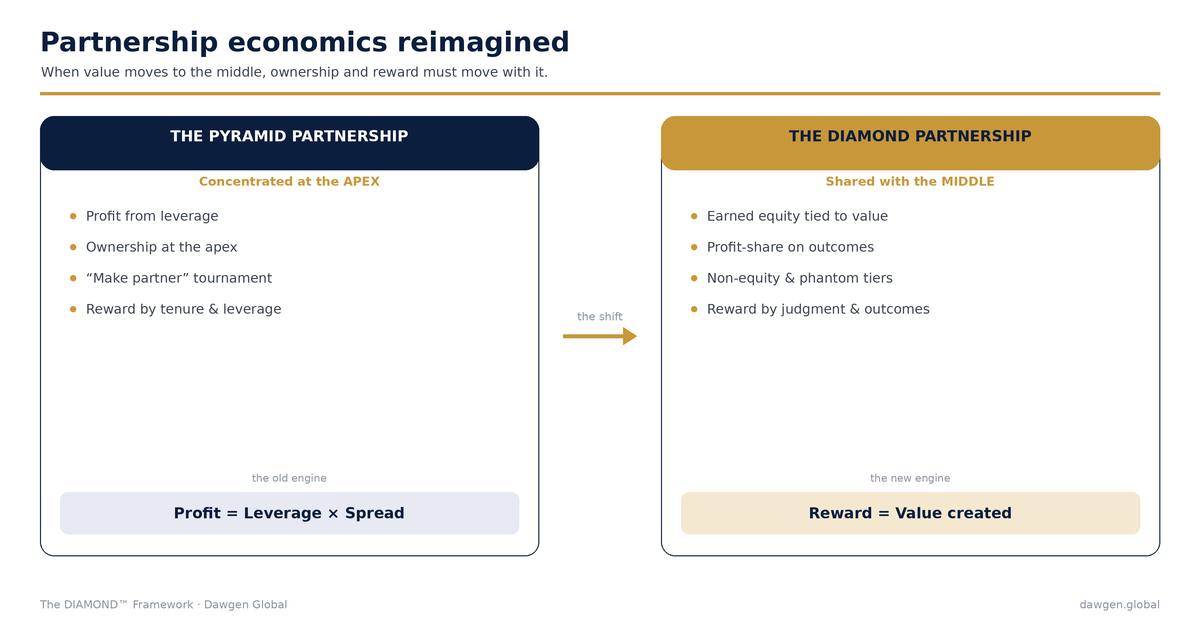
The leverage that funded ownership has gone to the machine; the judgment that now creates the value sits with people the old model never made owners.
This is the structural fault line. The reward system still channels the surplus toward an apex defined by a vanishing engine, while the value increasingly comes from a middle the system was built to keep out of ownership. Left unaddressed, the gap does not stay quietly theoretical — it shows up in the numbers and in the resignations.
The misalignment no one wants to name
Keep pyramid-era ownership economics in a diamond-shaped firm and three things follow, none of them comfortable. First, the people creating the value can see that they are not sharing in it, and the most capable of them — precisely the judgment-rich experts the firm cannot replace with software — are the easiest to poach and the most able to leave. Second, the apex finds itself defending a claim on a surplus that the old leverage no longer generates, which puts pressure on profits and on relationships at the top. Third, and most corrosively, the firm keeps optimising reward toward a contribution that is shrinking, while underpaying the contribution that is growing.
None of this is a failure of generosity. It is a failure of design. The ownership model was built for a shape the firm no longer has.
Reimagining ownership
If value now comes from the middle, then ownership and reward have to reach the middle. That does not mean abolishing the partnership; it means widening and re-pricing it. The mechanisms already exist and are well understood: expanded and earned equity tied to the value a professional actually creates rather than to tenure; profit-sharing linked to outcomes rather than to billed hours; non-equity partner and principal tiers that confer real upside without requiring a capital buy-in; phantom equity and long-term incentive plans for the experts a firm most needs to keep. The instrument matters less than the principle behind it.
Reward judgment and outcomes, not leverage and tenure. The people who create the value should own a meaningful share of it.
This is the natural extension of the previous article. Once a firm prices by outcomes rather than hours, it can also reward by outcomes rather than hours — sharing in the value created with the people who created it. Pricing and ownership become two halves of the same realignment.
The apex, reimagined
This is the Direct dimension of the DIAMOND™ framework in its most demanding form. Earlier, Direct meant a narrower apex doing different work — stewardship, capital allocation, brand, relationships, and the cultivation of talent rather than the supervision of leverage. Ownership economics is where that redefinition becomes concrete. Leadership’s defining act in the diamond is not to defend the apex’s historic share of the surplus. It is to decide, deliberately, how ownership in the value the firm now creates should be shared — and to act on that decision before the market forces it.
Why this is the hardest change
Everything else in this series can be implemented by the firm acting on its environment. This change asks something of the people who hold the power to make it: that today’s owners voluntarily dilute and share what they spent careers earning. It touches identity as much as economics — the partnership was, for many, the whole point of the long climb. No framework dissolves that difficulty. But the alternative is more expensive than it looks. Refuse to share, and you keep a larger slice of a shrinking pie, while the people who could have grown it leave to own their value somewhere else. The firms that endure will be the ones whose current owners understand that a smaller share of a larger, well-led enterprise is the better deal — and the more durable one.
Why this matters for the Caribbean
Regional firms have an unusual advantage here, and an unusual exposure. Many are founder-led or family-held, with ownership concentrated and decisions made quickly. They are not weighed down by a sprawling legacy partnership that must be renegotiated across hundreds of vested interests; they can redesign their ownership economics deliberately, while the change is still a choice rather than a crisis. The exposure is the mirror image: concentrated ownership and a small senior cohort make it harder to retain the judgment-rich professionals the diamond depends on, especially now that global firms and remote work can reach Caribbean talent directly. Sharing ownership in the value the middle creates is not a concession for the regional firm. It is the most effective way to keep its best people, attract the next ones, and compete on something more durable than salary.
Part III has set out the hard implications of the diamond: the broken rung, apprenticeship without the old ladder, outcomes over hours, and ownership reimagined. What remains is the question every leader who has read this far will be asking — how do you actually build it? That is where the series turns next.
Who owns the value your firm now creates?
Dawgen Global — Independent. Integrated. Multidisciplinary.
This article is part of “From Pyramid to Diamond,” a Dawgen Global thought leadership series built on the proprietary DIAMOND™ Framework. Dr. Dawkins Brown is Executive Chairman and Founder of Dawgen Global.
© 2026 Dawgen Global. DIAMOND™ is a proprietary framework of Dawgen Global. dawgen.global | info@dawgen.global
About Dawgen Global
Dawgen Global is an independent, integrated multidisciplinary professional services firm headquartered at Dawgen Towers, 47-49 Trinidad Terrace, Kingston 5, Jamaica, serving more than 15 territories across the Caribbean. Founded and led by Dr. Dawkins Brown, Executive Chairman, the firm is independent and not affiliated with any international network. It delivers a full suite of professional services under one roof: audit and assurance; tax advisory; IT and digital transformation; risk management; cybersecurity; actuarial and insurance regulatory advisory; HR advisory; mergers and acquisitions; corporate recovery; business advisory and strategy; accounting BPO and virtual CFO services; and legal process outsourcing.
The proposition is simple: big-firm capability without the big-firm price. Dawgen Global’s integrated approach is built for the specific complexities and opportunities of the Caribbean market, helping organizations make sharper, better-informed decisions that drive measurable progress.
To explore a partnership, reach out:
- Website: dawgen.global
- Email: info@dawgen.global
- WhatsApp (Global): +1 555-795-9071
- Caribbean offices: +1 876-929-3670 | +1 876-926-5210
Related service: Explore how we can help →



