
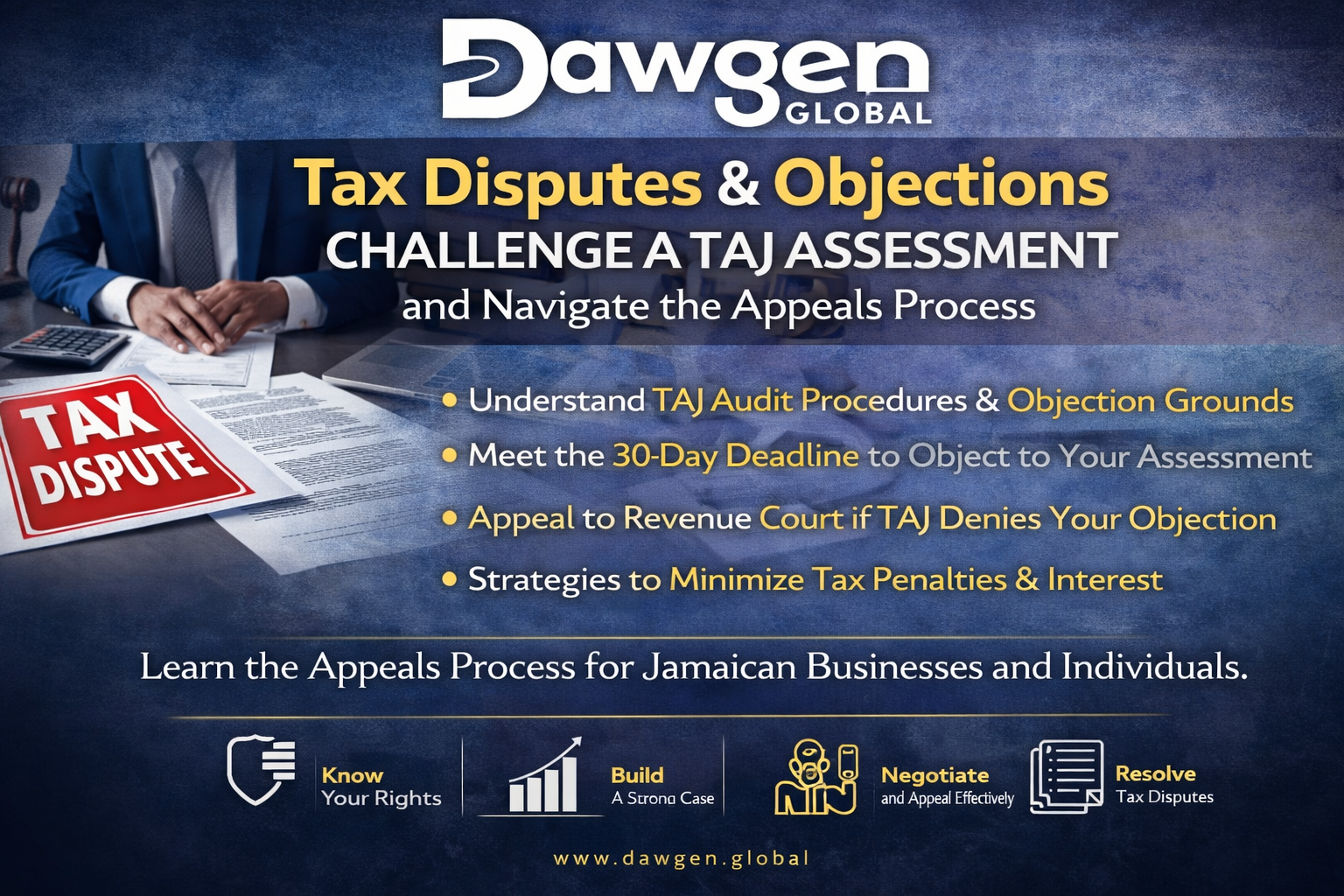
When TAJ and the Taxpayer Disagree
Receiving a tax assessment from Tax Administration Jamaica is one of the most consequential financial events a Caribbean business or individual can face. The assessment sets out TAJ’s determination of the tax liability for a particular period — a determination that may include additional tax, interest, and penalties that, together, can represent a material financial obligation. And unlike most commercial disputes, where the parties negotiate on equal footing, a TAJ assessment carries the weight of statute behind it: unless successfully challenged, it is legally enforceable, and the interest clock continues running from the original due date regardless of whether the taxpayer agrees with the assessment.
Yet TAJ assessments are frequently wrong. They are based on incomplete information, incorrect legal interpretations, factual mischaracterisations, and — in some cases — fundamental errors in the application of the statute. Caribbean businesses that accept TAJ assessments without challenge — whether from a belief that TAJ is always right, a desire to avoid conflict, or simply a lack of awareness that the right to object and appeal exists — are sometimes paying tax they do not legally owe. The objection and appeal framework under Jamaica’s Revenue Administration Act (RAA) exists precisely to give taxpayers a structured, legally defined process for challenging assessments they believe to be incorrect.
This article — the eleventh in Dawgen Global’s The Caribbean Tax Playbook — provides a comprehensive guide to the tax dispute resolution process in Jamaica. We examine the full appeals process from TAJ audit through to the Privy Council, explain the grounds on which assessments can be successfully challenged, address the critical time limits that govern each stage, explore the strategic considerations in deciding whether to object or negotiate, and provide practical guidance on preparing a compelling objection that gives the taxpayer the best possible chance of a favourable outcome.
| KEY INSIGHT
The right to object to a TAJ assessment is a statutory right guaranteed by the Revenue Administration Act. Exercising it does not make a taxpayer adversarial or mark them for future scrutiny — it is a legitimate, professionally managed response to an assessment that is believed to be incorrect. Caribbean businesses that do not exercise this right when they have valid grounds are accepting unnecessary financial losses. |
Understanding TAJ Audits: Types, Triggers, and Initial Response
Before examining the objection and appeal process, it is important to understand the audit process that precedes a formal assessment. TAJ conducts several categories of audit — ranging from desk-based correspondence audits to comprehensive field examinations and formal criminal investigations. Understanding the type of audit the taxpayer is facing, the triggers that led to selection, and the appropriate initial response strategy significantly influences the outcome. The table below provides a reference to the principal TAJ audit types.
| Audit Type | How It Works | Common Triggers | Taxpayer Response Strategy |
| Desk Audit / Correspondence Audit | TAJ reviews taxpayer’s return and supporting information from its office; requests specific information or documentation by letter; no site visit required | Discrepancy in tax return; specific item query; information from third-party matching; random compliance check on specific return line items | Respond within stated deadline; provide specific information requested; do not volunteer unrequested information; engage tax advisor if queries are substantive |
| Field Audit (Comprehensive) | TAJ auditors attend the taxpayer’s premises; conduct a comprehensive examination of all books, records, and systems; covers all tax types for the audit period; typically takes days to weeks | Risk profiling based on industry, size, or income patterns; prior audit history; third-party data inconsistencies; tip-offs; random selection for compliance programme purposes | Prepare thoroughly before auditors arrive; ensure records are organised and accessible; have tax advisor present from day one; understand your rights under the RAA |
| Limited Scope / Issue-Specific Audit | TAJ focuses on a specific tax type or specific issue — transfer pricing, GCT apportionment, payroll compliance, capital allowances; more targeted than a comprehensive audit | Sector-wide compliance initiative; specific risk identified through data analytics; previous audit finding in same area; regulatory referral (BOJ, FSC) | Engage specialist advisor for the specific tax type under audit; prepare targeted documentation; do not expand scope voluntarily beyond TAJ’s stated focus |
| Investigation (Criminal) | TAJ’s Audit and Investigations Division conducts a formal investigation into suspected tax evasion, fraud, or wilful non-disclosure; more formal powers; criminal referral possible | Evidence of deliberate fraud, phantom employees, falsified invoices, concealed income, or destruction of records; tip-offs with supporting evidence; cross-referral from law enforcement | Engage legal counsel immediately; exercise right to silence on criminal matters; cooperate with production of documents while protecting against self-incrimination; specialist criminal tax counsel essential |
| Transfer Pricing Audit | Specialist TAJ auditors with transfer pricing expertise examine related-party transactions; documentation requested; benchmarking analysis challenged; arm’s length standard applied | Large related-party transactions; management fee payments to overseas entities; significant intercompany balances; CbCR inconsistencies; low effective tax rate relative to group | Ensure contemporaneous TP documentation is available before audit commences; engage specialist TP advisor; prepare robust response to benchmarking challenges |
| Post-Filing Verification | TAJ verifies specific claims made on recently filed returns — large refunds, loss claims, capital allowance claims, exemption applications; less comprehensive than a full audit | Large GCT refund claim; significant CIT loss carry-forward; capital allowances on major asset acquisition; first-year filing of a new entity | Prepare supporting documentation for specific claim before filing return; respond promptly to TAJ queries; large refund claims should be supported by detailed documentation filed with the return |
The Taxpayer’s Rights During a TAJ Audit
The Revenue Administration Act provides taxpayers with specific rights during an audit that must be understood and exercised appropriately. These include: the right to be informed of the nature and scope of the audit; the right to have a representative (tax advisor, accountant, or legal counsel) present during audit interviews and site visits; the right to receive adequate time to locate and produce requested documentation; the right to challenge requests for information that are beyond TAJ’s statutory scope; and the right to be treated with respect and fairness by TAJ officers.
A common mistake made by Caribbean businesses facing a TAJ audit is the instinct to be maximally cooperative — answering all questions without restriction, voluntarily disclosing information beyond what TAJ has requested, and treating the TAJ auditor as a partner in an information-gathering exercise. While cooperation with legitimate audit requests is both legally required and strategically prudent, volunteering information beyond the scope of the audit request is rarely in the taxpayer’s interest. Specific and targeted responses to specific and targeted requests — guided by a tax advisor who understands the audit scope — consistently produce better outcomes than unguided cooperation.
| KEY INSIGHT
The moment TAJ issues a formal audit notification, the taxpayer should engage a tax advisor. The advisor’s role is not to obstruct the audit but to ensure that responses are accurate, appropriately scoped, and strategically managed — and that the taxpayer’s legal rights are protected throughout the process. The cost of advisor involvement from the outset is almost always less than the cost of managing consequences that arise from unguided early-stage audit responses. |
The Objection and Appeals Process: A Step-by-Step Guide
Jamaica’s tax dispute resolution process follows a prescribed statutory pathway — from TAJ assessment through internal objection, Revenue Court appeal, Court of Appeal, and ultimately the Privy Council for cases of sufficient legal significance. Each stage has specific time limits, procedural requirements, and decision-making authority. The table below maps the full process from assessment to final appeal.
| Stage | What Happens | Time Limit | Decision Maker | Format |
| TAJ Assessment | TAJ issues formal Notice of Assessment (NoA) to the taxpayer; assessment sets out the tax liability determined by TAJ including any adjustments, penalties, and interest; assessment is based on TAJ’s audit findings or default assessment where no return was filed | None — receipt of assessment triggers 30-day objection clock immediately | TAJ — Audit and Investigations Division or Returns Processing | Formal written notice; delivered by hand, registered post, or electronic notification |
| Internal Review (Pre-Objection) | Before filing a formal objection, many taxpayers engage informally with the TAJ audit officer or supervisor to clarify findings, provide additional documentation, or negotiate adjustments; this stage is not prescribed by the RAA but is commercially important | Before the 30-day objection deadline; does not pause the clock | TAJ audit officer; senior TAJ officer or supervisor | Informal; no prescribed form; useful for straightforward factual disputes or documentation gaps; does not substitute for formal objection |
| Formal Objection to TAJ | Taxpayer files written objection to the assessment within 30 days of the date of the assessment; objection must state the grounds of objection specifically; TAJ acknowledges receipt; objection suspends enforcement of the assessment while it is under review | Within 30 days of assessment date — strict deadline; extension requests possible but not guaranteed | TAJ — Appeals Unit; Commissioner General of TAJ | Written objection with grounds stated; supporting documentation attached; acknowledgement of receipt from TAJ should be obtained and retained |
| TAJ Determination on Objection | TAJ reviews the objection and issues a formal determination — confirming the assessment, reducing it, or withdrawing it; TAJ must issue the determination within a reasonable time (in practice, this can take several months to over a year) | TAJ has no prescribed time limit for issuing its determination; taxpayer may request an update; escalate if unreasonably delayed | TAJ — Appeals Unit; Commissioner General | Written determination; if TAJ confirms or partially confirms the assessment, the 30-day clock to appeal to the Revenue Court begins from the date of the determination |
| Appeal to the Revenue Court | Taxpayer appeals the TAJ determination to the Revenue Court — a specialist tax tribunal with jurisdiction over tax disputes; appeal must be filed within 30 days of the TAJ determination; taxpayer files Notice of Appeal and Statement of Case | Within 30 days of TAJ determination date — strict deadline | Revenue Court of Jamaica — specialist tax jurisdiction | Formal court proceedings; legal representation strongly recommended; Revenue Court has powers to confirm, vary, or set aside the TAJ determination; evidence and legal argument presented formally |
| Appeal to the Court of Appeal | Either party (taxpayer or TAJ) may appeal the Revenue Court decision to the Court of Appeal on a point of law; appeal must be filed within the prescribed period; leave to appeal may be required | Within prescribed period following Revenue Court decision; leave requirement applies | Jamaica Court of Appeal | Superior court proceedings; complex legal argument; limited to points of law, not fresh factual evidence; legal representation essential |
| Privy Council (final appeal) | In exceptional cases involving important points of law, a further appeal may be taken to the Judicial Committee of the Privy Council as Jamaica’s highest appellate court; leave of the Court of Appeal or Privy Council required | Within prescribed period; requires leave; exceptional cases only | Judicial Committee of the Privy Council, London | Highest appellate court; binding precedent; exceptional and costly; reserved for cases of significant legal principle |
The 30-Day Objection Deadline: The Most Critical Time Limit in Tax Disputes
The single most important time limit in the entire tax dispute process is the 30-day deadline for filing a formal objection with TAJ following the date of assessment. This deadline is prescribed by the Revenue Administration Act and is strictly applied. A taxpayer who misses the 30-day objection deadline loses the right to formally contest the assessment through the statutory objection process — and with it, the right to appeal to the Revenue Court.
In practice, the 30 days from the assessment date can pass very quickly — particularly where the assessment is delivered by post, where the taxpayer’s management team is distracted by other business pressures, or where the taxpayer initially believes the assessment can be resolved informally without a formal objection. Caribbean businesses that receive a TAJ assessment should treat the document as the start of a 30-day countdown and immediately engage their tax advisor to assess the grounds for objection — even if they are simultaneously pursuing informal discussions with the TAJ auditor.
Extension of the 30-day deadline is possible on application to TAJ, but extensions are not automatic and are not always granted. The risk of relying on an extension request — particularly where the substantive grounds for objection are strong — is that TAJ declines the extension and the taxpayer is left without the right to formally contest an incorrect assessment. Filing a protective objection within the 30 days — even in broad terms, to be supplemented with detailed grounds later — is the safest approach where there is any uncertainty about whether a formal objection will be needed.
Preparing a Compelling Objection: What TAJ Needs to See
The quality of the written objection is one of the most significant determinants of the outcome of the TAJ review. An objection that clearly identifies the specific grounds of challenge, provides the legal and factual basis for each ground, and is supported by well-organised documentary evidence gives TAJ a clear framework within which to assess the taxpayer’s position — and makes it significantly harder for TAJ to maintain an incorrect assessment. An objection that is vague, unsupported, or that raises multiple grounds without distinguishing between them gives TAJ less to work with and typically produces a less favourable determination.
The Seven Grounds on Which Assessments Can Be Challenged
Every effective objection is built on one or more clear grounds of challenge — specific legal or factual bases on which the assessment is said to be incorrect. The table below identifies the seven most significant grounds on which TAJ assessments are successfully challenged, with the basis for each ground and practical guidance on how to pursue it.
| Ground of Objection | Basis | How to Pursue It |
| Factual error in assessment | TAJ has mischaracterised or incorrectly calculated income, deductions, or tax liability based on the taxpayer’s actual records; TAJ’s figures do not match the underlying documentation | Produce the correct records and documentation; demonstrate the correct figure with primary evidence; request that TAJ recalculate based on correct facts; strongest ground where records are complete and contemporaneous |
| Incorrect application of law | TAJ has applied the wrong legal provision, misinterpreted a statutory definition, or failed to apply an exemption or relief that the taxpayer is legally entitled to; legal interpretation dispute | Identify the specific provision TAJ has misapplied; cite the correct statutory authority; rely on TAJ public rulings, practice notes, or prior assessments where they support the taxpayer’s position; legal argument required — obtain specialist advice |
| Limitation period expired | TAJ has raised the assessment after the six-year limitation period prescribed under the Revenue Administration Act; assessment is statute-barred and must be withdrawn | Confirm the date of the assessment and the tax period to which it relates; calculate the limitation period from the end of the relevant year of assessment; if assessment is out of time, assert limitation as a complete defence; NB: fraud or wilful non-disclosure extends the limitation period |
| Inadequate procedural basis | TAJ did not follow prescribed procedures in raising the assessment — failed to issue required notices, denied the taxpayer an opportunity to respond, or used assessment powers beyond their statutory scope | Review the procedural basis of the assessment against the RAA requirements; identify specific procedural failures; raise as ground for quashing the assessment; courts take procedural compliance seriously in tax matters |
| Double assessment | TAJ has assessed tax on the same income or transaction more than once — either in the same or different tax periods; creates an obligation to pay the same tax twice | Identify the duplicate assessment by reference to the specific income or transaction assessed; demonstrate that the same amount has been assessed in a prior return or prior assessment; TAJ must withdraw the duplicate assessment |
| Quantum challenge | Taxpayer accepts that tax is due but disputes the amount — the quantum of the assessment is excessive relative to the taxpayer’s actual liability; typically combined with other grounds | Produce documentation supporting the correct quantum; demonstrate specific items that should reduce the assessment; often resolved through negotiation once both parties have access to the same underlying data |
| Penalty challenge | Taxpayer accepts the tax liability but disputes the application or quantum of penalties — for example, arguing that the under-declaration was not negligent or fraudulent, or that the penalty rate applied is excessive | Demonstrate that the tax position was taken in good faith with reasonable care; produce evidence of professional advice relied upon; distinguish between honest mistakes and negligence; TAJ has discretion to mitigate penalties in appropriate cases |
Structuring the Objection Document
An effective objection to a TAJ assessment should follow a clear structure that enables TAJ to understand the taxpayer’s position quickly and assess its merits systematically. A well-structured objection includes the following components:
- Identification: The taxpayer’s name, TRN, and the reference number of the assessment being objected to.
- Statement of grounds: A clear and specific statement of each ground of objection — why the assessment is wrong — with each ground identified separately.
- Legal basis: For each ground, the specific provision of the Income Tax Act, GCT Act, or other applicable legislation on which the taxpayer relies; citation of any relevant TAJ practice notes, public rulings, or court decisions that support the taxpayer’s position.
- Factual basis: For each ground, the specific facts that support the objection — with references to the supporting documents being provided.
- Quantum: Where the objection relates to the amount of the assessment rather than the principle, a calculation of the correct tax liability with supporting workings.
- Supporting documentation: All primary records, financial statements, invoices, contracts, and other documents that support the grounds of objection; organised by reference to the specific grounds they support.
- Relief sought: A clear statement of what the taxpayer is asking TAJ to do — withdraw the assessment, reduce it to a specified amount, or reduce specific penalty elements.
Objections that are signed by a qualified tax advisor carry additional credibility with TAJ — particularly where the advisor is prepared to confirm that the tax position taken was based on professional advice and was arrived at in good faith. TAJ officers are generally more willing to engage constructively with a well-prepared, professionally supported objection than with an unsupported assertion that the assessment is wrong.
Negotiation and Settlement: Resolving Disputes Without Full Litigation
Not every tax dispute requires formal escalation through the Revenue Court and beyond. Many tax disputes are resolved through negotiation between the taxpayer (or their advisor) and TAJ — reaching a settlement that reflects both the merits of the taxpayer’s position and the practical realities of tax administration. Understanding when negotiation is the most efficient route to resolution, and how to negotiate effectively with TAJ, is a critical skill in tax dispute management.
When Negotiation Is the Right Strategy
Negotiation with TAJ is typically the most efficient dispute resolution route where: the underlying facts are complex and both parties recognise that reasonable people could take different views on their application; the assessment involves significant penalties where TAJ has discretion to mitigate; the cost and time of litigation is disproportionate to the amount in dispute; the taxpayer has some exposure on specific items even while disputing others; or there is a long-term relationship with TAJ that the taxpayer wishes to manage constructively.
Negotiation is less appropriate — and litigation may be necessary — where: the assessment involves a clear legal error that TAJ refuses to correct; the amount at issue is large enough to justify the cost and time of court proceedings; the legal point at issue has broader implications for other tax years or other taxpayers; or TAJ has acted improperly in raising the assessment or conducting the audit.
The Art of Negotiating with TAJ
Effective negotiation with TAJ requires a clear understanding of the taxpayer’s own position — both its strengths and its vulnerabilities — and an equally clear understanding of TAJ’s likely position and the factors that influence their willingness to settle. TAJ auditors and senior managers operate within a framework of legal obligations, performance targets, and professional discretion. A negotiation strategy that acknowledges TAJ’s legitimate interests while clearly presenting the taxpayer’s legal position is more likely to produce a mutually acceptable settlement than an adversarial approach that treats every TAJ position as wrong.
Key negotiation principles in tax disputes include: engaging at the appropriate level — complex legal disputes require engagement with senior TAJ officers or the Commissioner General’s office, not just the audit team; making offers that are credible — settlement offers should be defensible by reference to the taxpayer’s legal position, not simply set at a level the taxpayer finds financially acceptable; using the formal process strategically — filing a formal objection while simultaneously pursuing negotiation preserves the taxpayer’s legal rights while the parties explore settlement; and being patient — tax dispute negotiations often take longer than expected, and the quality of the settlement outcome is usually better when the taxpayer does not appear desperate to resolve the matter quickly.
Interest and Penalties: Understanding the Financial Stakes
The Interest Regime
Interest on unpaid tax in Jamaica accrues from the original due date of the tax — not from the date of the assessment. This means that a TAJ assessment for underpaid CIT in a year that ended five years ago carries five years of interest at the prescribed rate — currently linked to the Bank of Jamaica’s policy rate and typically ranging from 15 to 20 percent per annum. For a significant underpayment, this accumulated interest can exceed the original tax liability, making the interest component of the assessment as significant as the tax itself.
Crucially, a pending objection or appeal does not stop interest accruing. Interest continues to accumulate on any unpaid tax while the dispute is under review — regardless of the merits of the taxpayer’s position. This creates a powerful financial incentive to pay the disputed tax under protest — to stop the interest clock — while pursuing the objection or appeal. Tax paid under protest is refundable with interest if the taxpayer is ultimately successful. Tax that remains unpaid throughout a protracted appeal may carry five or more additional years of interest by the time the dispute is resolved.
The Penalty Regime
Jamaica’s penalty regime under the Revenue Administration Act is designed to reflect the nature and seriousness of the non-compliance. The principal penalty categories are: a fixed penalty plus a percentage of the tax payable for failure to file a return on time; a percentage of the tax deficiency for under-declaration resulting from negligence (typically 25 percent); a higher percentage for under-declaration resulting from gross negligence or careless disregard (typically 50 percent); and up to 100 percent (or criminal prosecution) for fraud or wilful non-disclosure. Penalties for failure to maintain required documentation — particularly transfer pricing documentation — are charged independently of any substantive tax adjustment.
TAJ has discretion to mitigate penalties in appropriate cases — and taxpayers who demonstrate that their tax position was taken in good faith, based on professional advice, with all relevant facts disclosed to their advisors, typically achieve better penalty outcomes than those who cannot demonstrate these factors. The objection process is the appropriate forum for challenging the application of penalties — both the principle (whether a penalty is warranted at all) and the quantum (whether the rate applied is appropriate given the circumstances).
| THE COST OF IGNORING A TAJ ASSESSMENT
A Caribbean company that receives a J$50 million CIT assessment and takes no action — neither paying nor objecting — faces the following consequences: (1) the 30-day objection window closes and the right to formally contest the assessment is lost; (2) TAJ commences enforcement action — issuing a certificate of tax owing that constitutes a charge on the company’s assets; (3) TAJ may garnish bank accounts, issue a warrant of distress against moveable property, or petition for winding-up; (4) interest continues accruing at the prescribed rate — on a J$50M assessment at 18% per annum, interest alone adds J$9M per year; (5) the company’s ability to obtain bank financing, government licences, or regulatory approvals is compromised by the outstanding tax liability. The cost of doing nothing is always greater than the cost of engaging. |
A Practical Guide for Caribbean Businesses Facing a TAJ Dispute
The following practical guidance distils the key action steps for Caribbean businesses at each stage of a tax dispute — from the receipt of a TAJ audit notification through to resolution.
On Receipt of a TAJ Audit Notification
- Engage your tax advisor immediately — before responding to TAJ or providing any documentation.
- Understand the scope of the audit — which tax types, which periods, and which specific issues TAJ has indicated it wishes to examine.
- Locate and organise the relevant records for the audit period — financial statements, tax returns, supporting schedules, invoices, contracts, and correspondence.
- Identify any known vulnerabilities in your tax position for the audit period — and discuss these with your advisor before TAJ identifies them.
- Do not destroy, alter, or conceal any records — destruction of records is a criminal offence under the Revenue Administration Act and significantly worsens the outcome of any dispute.
On Receipt of a TAJ Assessment
- Note the assessment date immediately — the 30-day objection clock starts from this date.
- Instruct your tax advisor to review the assessment against your actual tax position within the first week of receipt.
- File a protective objection within 30 days even if the detailed grounds are still being developed — a broad objection preserves your rights; a missed deadline forfeits them.
- Consider whether to pay the tax under protest to stop interest accruing while the objection is pursued — the financial cost of continued interest may exceed the cost of funding the payment.
- Do not engage in informal discussions with the TAJ auditor about the assessment without your tax advisor present — unguided conversations can inadvertently weaken your objection position.
During the Objection Review
- Maintain professional and constructive engagement with TAJ — the objection process is an administrative review, not an adversarial proceeding at this stage.
- Respond to TAJ information requests promptly and specifically — provide exactly what is asked for, supported by documentation, without volunteering unrequested information.
- Monitor the progress of the objection — TAJ has no prescribed time limit for issuing its determination, but unreasonable delay should be escalated through formal channels.
- Prepare for escalation to the Revenue Court if TAJ’s determination is unfavourable — your advisor should be building the legal case throughout the objection phase.
Conclusion: Exercise Your Rights, Protect Your Position
Tax dispute resolution is not a process that favours the passive. Caribbean businesses and individuals that receive TAJ assessments and do nothing — either accepting liabilities they do not legally owe or allowing the interest clock to run without resolution — consistently pay more tax than those who engage actively with the process. The statutory right to object and appeal exists because TAJ makes mistakes and because reasonable people can take different views on the application of complex tax legislation. It is a right designed to be used — and used promptly, within the strict time limits that the law prescribes.
The most important investment a Caribbean business can make when facing a TAJ assessment is in the quality of its representation. A tax advisor who understands Jamaican tax law, who knows how TAJ audits and objections work in practice, and who has the technical depth to construct a compelling objection and the negotiating skill to achieve a reasonable settlement — is the difference between an assessment that is successfully reduced or withdrawn and one that is paid in full because no one challenged it effectively.
In Article 12 — Tax Strategy and Governance: Building a World-Class Tax Function for Caribbean Businesses — the final article in The Caribbean Tax Playbook — we bring together the full spectrum of Caribbean tax covered in this series into a strategic framework for tax governance. We examine what a world-class Caribbean tax function looks like, how CFOs and boards should oversee tax risk, how to build a proactive tax planning culture, and how Dawgen Global’s Tax Advisory Practice can serve as the strategic tax partner your Caribbean business requires.
| FACING A TAJ ASSESSMENT OR AUDIT? WE CAN HELP.
Dawgen Global’s Tax Advisory Practice provides expert representation in TAJ audits, tax objections, Revenue Court appeals, and tax dispute negotiations. Our team combines deep knowledge of Jamaican tax law, the Revenue Administration Act, and TAJ audit methodology with the advocacy skills to present your case compellingly and the negotiation experience to achieve the best possible settlement. We serve Caribbean businesses and individuals at every stage of the dispute resolution process. Request a Proposal Today:
|
About Dawgen Global
“Embrace BIG FIRM capabilities without the big firm price at Dawgen Global, your committed partner in carving a pathway to continual progress in the vibrant Caribbean region. Our integrated, multidisciplinary approach is finely tuned to address the unique intricacies and lucrative prospects that the region has to offer. Offering a rich array of services, including audit, accounting, tax, IT, HR, risk management, and more, we facilitate smarter and more effective decisions that set the stage for unprecedented triumphs. Let’s collaborate and craft a future where every decision is a steppingstone to greater success. Reach out to explore a partnership that promises not just growth but a future beaming with opportunities and achievements.
 Email: [email protected]
  Visit: Dawgen Global Website

 WhatsApp Global Number : +1 555-795-9071
Caribbean Office: +1876-6655926 / 876-9293670/876-9265210  WhatsApp Global: +1 5557959071
USA Office: 855-354-2447
Join hands with Dawgen Global. Together, let’s venture into a future brimming with opportunities and achievements


