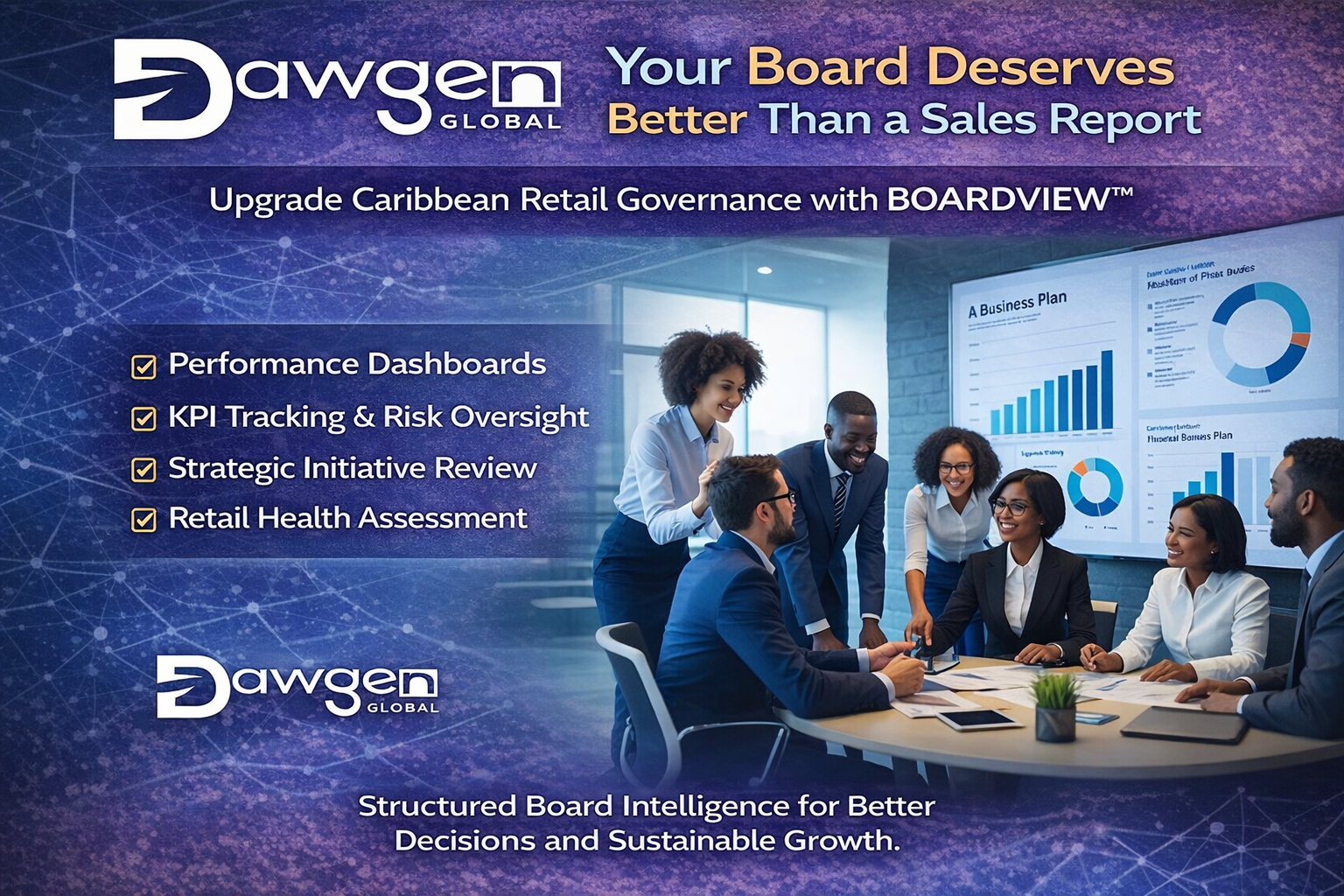
Governance is not a compliance obligation to be satisfied with the minimum viable reporting. It is the management discipline that makes sustainable commercial performance possible — the structured accountability framework that ensures the right decisions are being made, by the right people, with the right information, at the right time. Caribbean retail boards deserve that framework. BOARDVIEW™ builds it.
Let me describe a board meeting that happens, in some variation, in retail businesses across the Caribbean every month. The directors take their seats. The managing director presents a revenue summary — this month versus last month, this month versus the same month last year. A few high-level observations are made. One director asks about a specific location that has been underperforming. Another asks about the upcoming promotional calendar. The finance director presents the management accounts. There is a brief discussion about a capital expenditure item. The meeting ends in under two hours. Everyone feels broadly informed. And every one of the fifteen dimensions of the business’s operational and strategic health that the D·RIS™ framework measures — from inventory carrying costs to compliance posture, from conversion rate trends to cybersecurity vulnerability, from succession planning health to competitive market share movement — goes undiscussed, unscored, and unaccounted for.
This is not a governance failure in the dramatic sense. No one is acting in bad faith. No one is concealing material information. The directors are engaged, the management team is transparent, and the business is being managed with reasonable competence. But the board is not receiving the intelligence it needs to exercise the governance oversight that its legal and fiduciary responsibilities require — and, more practically, that the business’s long-term commercial performance demands. The sales report is not a governance framework. It is a subset of the financial data that a well-governed retail business should be reporting — and the absence of the broader intelligence architecture around it is a gap that BOARDVIEW™ is specifically designed to close.
BOARDVIEW™ is the capstone model of the D·RIS™ framework — the fifteenth and final domain, covering the ten standard operating procedures of executive and board-level governance and performance management. It is the model that aggregates the intelligence generated by all fourteen preceding domain assessments into the board-level reporting architecture that enables directors to govern effectively, executives to be held accountable for comprehensive performance rather than just financial results, and the business to build the governance credibility that investors, lenders, regulators, and strategic partners increasingly require.
The Governance Gap in Caribbean Retail
The governance standards of Caribbean retail businesses are, with notable exceptions, materially below the level that the commercial complexity, the regulatory environment, and the stakeholder expectations of a well-run modern enterprise require. This is not a uniquely Caribbean problem — retail governance is a discipline that receives less attention than it deserves in markets far larger and more sophisticated than ours. But the Caribbean context amplifies the governance gap in ways that make it both more prevalent and more commercially consequential.
The first amplifying factor is ownership structure. The overwhelming majority of Caribbean retail businesses are family-owned or founder-managed, with governance structures that reflect the founding generation’s preference for management flexibility over formal accountability processes. The board may be a largely nominal body — a legal requirement fulfilled by family members and trusted advisors rather than a functioning governance mechanism with the independence, expertise, and authority to provide genuine oversight. The management information provided to this board reflects what the founder or managing director is comfortable sharing rather than the comprehensive operational and strategic picture that effective governance requires.
The second amplifying factor is the information infrastructure gap. Effective board governance requires timely, accurate, and comprehensive management information. In Caribbean retail businesses where the TECHCORE™ assessment has identified significant gaps in data accuracy and analytical capability, the information available for board reporting is constrained by the same weaknesses that limit management decision-making. A board cannot govern what it cannot see — and Caribbean retail boards frequently cannot see the operational and strategic dimensions of the business’s performance because the information infrastructure required to make them visible has not been built.
The third amplifying factor is the talent gap at board level. Caribbean retail boards frequently lack directors with the specific commercial, financial, and operational expertise that effective retail governance requires. The independent director pool in Caribbean markets is limited, and the directors available may bring legal, accounting, or general business credentials without the specific retail operational knowledge that enables meaningful scrutiny of management reporting and performance.
The BOARDVIEW™ assessment addresses all three of these amplifying factors — not by redesigning the ownership structure (which is a matter for shareholders, not advisors) but by building the governance infrastructure — the reporting framework, the KPI architecture, the risk oversight process, and the accountability mechanisms — that enables the board that exists, with the directors it has, to govern more effectively than the current information environment allows.
The Ten Dimensions of BOARDVIEW™
- Monthly Business Review
The monthly business review is the primary executive performance accountability mechanism in a well-governed retail business — the structured process by which the management team reports comprehensive operational and financial performance to senior leadership and, where the governance structure requires it, to the board. The BOARDVIEW™ assessment evaluates the monthly business review process against a structured standard covering five dimensions: the comprehensiveness of the performance picture (does the review cover all material dimensions of the business’s performance, or is it limited to financial and sales data?), the timeliness of the information (is the review produced and distributed with sufficient lead time for directors to read and digest it before the meeting?), the accuracy and reliability of the data (is the information in the review independently verified, or does it rely on unvalidated management estimates?), the forward-looking content (does the review include a forecast and a discussion of the business’s trajectory, or is it purely retrospective?), and the action orientation (does the review produce specific accountabilities and timelines for addressing performance gaps, or does it generate discussion without producing decisions?).
In most Caribbean retail businesses, the monthly business review fails on at least three of these five dimensions. Comprehensiveness is the most common failure — the review is financial and sales-centric, with operational, people, compliance, and strategic dimensions absent or addressed only when a specific crisis requires it. Action orientation is the second most common failure — the review generates discussion but not decisions, and the same performance gaps are discussed at successive meetings without producing the specific accountabilities that would close them. BOARDVIEW™ establishes the review format and governance process that addresses all five dimensions.
- Quarterly Performance Audit
The quarterly performance audit is the deeper, more analytical cycle of governance review — the process by which the board or a designated governance committee conducts a structured assessment of performance against the annual plan across all material dimensions of the business. It is distinct from the monthly business review in its scope (it covers a broader range of performance dimensions), its analytical depth (it includes trend analysis, benchmarking against external comparators, and a structured assessment of whether the business is on track to achieve its annual objectives), and its governance formality (it is a board-level process with formal documentation and accountability follow-through).
The BOARDVIEW™ quarterly performance audit framework structures this review across five performance clusters: financial performance and profitability (drawing from PROFIT-SCAN™ domain data), operational performance (drawing from OPS-360™, CASHFLOW-GUARD™, STOCKVUE™, and SHELF-IQ™ data), commercial performance (drawing from SALESVECTOR™, CX-COMPASS™, and BRANDPULSE™ data), people and compliance performance (drawing from PEOPLEMETRICS™ and RISKSHIELD™ data), and strategic progress (drawing from MARKET-EDGE™ and OMNI-LINK™ data). The quarterly audit is explicitly designed to ensure that the board’s performance oversight goes beyond the financial dimension to encompass the full spectrum of operational and strategic health that the D·RIS™ framework measures.
- KPI Alignment Review
The KPI alignment review assesses whether the business’s key performance indicators — the metrics by which management performance is measured and reported — are correctly configured to drive the behaviours and outcomes that the business’s strategy requires. This is a more nuanced assessment than it might initially appear. KPIs that are misaligned with strategy — metrics that measure activity rather than outcome, that reward the achievement of easy targets rather than genuinely stretching performance, or that create perverse incentives by optimising for one dimension of performance at the expense of another — are not merely ineffective. They are actively harmful, because they direct management attention and effort toward the wrong objectives.
The BOARDVIEW™ KPI alignment review examines the business’s current KPI architecture across five dimensions: strategic alignment (do the KPIs measure the specific drivers of the outcomes the strategy intends to achieve?), balance (does the KPI set cover financial performance, operational performance, customer performance, people performance, and strategic progress — or is it dominated by financial and sales metrics?), measurability and reliability (are the KPIs measured consistently, accurately, and with sufficient frequency to be useful as management tools?), actionability (when a KPI signals a performance problem, is the causal pathway from KPI to management action sufficiently clear to enable a timely and appropriate response?), and accountability (is there a specific individual who is accountable for the performance of each KPI, with the authority and resources to drive improvement?).
| The BOARDVIEW™ Governance Dashboard
The BOARDVIEW™ assessment produces a Governance Dashboard — a structured, board-ready reporting framework that presents the fifteen D·RIS™ domain scores alongside the key financial metrics, the risk register status, the strategic initiative progress, and the capital expenditure programme in a single, integrated view. The Governance Dashboard is designed to give directors, in a single document, the comprehensive picture of the business’s health, performance, and strategic trajectory that their governance responsibilities require. It replaces the fragmented, financially-dominated reporting that most Caribbean retail boards currently receive with the multi-dimensional intelligence architecture that genuine governance oversight demands. |
- Board Reporting Accuracy
The board reporting accuracy dimension of BOARDVIEW™ assesses the reliability and integrity of the management information provided to the board — not merely its completeness, but the accuracy of the data, the transparency of the assumptions, and the quality of the analysis that translates raw data into the board-level insights that directors need to make informed decisions and exercise effective oversight. Board reporting that contains errors, that presents optimistic assumptions without disclosing the downside scenarios, or that presents management estimates as verified data is not just a governance failure — it is a fiduciary risk. Directors who make decisions on the basis of inaccurate reporting may face personal liability if those decisions cause harm to the business or its stakeholders.
The BOARDVIEW™ board reporting accuracy assessment examines the data sourcing and verification processes that underpin the board report, the presentation of uncertainty and risk in the financial and operational projections, the independence of the analytical process that produces the report from the management team whose performance it evaluates, and the board’s own analytical capability to scrutinise and challenge the reporting it receives. The last dimension — the board’s capacity for independent scrutiny — is among the most important and most consistently underresourced governance capabilities in Caribbean retail boards.
- Strategic Initiative Tracking
Strategic initiative tracking is the governance mechanism by which the board maintains visibility of the progress, commercial performance, and resource consumption of the major strategic programmes that the business is executing. Caribbean retail businesses frequently invest in significant strategic initiatives — store refurbishment programmes, technology transformation projects, new format developments, geographic expansions, product range overhauls — that are approved at board level and then managed at executive level with limited structured reporting back to the board until a problem requires escalation. The consequence is that boards approve capital and operational commitments without the ongoing visibility required to assess whether the initiative is on track, whether the original commercial case assumptions are being validated or invalidated by actual performance, and whether the resource consumption is within the approved parameters.
The BOARDVIEW™ strategic initiative tracking framework establishes the governance process by which every material strategic initiative is reported to the board on a structured cycle — covering progress against milestones, financial performance against the approved business case, risk status, and the management team’s current confidence in the initiative’s commercial projections. This framework does not reduce management authority to execute initiatives — it ensures that the board is equipped to provide the oversight and support that effective initiative governance requires.
- Risk Register Update
The risk register is the board’s primary tool for maintaining visibility of the business’s material risk exposure — the structured documentation of the risks that could materially affect the business’s commercial performance, regulatory compliance, or operational continuity. The BOARDVIEW™ risk register update dimension assesses the quality and currency of the business’s risk register, the governance process by which it is reviewed and updated, and the link between the risk register and the board’s decision-making on capital allocation, operational prioritisation, and strategic initiative selection.
In Caribbean retail businesses where the RISKSHIELD™ assessment has identified specific compliance and operational risk exposures, the risk register is the governance mechanism that ensures these exposures are visible to the board and tracked through to resolution. A risk that has been identified by the advisory team, documented in the RISKSHIELD™ report, but never incorporated into the board’s risk register has not been governed — it has been noted and forgotten. The BOARDVIEW™ risk register governance process closes this gap, ensuring that identified risks are owned, tracked, and reported to the board until they are adequately mitigated.
- Capital Expenditure Review
Capital expenditure governance — the process by which significant investment decisions are made, approved, monitored, and evaluated — is one of the highest-stakes governance responsibilities of a retail board. Capital allocation decisions determine the physical and technological infrastructure of the business, its competitive position in the market, and its financial structure for years after the investment is made. Poor capital allocation — investments that underperform their commercial projections, that absorb more capital than approved, or that are made without adequate strategic analysis — is a primary cause of financial distress in retail businesses that were otherwise commercially sound.
The BOARDVIEW™ capital expenditure review assesses the business’s capital governance framework across four dimensions: the pre-investment appraisal process (are capital investment decisions subject to structured financial modelling, strategic fit analysis, and risk assessment before approval?), the approval authority framework (are capital decisions made at the appropriate level of authority, with the board involved in decisions above a defined materiality threshold?), the post-investment monitoring process (are approved investments tracked against their commercial case assumptions during implementation?), and the post-completion review discipline (are completed investments subject to a structured review that compares actual returns against the approved business case, producing learning that improves future investment decisions?).
| The business that reviews its completed capital investments rigorously — that compares actual returns against the approved business case and uses the findings to improve future investment decisions — is the business that gets progressively better at capital allocation over time. Caribbean retail boards that do not require post-completion reviews of material capital investments are forgoing the institutional learning that is one of the most valuable governance disciplines available to them. |
- Profit Improvement Plan Audit
The profit improvement plan (PIP) audit assesses whether the business has a structured, governed programme for closing the identified gap between current profitability and the profitability that the business’s assets, market position, and competitive capabilities could reasonably support. The PIP is distinct from the annual budget in an important way: the budget targets the performance level that the business expects to achieve within its current operating model. The PIP targets the performance improvement that the structured assessment of operational and commercial gaps — generated by the full D·RIS™ assessment — identifies as achievable through disciplined improvement across all fifteen domains.
The BOARDVIEW™ PIP audit evaluates the quality of the business’s current profit improvement programme — whether one exists, whether it is sufficiently ambitious relative to the identified gap, whether it is governed with the accountability and rigour that material financial improvement requires, and whether it is producing the financial results that the improvement initiatives were projected to generate. In businesses where the D·RIS™ assessment has identified significant improvement opportunities — and in our experience, virtually every Caribbean retail business presents material improvement opportunities in at least four to six domains — the PIP audit is the governance mechanism that ensures those opportunities are pursued with the discipline and accountability that makes the difference between a planning exercise and an actual profit improvement.
- Business Continuity Plan Review
Business continuity planning — the process of preparing the business to maintain critical operations and recover effectively from disruptive events — is a governance responsibility that the Caribbean’s specific risk profile makes more urgent than in most other business environments. The combination of weather event exposure, infrastructure fragility (power supply, internet connectivity, logistics), geopolitical risk, and the health emergency experience of 2020–2022 makes business continuity a genuinely material governance concern for Caribbean retail businesses — not an administrative formality to be satisfied with a document that lives on a shelf and is never tested.
The BOARDVIEW™ business continuity plan review assesses the quality and currency of the business’s BCPacross six dimensions: the threat scenario coverage (does the plan address the specific threat scenarios most relevant to the business’s operating environment, including weather events, power supply interruption, technology failure, supply chain disruption, and public health emergency?), the operational continuity protocols (does the plan specify precisely how critical operations will be maintained for each threat scenario?), the communication framework (are the communication protocols for staff, customers, suppliers, and regulatory authorities clearly documented and regularly tested?), the recovery time objectives (are realistic recovery timelines established for each critical operational function?), the testing and rehearsal programme (is the plan tested at least annually, with findings incorporated into plan updates?), and the board oversight (does the board receive a formal annual review of the BCPs status and the findings of the most recent test?).
- Annual Retail Health Assessment
The annual retail health assessment is the governance capstone of the BOARDVIEW™ model — and of the entire D·RIS™ framework. It is the structured, comprehensive assessment of the business’s performance across all fifteen D·RIS™ domains, conducted on an annual cycle, that produces the Dawgen Retail Health Index score for the year and the formal Retail Health Assessment Report that is presented to the board. It is the governance mechanism that ensures the full intelligence of the D·RIS™ framework is incorporated into the board’s annual strategic review — that the directors’ understanding of the business’s performance goes beyond the financial statements to encompass the operational, commercial, people, compliance, technology, digital, and strategic dimensions that determine whether the business is genuinely, sustainably healthy.
The Difference Between Reporting and Governance
I want to make a distinction that is important and that is frequently blurred in discussions of board governance in Caribbean retail: the distinction between reporting and governance. These are related activities but they are not the same thing, and confusing them is one of the primary sources of governance weakness in Caribbean retail boards.
Reporting is the process of producing and sharing information about the business’s performance. It is a necessary input to governance. But reporting by itself is not governance. Governance is the process by which the board exercises accountability, makes decisions, and ensures that the business is being managed in a manner consistent with its legal obligations, its strategic objectives, and the interests of its stakeholders. Governance requires information — but it also requires the analytical capacity to interpret that information, the institutional confidence to challenge management when the information raises concerns, the decision-making authority to require changes when performance is inadequate, and the follow-through discipline to ensure that decisions produce actions and actions produce results.
Many Caribbean retail boards receive adequate reporting and exercise inadequate governance. They receive the management accounts, the sales summary, and the management team’s assessment of the business’s performance — and they accept that assessment without the independent scrutiny, the structured challenge process, and the accountable follow-through that genuine governance requires. The BOARDVIEW™ model addresses this by building not just the reporting architecture but the governance process — the decision-making framework, the accountability mechanisms, and the follow-through discipline — that converts good reporting into genuine governance.
Governance as a Commercial Competitive Advantage
There is a commercial argument for governance investment that Caribbean retail leaders do not hear often enough, and that I want to make directly. Well-governed businesses perform better commercially over the medium and long term than poorly-governed ones. This is not a theoretical proposition — it is one of the most consistently supported findings in corporate governance research across markets, ownership structures, and business sizes.
The commercial mechanisms through which good governance creates superior performance are straightforward. First, better information quality produces better decisions. Boards that receive comprehensive, accurate, independently-verified performance information make better capital allocation decisions, better strategic choices, and better risk management decisions than boards operating on incomplete or unreliable information. Second, stronger accountability produces better execution. Management teams that know their performance across all material dimensions of the business will be scrutinised and challenged at board level have stronger incentives to address performance gaps proactively rather than managing them quietly. Third, better governance commands better terms from capital providers. Banks, investors, and strategic partners who assess the governance quality of a business before committing capital consistently offer better terms to well-governed businesses — reflecting the lower risk that structured governance represents.
For Caribbean retail businesses approaching a capital raise, a banking facility review, a franchise agreement, or a potential acquisition, the BOARDVIEW™ governance certification — the formal evidence of a structured, assessed governance framework — is a commercial asset with measurable financial value. It is the difference between being seen as a well-run business that merits the terms it is requesting and being seen as a business whose governance is uncertain and whose risk profile is therefore higher than its financials alone would suggest.
| BOARDVIEW™ and the D·RHI Governance Contribution
The BOARDVIEW™ domain score contributes 4% of the base weighting to the composite Dawgen Retail Health Index. While this weight reflects its position as a capstone rather than an operational domain, the governance dimension has a multiplier effect on the D·RHI that exceeds its direct weighting — because the quality of governance determines how effectively the business identifies and addresses performance gaps across all fifteen domains. A business with a high BOARDVIEW™ score is a business that sees its performance gaps clearly, acts on them decisively, and tracks the improvement with accountability. That is the governance infrastructure that makes sustainable commercial excellence possible. |
The Board Conversation That Every Caribbean Retail Business Needs to Have
I want to close this article with a direct challenge to the directors of Caribbean retail businesses — the owners, the independent directors, the family members who serve on the board because it is expected, and the professional advisors who attend board meetings in a supporting capacity. You have a governance responsibility. Not just a legal one — though the legal obligations of directors are real and personally consequential. A commercial and ethical one.
The business you oversee employs people whose livelihoods depend on its performance. It serves customers whose trust it has a responsibility to honour. It operates in a community that expects it to be managed with integrity. It may carry obligations to banks, investors, or franchise principals who have extended capital on the assumption that the business is being governed with competence and accountability. These responsibilities are not satisfied by attending a monthly meeting, reviewing a sales report, and approving the management team’s recommendations without structured scrutiny. They require governance — genuine, informed, accountable governance.
The BOARDVIEW™ model is the structured framework that enables Caribbean retail boards to move from the compliance model of governance — attending meetings, signing off accounts, satisfying the minimum legal requirement — to the governance model of governance: exercising real oversight, asking the hard questions, holding management accountable for comprehensive performance, and contributing the independent judgment and accumulated experience that boards are uniquely positioned to provide.
The conversation that every Caribbean retail board needs to have is this: are we governing this business, or are we merely attending its meetings? Are we making decisions with the information we need, or are we approving proposals we cannot adequately scrutinise? Are we holding management accountable for the full spectrum of the business’s health, or only for the financial results that the sales report presents? BOARDVIEW™ is the framework that structures that conversation — and the practical toolkit that turns the right answers to those questions into the governance infrastructure that the business, its people, and its stakeholders deserve.
The annual Retail Health Assessment is not just a report. It is a statement of governance intent — a commitment by the board and the management team to see the business clearly, to hold themselves accountable for its comprehensive performance, and to invest in the improvement that the assessment identifies. That commitment, made publicly and pursued rigorously, is among the most powerful commercial signals that a Caribbean retail business can send to the market. It is the signal that says: this business knows itself. This business holds itself to a standard. And this business will still be here, thriving, a decade from now.
| How Dawgen Global Can Help
Dawgen Global’s Governance and Advisory practice helps Caribbean retail boards and executive teams build the governance infrastructure that long-term commercial performance and accountability require. Using the BOARDVIEW™ model within the Dawgen Retail Intelligence Suite (D·RIS™), we assess the quality of your executive reporting, KPI alignment, strategic initiative governance, risk oversight, capital expenditure management, profit improvement discipline, and business continuity readiness — and produce the board-level intelligence framework that gives directors and investors the structured visibility they need to discharge their responsibilities effectively. Whether your business is seeking to improve the quality of its board reporting, preparing for external investment or a capital transaction, building the governance standards required for regulatory compliance, or simply ensuring that its leadership team is receiving the intelligence it needs to make consistently good decisions, Dawgen Global’s advisors provide the structured, independent assessment and practical implementation support that Caribbean retail governance deserves. To request a complimentary BOARDVIEW™ Governance Assessment Briefing or discuss your retail governance advisory needs, contact us at:
|
About Dawgen Global
“Embrace BIG FIRM capabilities without the big firm price at Dawgen Global, your committed partner in carving a pathway to continual progress in the vibrant Caribbean region. Our integrated, multidisciplinary approach is finely tuned to address the unique intricacies and lucrative prospects that the region has to offer. Offering a rich array of services, including audit, accounting, tax, IT, HR, risk management, and more, we facilitate smarter and more effective decisions that set the stage for unprecedented triumphs. Let’s collaborate and craft a future where every decision is a steppingstone to greater success. Reach out to explore a partnership that promises not just growth but a future beaming with opportunities and achievements.
 Email: [email protected]
  Visit: Dawgen Global Website

 WhatsApp Global Number : +1 555-795-9071
Caribbean Office: +1876-6655926 / 876-9293670/876-9265210  WhatsApp Global: +1 5557959071
USA Office: 855-354-2447
Join hands with Dawgen Global. Together, let’s venture into a future brimming with opportunities and achievements


