
Securing the Caribbean Digital Frontier
The Night the Reservations Disappeared
A 280-room luxury resort and spa on the western coast of a popular Caribbean island destination was entering its peak season. Bookings were at ninety-two percent occupancy for the upcoming three months, and the resort’s management team was anticipating their strongest quarter in five years. The property’s newly renovated beachfront villas had attracted significant international attention, and high-profile travel publications had recently featured the resort in their annual Caribbean destination guides.
On a Friday evening in late November — precisely when the property was transitioning into its busiest operational period — the front desk manager attempted to access the central reservation system and was met with a screen she had never seen before. A bright red notification informed her that all resort systems had been encrypted and that the management team should contact a specific email address to discuss payment terms for the decryption key. Within minutes, reports flooded in from across the property: the point-of-sale systems in all three restaurants were frozen, the spa booking platform was inaccessible, the electronic key card system was offline, and — most critically — the property management system containing all guest reservations, billing records, and customer personal data was completely locked.
The resort was forced to revert to manual check-in procedures using paper forms. Guests arriving for their Caribbean holiday were greeted not with the seamless luxury experience they expected, but with lengthy queues, handwritten room assignments, and staff who could not access dietary preferences, special requests, or loyalty programme status. Within hours, negative reviews began appearing on travel platforms. Within days, international tour operators were redirecting bookings to competing properties.
This fictional scenario — constructed from patterns observed across the Caribbean hospitality sector — illustrates a reality that many tourism stakeholders have been slow to acknowledge: the Caribbean hospitality industry, the economic lifeblood of the region, is profoundly vulnerable to cyber threats that can cripple operations, destroy guest trust, and erode competitive positioning with devastating speed.
Tourism as Economic Foundation — and Cybersecurity Vulnerability
For the majority of Caribbean nations, tourism is not merely one industry among many — it is the economic foundation upon which national prosperity depends. The Caribbean Tourism Organisation reports that travel and tourism contribute between thirty and ninety percent of gross domestic product across member states, directly and indirectly supporting millions of jobs and generating the foreign exchange earnings that sustain national economies.
This economic centrality makes the hospitality sector a uniquely attractive and consequential target for cybercriminals. A successful attack against a major resort, hotel chain, cruise port, or destination management company does not merely affect a single business — it can ripple through an entire island economy, impacting taxi operators, tour guides, restaurants, craft vendors, and the countless small businesses that form the tourism value chain.
The Caribbean hospitality sector’s cybersecurity vulnerabilities are both structural and cultural. Structurally, the industry relies on an extraordinarily complex technology ecosystem. A modern Caribbean resort typically operates interconnected systems spanning property management, reservation platforms, point-of-sale terminals, guest Wi-Fi networks, electronic key card systems, spa and activity booking platforms, loyalty programme databases, and payment processing infrastructure. Each system represents a potential entry point for attackers, and the integration points between systems often create additional vulnerabilities.
Culturally, the hospitality industry has historically prioritised guest-facing technology investment — sleek booking engines, mobile apps, in-room entertainment systems — over the less visible but equally critical infrastructure of cybersecurity. Security is often perceived as a back-office concern, distant from the guest experience. This perception, while understandable, is dangerously outdated. In the modern threat landscape, cybersecurity is guest experience.
Anatomy of Hospitality Cyber Threats in the Caribbean
The threat vectors targeting Caribbean hospitality operations are diverse and evolving. Understanding them is the first step toward effective defence.
Ransomware Attacks on Operational Systems: As illustrated in the resort scenario above, ransomware represents an existential threat to hospitality operations. Unlike a financial institution, where a system outage primarily affects internal processes, a hotel ransomware attack immediately and visibly degrades the guest experience. Attackers understand this dynamic and exploit it, calculating that hospitality operators — particularly during peak season — will pay ransoms quickly to restore operations. Caribbean properties are especially vulnerable because many operate with limited IT redundancy and may lack the offline backup infrastructure needed to recover without paying.
Payment Card Data Theft: Caribbean resorts and hotels process enormous volumes of payment card transactions, making them prime targets for payment card data theft. Point-of-sale malware, which silently captures card data as it passes through compromised terminals, has been deployed against hospitality targets worldwide. In the Caribbean context, where many properties still operate legacy POS systems with limited encryption capabilities, the risk is particularly acute. A significant card data breach can trigger Payment Card Industry Data Security Standard investigations, substantial fines, and the potential loss of the ability to process card payments — effectively a death sentence for a hospitality business.
Guest Data Exposure: Modern hospitality operations collect and store vast quantities of guest personal data: passport numbers, home addresses, email addresses, credit card details, travel itineraries, dietary requirements, and even medical information for spa services. This data is extraordinarily valuable to cybercriminals for identity theft, targeted phishing campaigns, and social engineering attacks. A breach that exposes guest data not only triggers regulatory obligations under Caribbean data protection laws but can permanently damage a property’s reputation among the high-net-worth travellers who represent its most valuable customer segment.
Wi-Fi Network Exploitation: Guest Wi-Fi networks represent a frequently underestimated attack surface. Many Caribbean properties offer open or weakly secured wireless networks that provide attackers with a gateway into the broader hotel network. Through techniques such as man-in-the-middle attacks, evil twin access points, and network sniffing, threat actors can intercept guest communications, steal credentials, and potentially pivot into the property’s operational systems. Business travellers conducting sensitive work from poolside cabanas represent particularly high-value targets.
Third-Party Booking Platform Vulnerabilities: Caribbean hospitality businesses rely heavily on online travel agencies, global distribution systems, and regional booking platforms. Compromised credentials for these platforms can enable attackers to manipulate pricing, redirect bookings, steal guest data, or create fraudulent reservations used to facilitate other criminal activities. The proliferation of channel management tools that connect multiple platforms amplifies this risk.
The Cascading Impact of a Hospitality Breach
The consequences of a cyber incident in the Caribbean hospitality sector cascade far beyond the immediately affected property. Consider the multi-dimensional impact that follows a significant breach.
Operational paralysis arrives first. When critical systems are compromised, every aspect of hotel operations is affected — from check-in and housekeeping to food and beverage service and billing. Properties that lack tested manual fallback procedures can find themselves essentially unable to function, forcing guest relocations to competitor properties and the cancellation of incoming reservations.
Reputational damage accelerates in the age of instant reviews and social media amplification. A single guest’s account of a chaotic check-in experience caused by a cyber incident can reach millions of potential travellers within hours. Travel advisors and tour operators monitor these signals closely, and a property’s removal from recommended lists can take years to reverse.
Financial losses accumulate from multiple sources: the direct cost of incident response and system recovery; lost revenue from cancelled bookings and reduced occupancy; regulatory fines and legal costs; increased insurance premiums; and the long-term revenue impact of reputational damage. For independently owned Caribbean properties — which constitute the majority of the region’s accommodation stock — these cumulative costs can threaten viability.
Destination-level impact emerges when breaches at prominent properties generate negative media coverage that extends beyond the affected business to the destination itself. International travellers making booking decisions may associate cybersecurity concerns with the destination rather than the individual property, affecting tourism arrivals across the territory.
The Unique Caribbean Context
Several factors unique to the Caribbean environment compound the cybersecurity challenges facing the hospitality sector.
Geographic dispersion creates logistical complexity. Many Caribbean hotel groups operate properties across multiple territories, each with different regulatory frameworks, infrastructure quality, and available technical talent. Maintaining consistent cybersecurity standards across geographically dispersed operations in island environments with varying levels of telecommunications reliability is inherently challenging.
Seasonal staffing patterns introduce risk. Many Caribbean properties significantly expand their workforce during peak season, onboarding temporary employees who may receive abbreviated training and who may be unfamiliar with security protocols. These seasonal workers are often granted access to critical systems with limited vetting and supervision, creating windows of vulnerability that coincide precisely with the periods of highest transaction volume and greatest operational complexity.
Limited local cybersecurity talent constrains response capabilities. The Caribbean faces a significant shortage of qualified cybersecurity professionals, and hospitality businesses — which typically cannot match the compensation packages offered by financial institutions or technology companies — struggle disproportionately to attract and retain skilled personnel.
Hurricane season creates an additional dimension of risk. The annual threat of tropical weather systems introduces scenarios where properties may need to rapidly shut down and restart systems, relocate data, or operate from backup facilities — all under conditions that may compromise security protocols and create exploitable vulnerabilities.
Dawgen Global’s Hospitality Cybersecurity Framework
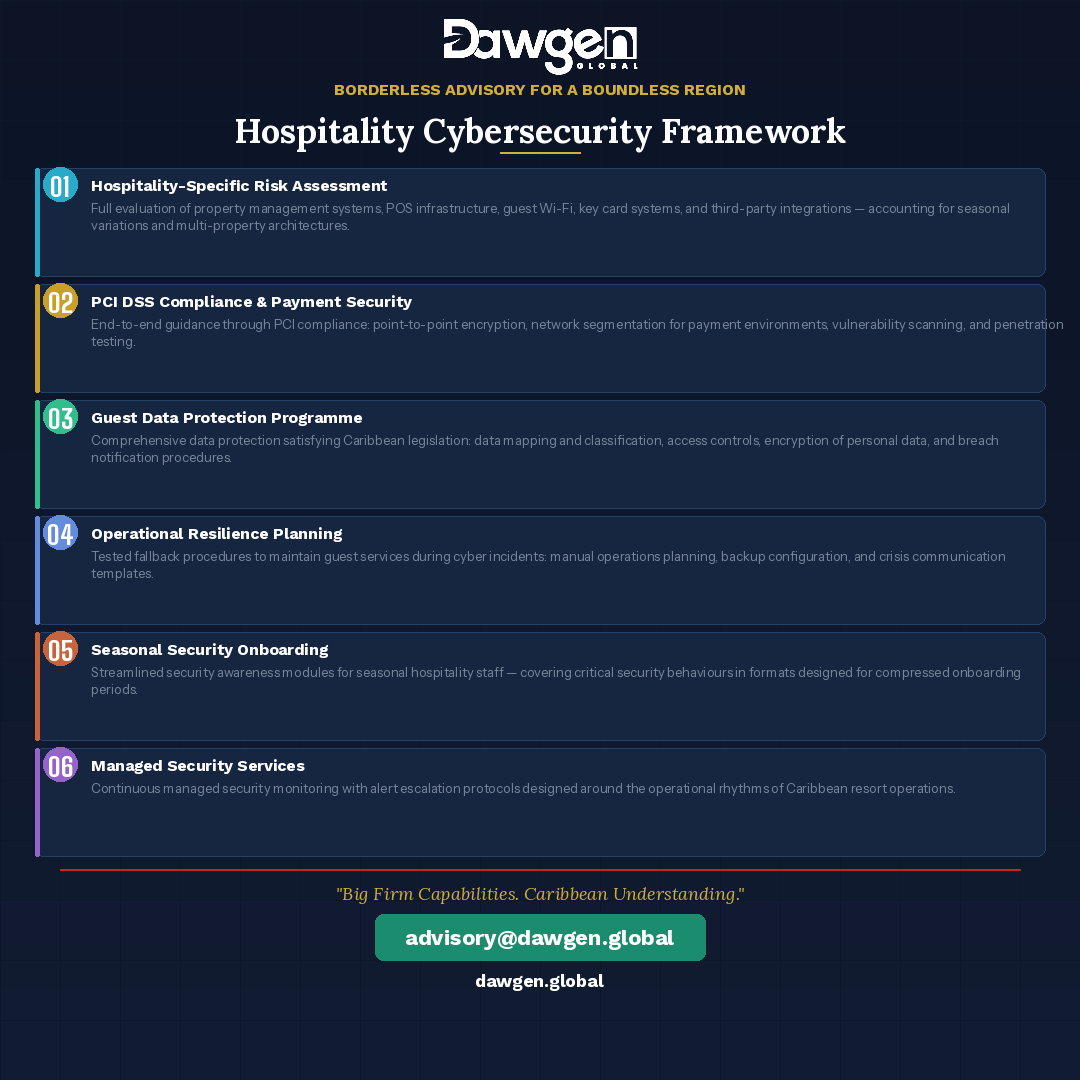
Dawgen Global has developed a cybersecurity framework specifically designed for the Caribbean hospitality sector, recognising that the industry’s unique operational requirements, seasonal dynamics, and regional context demand specialised solutions rather than generic corporate security approaches.
Hospitality-Specific Risk Assessment: Dawgen Global’s assessments evaluate the full hospitality technology ecosystem — from property management systems and POS infrastructure to guest Wi-Fi networks, key card systems, and third-party platform integrations. The assessment methodology accounts for seasonal operational variations, multi-property architectures, and the specific threat patterns observed in Caribbean hospitality environments.
PCI DSS Compliance and Payment Security: Dawgen Global guides properties through the Payment Card Industry Data Security Standard compliance process, implementing the technical controls, policies, and monitoring systems necessary to protect card data throughout the transaction lifecycle. This includes point-to-point encryption deployment, network segmentation to isolate payment environments, and regular vulnerability scanning and penetration testing.
Guest Data Protection Programme: Dawgen Global helps properties develop comprehensive data protection programmes that satisfy Caribbean data protection legislation while building guest confidence. This includes data mapping and classification, access control implementation, encryption of stored personal data, and breach notification procedure development.
Operational Resilience Planning: Recognising that business continuity is paramount in hospitality, Dawgen Global develops tested fallback procedures that enable properties to maintain guest services during and after cyber incidents. This includes manual operations planning, backup system configuration, and crisis communication templates tailored to the hospitality context.
Seasonal Security Onboarding: Dawgen Global provides streamlined but effective security awareness modules designed specifically for seasonal hospitality staff, covering the most critical security behaviours in formats that can be delivered during compressed onboarding periods without overwhelming new employees.
Managed Security Services: For properties that cannot justify dedicated in-house security teams, Dawgen Global offers managed security monitoring that provides continuous oversight of hospitality technology environments, with alert escalation protocols designed around the operational rhythms of Caribbean resort operations.
Protecting the Region’s Most Valuable Industry
The Caribbean hospitality industry cannot afford to treat cybersecurity as an afterthought. The sector’s economic centrality, its dependence on guest trust, and the sophistication of modern threats demand a proactive, structured, and regionally informed approach to cyber defence.
Every Caribbean hospitality operator — from boutique inns to international resort chains — must ask themselves a fundamental question: if an attack occurred today, would we be prepared? Would we be able to maintain guest services, protect customer data, satisfy regulatory requirements, and preserve our reputation?
For the vast majority of Caribbean hospitality businesses, an honest answer to these questions would reveal significant gaps. Dawgen Global exists to help close those gaps — with solutions designed for the Caribbean, by professionals who understand the Caribbean, delivered in partnership with world-class cybersecurity technology providers.
The fictional story of the compromised resort is one that no real Caribbean property should ever have to live. With the right preparation, the right partnerships, and the right investment in cyber resilience, it does not have to.
Take the First Step
The threats facing Caribbean organisations are real, evolving, and increasingly sophisticated. Waiting for an incident to force action is a strategy that no responsible institution can afford.
Protect your guests and your reputation. Submit an RFP to Dawgen Global for a tailored hospitality cybersecurity solution designed for Caribbean tourism operations.
Email: [email protected] | Visit: www.dawgen.global
This article is part of the “Securing the Caribbean Digital Frontier” series by Dawgen Global, examining cybersecurity risks and solutions across key Caribbean industries. All scenarios described are fictional constructions based on observed threat patterns and are used for illustrative purposes only
About Dawgen Global
“Embrace BIG FIRM capabilities without the big firm price at Dawgen Global, your committed partner in carving a pathway to continual progress in the vibrant Caribbean region. Our integrated, multidisciplinary approach is finely tuned to address the unique intricacies and lucrative prospects that the region has to offer. Offering a rich array of services, including audit, accounting, tax, IT, HR, risk management, and more, we facilitate smarter and more effective decisions that set the stage for unprecedented triumphs. Let’s collaborate and craft a future where every decision is a steppingstone to greater success. Reach out to explore a partnership that promises not just growth but a future beaming with opportunities and achievements.
 Email: [email protected]
  Visit: Dawgen Global Website

 WhatsApp Global Number : +1 555-795-9071
Caribbean Office: +1876-6655926 / 876-9293670/876-9265210  WhatsApp Global: +1 5557959071
USA Office: 855-354-2447
Join hands with Dawgen Global. Together, let’s venture into a future brimming with opportunities and achievements


