
| EXECUTIVE SUMMARY
The Caribbean enters 2026 at a crossroads. ECLAC projects the English- and Dutch-speaking Caribbean will grow by 4.7 percent in 2025—but just 1.9 percent excluding Guyana’s oil-driven expansion. Global growth has slowed to its weakest pace since the 2008 financial crisis. Trade tensions, climate shocks, and digital disruption are reshaping the competitive landscape at a speed that rewards agility and punishes complacency. Over the preceding eleven articles in this series, Dawgen Global has examined the critical dimensions of Caribbean enterprise competitiveness—from digital-first advisory and tariff strategy to finance transformation, cybersecurity, ESG, talent, regulatory modernisation, AI adoption, climate resilience, M&A, and audit innovation. This concluding article synthesises those insights into a unified strategic blueprint: a Vision 2030 framework that positions Caribbean enterprises not merely to survive the turbulence ahead, but to emerge as resilient, technology-enabled, regionally integrated competitors in the global economy. |
The State of Caribbean Competitiveness: An Honest Assessment
Before charting a path forward, intellectual honesty demands an unflinching assessment of where Caribbean enterprises stand today. The region possesses genuine strengths: a strategic geographic position linking the Americas and Europe; a young, English-speaking population with strong educational foundations; established financial services sectors with international credibility; a tourism industry that remains the global benchmark for island hospitality; and an emerging energy windfall in Guyana that could transform regional investment flows.
But these strengths coexist with structural vulnerabilities that have constrained Caribbean competitiveness for decades. The region imports over 87 percent of its energy—one of the highest fossil fuel dependencies in the world. Approximately 80 percent of food consumed in the Caribbean is imported, creating chronic trade deficits and food security risks. Public debt exceeds 100 percent of GDP in several CARICOM nations, constraining fiscal policy and public investment. The Caribbean’s small, fragmented markets limit domestic scale and raise the cost of doing business. And the region’s talent pipeline, as explored in Article 6, is under severe pressure from emigration, skills mismatches, and limited specialisation pathways.
The global environment compounds these challenges. The World Bank’s January 2026 Global Economic Prospects report projects global growth easing to 2.6 percent in 2026—with the 2020s on track to be the weakest decade for global growth since the 1960s. Latin America and the Caribbean is forecast to grow just 2.3 percent in 2026, a pace ECLAC describes as insufficient to generate adequate job creation or meaningful poverty reduction. For Caribbean enterprise leaders, the message is clear: the external environment will not rescue the region from its structural constraints. Competitiveness must be built deliberately, from within.
Seven Pillars of Caribbean Enterprise Competitiveness
Drawing on the full body of analysis developed across this twelve-article series, Dawgen Global identifies seven interconnected pillars that collectively define the competitiveness agenda for Caribbean enterprises through 2030.
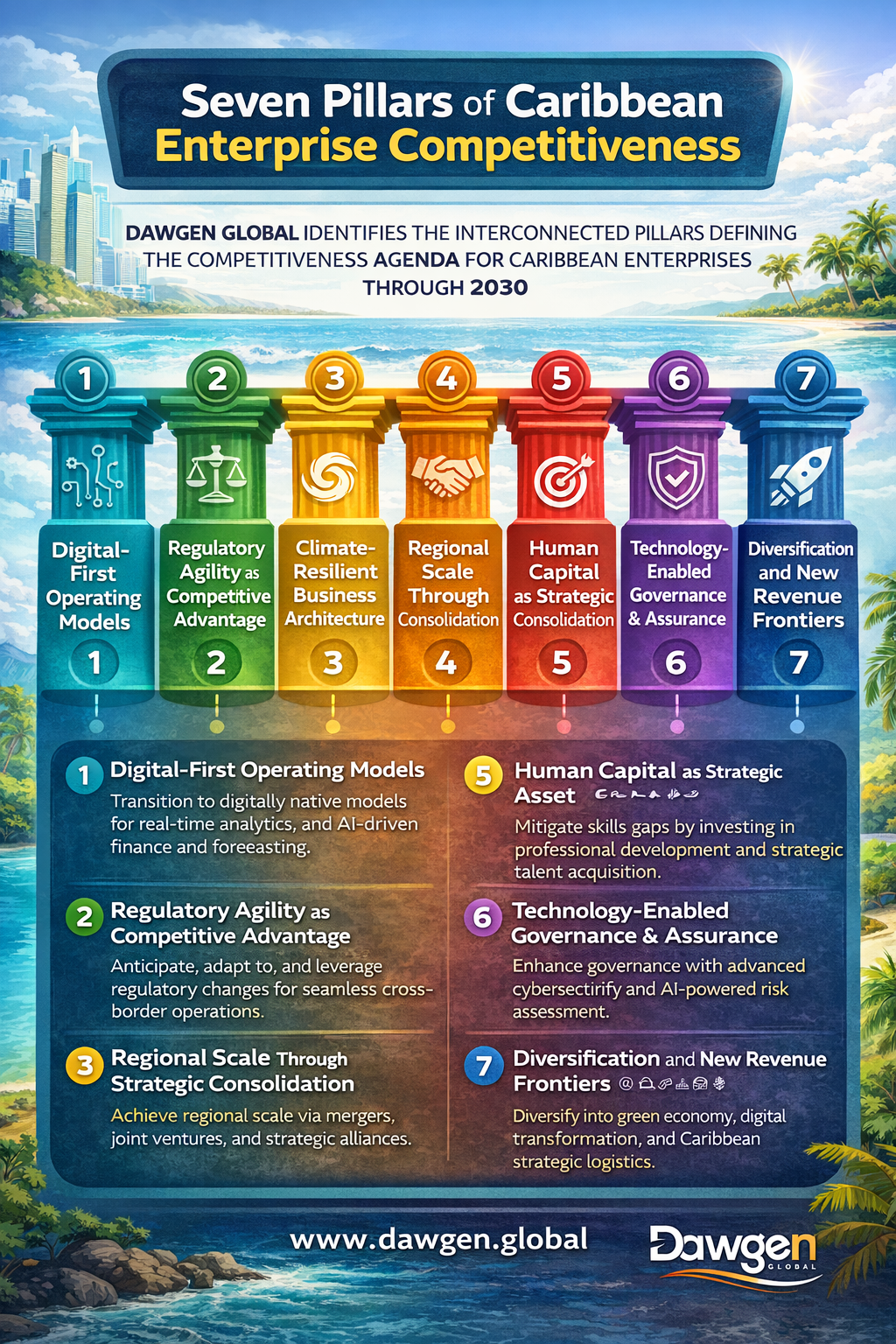
Pillar 1: Digital-First Operating Models
The foundation of competitiveness in the coming decade is digital. Articles 1, 3, and 8 of this series established that Caribbean enterprises must transition from digitally supplemented to digitally native operating models. This means finance functions powered by real-time analytics and AI-augmented forecasting rather than spreadsheets and backward-looking reports (Article 3). It means adopting AI strategically—not as a novelty but through a structured roadmap that moves from assessment through pilot, scale, and transformation (Article 8). And it means accessing global expertise through digital delivery models that eliminate the traditional trade-off between capability and proximity (Article 1). The Caribbean Datacenter Association’s call for a federated regional digital backbone—ensuring local traffic stays local and regional traffic remains within the region—underscores the infrastructure dimension of this transformation. Barbados’s achievement of over 20 percent renewable electricity generation, Jamaica’s digitisation of over 130 government services through eGov Jamaica, and the ECCB’s DCash digital currency pilot all demonstrate that Caribbean digital transformation is not aspirational—it is underway.
Pillar 2: Regulatory Agility as Competitive Advantage
Article 7 documented the wave of regulatory modernisation sweeping the Caribbean—from data protection and AML/CFT compliance to beneficial ownership registers, crypto-asset frameworks, and cross-border regulatory harmonisation. The enterprises that treat this wave as merely a compliance burden will fall behind. Those that build regulatory agility—the organisational capability to anticipate, adapt to, and leverage regulatory change—will gain competitive advantage. By 2030, Caribbean enterprises should have compliance-as-code infrastructure that automates regulatory reporting; cross-jurisdictional compliance capability that enables seamless operation across CARICOM markets as the CSME free movement framework matures; and governance frameworks that position the enterprise ahead of emerging standards in ESG disclosure, AI governance, and data protection, as explored in Article 5.
Pillar 3: Climate-Resilient Business Architecture
Article 9 demonstrated that climate risk is now a balance sheet issue. Hurricane Melissa’s US$8.8 billion impact on Jamaica—equivalent to 41 percent of GDP—is not an anomaly but a preview of the Caribbean’s operating reality. By 2030, competitive Caribbean enterprises will have embedded climate resilience into every dimension of their operations: business continuity plans that assume Category 5 disruption as baseline; strategic insurance programmes that combine parametric instruments like CCRIF with traditional coverage; climate-adapted capital allocation that weights resilience in every investment decision; and active participation in the growing ecosystem of green and resilience finance, with Caribbean green finance volumes expected to exceed US$5 billion by 2025. Climate resilience is not a cost centre. It is a competitive differentiator that determines which enterprises survive the next storm—and which do not.
Pillar 4: Regional Scale Through Strategic Consolidation
Article 10 addressed the imperative of building scale in small-market economies. The CARICOM Secretariat’s Strategic Plan 2022–2030 targets full implementation of the five CSME regimes—free movement of nationals, goods, services, capital, and the right of establishment—by 2030. If achieved, this will create the single economic space that Caribbean enterprises need to compete regionally and globally. But enterprise leaders cannot wait for governments to deliver the enabling framework. They must act now to identify and execute M&A transactions, joint ventures, and strategic alliances that build the cross-border scale, capability, and resilience that individual national markets cannot support. The regional banking mergers and telecom consolidations of recent years provide the template; the opportunity now extends to fintech, logistics, renewable energy, healthcare technology, and professional services.
Pillar 5: Human Capital as Strategic Asset
Article 6 documented the Caribbean’s skills crisis in granular detail. By 2030, the enterprises that thrive will be those that have solved—or at least significantly mitigated—the talent equation. This requires workforce planning that anticipates skills needs three to five years ahead; investment in continuous professional development, particularly in digital, AI, and data analytics capabilities; creative approaches to accessing talent—including diaspora engagement, remote work models, and regional talent-sharing arrangements; and employer brand strategies that position Caribbean enterprises as destinations of choice for the region’s best professionals. The CARICOM Human Resource Development 2030 Strategy provides the regional framework; individual enterprises must translate that framework into concrete talent strategies that close the gap between available skills and competitive requirements.
Pillar 6: Technology-Enabled Governance and Assurance
Articles 4 and 11 addressed cybersecurity and audit transformation respectively—two dimensions of the same underlying imperative: governance that is fit for a digital age. By 2030, competitive Caribbean enterprises will have cybersecurity frameworks that protect digital assets as rigorously as physical ones, with board-level oversight and incident response capabilities that meet the standards of the CARICOM Cyber Security and Cyber Crime Action Plan; audit and assurance functions powered by data analytics, AI-augmented risk assessment, and continuous monitoring rather than annual, sample-based procedures; and ESG reporting capabilities that meet the disclosure standards increasingly demanded by investors, regulators, and trading partners. This governance pillar is the trust infrastructure that underpins everything else. Without it, digital transformation becomes digital vulnerability, and regulatory agility becomes regulatory exposure.
Pillar 7: Diversification and New Revenue Frontiers
The Caribbean’s dependence on tourism, energy commodities, and financial services creates concentration risk that no amount of operational excellence within those sectors can fully mitigate. Vision 2030 demands deliberate diversification into new revenue frontiers. The Caribbean Investment Forum 2025, organised by the Caribbean Export Development Agency, identified three priority sectors: the green economy transition, with particular emphasis on renewable energy, waste-to-energy, and environmental resilience; digital transformation, driving uptake of AI, fintech, and smart infrastructure; and logistics and trade facilitation, leveraging the Caribbean’s strategic position as a junction for global commerce. Caribbean enterprises should position themselves to participate in—and capture value from—these growth sectors, whether as direct operators, as partners to international investors, or as providers of the professional services infrastructure that these sectors require.
The Integration Imperative: Why No Pillar Stands Alone
The seven pillars of Vision 2030 are not independent priorities to be pursued in sequence. They are deeply interconnected, and it is their integration that creates genuine competitive advantage.
Digital transformation (Pillar 1) enables technology-powered governance (Pillar 6) and creates the data infrastructure for climate risk management (Pillar 3). Regulatory agility (Pillar 2) facilitates the cross-border operations that regional scale (Pillar 4) demands. Human capital investment (Pillar 5) provides the talent that digital transformation, governance modernisation, and diversification all require. And diversification (Pillar 7) reduces the concentration risk that climate shocks (Pillar 3) and trade disruption (Article 2) can exploit.
Caribbean enterprises that pursue these pillars in isolation—investing in technology without talent, or seeking scale without governance—will achieve suboptimal results. Those that design integrated strategies addressing all seven pillars simultaneously will build the compounding advantages that define sustained competitiveness.
A Call to Action: Five Commitments for Caribbean Enterprise Leaders
Vision 2030 is not a policy document or a government plan. It is a challenge to the private sector leaders who will determine whether the Caribbean’s next decade is defined by stagnation or transformation. Dawgen Global calls on Caribbean enterprise leaders to make five commitments.
Commitment One: Adopt a Strategic Planning Horizon of Five Years, Not One
Too many Caribbean enterprises operate on annual planning cycles that perpetuate short-term thinking. The challenges and opportunities of the next decade demand strategic plans that look five years ahead, with clear milestones, investment commitments, and accountability mechanisms. Boards should demand—and management should deliver—strategic plans that articulate where the enterprise will be in 2030 and how it will get there.
Commitment Two: Invest in Digital and Human Capital Before You Are Forced To
The enterprises that invest in digital transformation and talent development now will build advantages that compound over time. Those that wait until competitive pressure or regulatory mandate forces their hand will find that the cost of catching up far exceeds the cost of leading. Allocate at least five percent of revenue to combined digital and human capital investment each year through 2030.
Commitment Three: Think Regionally, Not Nationally
The Caribbean’s competitive future is regional, not national. Enterprise strategies should be designed for the CARICOM market as a minimum, with expansion into the wider Caribbean and Latin American markets as a natural progression. Seek partners, targets, and alliances across borders. Staff your teams with talent from across the region. Build governance structures that operate seamlessly across jurisdictions.
Commitment Four: Embed Resilience into Every Decision
Climate resilience, cyber resilience, financial resilience, and operational resilience are not separate initiatives—they are dimensions of a single strategic imperative. Every investment decision, every partnership, every operational change should be evaluated through the lens of resilience. The enterprises that build resilient architectures will be the enterprises that survive—and capitalise on—the disruptions that the next decade will inevitably bring.
Commitment Five: Engage Advisory Partners Who Share Your Ambition
The scope and complexity of the Vision 2030 agenda exceeds what any single enterprise can navigate alone. Engage advisory partners who combine Caribbean depth with global capability; who bring technical excellence across the full range of disciplines this agenda demands—audit, tax, digital, risk, strategy, ESG, and governance; and who are committed to the Caribbean’s success not as a market to be served but as a community to be strengthened. Dawgen Global exists to be that partner.
The Caribbean’s Defining Decade
The Caribbean has been at crossroads before. What makes this moment different is the convergence of multiple transformative forces—digital disruption, climate acceleration, regulatory modernisation, geopolitical realignment, and demographic pressure—arriving simultaneously. No single challenge can be addressed in isolation. No enterprise can navigate this convergence alone.
But there is cause for optimism. The Caribbean has assets that no amount of money can buy: geographic position, cultural richness, institutional maturity, diaspora networks, and a resilience forged by centuries of navigating adversity. The CARICOM Secretariat’s Strategic Plan 2022–2030 provides the regional framework. The CSME promises the single economic space. The CDB, IDB, and international development partners stand ready with financing and technical support. What is needed now is enterprise leadership—the willingness to invest, to integrate, to think beyond national borders, and to build the organisations that the Caribbean’s next generation deserves.
Throughout this twelve-article series, Dawgen Global has aimed to provide Caribbean enterprise leaders with the analysis, frameworks, and practical guidance to act with confidence. We believe that the Caribbean’s best days are not behind it. We believe that the enterprises built in this decade will define the region’s prosperity for generations to come. And we are committed to standing alongside the leaders who will build them.
The future of the Caribbean is not a destination to be reached. It is an enterprise to be built—deliberately, boldly, and together.
Dawgen Global is a multidisciplinary professional services firm delivering audit, assurance, tax, advisory, and risk management solutions to Caribbean enterprises through a digital-first engagement model. We believe that the Caribbean’s enterprises deserve advisory partners who combine global technical excellence with deep regional understanding—big firm capabilities, delivered with Caribbean soul.
To explore how Dawgen Global can support your organisation’s Vision 2030 journey, visit dawgen.global or contact our advisory team at [email protected].
| SERIES COMPLETE
This is the final article in Dawgen Global’s “Borderless Advisory for a Boundless Region” series. For the complete collection of all twelve articles, visit dawgen.global |
About Dawgen Global
“Embrace BIG FIRM capabilities without the big firm price at Dawgen Global, your committed partner in carving a pathway to continual progress in the vibrant Caribbean region. Our integrated, multidisciplinary approach is finely tuned to address the unique intricacies and lucrative prospects that the region has to offer. Offering a rich array of services, including audit, accounting, tax, IT, HR, risk management, and more, we facilitate smarter and more effective decisions that set the stage for unprecedented triumphs. Let’s collaborate and craft a future where every decision is a steppingstone to greater success. Reach out to explore a partnership that promises not just growth but a future beaming with opportunities and achievements.
 Email: [email protected]
  Visit: Dawgen Global Website

 WhatsApp Global Number : +1 555-795-9071
Caribbean Office: +1876-6655926 / 876-9293670/876-9265210  WhatsApp Global: +1 5557959071
USA Office: 855-354-2447
Join hands with Dawgen Global. Together, let’s venture into a future brimming with opportunities and achievements


