
| EXECUTIVE SUMMARY
Artificial intelligence has moved from boardroom buzzword to operational imperative. Globally, enterprise AI adoption has reached 72 percent, worker access to sanctioned AI tools grew by 50 percent in 2025, and two-thirds of organisations report measurable productivity gains. Yet the Caribbean remains largely on the sidelines—no CARICOM member state has published a national AI strategy, regional AI investment is a fraction of the global average, and most Caribbean firms are still at the experimentation stage. This article provides a pragmatic, Caribbean-specific roadmap for mid-market enterprises ready to move beyond the hype: identifying where AI delivers genuine value today, how to navigate the region’s unique infrastructure and talent constraints, and what a responsible, phased adoption strategy looks like in practice. |
The Global AI Moment—and the Caribbean’s Position in It
The numbers are difficult to ignore. According to Microsoft’s Global AI Adoption report, 16.3 percent of the world’s population was actively using generative AI tools by the second half of 2025, with leading nations such as the UAE, Singapore, and Norway reporting adoption rates above 45 percent of their working-age populations. McKinsey’s 2025 Global AI Survey found enterprise adoption at 72 percent globally, up from just 20 percent in 2017. Deloitte’s State of AI in the Enterprise 2026 report revealed that worker access to AI rose by 50 percent in 2025 alone, and two-thirds of organisations reported concrete productivity and efficiency gains.
Yet adoption rates average 24.7 percent in the Global North and just 14.1 percent in the Global South—a divide that carries particular urgency for the Caribbean. Latin America and the Caribbean account for 6.6 percent of global GDP but receive only 1.12 percent of global AI investment. No CARICOM member state has published a national AI strategy. The region’s digital infrastructure—internet connectivity, computing power, data storage capacity—remains insufficient to support the development of large-scale AI models. And the advanced AI talent pipeline is thin and concentrated in a handful of countries, with an accelerating brain drain of specialists to North American and European markets.
This is not, however, a story of inevitability. The Caribbean has distinctive advantages that a thoughtful AI adoption strategy can exploit: deep domain expertise in sectors such as financial services, tourism, and agriculture; a growing ecosystem of regional technology initiatives; and the emerging policy architecture—including the UNESCO Caribbean AI Policy Roadmap and the newly launched CTU Caribbean AI Task Force—that can guide responsible deployment. The challenge is not whether Caribbean enterprises should adopt AI, but how they should do so in ways that are practical, affordable, and aligned with regional realities.
The Caribbean AI Landscape: Emerging Architecture, Persistent Gaps
Policy and Governance Momentum
The past eighteen months have seen a significant acceleration in regional AI governance efforts. UNESCO’s Caribbean AI Policy Roadmap, developed through consultations with over 1,000 institutions and individuals across 20 Caribbean countries, established four strategic pillars: Culture and Creativity, Governance and Transformation, Education and Upskilling, and Resiliency and Sustainability. This roadmap provides the first comprehensive policy framework tailored to Caribbean Small Island Developing States.
In July 2025, the Caribbean Telecommunications Union launched the CTU Caribbean AI Task Force, charged with harmonising AI policies and regulatory frameworks across the region, building regional AI capacity with a focus on youth, women, and underrepresented communities, and promoting inclusive and ethical AI deployment aligned with the UN Sustainable Development Goals. The CARICOM Secretariat has endorsed UNDP interventions to strengthen AI capabilities in public administration, and the School of Digital Transformation and Innovation in the Caribbean convened its second edition in June 2025, bringing together policymakers, regulators, and technical experts from across the region.
Trinidad and Tobago has gone furthest among CARICOM states, establishing a Ministry of Artificial Intelligence and articulating a vision for AI-powered public services. The Bahamas and Belize have created digital transformation ministries. These are encouraging signals—but they remain institutional rather than operational. The gap between policy aspiration and enterprise-level AI deployment is where the real work lies.
Infrastructure and Talent Realities
Caribbean enterprises confront two structural constraints that shape any realistic AI adoption strategy. The first is infrastructure. The World Bank estimates that between 8 and 12 percent of jobs in Latin America and the Caribbean could receive a productivity boost from generative AI, but up to half will never realise the full benefits because of deficient technological architecture—unreliable internet connectivity, limited cloud computing capacity, and insufficient data storage and processing capability.
The second constraint is talent. ECLAC’s ILIA 2025 index documented that the advanced AI training gap in Latin America and the Caribbean has widened since 2022, driven by accelerated brain drain of specialists to higher-paying markets. Caribbean enterprises compete not only with global technology companies for AI talent but with every other sector in the region undergoing digital transformation. The practical implication is that most Caribbean mid-market firms cannot build large internal AI teams—they must instead develop strategies that leverage external platforms, partnerships, and advisory relationships to access AI capability.
Where AI Delivers Real Value for Caribbean Enterprises
The global data makes one thing clear: AI’s greatest enterprise impact today is not in the futuristic applications that dominate headlines—it is in the operational fundamentals that drive profitability in every business. Deloitte reports that improving productivity and efficiency remains the primary benefit achieved from enterprise AI adoption, with 66 percent of organisations reporting measurable gains. Revenue growth, by contrast, remains largely aspirational: only 20 percent of organisations report AI-driven revenue increases, while 74 percent hope to achieve them in the future.
For Caribbean enterprises, this distinction matters enormously. The highest-value AI applications are not those requiring massive infrastructure investment or specialist engineering teams. They are the practical tools that automate repetitive processes, enhance decision-making, and improve customer experiences using readily available platforms. Dawgen Global identifies five high-impact, low-barrier AI use cases particularly suited to Caribbean mid-market enterprises.
1. Financial Planning, Analysis, and Reporting
AI-powered financial planning and analysis tools can transform the CFO function in Caribbean enterprises—automating variance analysis, generating cash flow forecasts, identifying anomalies in expense patterns, and producing board-ready reports in a fraction of the time required by manual processes. These tools operate on existing financial data and require no custom model development, making them immediately accessible to firms with standard ERP or accounting systems.
2. Customer Intelligence and Personalisation
Caribbean tourism, financial services, and retail enterprises sit on rich customer data that is overwhelmingly underutilised. AI-driven customer segmentation, predictive churn modelling, and personalised recommendation engines can materially improve customer lifetime value and marketing efficiency. Cloud-based platforms from major providers make these capabilities available as subscription services, eliminating the need for on-premises infrastructure.
3. Supply Chain and Inventory Optimisation
For Caribbean enterprises managing complex import-dependent supply chains—a challenge intensified by the tariff volatility discussed in Article 2 of this series—AI-powered demand forecasting and inventory optimisation can reduce stockouts, minimise carrying costs, and improve supplier selection. These tools are particularly valuable in small-market economies where the margin for error in inventory management is thin.
4. Compliance and Risk Monitoring
As explored in Article 7, the Caribbean regulatory environment is growing rapidly in complexity. AI-driven compliance monitoring tools can automate transaction screening for AML/CFT purposes, flag data protection risks, track regulatory changes across multiple jurisdictions, and generate audit-ready compliance documentation. For firms operating across CARICOM markets, the time and cost savings can be substantial.
5. Document Processing and Knowledge Management
Caribbean professional services firms, government agencies, and financial institutions process enormous volumes of documents—contracts, applications, regulatory filings, correspondence. AI-powered document extraction, classification, and summarisation tools can dramatically accelerate these workflows while reducing error rates. Generative AI assistants can make institutional knowledge searchable and actionable across the organisation.
The Dawgen Global AI Adoption Roadmap: Four Phases
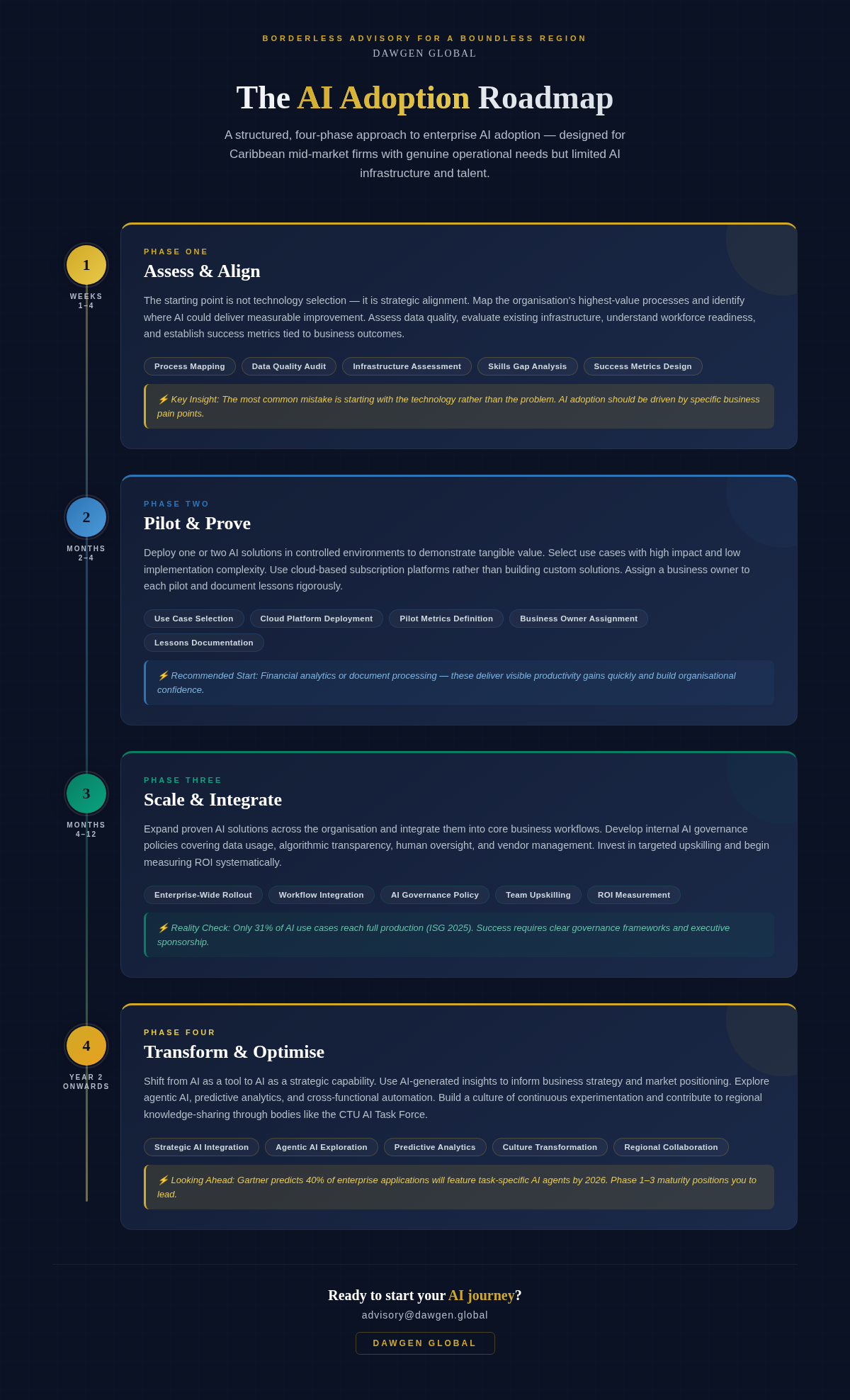
Based on our advisory experience across the Caribbean and informed by the global research evidence, Dawgen Global recommends a structured, four-phase approach to enterprise AI adoption. This roadmap is designed specifically for Caribbean mid-market firms—organisations with genuine operational needs but limited AI infrastructure and talent.
Phase 1: Assess and Align (Weeks 1–4)
The starting point is not technology selection—it is strategic alignment. This phase involves mapping the organisation’s highest-value processes and identifying where AI could deliver measurable improvement; assessing the current state of data quality, accessibility, and governance; evaluating existing technology infrastructure and identifying gaps; understanding the workforce’s AI readiness and identifying skills development needs; and establishing clear success metrics tied to business outcomes, not technology deployment. The most common mistake Caribbean enterprises make at this stage is starting with the technology rather than the problem. AI adoption should be driven by specific business pain points, not by the desire to appear innovative.
Phase 2: Pilot and Prove (Months 2–4)
With strategic priorities established, the second phase focuses on deploying one or two AI solutions in controlled environments to demonstrate tangible value. The key principles are to select use cases with high impact and low implementation complexity; use cloud-based, subscription AI platforms rather than building custom solutions; define clear pilot metrics and evaluation criteria before deployment; assign a business owner (not just a technology lead) to each pilot; and document lessons learned rigorously for organisational learning. Dawgen Global typically recommends beginning with financial analytics or document processing use cases, as these deliver visible productivity gains quickly and build organisational confidence for broader adoption.
Phase 3: Scale and Integrate (Months 4–12)
Successful pilots create the mandate for broader deployment. Phase 3 involves expanding proven AI solutions across the organisation; integrating AI tools into core business workflows rather than running them as standalone experiments; developing internal AI governance policies covering data usage, algorithmic transparency, human oversight, and vendor management; investing in targeted upskilling for the teams using AI tools daily; and beginning to measure return on investment systematically. ISG’s 2025 Enterprise AI Adoption report found that only 31 percent of AI use cases had reached full production—double the figure from 2024, but still indicating that most organisations struggle with the transition from pilot to scale. The Caribbean enterprises that navigate this transition successfully will be those with clear governance frameworks and executive sponsorship.
Phase 4: Transform and Optimise (Year 2 Onwards)
The final phase represents the shift from AI as a tool to AI as a strategic capability. This involves using AI-generated insights to inform business strategy, product development, and market positioning; exploring more advanced applications including agentic AI, predictive analytics, and cross-functional automation; building a culture of continuous experimentation and data-driven decision-making; contributing to and benefiting from regional AI knowledge-sharing through bodies like the CTU AI Task Force; and regularly reassessing the AI portfolio to retire underperforming applications and invest in emerging opportunities. Gartner predicts that 40 percent of enterprise applications will feature task-specific AI agents by 2026. Caribbean enterprises that have completed the first three phases will be positioned to adopt these more sophisticated capabilities from a foundation of governance maturity and organisational readiness.
AI Governance: The Caribbean Imperative
Deloitte’s research reveals a critical finding: enterprises where senior leadership actively shapes AI governance achieve significantly greater business value than those delegating governance to technical teams alone. For Caribbean enterprises, this principle is non-negotiable.
AI governance in the Caribbean context must address several dimensions that are particularly acute for the region. Data sovereignty is the first concern: Caribbean enterprises must understand where their data is stored, processed, and accessed when using cloud-based AI platforms, and ensure compliance with the emerging patchwork of regional data protection legislation. Algorithmic fairness is another priority, as AI systems trained on data from larger markets may encode biases that produce inappropriate or inequitable outcomes when applied in Caribbean contexts. Workforce impact requires honest assessment, since AI adoption will change job roles and skill requirements, and responsible deployment demands investment in reskilling and transparent communication with employees. Vendor dependency is also a concern, given that Caribbean enterprises relying on external AI platforms must manage the risks of vendor lock-in, service disruption, and pricing changes.
Dawgen Global recommends that every Caribbean enterprise adopting AI establish a formal AI governance charter, approved by the board, that defines the organisation’s principles for AI use; designate a senior leader (not necessarily a technologist) as the AI governance sponsor; conduct impact assessments before deploying AI in any customer-facing or decision-making context; and build audit trails that enable the organisation to explain AI-driven decisions to regulators, customers, and other stakeholders.
The Cost Question: AI on a Caribbean Budget
One of the most persistent myths about AI adoption is that it requires massive capital investment. For Caribbean mid-market enterprises, this myth is a barrier to action. The reality is more encouraging. Cloud-based AI platforms operate on subscription models that convert capital expenditure into operating expenditure, allowing firms to start small and scale as value is demonstrated. Many high-impact AI tools—including generative AI assistants, financial analytics platforms, and document processing solutions—are available at price points accessible to mid-market firms. The primary cost is not technology but change management: training staff, redesigning workflows, and building governance frameworks.
Dawgen Global’s experience suggests that a Caribbean mid-market enterprise can execute Phases 1 and 2 of the adoption roadmap—assessment, alignment, and initial pilots—with a modest investment focused primarily on advisory support and platform subscriptions rather than infrastructure. The business case for proceeding to Phases 3 and 4 should be self-funding, built on the productivity gains and cost reductions demonstrated during the pilot phase.
Three Priorities for Caribbean Enterprise Leaders in 2026
Priority One: Start with Strategy, Not Technology
Resist the temptation to adopt AI tools because competitors or vendors are promoting them. Instead, conduct a rigorous assessment of where AI can address your organisation’s most significant operational pain points. The best AI investments are boring ones—they automate the tedious, error-prone processes that consume disproportionate time and talent.
Priority Two: Invest in Data Readiness
AI is only as good as the data it operates on. Before deploying any AI solution, ensure your organisation’s data is clean, accessible, and governed. This may require investment in data infrastructure, data quality processes, and data governance policies—but these investments pay dividends far beyond AI, strengthening every aspect of the organisation’s decision-making and reporting capability.
Priority Three: Build Governance Before You Build Scale
Establish your AI governance framework during the pilot phase, not after you have deployed AI across the organisation. Governance built early is governance built cheaply; governance retrofitted is governance built expensively and often ineffectively. Engage your board, involve your compliance and risk teams, and ensure human oversight is embedded from the outset.
Practical Ambition
The Caribbean cannot afford to sit out the AI transformation—the productivity gaps, competitive pressures, and operational efficiencies at stake are too significant. But neither can Caribbean enterprises afford to chase every headline or adopt AI without a clear strategic rationale and governance framework.
The path forward is practical ambition: starting with high-impact, low-complexity use cases; leveraging cloud-based platforms that minimise infrastructure requirements; building governance and data readiness in parallel with technology deployment; and partnering with advisors who understand both the power of AI and the realities of Caribbean enterprise operations.
AI is not a destination. It is a discipline—and the Caribbean enterprises that master it will define the region’s competitive future.
Dawgen Global is a multidisciplinary professional services firm delivering audit, assurance, tax, advisory, and risk management solutions to Caribbean enterprises through a digital-first engagement model. Our borderless advisory approach connects Caribbean leaders with specialist expertise across the full spectrum of regulatory, financial, and strategic challenges—without the constraints of geography.
To discuss how Dawgen Global can support your organisation’s AI adoption strategy, contact our advisory team directly.
About Dawgen Global
“Embrace BIG FIRM capabilities without the big firm price at Dawgen Global, your committed partner in carving a pathway to continual progress in the vibrant Caribbean region. Our integrated, multidisciplinary approach is finely tuned to address the unique intricacies and lucrative prospects that the region has to offer. Offering a rich array of services, including audit, accounting, tax, IT, HR, risk management, and more, we facilitate smarter and more effective decisions that set the stage for unprecedented triumphs. Let’s collaborate and craft a future where every decision is a steppingstone to greater success. Reach out to explore a partnership that promises not just growth but a future beaming with opportunities and achievements.
 Email: [email protected]
  Visit: Dawgen Global Website

 WhatsApp Global Number : +1 555-795-9071
Caribbean Office: +1876-6655926 / 876-9293670/876-9265210  WhatsApp Global: +1 5557959071
USA Office: 855-354-2447
Join hands with Dawgen Global. Together, let’s venture into a future brimming with opportunities and achievements


