
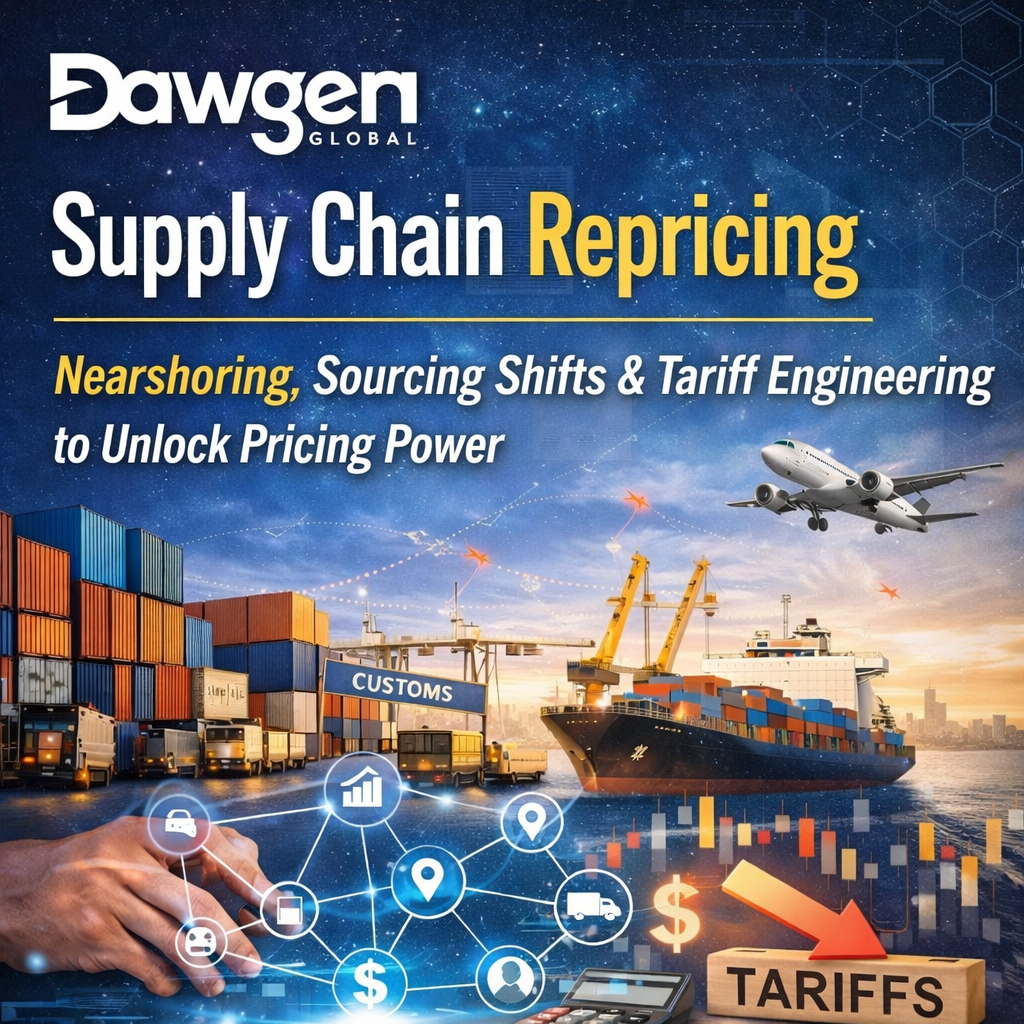
A Dawgen Global Advisory Perspective on Transforming Supply Chain Strategy Into Durable Competitive Pricing Advantage
The Supply Chain as Pricing Lever
In the four preceding articles of this series, we examined the tariff landscape, the mechanics of tariff cost, the case for value-based pricing, and the complexities of cost pass-through. Throughout those discussions, a recurring theme has emerged: the most effective tariff-era pricing strategies are not constructed in the pricing function alone. They are built in the supply chain.
This insight is both profound and underappreciated. Most companies treat supply chain management and pricing strategy as parallel but largely independent disciplines. Supply chain teams optimize for cost, reliability, and speed. Pricing teams set prices based on cost data, competitive intelligence, and margin targets. The two functions interact at the point where supply chain costs feed into pricing models, but the strategic integration stops there.
In the tariff era, this separation is a strategic handicap. The companies that are winning the pricing battle are those that have recognized a transformative truth: every supply chain decision is a pricing decision. A sourcing shift that reduces landed cost by eight percent creates eight points of pricing flexibility that competitors without that supply chain agility cannot match. A tariff engineering initiative that reclassifies a product into a lower-duty category eliminates the cost pressure that would otherwise force a customer-facing price increase. A nearshoring strategy that shortens lead times and reduces inventory carrying costs improves total cost-to-serve in ways that enhance pricing competitiveness beyond the tariff savings alone.
This article explores the supply chain strategies that create pricing power in the tariff era—not as abstract supply chain theory, but as concrete, quantifiable inputs to pricing decisions that CEOs and CFOs can act on.
The Supply Chain-Pricing Nexus: A New Mental Model
To harness supply chain strategy as a pricing tool, leadership teams must adopt a new mental model that connects supply chain decisions directly to pricing outcomes.
From Cost Center to Value Creator
Historically, supply chains have been managed as cost centers. The objective was to procure materials, manufacture products, and deliver them to customers at the lowest possible cost, with acceptable quality and reliability. Supply chain performance was measured in cost per unit, on-time delivery, and inventory turns. These are important metrics, but they reflect a cost-minimization mindset that misses the supply chain’s potential as a value creator and pricing enabler.
In the tariff era, the supply chain’s contribution to competitive advantage extends far beyond cost. A supply chain that can pivot sourcing rapidly in response to tariff changes provides agility that competitors with fixed supply chains cannot replicate. A supply chain that qualifies products for preferential trade treatment creates a structural cost advantage that flows directly to pricing flexibility. A supply chain that enables faster time-to-market through nearshoring or regionalization creates customer value that supports premium pricing. Each of these capabilities has a quantifiable pricing implication that should be explicitly incorporated into the company’s pricing strategy.
The Total Landed Cost Pricing Bridge
The operational link between supply chain strategy and pricing is the total landed cost. As we discussed in Article 2, the landed cost includes every expense from the point of manufacture to the point of sale or use. Supply chain decisions that reduce any component of landed cost—duty rates, freight costs, insurance, handling, warehousing, compliance, or working capital—create pricing headroom that the company can deploy strategically.
Dawgen Global recommends that companies build what we call a Pricing Bridge: a quantitative model that shows exactly how each supply chain initiative translates into landed cost reduction and, from there, into pricing options. For each initiative, the Pricing Bridge answers three questions. How much does it reduce landed cost per unit? What pricing actions does that cost reduction enable—lower prices to gain share, maintained prices to improve margin, or a combination across segments? And what is the competitive impact—does the cost reduction create a sustainable advantage or merely restore parity?
Sourcing Shifts: Rewriting the Origin Equation
The most direct supply chain response to tariffs is shifting sourcing from tariff-disadvantaged origins to tariff-advantaged ones. In concept, this is straightforward. In execution, it is fraught with complexity that has pricing implications at every stage.
The Origin Diversification Imperative
Companies that source primarily or exclusively from a single country face acute tariff concentration risk. When tariffs are imposed on that origin, the company’s entire cost structure is affected, and the pricing impact is immediate and comprehensive. Origin diversification—developing qualified supply sources in multiple countries—reduces this concentration risk and creates the flexibility to shift volume between origins as tariff conditions change.
The pricing power created by origin diversification is substantial. A company with qualified suppliers in three countries facing different tariff rates can optimize its sourcing mix to minimize the blended landed cost and maximize pricing flexibility. When a new tariff is imposed on one origin, the company shifts volume to an alternative origin rather than passing the full tariff cost through to customers. This capability becomes a durable competitive moat: competitors who cannot replicate the diversified supply base must either absorb the tariff at their own expense or pass it through and risk losing customers to the more agile company.
The True Cost of Sourcing Shifts
Origin diversification sounds compelling in a boardroom presentation, but the true cost and complexity of shifting sourcing are frequently underestimated. Qualifying a new supplier requires significant investment in evaluation, testing, validation, and relationship building. Quality consistency across origins must be managed carefully—a cost savings that comes with quality problems ultimately destroys more value than it creates. Lead times and logistics networks for new origins may be less mature, introducing supply chain risks that have their own cost implications. And the new origin’s tariff advantage may itself be temporary, subject to the same policy volatility that motivated the shift in the first place.
For CFOs evaluating sourcing shifts as pricing levers, the critical discipline is total cost analysis that accounts for all transition costs, ongoing quality and logistics risks, and the probability-weighted durability of the tariff advantage. A sourcing shift that reduces tariff costs by $5 million annually but requires $8 million in qualification and transition costs, introduces quality risks valued at $2 million per year, and relies on a tariff advantage that may persist for only three years before policy changes erode it is a very different proposition than the headline savings suggest.
Vietnam, Mexico, India, and Beyond: Evaluating Alternative Origins
The global sourcing landscape has been dramatically reshaped by tariff actions, with certain countries emerging as primary beneficiaries of supply chain diversification away from heavily tariffed origins. Vietnam has attracted substantial manufacturing relocation, particularly in electronics, textiles, and consumer goods, due to its competitive labor costs, improving infrastructure, and favorable trade agreements. Mexico has benefited from proximity to the United States market, USMCA preferential treatment, and the cost and lead time advantages of nearshoring. India has positioned itself as an alternative for a range of manufacturing categories, supported by government incentive programs designed to attract foreign manufacturing investment.
Each alternative origin presents a unique combination of advantages and challenges that affect pricing outcomes. Labor costs, infrastructure maturity, supplier capability, logistics connectivity, regulatory environment, intellectual property protection, and political stability all vary significantly and all influence the effective cost advantage that translates into pricing power. A rigorous evaluation framework must weigh all these factors—not just the tariff rate differential—to identify sourcing shifts that create genuine, sustainable pricing advantages.
Nearshoring and Regionalization: Pricing Beyond Tariffs
Nearshoring—relocating production closer to end markets—has accelerated dramatically in the tariff era, driven initially by the desire to avoid tariffs but increasingly valued for benefits that extend well beyond duty savings.
The Multi-Dimensional Value of Proximity
Nearshoring creates pricing advantages across multiple cost dimensions simultaneously. Reduced transit distances lower freight costs, which directly reduce landed cost. Shorter lead times enable smaller, more frequent shipments that reduce inventory carrying costs and working capital requirements. Proximity to the end market simplifies logistics, reduces supply chain risk, and improves responsiveness to demand fluctuations. Each of these benefits has a quantifiable impact on total cost-to-serve that can be translated into pricing flexibility.
Perhaps more importantly, nearshoring creates customer value that supports pricing beyond cost. Shorter lead times mean faster order fulfillment. Reduced supply chain complexity means more reliable delivery. Local production means easier quality oversight and faster response to quality issues. In industries where speed, reliability, and responsiveness command premium pricing, nearshoring enables a value-based pricing strategy that captures these benefits as revenue rather than merely as cost savings.
The Nearshoring Cost-Benefit Calculus
The decision to nearshore involves significant capital investment, operational transition costs, and ongoing cost structure changes that must be evaluated rigorously. Labor costs in nearshore locations are typically higher than in the offshored origin, partially or fully offsetting the tariff and logistics savings. Facility costs, regulatory compliance, workforce training, and supply base development all add to the investment. The pricing case for nearshoring must account for these costs and demonstrate that the net effect—across tariffs, freight, inventory, lead time, quality, and customer value—supports the company’s competitive pricing objectives.
Dawgen Global’s advisory methodology for nearshoring evaluation uses a ten-year total cost of ownership model that captures all relevant cost dimensions, applies probability-weighted tariff scenarios, and quantifies the customer value benefits that support premium pricing or improved win rates. This comprehensive analysis prevents the common mistake of nearshoring decisions driven solely by tariff avoidance that inadvertently create new cost disadvantages in other dimensions.
Regional Supply Chain Architectures
Beyond individual nearshoring decisions, some companies are redesigning their supply chains along regional lines—building separate supply chain ecosystems for the Americas, Europe, and Asia-Pacific that are largely self-contained within each trade bloc. This regionalization strategy eliminates cross-bloc tariff exposure entirely for intra-regional trade, though it may sacrifice some scale economies.
The pricing implications of regionalization are significant. Products manufactured and sold within the same trade bloc face zero or minimal tariff friction, creating a structural cost advantage over competitors who continue to rely on cross-bloc supply chains. However, the cost of maintaining separate regional manufacturing and supply operations may exceed the tariff savings, particularly for products with significant scale economies. The pricing case for regionalization depends on the specific tariff exposure, the scale economics of the product, and the competitive dynamics of each regional market.
Tariff Engineering: Redesigning Products for Pricing Advantage
Article 2 introduced the concept of tariff engineering—modifying a product’s design, composition, or assembly to qualify for a more favorable tariff classification. In this section, we explore tariff engineering as a systematic pricing strategy rather than a one-off customs optimization.
Identifying Tariff Engineering Opportunities
Tariff engineering opportunities exist whenever a product’s current HS classification does not represent the lowest available duty rate for a functionally equivalent product. The search for these opportunities requires a systematic review that combines deep tariff schedule knowledge with product engineering expertise—an intersection of capabilities that few organizations possess internally.
The most productive areas for tariff engineering typically include material substitution, where changing the composition or primary material of a product shifts it into a lower-duty classification. Assembly sequence modification, where importing components separately and performing final assembly domestically or in a tariff-advantaged location avoids the higher duty rate that applies to the complete product. Packaging and presentation changes, where the size, format, or packaging of a product determines which tariff heading applies. And functional reclassification, where a product’s stated intended use or functional characteristics influence which tariff heading customs authorities assign.
The Pricing Leverage of Tariff Engineering
The pricing power generated by tariff engineering is unique because it reduces cost without requiring any compromise on product performance, customer value, or market positioning. A product that has been tariff-engineered to qualify for a 5 percent duty rate rather than a 25 percent rate delivers identical value to the customer at a fundamentally lower cost-to-serve. This creates pricing options that no other strategy can match: the company can maintain its existing price and capture the full duty savings as margin improvement, reduce its price to gain competitive advantage in price-sensitive segments, or adopt a blended approach that improves margin while strengthening competitive position.
The competitive advantage is compounded by the fact that tariff engineering requires specialized knowledge and sustained investment that most competitors have not made. While a sourcing shift can be replicated by any competitor with the resources to qualify alternative suppliers, a tariff engineering advantage is embedded in product design and customs compliance infrastructure that takes years to develop. This makes it one of the most defensible sources of pricing advantage in the tariff era.
Risk Management and Compliance
Tariff engineering is entirely legal when executed properly, but it operates in a zone that requires careful attention to customs compliance and regulatory risk. The distinction between legitimate tariff engineering and evasion is the distinction between modifying a product to genuinely qualify for a different classification and misrepresenting a product’s characteristics to claim a classification it does not merit. The former is a sophisticated business strategy practiced by the world’s leading importers. The latter is customs fraud that carries severe penalties including fines, duty recovery, and criminal prosecution.
Companies pursuing tariff engineering should invest in robust compliance infrastructure, including independent classification opinions from qualified customs experts, thorough documentation of product modifications and their classification rationale, and ongoing monitoring of regulatory changes that may affect classification eligibility. The cost of this compliance infrastructure is trivial relative to the pricing advantage that well-executed tariff engineering creates.
Free Trade Zone Strategies: Creating Pricing Optionality
Free Trade Zones, introduced in Article 2 as a duty mitigation tool, deserve deeper exploration as a supply chain architecture that creates structural pricing advantages.
The Inverted Tariff Opportunity
One of the most valuable FTZ benefits for pricing is the inverted tariff privilege. When imported components face higher duty rates than the finished product into which they are assembled, FTZ manufacturing allows the company to elect the lower finished-product duty rate on the value of the imported components. For products with significant import content in their bill of materials, this inversion benefit can reduce effective duty rates by 30 to 60 percent compared to importing components directly into the domestic market.
The pricing implication is direct and substantial. A manufacturer operating in an FTZ with significant inverted tariff benefits operates at a structurally lower cost than a competitor manufacturing outside the FTZ with the same supply chain. This cost advantage can be deployed as lower prices to gain market share, as improved margins to fund investment and innovation, or as a buffer that absorbs tariff volatility without requiring customer-facing price changes.
FTZ as Inventory and Cash Flow Strategy
FTZs also create pricing-relevant advantages through duty deferral and inventory optimization. Goods stored in an FTZ incur no duty until they are withdrawn for domestic consumption. For companies with significant imported inventory, this deferral represents a substantial cash flow benefit that reduces the working capital cost component of landed price. In a high-interest-rate environment, the present value of duty deferral can be meaningful—particularly for high-value goods with long inventory holding periods.
Additionally, goods that are imported into an FTZ and subsequently re-exported incur no duty at all. For companies with export business, routing goods through an FTZ creates the flexibility to serve both domestic and export markets from a single inventory pool without incurring duty on the export-destined portion. This flexibility improves inventory efficiency and reduces the total cost of serving multi-market customer bases.
Integrating Supply Chain Strategy into Pricing Governance
The strategies outlined in this article—sourcing shifts, nearshoring, tariff engineering, and FTZ utilization—create pricing power only when they are systematically integrated into the company’s pricing governance and decision-making processes. Without this integration, supply chain improvements reduce costs but fail to translate into strategic pricing advantage.
The Supply Chain Pricing Council
Dawgen Global recommends establishing a Supply Chain Pricing Council that brings together supply chain, procurement, pricing, finance, and commercial leadership on a regular cadence. This council’s mandate is to ensure that every significant supply chain decision is evaluated for its pricing implications and that every pricing decision incorporates the latest supply chain cost and capability data. The council should review and approve major sourcing shifts, tariff engineering initiatives, and FTZ strategies through a pricing lens, quantifying the expected pricing impact and establishing how the resulting cost advantage will be deployed in the market.
Dynamic Cost-to-Serve Dashboards
Real-time visibility into how supply chain changes affect landed cost is essential for responsive pricing. Dynamic cost-to-serve dashboards that track landed cost by product, origin, trade lane, and customer should be accessible to both supply chain and pricing teams. When a sourcing shift reduces landed cost on a product line, the pricing team should see that change reflected in their dashboards within days, enabling rapid decisions about whether to use the savings for margin improvement, competitive pricing, or customer retention.
Supply Chain Scenario Modeling for Pricing
Just as we recommended scenario-based pricing models in earlier articles, supply chain strategies should be modeled across multiple tariff and cost scenarios. What is the pricing impact of a proposed nearshoring initiative if tariff rates increase by an additional 10 percent? What if they decrease? What if freight costs spike due to geopolitical disruption? What if a new free trade agreement creates an even more advantageous sourcing origin? Supply chain decisions with pricing implications should be stress-tested against these scenarios before commitment, ensuring that the pricing advantage is robust rather than dependent on a single set of assumptions.
The Competitive Moat: Supply Chain as Pricing Defense
The supply chain strategies described in this article do more than reduce costs and create pricing flexibility. Collectively, they build a competitive moat that is extraordinarily difficult for competitors to replicate. A diversified supplier base spanning multiple tariff-advantaged origins, tariff-engineered products qualifying for the lowest available duty rates, FTZ manufacturing operations capturing inverted tariff benefits, and nearshored production facilities delivering speed and reliability advantages—these capabilities take years and significant investment to develop. A competitor who decides today to replicate your supply chain pricing advantage faces a multi-year journey during which you continue to extend your lead.
This durability is what makes supply chain-driven pricing power fundamentally different from other forms of competitive advantage. A price cut can be matched by a competitor in days. A marketing campaign can be replicated in weeks. But a supply chain architecture optimized for tariff-era pricing cannot be copied in less than years. For CEOs and CFOs seeking competitive advantages that endure beyond the next tariff announcement, supply chain transformation is the most reliable path.
In the next article, we will explore how technology and data infrastructure enable dynamic pricing systems that adjust in real time to tariff volatility—building on the cost advantages created by supply chain optimization to deliver pricing that is not only strategically sound but operationally responsive.
PARTNER WITH DAWGEN GLOBAL
Is your supply chain working for your pricing strategy—or against it? Have you quantified the pricing power locked inside your sourcing decisions, your trade zone options, and your product classifications?
Dawgen Global’s Advisory team specializes in the intersection of supply chain strategy and pricing optimization. We help CEOs and CFOs identify, quantify, and capture the pricing advantages embedded in supply chain redesign—from origin diversification and nearshoring evaluation to tariff engineering programs and FTZ feasibility studies. Our methodology bridges the gap between supply chain operations and pricing strategy, ensuring that every dollar of cost reduction translates into deliberate, strategic pricing action.
Our Supply Chain Pricing Power Assessment is a complimentary executive engagement that maps your current supply chain cost structure, identifies the highest-value tariff mitigation and supply chain optimization opportunities, and quantifies the pricing flexibility each initiative would create. We deliver a prioritized roadmap that connects supply chain investment to measurable pricing outcomes—giving your leadership team the confidence to invest in the supply chain capabilities that will define your competitive position for years to come.
Request Your Complimentary Supply Chain Pricing Power Assessment
 Email: [email protected]
 WhatsApp Global Number : +1 555-795-9071
Your supply chain is your most powerful pricing lever. Let Dawgen Global help you pull it.
About Dawgen Global
“Embrace BIG FIRM capabilities without the big firm price at Dawgen Global, your committed partner in carving a pathway to continual progress in the vibrant Caribbean region. Our integrated, multidisciplinary approach is finely tuned to address the unique intricacies and lucrative prospects that the region has to offer. Offering a rich array of services, including audit, accounting, tax, IT, HR, risk management, and more, we facilitate smarter and more effective decisions that set the stage for unprecedented triumphs. Let’s collaborate and craft a future where every decision is a steppingstone to greater success. Reach out to explore a partnership that promises not just growth but a future beaming with opportunities and achievements.
Email: [email protected]  Visit: Dawgen Global Website
WhatsApp Global Number : +1 555-795-9071
Caribbean Office: +1876-6655926 / 876-9293670/876-9265210  WhatsApp Global: +1 5557959071
USA Office: 855-354-2447
Join hands with Dawgen Global. Together, let’s venture into a future brimming with opportunities and achievements


