
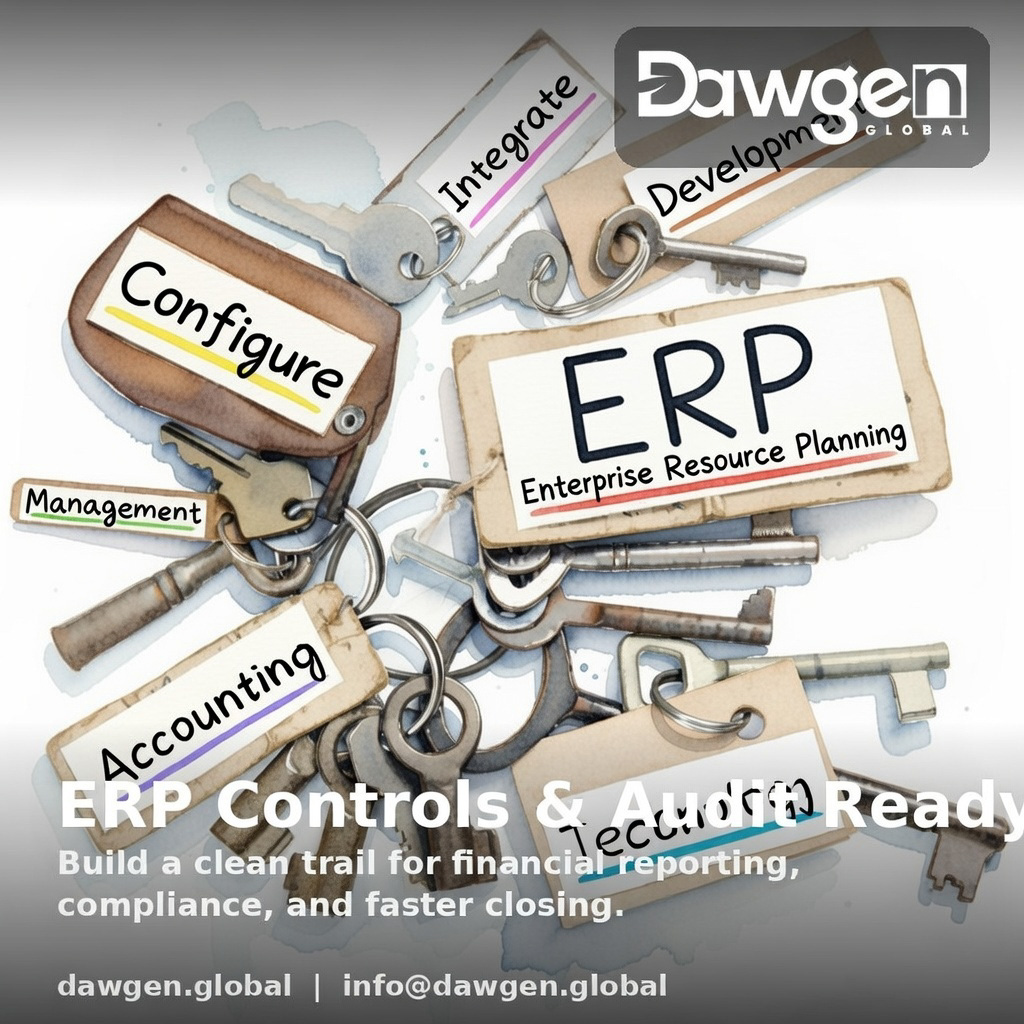
Many SMEs struggle with audit readiness not because they lack transactions, but because they lack traceability—a reliable way to prove who did what, when, why, and with what approval. An ERP system can change that by embedding controls into everyday workflows: purchase approvals before commitments are made, segregation of duties across cash and procurement cycles, disciplined master-data governance, automated reconciliations, and consistent document retention. This article explains how ERP-enabled controls strengthen financial reporting, reduce fraud and error risk, and shorten audit cycles—without turning the organization into a bureaucracy. We outline a practical “controls blueprint” SMEs can adopt: role-based access, approval matrices, three-way matching, journal controls, period-close discipline, audit trails, exception reporting, and continuous monitoring. We also share a readiness roadmap: how to assess your current control maturity, define control owners, configure policies in the system, and generate evidence that auditors can rely on. The result is not just a smoother audit—it’s stronger management reporting, improved lender/investor confidence, and a foundation for scalable growth.
Why “Audit Readiness” Is Really “Trust Readiness”
When leaders say, “We need to be audit-ready,” they’re typically solving for three broader outcomes:
-
Trust in the numbers
Management wants confidence that margins, inventory, payroll, receivables, and cash are accurate. -
Consistency under pressure
Month-end, year-end, tax filings, board meetings, and lender requests intensify scrutiny—weak processes break. -
Evidence on demand
Auditors, regulators, banks, and investors don’t just want results; they want support. Support means a complete chain from transaction → approval → posting → reconciliation → reporting.
A modern ERP, implemented correctly, turns audit readiness into “business readiness”—because the same controls that satisfy auditors also reduce leakage, improve cash flow, and speed up decision-making.
The SME Control Gap: Where Issues Usually Start
Most audit findings in SMEs trace back to recurring patterns:
-
Manual workarounds: spreadsheets, emailed approvals, and offline “shadow ledgers”
-
Weak access control: shared logins, broad permissions, no review of privileged roles
-
Poor master data discipline: duplicate vendors/customers, inconsistent item codes, uncontrolled chart-of-accounts growth
-
Uncontrolled journals: late postings, missing support, no review, and backdated entries
-
Weak close process: reconciliations not performed consistently; period-end adjustments are rushed
-
Inconsistent documentation: invoices and contracts stored across inboxes, paper files, and phones
-
Procurement leakage: purchases made outside policy; no three-way match; price variances ignored
-
Revenue and credit risk: discounts, credit notes, and write-offs processed without oversight
ERP doesn’t automatically fix these. What it does is provide the structure to enforce policy and generate evidence—if governance, configuration, and user adoption are handled properly.
What ERP Controls Look Like in Practice
A good ERP controls environment has three layers:
1) Preventive controls (stop issues before they happen)
-
Approval workflows (purchases, expenses, credit limits, discounts, master data changes)
-
Segregation of duties
-
Role-based access and limits
-
System validations (mandatory fields, tolerance checks)
2) Detective controls (spot issues quickly)
-
Exception reports (price overrides, duplicate payments, unusual journals)
-
Continuous monitoring dashboards
-
Alerts (threshold breaches, overdue approvals, missing GRNs)
3) Corrective controls (fix issues and reduce recurrence)
-
Issue management with owners and due dates
-
Root-cause analysis
-
Policy updates and training
For SMEs, the goal is control with agility: enough rigor to protect the organization, without slowing operations.
The Controls Blueprint: Key ERP Control Areas Every SME Should Configure
A) Identity, Access, and Segregation of Duties (SoD)
If your ERP is the “system of record,” then access is the front door to financial integrity.
What to implement:
-
Named users only (no shared logins)
-
Role-based access aligned to job function (AP Clerk ≠ AP Supervisor ≠ Finance Manager)
-
Least privilege (users get only what they need)
-
Privileged access controls for system admins and finance power users
-
Segregation of duties rules for high-risk pairs, such as:
-
Vendor creation and payment release
-
Purchase order approval and goods receipt
-
Payroll master changes and payroll processing
-
Journal entry creation and posting/release
-
-
Periodic access reviews (quarterly is a practical SME cadence)
Audit benefit: Clear proof of who can do what; auditors can rely more on system controls and reduce substantive testing.
Management benefit: Reduced fraud risk and fewer “surprise” adjustments later.
B) Master Data Governance: The Quiet Foundation of Reliable Reporting
Master data errors create “false narratives” in reporting.
What to govern:
-
Vendors, customers, items, price lists, tax codes, locations/warehouses
-
Chart of accounts and cost centers (or departments/projects)
Controls to embed:
-
Maker-checker workflow for new vendor/customer creation
-
Duplicate detection rules (name, tax ID, bank account)
-
Restricted changes to bank account fields and payment terms
-
Controlled COA additions (avoid hundreds of “misc” accounts)
-
Data ownership: Finance owns COA/taxes; Operations owns items; HR owns employee master
Audit benefit: Cleaner population data = fewer audit exceptions and fewer sampling issues.
Management benefit: Better profitability and working capital insights (e.g., by product, customer, location).
C) Procure-to-Pay Controls: Where Cash Leakage Usually Lives
Procurement is often the biggest opportunity for control-driven savings.
Core ERP controls:
-
Budget or approval thresholds before commitment
-
Purchase order discipline (PO required for defined categories)
-
Three-way match (PO ↔ Goods Receipt ↔ Supplier Invoice)
-
Tolerance limits for price/quantity variances
-
Duplicate invoice checks
-
Payment run controls (payment batches reviewed and approved)
-
Vendor statement reconciliation and aged AP review
Audit benefit: Clear evidence for completeness and occurrence; reduced risk of unauthorized payments.
Management benefit: Better spend visibility, fewer duplicate payments, stronger supplier negotiations.
D) Quote-to-Cash Controls: Revenue Integrity Without Slowing Sales
Revenue isn’t just a sales issue—it’s a reporting and credit risk issue.
Controls to configure:
-
Approval for discounts beyond thresholds
-
Credit limit enforcement and overrides logging
-
Price list governance (who can change what)
-
Returns and credit note workflows
-
Revenue recognition alignment (where relevant)
-
Customer master governance and anti-duplicate checks
Audit benefit: Clear linkage from order → delivery/service → invoice → cash.
Management benefit: Lower bad debt and cleaner sales margin reporting.
E) Journal Entries and Period Close: Protecting the General Ledger
In many SMEs, the general ledger becomes the “dumping ground” for fixes made under time pressure.
ERP controls that matter:
-
Journal templates with mandatory fields and attachments
-
Maker-checker (prepare vs post) for journals above thresholds
-
Restricted access to post to sensitive accounts (cash, revenue, payroll, suspense)
-
Period locking rules (controlled reopening with approvals)
-
Automated recurring entries where appropriate
-
Clear cutoff procedures and close checklist tracking
Audit benefit: Stronger reliance on GL controls, clearer support for adjustments, fewer post-close surprises.
Management benefit: Faster, calmer close cycles and more stable month-to-month numbers.
F) Bank, Cash, and Treasury Controls
Cash is the highest-risk area in any organization.
Best-practice ERP controls:
-
Bank feeds or controlled bank upload processes
-
Bank reconciliation discipline (daily/weekly depending on volume)
-
Dual authorization for payment release
-
Separate roles for creating beneficiaries vs approving payments
-
Limits for petty cash and expense claims
-
Automated aging and exception tracking (unreconciled items)
Audit benefit: Reduced fraud risk and stronger reconciliation evidence.
Management benefit: Better cash forecasting and fewer liquidity surprises.
G) Inventory and Costing Controls (If You Hold Stock)
Inventory findings are common, especially where stock movement isn’t captured consistently.
Controls to embed:
-
Role-based controls on inventory adjustments
-
Mandatory reasons and approvals for write-offs
-
Cycle counts and periodic full stock counts
-
Standard costing governance (if used)
-
GRN discipline tied to POs
-
Serial/lot tracking where required (e.g., regulated goods)
Audit benefit: Stronger inventory existence and valuation evidence.
Management benefit: Lower shrinkage and clearer gross margin performance.
H) Payroll and HR Controls (If Payroll Is Material)
Payroll is high-volume and sensitive.
Controls to implement:
-
Controlled onboarding/offboarding workflow
-
Approval for salary changes, allowances, and overtime
-
Separation: HR master updates vs payroll processing vs payment release
-
Audit trail for changes to bank details and pay elements
-
Headcount-to-payroll reconciliation
Audit benefit: Reduced payroll fraud and cleaner payroll support.
Management benefit: Better workforce cost visibility and budget control.
Evidence: The “Audit File” Your ERP Should Produce Automatically
One of the biggest wins is shifting from “searching for support” to “generating support.”
Your ERP should enable you to produce:
-
Approval logs (who approved, timestamp, threshold)
-
Audit trails for master data changes
-
Attached source documents (POs, invoices, contracts, GRNs)
-
Reconciliation reports (bank, AP/AR control accounts, inventory)
-
User access listings and role matrices
-
Exception and override reports (discounts, credit overrides, price changes)
-
Period close checklists and sign-offs
This becomes your “always-ready audit file.”
A Practical Roadmap: How SMEs Can Become Audit-Ready in 90 Days
You don’t need a multi-year transformation to improve controls.
Phase 1 (Weeks 1–3): Diagnose and prioritize
-
Map key cycles: P2P, Q2C, payroll, close, inventory
-
Identify “top 10 risks” (by cash impact and likelihood)
-
Confirm compliance expectations (tax, industry rules, lender covenants)
-
Define control owners (Finance, Procurement, HR, Operations)
Phase 2 (Weeks 4–8): Configure core controls
-
Implement role-based access and SoD constraints
-
Turn on approval workflows with thresholds
-
Enforce three-way match (where applicable)
-
Configure journal policies and period lock rules
-
Implement reconciliation discipline and reporting dashboards
-
Establish master data governance workflows
Phase 3 (Weeks 9–12): Prove and stabilize
-
Run control test scenarios (e.g., attempt duplicate invoice, override price, backdate journal)
-
Train users and publish a short “controls playbook”
-
Produce your first “audit-ready pack” from the ERP
-
Establish monthly access reviews and exception review meetings
Common Pitfalls (and How to Avoid Them)
-
Over-controlling too early
Start with high-risk areas first; don’t add approvals to every small transaction. -
Ignoring data standards
Bad master data will sabotage reporting and controls, even with a strong ERP. -
SoD conflicts in small teams
Where separation is hard, use compensating controls: extra approvals, exception monitoring, audit logs review. -
Customizations that bypass controls
Minimize “off-system” workarounds. If you must customize, build controls into the design. -
No ownership
Controls that “belong to everyone” often belong to no one. Assign owners explicitly.
What This Means for Management Reporting
ERP controls don’t only satisfy auditors—they improve board and management reporting:
-
Cleaner KPIs (margin, DSO, inventory turns, payroll ratio)
-
Better variance explanations (because transactions have context and approvals)
-
Faster close cycles and more timely insights
-
Higher confidence for banks, investors, and partners
In other words, controls are not overhead—they are a performance enabler.
A Vendor-Neutral Note on ERP Selection
Different ERP products can support strong controls, but outcomes depend on:
-
Your business processes and risk profile
-
Configuration and workflow design
-
Data quality and governance
-
Training and adoption
-
Ongoing monitoring and improvement
That’s why vendor-neutral selection matters: the right fit should match your operations, reporting needs, industry obligations, and growth plans.
Next Step: Invite an RFP Without Being Salesy
If your organization wants stronger audit readiness, faster closes, and reliable board reporting, the next step is to define your requirements and control blueprint before selecting a solution.
Dawgen Global can support a vendor-neutral ERP initiative, including:
-
Control and audit readiness assessment
-
Process mapping (P2P, Q2C, payroll, inventory, close)
-
Requirements definition and reporting blueprint
-
RFP preparation and evaluation support
-
Implementation governance and post-go-live controls monitoring
Invite an RFP conversation (no obligation):
? Dive Deeper: https://dawgen.global/
? Connect with Us: info@dawgen.global
Telephone Contact Centre:
? Caribbean: 876-9293670 | 876-9293870
? USA: 855-354-2447
WhatsApp Global: +1 555 795 9071
Message: At Dawgen Global, we help you make Smarter and More Effective Decisions. Let’s have a conversation.
About Dawgen Global
“Embrace BIG FIRM capabilities without the big firm price at Dawgen Global, your committed partner in carving a pathway to continual progress in the vibrant Caribbean region. Our integrated, multidisciplinary approach is finely tuned to address the unique intricacies and lucrative prospects that the region has to offer. Offering a rich array of services, including audit, accounting, tax, IT, HR, risk management, and more, we facilitate smarter and more effective decisions that set the stage for unprecedented triumphs. Let’s collaborate and craft a future where every decision is a steppingstone to greater success. Reach out to explore a partnership that promises not just growth but a future beaming with opportunities and achievements.
 Email: info@dawgen.global
  Visit: Dawgen Global Website

 WhatsApp Global Number : +1 555-795-9071
Caribbean Office: +1876-6655926 / 876-9293670/876-9265210  WhatsApp Global: +1 5557959071
USA Office: 855-354-2447
Join hands with Dawgen Global. Together, let’s venture into a future brimming with opportunities and achievements


